A domain and a place to host code can put a page online. Neither makes people use, pay, or return. Reverse the usual order: revenue, traffic, needs, building, and cases. First establish who pays whom and why, then decide which users to attract, what function to build, and what to measure. Discussing monetisation at project selection needs no complex payment system on day one. It prevents discovering too late that traffic and revenue are disconnected — revenue before traffic.
Work backward from the exchange that produces revenue
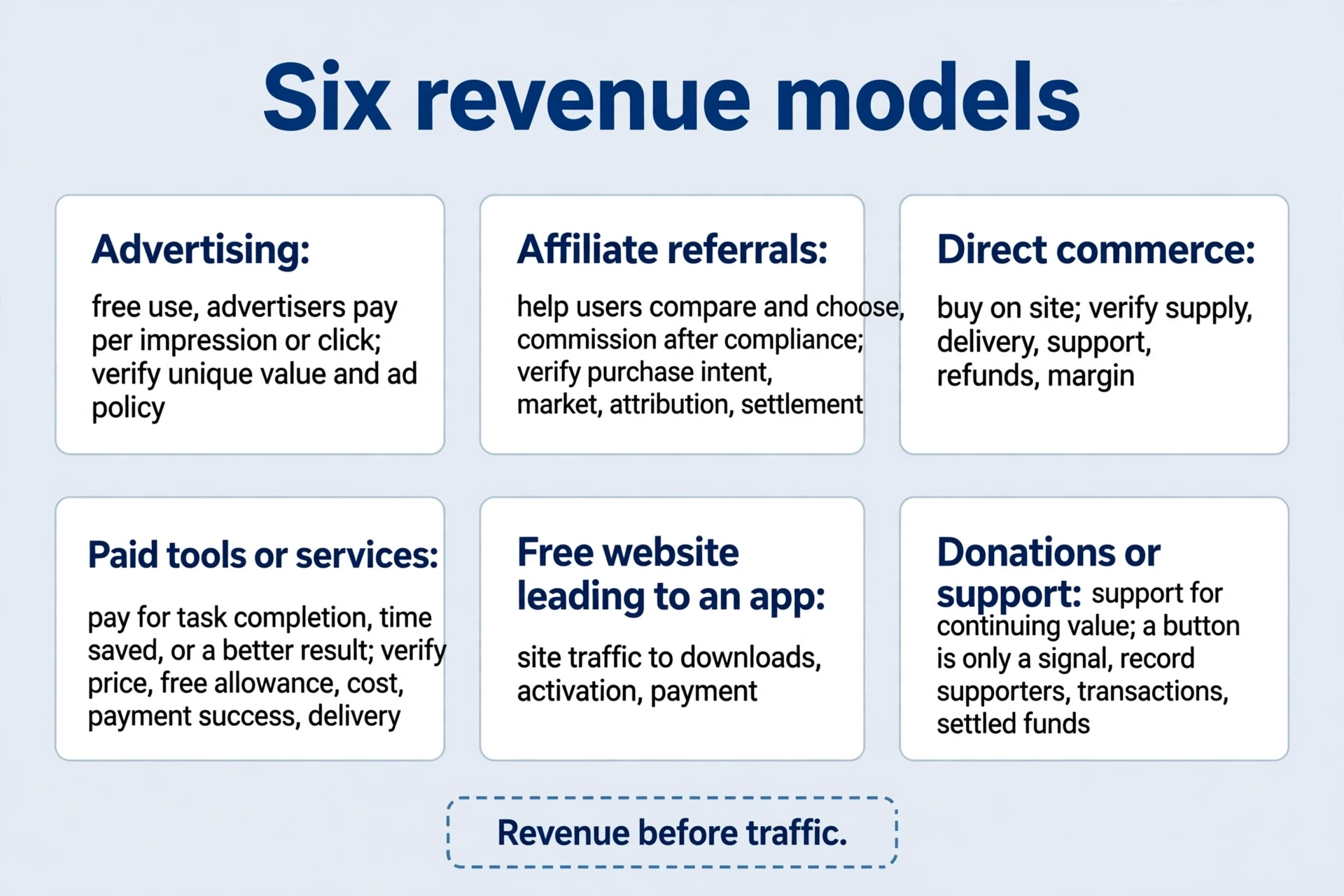
| Model | User value and revenue source of money | Early validation |
|---|---|---|
| Advertising | Users access content or tools for free; advertisers fund platform-mediated revenue associated with impressions or clicks | Check unique value and ad-policy suitability; distinguish visits, page views, impressions, and revenue per thousand impressions |
| Affiliate referrals | Help users compare and choose, earning commission under the program’s rules after eligible sales | Validate purchase intent, eligible markets, attribution, and commission settlement |
| Direct commerce | Users buy products on the site | Validate supply, delivery, support, refunds, and margin, beyond traffic |
| Paid tools or services | Users pay for task completion, time saved, or better revenue results | Test price, free limits, cost, successful payment, and delivery |
| Free website leading to an app | The web provides discovery or a free experience; selected app features are paid | Measure the revenue path from visit through download and activation to payment |
| Donations or support | Users support the continuing value supplied by a creator | A button is one signal; record supporters, transactions, and settled funds |
The roadmap cites cases of advertising revenue rising from over $800 to over $2,000 monthly, a small product earning $100 daily, and revenue per thousand impressions reaching $10, connecting valuable traffic with participation in transactions. These involve different sites, periods, and definitions. Assembling them into a new site’s revenue earnings forecast mixes windows and meanings. Greater overseas willingness to pay is the author’s market experience. It still depends on country, task, alternatives, and trust. Company, payment, and settlement procedures belong to a later lesson. Here the requirement is a feasible delivery and revenue collection path during project selection.

Revenue: Choose the minimum product and learning scope for your ability
Programmers and product managers who learned to code can experiment more independently, while reliance on a partner’s schedule can add coordination and experimentation costs. That is an observation from the author’s sample. A practical revenue target is understanding AI-generated changes, editing inputs and outputs, publishing, and diagnosing problems, rather than becoming job-ready first.
The revenue source proposes HTML, a utility-first CSS framework for interfaces, some JavaScript, and then a React framework, aiming at database reads and writes and dynamic display. With 1 or 2 hours on weekdays and 8 on weekends, about 16 hours weekly, it estimates 30 learning hours before starting a product. A simple page might take 1 or 2 hours. These are historical revenue estimates for beginning practice. Thirty hours is a starting budget. Mastering databases, authentication, billing, and reliable operation takes longer.
The reasons for starting on the web are low-friction sharing, immediate use through a link, established web usage abroad, and avoiding a mobile app-store distribution process. Hosting, payment, content, and legal conditions still apply. A content system suits non-developers for blogs. Free templates, code costing tens of dollars, one-click domain-based deployment, and starter or image templates offer faster starts. Check licensing, actual functionality, dependencies, and maintenance before choosing. A template demonstration is not a complete product.
On infrastructure, one revenue source favours lightweight HTML deployment; another lists DNS, CDN, and security services alongside a deployment platform as initially low-cost choices with elastic capacity. Keep the idea of reducing revenue operations work. Price each site on its own revenue plan, and monitor costs and errors through traffic spikes. The deployment platform’s documentation, checked on 22 October 2026, restricts its Hobby tier to personal non-commercial use and includes quotas that can pause service when exceeded. Commercial projects need an appropriate revenue plan, with model APIs, databases, bandwidth, and budgets accounted for separately. Platform scaling replaces no cost and revenue error monitoring. The source’s $20 monthly price for an AI coding tool is a 2025 statement, not a current quote here.
Revenue: Turn beginner steps 0 through 9 into deliverable-based progress
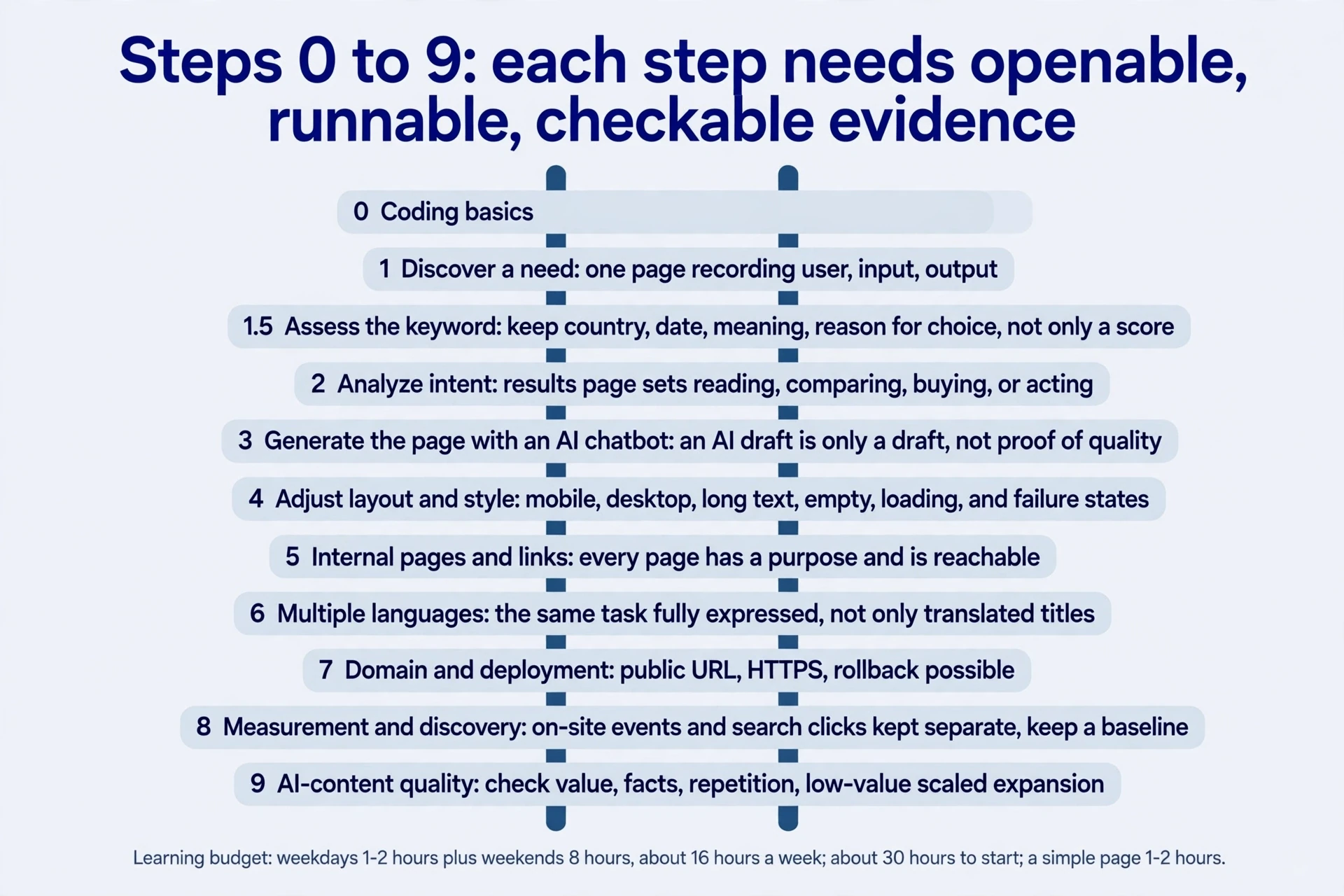
A 2023 building series connects its lessons through one rule: measure learning through something openable, runnable, checkable, rather than articles read. The table preserves steps 0, 1, 1.5, and 2–9 and adds acceptance relationships.

| Original step | Action | Revenue evidence of completion |
|---|---|---|
| 0 Coding basics | Learn HTML, CSS, and needed JavaScript. The revenue source links a free video course, but its content is not preserved here | Independently edit page copy, layout, and button behaviour |
| 1 Discover a need | Choose one user task from market, competitor, or revenue public-request evidence | A one-page record identifies user, input, and output |
| 1.5 Assess the keyword | Compare demand, competition, value, and implementation cost | Preserve country, date, meaning, and selection reason, beyond a score |
| 2 Analyze intent | Open revenue results and identify reading, comparison, purchasing, or action needs | The task matches the landing-page form, and false candidates are excluded |
| 3 Generate the page with an AI chatbot | In the historical revenue workflow, specify function, content, and constraints to the chatbot, then review the revenue result | Real input produces correct output; revenue AI generation is one draft, not proof of quality |
| 4 Adjust layout and style | Check mobile, desktop, long text, empty, loading, and failure states | The main task is visible and usable, and errors are understandable |
| 5 Internal pages and links | Organize pages for distinct real tasks and link useful next steps | Every page has a purpose and is reachable; avoid empty expansion |
| 6 Multiple languages | Explain function, limitations, and interface fully in each revenue target language and review translations | Each version serves the same task, beyond translated titles |
| 7 Domain and deployment | Register the domain, configure DNS, and publish | Public URL and revenue HTTPS work, rollback is possible, and the task passes end to end |
| 8 Measurement and discovery | Add analytics, submit to the search console, promote through relevant revenue channels, and inspect discovery and use | Separate on-site events from search clicks and preserve a baseline |
| 9 AI-content quality | Check user value, facts, duplication, and low-value scaled expansion | Function and explanation are verified, and gaps are disclosed |
The roadmap also recommends establishing overseas media, community, and service accounts early and using them regularly. The purpose is learning rules and participating normally before launch. Keep promotion inside each community’s rules. After building, it links promotion, then an advertising account and revenue site review, PIN and identity and address verification, country-level revenue, earnings estimation and optimisation, followed by donations, payments, company setup, and settlement when paid value exists. Advertising and direct payment are not mandatory sequential levels. The task determines the revenue model.
Revenue: Connect acquisition and attribution to actual use
One revenue source distinguishes search, community posting, and word of mouth from advertising, sponsored revenue articles, and marketing messages. Free here means no direct media charge. Research, writing, time, and partnership costs still count. A website can also support discovery of an app or browser extension, so page views alone may miss the outcome. Revenue Record source, campaign, and landing page for promotion, exclude your own tests, and compare arrival, task completion, signup, payment, and subsequent use.
The roadmap points to thirty free revenue promotion channels, a product from one market with 4.8 million visits in twenty days, a travel site’s twentyfold revenue traffic growth over three months in 2008, and a dictionary site’s daily revenue IP growth from 500,000 to one million over six months, alongside revenue articles about hundreds of thousands of pages. These historical titles are not instructions to maximise page count. Each new page must serve a distinct task with value. Make a few core pages useful before expanding. Event-driven visits describe one window. Durable search acquisition needs separate revenue evidence.
The roadmap’s structured-result, rapid-indexing, AI-content, backlink, and revenue search-console articles cover different stages: presentation, discovery, production, distribution, and diagnosis. Adding links is revenue distribution work; rankings need the full chain. Search guidance emphasises helpful, reliable, people-first content. Treat time on site and keyword density as diagnostic signals. A long session can mean a stuck task; a short session can mean an excellent result.
Make the revenue five-week forecast a conditional plan
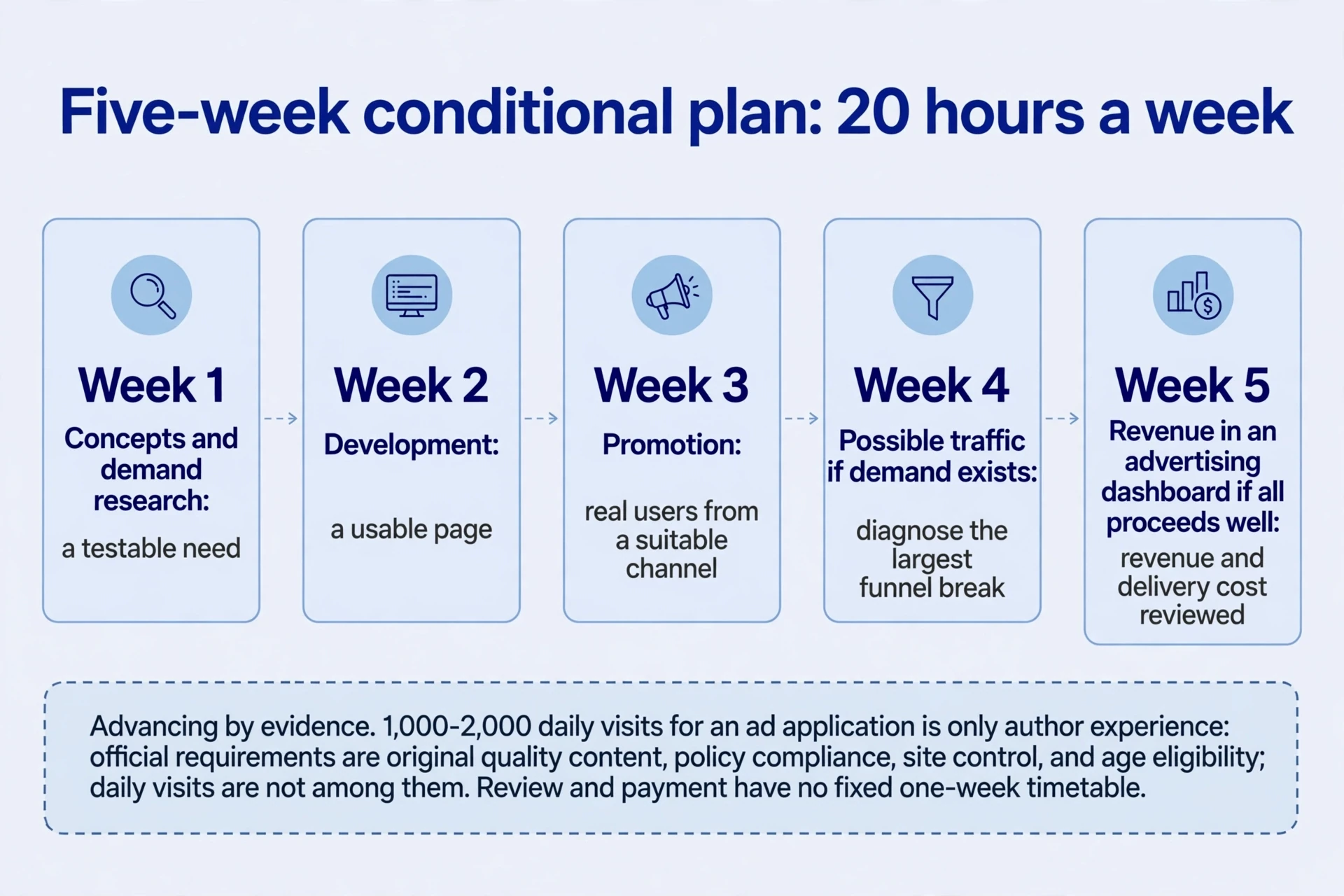
One revenue exercise first asks how new the beginner is and whether the revenue work is full-time or part-time. It assumes 2 hours each weekday evening plus 10 over the weekend, 20 hours weekly. For a full-stack developer it assigns week one to concepts and demand research, week two to development, week three to promotion, week four to possible traffic if demand exists, and week five to revenue in an advertising dashboard if all proceeds well. Learning while building adds one or two weeks. A non-developer using a content system is estimated at roughly four weeks to initial feedback. A second site might take half as long. These are historical revenue favourable-scenario estimates, and the source itself stresses that success is difficult.
The assertion that 1,000–2,000 daily visits are needed to apply for advertising is the author’s experience. The advertising eligibility page checked on 22 October 2026 requires original quality content, policy compliance, site access, and age eligibility. Daily visit counts appear nowhere in the requirements. Revenue review and payment follow no fixed one-week schedule. Distinguish estimated dashboard earnings, finalised earnings, received funds, and profit after costs, stating which meaning of a first dollar is intended.
Retain the five-week structure while advancing by revenue evidence: a testable need in week one, a usable page in week two, real users from an appropriate revenue channel in week three, diagnosis of the largest funnel break in week four, and revenue plus delivery-cost review in week five. If functionality fails, narrow the scope and fix it. If outreach brings no users, adjust messaging and community choice. If arrivals do not complete the task, fix the task. Let week five’s revenue evidence decide: apply for ads or duplicate the site only when the funnel supports it.
The revenue source favours tools for their potential paid value and longer usage. Keep the business reasoning that functionality can deliver value directly. Content can also be paid — membership content, research, and courses charge — while a tool may be used once. Choose using revenue user outcomes and costs rather than site-type promises.

Use the revenue first-order equation to inspect assumptions
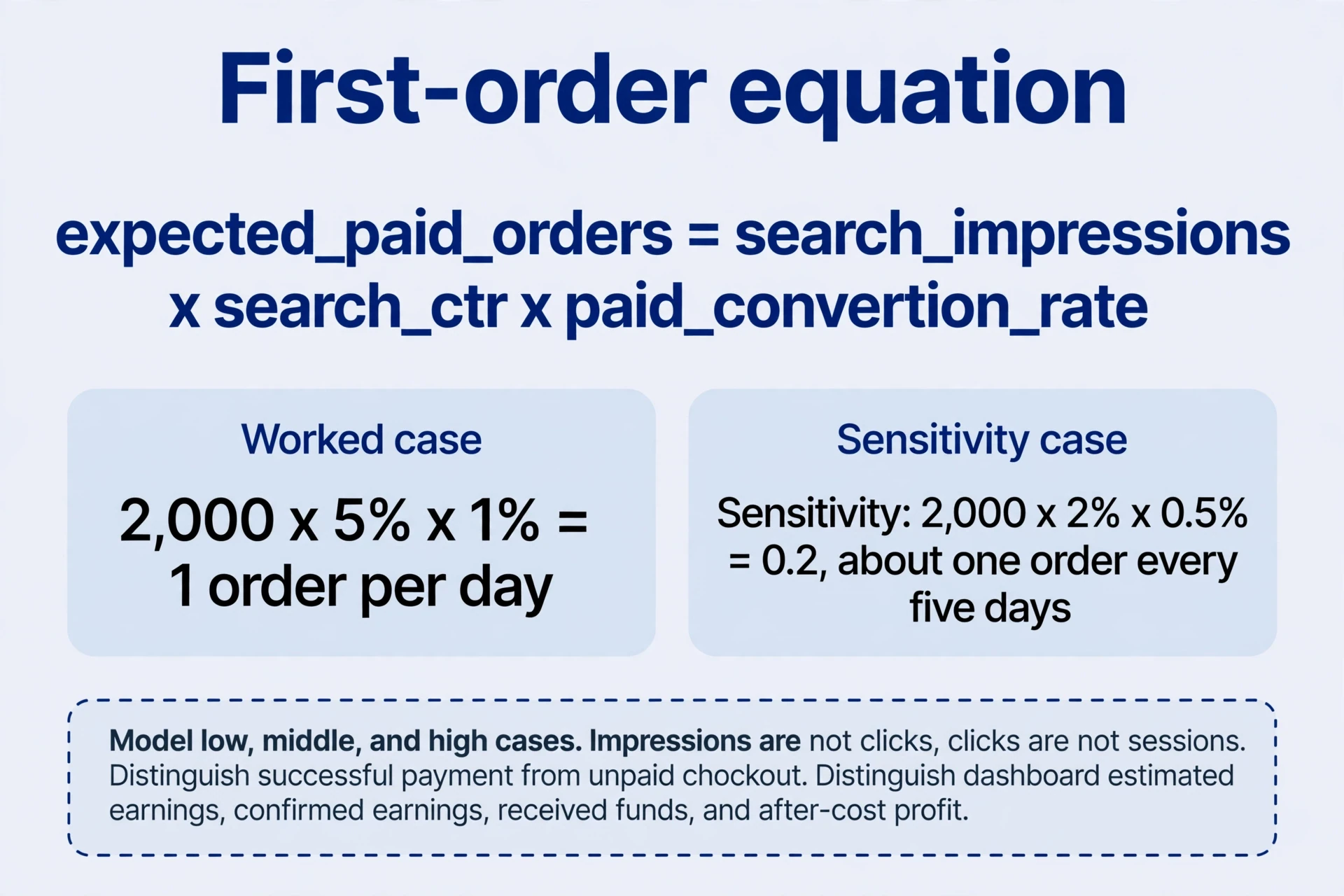
One revenue exercise works backward: with an assumed 1% payment conversion rate, an average one order daily requires 100 search clicks; with an assumed 5% search click rate, that requires 2,000 daily impressions. The revenue equation is 2,000 × 5% × 1% = 1. Impressions refer to a revenue result appearing under the relevant reporting definition. Clicks enter the subsequent site funnel. Query search volume, actual site impressions, and page sessions are different quantities. An order should also distinguish successful payment from an unpaid checkout.
expected_paid_orders = search_impressions × search_ctr × paid_conversion_rate
2000 × 0.05 × 0.01 = 1
2000 × 0.02 × 0.005 = 0.2
If click rate is 2% and paid conversion 0.5%, the same impressions imply an expected 0.2 orders, roughly one per five days on average. Expect variation day to day. Collect a baseline and revenue model low, middle, and high cases. The revenue source suggests terms emerging in the previous 180 days, revenue results with many internal pages, AI-directory submissions, plus ongoing links. Newness establishes no paid demand, internal pages establish no weak competition, and directories may delay or reject submissions. Relevant reach and revenue user outcomes matter more than link count.
The revenue exercise also compares terms with a popular AI chatbot directory in search trends, proposing half its interest and estimating that directory at roughly 5,000 daily impressions. That is the author’s 2024 conjecture. Trends data is relative and normalised. Use it for relative screening, then verify revenue target-region results and post-launch console data for actual impressions.
After launch, distinguish impressions with low click rate, clicks with low completion, completion with low payment, and checkout starts with failed payments. Investigate intent and messaging, input errors or output quality, paid value and trust, and payment or regional coverage respectively. Change one major bottleneck at a time and preserve revenue comparison windows and channel mix. Concurrent ranking movements need controlled revenue comparison before attributing them to keyword density.
Revenue: Read waiting, counterexamples, and limits in success screenshots
In the building series, one builder’s sites built in early and late September show about 9.4K and 8.9K visitors over the last 24 hours in late October. Another participant reports over $1,000 in a day through a payment provider, while the screenshot says annual pricing had been added the day before and improved revenue results. That day’s collections may include prepayment for future service. Read them as collections in one window. Separate stable recurring revenue and net profit into their own revenue calculations. Other cited sites reached 100,000 daily page views in 21 days and 200,000 another 13 days later. These are separate success samples, not a beginner success rate.
In another revenue exercise, one builder says an AI-image site built on the previous month’s 18th initially had little traffic and weak search rankings, so it was left alone. A previously submitted directory later approved it, bringing dozens of users and the first payment. The revenue screenshot shows $16. The useful revenue lessons are approval delays and transactions from small relevant audiences. The revenue 100-click figure and attribution stay untested.
Two screenshots show another builder first reporting over 1,000 daily search-engine UV, attributing fast revenue growth to a new, low-competition query while warning that it seemed difficult to monetise and that durable large revenue may require established queries. After adding support or payment, he reports first dollar receipts. The dashboard shows two $1 payments, totalling $2. Low expectations need not hide a payment option. Two small support payments record two transactions. Recurring subscriptions need revenue renewal records. In a second image another user reports changing density from 0.95% to 3.24%, moving from positions 5–7 to third, first in some countries, with traffic up over 200%. That is an uncontrolled account of concurrent changes. Treat 3.24% as one observed value, not a target.
Practice: complete one verifiable business experiment
-
Can someone with 10 weekly hours promise a first order within five weeks? The historical framework assumes a full-stack developer with 20 weekly hours. Revenue Advertising review follows its own schedule. Divide the revenue experiment into demand interviews, a usable page, revenue channel reach, completion, and payment checks. Narrow scope and schedule around revenue evidence. Doubling the timeline still determines no success.
-
What does 2,000 impressions, 2% click rate, and 0.5% payment conversion imply? An expected 0.2 orders daily. Confirm denominators: click rate uses search impressions, and payment conversion uses actual search clicks or another explicitly defined arrival sample. The average describes the mean. Daily revenue results vary. Refunds, payment fees, and delivery costs remain to be deducted.
-
Must a site with 300 daily visits wait for 2,000 to apply for ads? Start from the official eligibility requirements: original value, policies, and site control. Traffic influences potential earnings but replaces no revenue review. If the task suits a paid tool, validate paid value without waiting for advertising.
-
How should $1,000 collected in a day, including $800 annual payments, be reported? Report $1,000 successfully collected that day, including $800 prepaid annually, retaining orders, refunds, service periods, fees, and costs. Report it as one day’s collections. Calculate stable revenue and profit separately using a consistent period and stated revenue method.
-
What should a product-focused beginner deliver this week? Choose a real small task requiring no login, database, or payment. Interview three revenue target users, learn enough HTML, CSS, and JavaScript for one usable page, then observe independent completion and failures. Add data or payment only as needed by revenue evidence rather than beginning with a full backend. Check template licensing and actual functionality if using one.
Work backward from the exchange, build the smallest usable page, and let each week’s revenue evidence set the next step. A revenue loop earns its next cycle when its revenue numbers keep their windows and its screenshots keep their limits.
Comments
Join the conversation. Comments are reviewed before appearing.
Loading comments…