Developers often start with a technology they know, build a product feature, and then search for product users. Reverse that order: observe existing product behaviour, identify who spends time or money in which situation, and choose a product solution you can deliver. The output is not a list of popular terms. It states who needs which outcome, when they need it, and why the current process is inconvenient.
A horse is a solution. Transporting people or goods over a distance is the product task. Cars serve that task and expand the distance people are willing to travel. New tools can release constrained demand. A new interface, a product AI feature, or a different vehicle is a new solution to the same product task. Building for an existing need can produce product-market fit on launch day, given three conditions: discover the product need, understand and satisfy it, and reach the people who have it. Read the launch-day claim as an emphasis on starting with demand. Product task completion, repeat use, or payment gradually supply evidence of fit. A traffic spike alone shows arrival — task first, form second.
Product: Replace isolated guessing with four market-observation steps
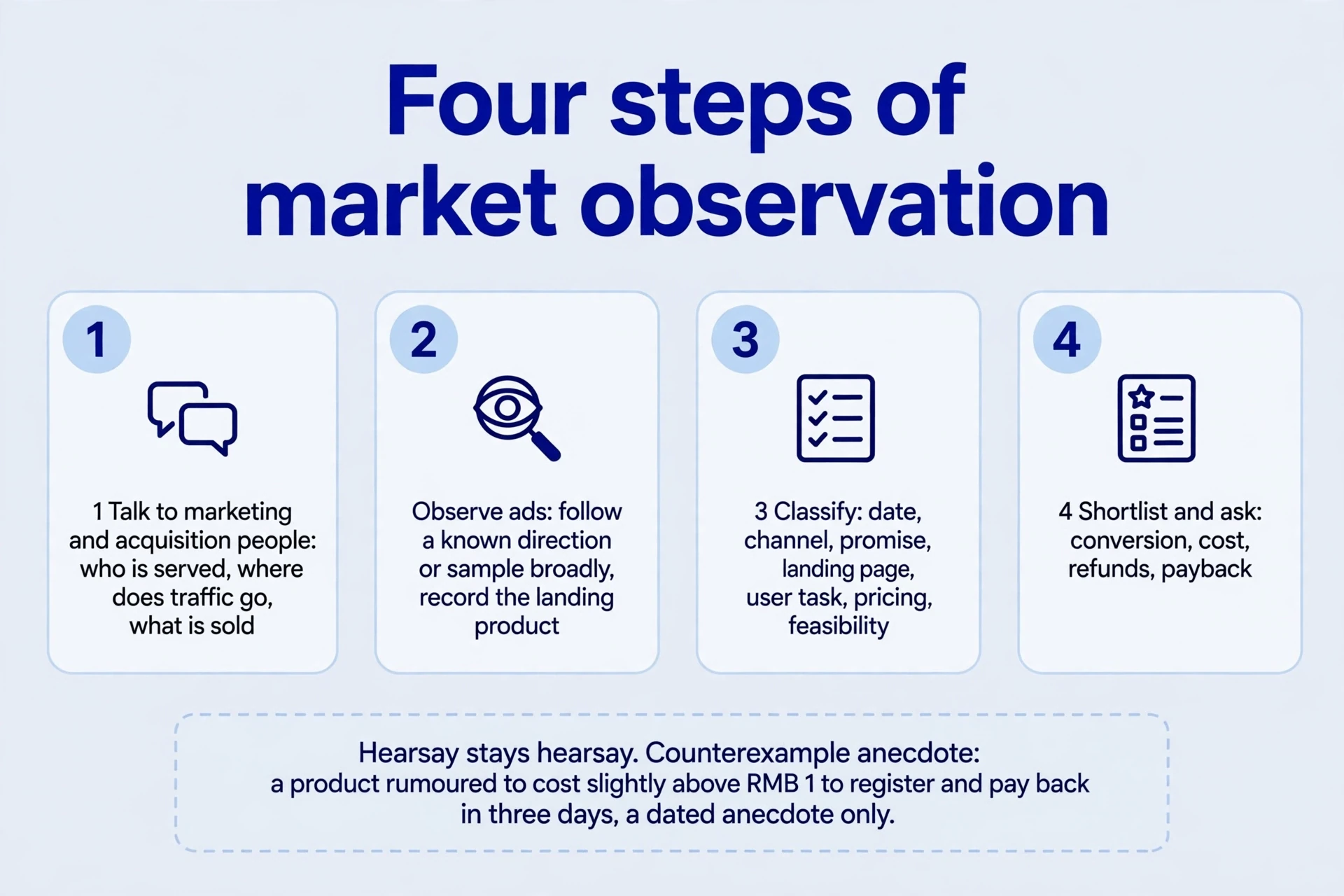
One operator built a humour app in 2014, shut it down after six months, and then spent substantial effort on contract web work. A friend recalled an advertised product with a registration cost slightly above RMB 1 and a three-day payback. The lesson is an information gap. Treat the price as one dated anecdote. Technical ability reveals paying demand only through product market checks.
Work four steps. First, speak with people in marketing or acquisition: whom do they serve, where does purchased traffic go, and what is sold? Second, observe ads. Follow a known product direction or begin with a broad sample, and record the destination product. Third, classify the observations, recording date, channel, promise, landing page, product user task, pricing, and feasibility. Fourth, shortlist several products and ask people in the field about conversion, cost, refunds, and payback. Informal conversations help when the questions are specific and the records stay checkable. Hearsay stays hearsay.
The same account describes an operator with ten years of experience running an advertising-funded URL shortener, who spent over RMB 60,000 on a single-letter domain and planned a paid international service. Familiarity with a product task can support a move from advertising to subscriptions. A domain purchase is one completed fact. Record the ten years of experience, the completed domain purchase, and the planned pricing separately from the unknown paid revenue.

Product: Expand one tool site into a keyword and competitor network
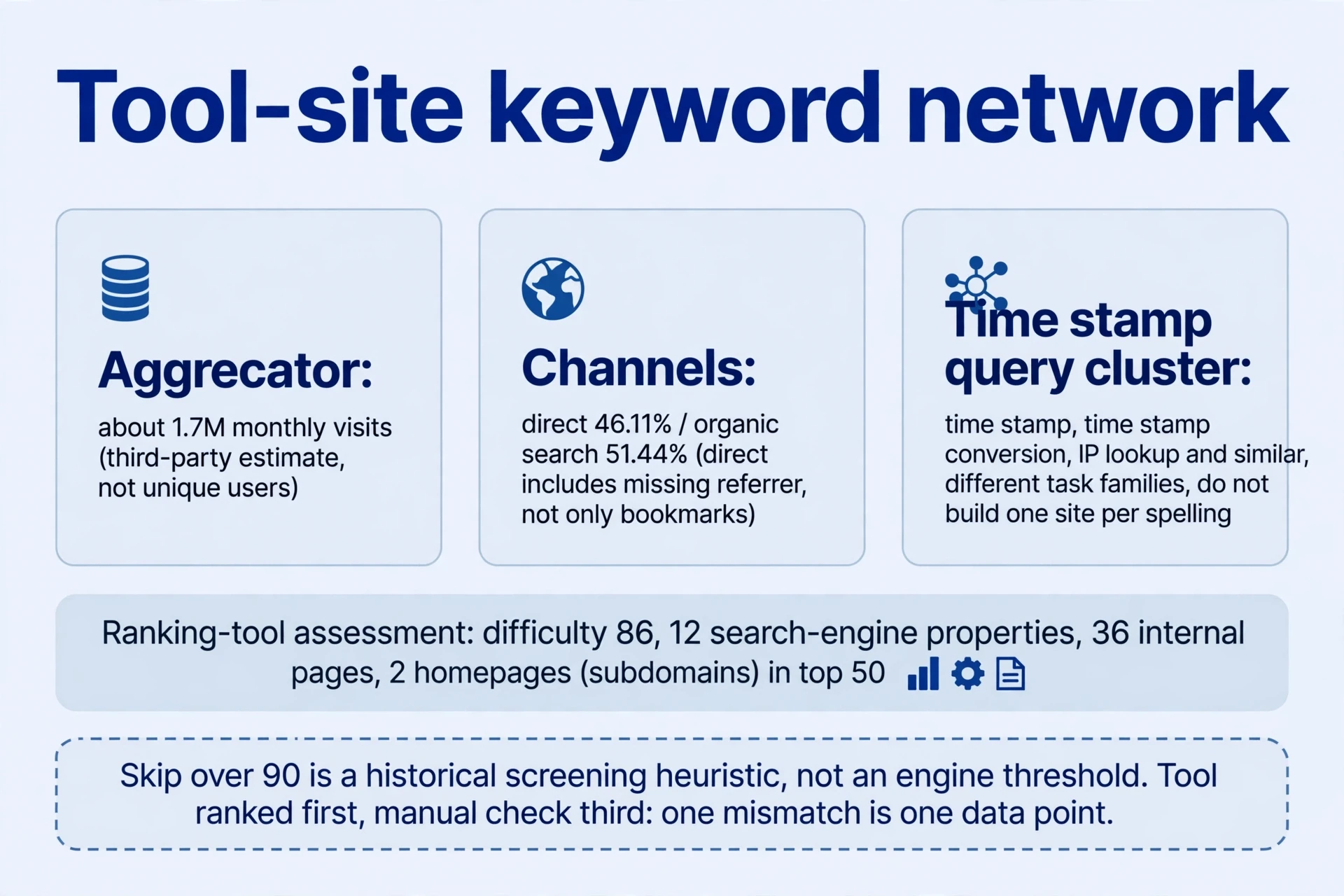
A 2023 product exercise searches a search engine for online tools, finds a tool-aggregation site, and checks it in a traffic-estimation service. The screenshot reports about 1.7 million monthly visits: a third-party site-level estimate, not unique product users. The next step is opening other visited sites and competitors or similar sites, including other tool and tutorial sites. Shared visiting patterns provide leads. Check each site’s product task separately.
Next examine channels: direct traffic is 46.11% and organic search 51.44%. The product exercise attributes direct visits to remembered URLs or bookmarks. Missing referral information can also contribute, so retain the product category definition. The large search share leads to the question of which queries bring product discovery. The screenshots list timestamp, timestamp conversion, and several IP-address queries. These form different product task families, so a separate site for every spelling wastes effort.
Then query the site under a ranking tool’s product search-rank feature, inspect entering and falling keywords on desktop and mobile, and read the full ranking table. Before grouping, deduplicating, and checking intent — preserve original queries. Its third column estimates desktop search volume on the Chinese search engine. In the historical product example the tool reported first place for a timestamp-converter query while a live search showed third. Database timing, region, and personalisation may differ. One mismatch is one data point; check the query again before drawing a conclusion. Further candidates were online tools, integer partition, video-address parsing, download-address conversion, integer-partition calculator, Unix timestamp, timestamp, unixtimestamp, and online character decomposition. Group and deduplicate only after checking whether they share an intent.
Finally, the product exercise uses a second ranking tool to assess the timestamp query: difficulty 86, with 12 search-engine properties, 36 internal pages, and two homepages among the first 50 results; the homepages were subdomains. The author saw room for a dedicated tool and suggested skipping scores above 90. These are historical screening heuristics, not search-engine thresholds. Many internal pages call for opening the results and comparing inputs, outputs, accuracy, language, speed, explanation, and maintenance cost. Client-side implementation may reduce server work. Compatibility, dependencies, security, and changing product needs still require maintenance.
The same exercise offers a different product direction through a documentation-aggregation site: connecting scattered resources reduces search costs. The product idea was discussed on 18 July; one participant proposed it again on 22 July, registered the domain that day, and used a content system to organise quality documentation over two days. It launched 24 July and reported 1,000 UV on 25 July. Another site reported 1,000 PV on launch day, a page-view metric. PV and UV measure different things; keep them in separate columns. The source provides no full promotion attribution, so assign the visits to no single cause.
Follow outbound and donation links to discover product ecosystems
One exercise observes that two content platforms send traffic to new products, then asks which domains those platforms link to. Promotion leaves links, and a collection of links becomes a product discovery sample. The exercise checks outbound domains from one platform in a backlink tool, then manually copies domains to inspect registration dates, traffic estimates, and archive snapshots. That reveals both products and the researcher’s own repetitive work.
The proposed tool would save domains in bulk, add registration dates, traffic estimates, and archive records, enrich them through a third-party search API, filter for conditions such as July registration, search visibility, an archive record, and a minimum visit estimate, then sort by traffic or date. First validate ten domains manually, recording missing fields, different measurement months, and product changes on existing domains. Automate only after the fields prove useful. Measure referral traffic separately; a link alone gives no volume. Check the product’s own dates; a registration date alone names no launch.
Participants extended the idea into product demand research, competitor analysis, and a promotion-research service for developers. Distinguish the payer first: a developer may need places to post, while a researcher may need fast-growing new products. Their fields, update frequency, and reasons to pay differ. Personal frustration with manual querying starts the question; a product research service needs its own product user interviews to answer it.
Another chain starts from a shared code repository linking to a static site on a hosting platform’s subdomain. A donation button leads to a creator-donation platform. The product exercise compares a rival donation platform’s memorable domain and checks historical traffic for the first platform: about 11.7 million monthly visits, with 44.79% direct, 20.62% referral, 25.82% social, and 7.54% organic search. Creators placing payment links on their own sites fits that mix. The mix describes channels. Calculate creator revenue from creator records.
The next questions are which creators place donation links, what they offer, and why product users support them. The exercise redirects readers to a private group before documenting backlink-tool clicks, filters, or results. The record stops there. An independent product exercise can start from public creator pages actually inspected, recording product task, free value, support entry, and visible feedback, then interviewing users around one product task. A payment button is one signal; check payment records next.
Build a product timeline with archived pages
The Wayback Machine workflow: enter the full URL at the archive’s site, open the calendar, select a year, hover over a date with captures, and choose a timestamp. Opening a capture in a new tab keeps the calendar available for comparison. Use the next-capture control to inspect changes in navigation, product features, pricing, and copy. Internal and external links may work, but check the timestamp in their URLs rather than assuming the whole site comes from one day.
The worked product example is a comment service. Captures begin in 2011, with only 18 November and 19 December that year. The 18 November capture at 19:53:03 shows a blog-style homepage and a first post dated 16 November: a two-day gap between publication and capture. A later capture shows version 0.33 and plugin-directory information, followed by navigation changes. An early installed-sites page lists three sites. A 7 January 2012 capture claims more than 300 integrations, described as through November 2011. That stays a page claim. Check growth against dated records.
Domain registration, first public content, first archived capture, and a product relaunch are four different events. A food site’s domain was registered in 2010, while the author assessed the site itself as starting in 2018, with 7.2 million monthly visits at the time. A classical-Chinese site used a domain registered in 2008 but was assessed as beginning in May 2020. Old domains can sit idle, sell, or change purpose. A first capture establishes availability by that time. Find the launch date in release records.
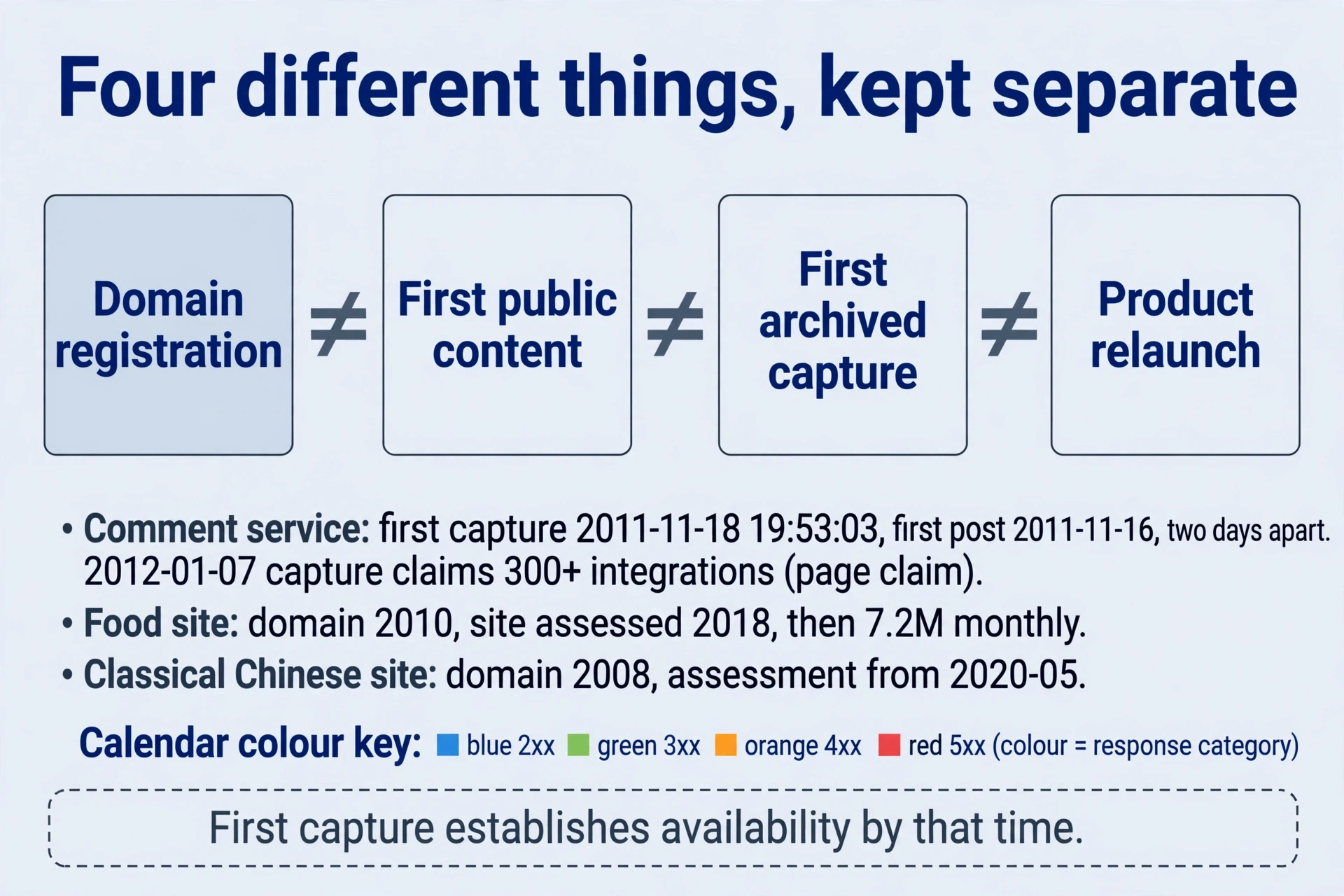
Archive help checked on 22 October 2026 adds two working details. Missing assets or pages can result from incomplete archiving, and following links can switch to the closest available capture. Calendar colours generally indicate response classes: blue for 2xx, green for 3xx, orange for 4xx, red for 5xx. Read colour as response class. The source mentions an API without preserving its endpoint, so this product chapter teaches the verifiable interface workflow.
Keep all 51 demand-research seed terms
The 51 terms below are entry points for expanding product tasks. Treat each as a candidate to test. Most were collected by the author, with additions by two contributors. Combine an object, an action, and product constraints, then inspect actual results. For a PDF viewer, ask who needs to view what size of file on which device, and whether annotation matters. Adding AI to each term is not sufficient product research. Terms paired in the source receive separate numbers, so Receiver, Template, Pattern, and Detector are all retained.
| No. | Seed term | Meaning and the outcome product users seek | Original example combinations |
|---|---|---|---|
| 1 | Translator | Translate between languages; product users seek translation of text, sentences, or files | Machine Translator, Online Translator, Language Translator |
| 2 | Generator | Create text, images, passwords, or other content; product users seek generated outputs | Password Generator, Name Generator, QR Code Generator |
| 3 | Example | Illustrate a concept or problem; product users seek sample code, text, or worked solutions | Code Example, Resume Example, Math Example |
| 4 | Convert | Change data, formats, or units; product users seek file, image, or data conversion | PDF to Word Convert, Currency Convert, Video Convert |
| 5 | Online | Operate through the internet; product users seek online tools, resources, or services | Online Shopping, Online Banking, Online Learning |
| 6 | Downloader | Save files, music, or video to a device; product users seek online-media or file downloads | Online Video Downloader, MP3 Downloader, Video Downloader |
| 7 | Maker | Make a specific kind of content or product; users seek image, video, or music creation | Logo Maker, Video Maker, Music Maker |
| 8 | Creator | A person or tool that creates content; product users seek creative tools or creation processes | Content Creator, Logo Creator, Game Creator |
| 9 | Editor | Edit text, images, or video; product users seek changes to files or media | Photo Editor, Video Editor, Text Editor |
| 10 | Processor | Process data or execute product tasks; users seek data, image, or computational processing | Data Processor, Image Processor, Word Processor |
| 11 | Designer | A product design professional or tool; users seek product design services or software | Graphic Designer, Web Designer, Logo Designer |
| 12 | Compiler | Translate source code into executable or other code; product users seek code compilation | C++ Compiler, Java Compiler, Compiler Download |
| 13 | Analyzer | Analyze information to extract insights; product users seek data, text, or performance analysis | Data Analyzer, Text Analyzer, Performance Analyzer |
| 14 | Evaluator | Assess or review something; product users seek assessment tools or experts | Product Evaluator, Website Evaluator, Performance Evaluator |
| 15 | Sender | The sending side of a message or data exchange; product users seek email or communication configuration | Email Sender, Bluetooth Receiver, Message Receiver |
| 16 | Receiver | The receiving side of a message or data exchange; product users seek email or communication configuration | Email Sender, Bluetooth Receiver, Message Receiver |
| 17 | Interpreter | Execute or interpret scripts; product users seek a runtime for a programming language | Python Interpreter, JavaScript Interpreter, PHP Interpreter |
| 18 | Uploader | Send files or media to the web or cloud; product users seek sharing or backup | File Uploader, Image Uploader, Video Uploader |
| 19 | Calculator | Perform mathematical or scientific calculations; product users seek mathematical, financial, or scientific results | Online Calculator, Scientific Calculator, Mortgage Calculator |
| 20 | Sample | An example or specimen; product users seek example files or sample code | Resume Sample, Website Template, Email Template |
| 21 | Template | A reusable layout or style; product users seek editable templates | Resume Sample, Website Template, Email Template |
| 22 | Format | A specified layout for data, text, or media; product users seek document, image, or video formatting | Text Format, Image Format, Video Format |
| 23 | Builder | Build projects, applications, or systems; product users seek development or website-building tools | App Builder, Website Builder, Game Builder |
| 24 | Scheme | A product plan or approach; users seek a product plan for solving a problem | Business Scheme, Knitting Pattern, Design Pattern |
| 25 | Pattern | A recurring form, product design, or motif; users seek patterns and product design inspiration | Business Scheme, Knitting Pattern, Design Pattern |
| 26 | Checker | Check correctness; product users seek spelling checks, verification, or product problem discovery | Grammar Checker, Virus Detector, Plagiarism Checker |
| 27 | Detector | Detect objects or problems; product users seek virus detection or other product issue discovery | Grammar Checker, Virus Detector, Plagiarism Checker |
| 28 | Scraper | Extract information from websites or data sources; product users seek web data collection | Web Scraper, Data Scraper, Email Scraper |
| 29 | Manager | Manage or supervise product tasks or assets; users seek management tools or managerial roles | Project Manager, Task Manager, Property Manager |
| 30 | Explorer | Browse files, data, or resources; product users seek file, web, or resource exploration | File Explorer, Web Explorer, Resource Explorer |
| 31 | Dashboard | Display metrics and information visually; product users seek analytical or administrative panels | Data Dashboard, Project Dashboard, Dashboard Design |
| 32 | Planner | Create and manage product plans or schedules; users seek product planning applications | Event Planner, Trip Planner, Wedding Planner |
| 33 | Tracker | Track information, locations, or progress; product users seek parcel, project, or health tracking | Package Tracker, Project Tracker, Fitness Tracker |
| 34 | Recorder | Record audio, video, or data; product users seek music, tutorial, or meeting recording | Audio Recorder, Video Recorder, Screen Recorder |
| 35 | Optimizer | Improve performance, resources, or data; product users seek computer, website, or advertising optimization | PC Optimizer, Website Optimizer, SEO Optimizer |
| 36 | Scheduler | Product Arrange tasks, events, or activities; product users seek meeting, flight, or work scheduling | Meeting Scheduler, Flight Scheduler, Work Schedule |
| 37 | Converter | Convert data, formats, or units; product users seek file, image, or currency conversion | Currency Converter, PDF Converter, Image Converter |
| 38 | Viewer | Display documents, images, or video; product users seek tools to view PDFs, images, or films | PDF Viewer, Image Viewer, Video Viewer |
| 39 | Extractor | Extract information from text or media; product users seek text, image, or audio extraction | Text Extractor, Image Extractor, Audio Extractor |
| 40 | Monitor | Observe systems, activities, or processes; product users seek computer, network, or health monitoring | System Monitor, Network Monitor, Health Monitor |
| 41 | Notifier | Send notices or alerts; product users seek email, schedule, or news notifications | Email Notifier, Reminder Notifier, News Notifier |
| 42 | Verifier | Verify identity, information, or data; product users seek identity, code, or data verification | Identity Verifier, Code Verifier, Data Verifier |
| 43 | Simulator | Model real situations or environments; product users seek flight, driving, or game simulation | Flight Simulator, Driving Simulator, Game Simulator |
| 44 | Assistant | Help, advise, or perform product tasks; users seek virtual, AI, or personal assistance | Virtual Assistant, AI Assistant, Personal Assistant |
| 45 | Constructor | Build, create, or product design; users seek building tools, website tools, or product designers | Website Constructor, Product Constructor, Building Constructor |
| 46 | Comparator | Compare data or options; users seek price, product, or feature comparisons | Price Comparator, Product Comparator, Feature Comparator |
| 47 | Navigator | Product Guide users to destinations; users seek GPS, maps, or website navigation | GPS Navigator, Map Navigator, Website Navigator |
| 48 | Syncer | Synchronize data, files, or devices; users seek phone, cloud, or email synchronization | Phone Syncer, Cloud Syncer, Email Syncer |
| 49 | Connector | Tools, components, or interfaces that connect objects, devices, or systems and carry signals, power, data, liquids, or other resources; users seek specific connectors for cables, wires, devices, or components | USB Connector, Ethernet Connector, Power Connector |
| 50 | Cataloger | Create and maintain catalogs, indexes, or classifications; users seek catalog tools, librarians, or digital-asset management | Library Cataloger, Online Cataloger, Digital Asset Cataloger |
| 51 | Responder | Respond to events or requests; users seek emergency response, customer support, or automated-response systems | Emergency Responder, Customer Support Responder, Automated Responder |
Screen seed terms into one feasible product task
A 2023 exercise starts with Translator: roughly 50 million global monthly searches, about 30 million in India, 6.1 million in Poland, and 5 million in Germany. The selected Indian database shows 30.4 million. It lists 470,000 keyword variations totalling 150 million searches, 19,000 questions totalling 280,000, and 3,500 related terms totalling 120 million. These are different sets. Adding them together counts the same searches more than once, and Indian readings describe India, not the world. Changing country changes a product market hypothesis. Compare willingness to pay, language, competition, service cost, and monetisation rather than assigning simplistic wealth labels.
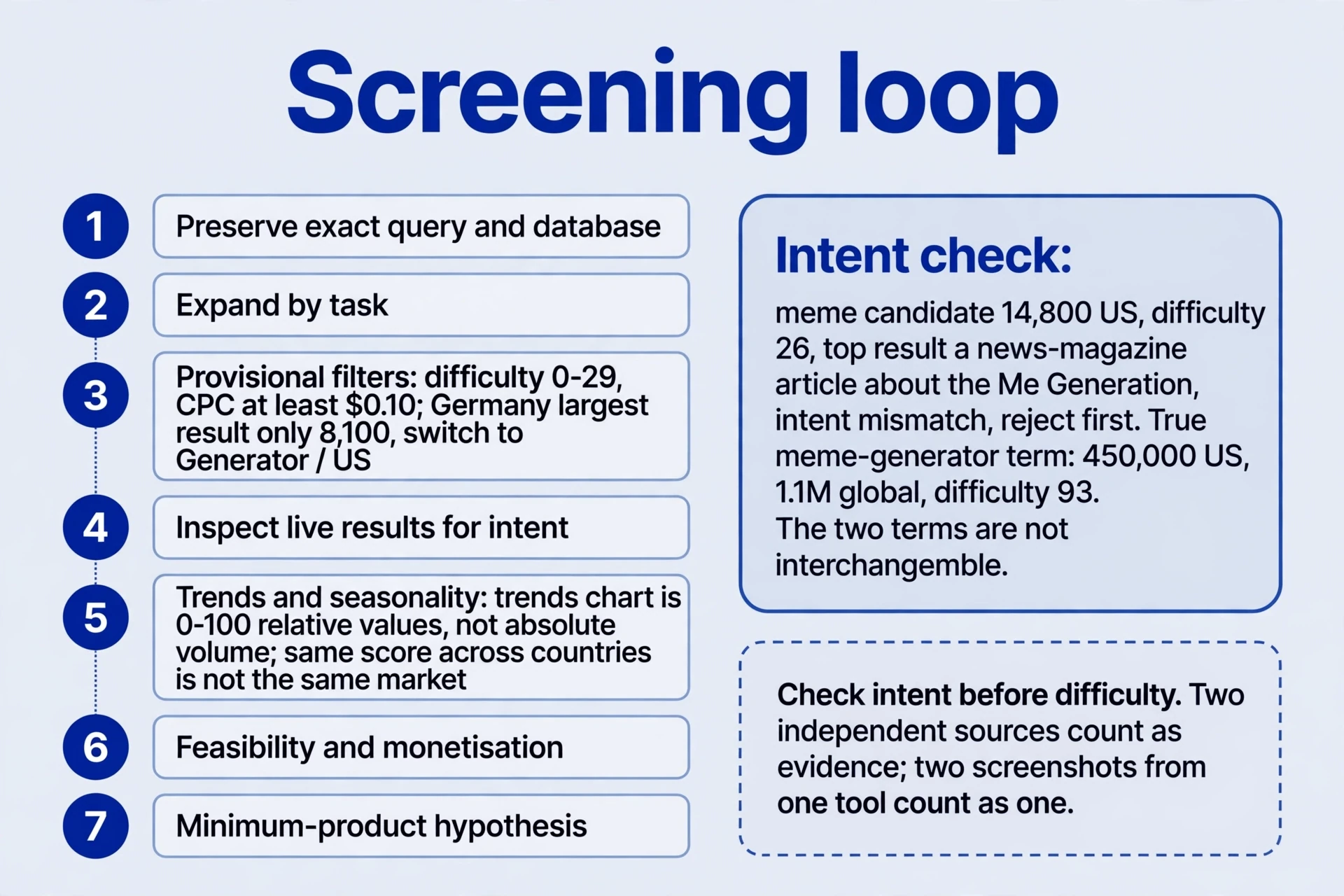
The author switches to Germany, inspects groupings and the keyword list, filters difficulty to 0–29 and cost-per-click to at least USD 0.10, then sorts by volume. The largest result is only 8,100, prompting a switch to Generator in the US. These are reproducible historical screening settings, not universal success thresholds. A small query with a clear paid product task and low costs may be worthwhile. Cost-per-click is an advertising-bid metric, not publisher earnings per click. The source excludes the first sensitive generator term over advertising and payment concerns but preserves no full policy analysis, so current platform policy needs a fresh check.
The most instructive failed candidate is a phrase that reads as meme generation: 14,800 US monthly searches and difficulty 26. The author initially connects this apparently easy term to meme culture and AI generation. Yet the search screenshot leads with a product news-magazine article about the Me Generation and questions about generations. The primary product task is learning about a generation, not creating memes. Reject it first for intent mismatch. Publisher strength is a separate question. The actual meme-generator term shows 450,000 US searches, 1.1 million globally, and difficulty 93. The terms are not interchangeable — check intent before difficulty.
AI meme products stay open as a separate question. One meme-caption tool, which captions a photo and combines it into a meme, rose in April and then declined, while another meme tool still had about 280,000 monthly visits, described as roughly 9,000 daily. The product observations show different traffic persistence. They identify no single-feature product as the sole cause of decline. A product social-distribution strategy should test entertaining output, sharing willingness, generation cost, and repeat-use situations rather than rely on a low difficulty score.
Another candidate, phone number generator, shows 14,800 US monthly searches, cost-per-click USD 1.07, and 2,600 variations totalling 62,600. The leading queries are phone number generator and random phone number generator. After seeing many internal pages in the tool, the author checks the search engine directly and a relatively stable twelve-month trends chart, then proposes a conversational generator. Product definition must still distinguish product test data from real numbers capable of receiving messages: random digits serve product test data only. Specify country format, quantity, export, and purpose before choosing an implementation. AI is not a prerequisite.
The product research loop runs: preserve the exact query and database, expand by product task, set provisional filters, inspect live results for intent, examine trends and seasonality, assess feasibility and monetisation, and write a minimum-product hypothesis. Search-trends documentation explains that trends charts use sampled searches normalised to 0–100. A trends chart shows relative interest, not absolute search volume, and equal scores across countries imply no equal product market size. Collection can be automated. Intent and quality still require sample checks.
Turn public AI requests into product constraints and interview questions
A 2024 product exercise recommends a public request board on an AI directory site. The author reports saving and translating 381 requests, but the archived product article contains only the first 20. Work with the 20 preserved here. The historical site estimate is about 5.05 million monthly visits, compared with more than 3 million six months earlier. The claim of being the largest AI directory is the author’s contemporary assessment. Directory traffic establishes no payment demand for every request.
The 20 preserved requests:
| No. | Request retained in the archive |
|---|---|
| 1 | AI tool for drawing sequence diagram |
| 2 | Someone’s newest cappuccino (context unclear) |
| 3 | AI for mass citations |
| 4 | Find and add hashtags with many followers |
| 5 | A graph of personal, social and economic causes of homicide |
| 6 | Recommend movies and series and log watchlists and watched movies |
| 7 | AI tools for file management |
| 8 | API book crawler with OCR and LaTeX for mathematics, physics and chemistry |
| 9 | A chatbot for presentation software |
| 10 | Making phone calls |
| 11 | Finding the lowest airfare |
| 12 | Looping a video |
| 13 | Creating an advertisement |
| 14 | An AI music critic |
| 15 | Presentation question (details unspecified) |
| 16 | What are dopplers |
| 17 | A tailored schedule respecting day/night balance, circadian rhythm, age, family, work and product exercise (source truncated) |
| 18 | Track bank accounts, bill-payment dates and transfers needed to top up balances |
| 19 | Sort through multiple emails |
| 20 | Summarize a slide deck and develop a product strategy around it |
Turn vague requests into questions first. The cappuccino request, the presentation question, and the dopplers question may be jokes, questions, or information needs requiring follow-up. For OCR plus LaTeX, ask about formula accuracy, layout, page count, output, and permission. For movie lists, identify whether product discovery or tracking causes the problem. For bank bills, ask whether reminders suffice or money movement is actually required. Costs, risks, and product validation difficulty differ substantially.
For looping a video, ask whether the setting is teaching, a display booth, or social creation; whether the input is a local file or a link; whether the product user needs endless preview or an exported repeated file; and whether uploads are acceptable. Native browser playback may suffice for a local classroom loop without an AI call. Demonstrate the product task, observe independent use, and ask what remains missing — clarify before building. That turns a public wish into evidence.
Write the product hypothesis and stopping conditions
Conclude with a one-page research record: product target user and trigger, input and expected output, product acceptance criteria, alternatives, query and geography, two independent forms of product demand evidence, a way to reach users, minimum implementation and cost, exclusions, and the next review date. Evidence may combine search with interviews, ads with product task observation, or public requests with competitor use. Demand evidence needs two independent sources: two charts from the same tool count as one.

A small learning product experiment could ask three people with the product task to use a working prototype — three users, one task, one product decision — and record completion, time, and failure reasons. Three is a teaching sample. Treat it as a learning run, not a product significance test. If no one tries it, examine reach and messaging. If arrivals fail the product task, fix the function. If completion produces no return, investigate task frequency. If people return but will not pay, compare free alternatives and paid value. Collecting more terms must not replace this experiment.
Practice: deliver a reviewable demand study
-
Can 1.7M estimated monthly visits and 51.44% organic search establish paying product users? Record the site-level visit estimate and channel share together. Keep UV in its own column. Paid conversion and refunds are unknown. Choose one product task, inspect the landing page, pricing, and alternatives, and interview actual product users. Mark paying-user count unknown.
-
Why does a low-difficulty query with 14,800 searches not justify a meme generator? The results concern the Me Generation, an informational topic rather than meme creation. Preserve the exact query, screenshot date, and intent, then reject it. Research the meme-generator term separately, including its historical US volume of 450,000, difficulty 93, and a possible social route. Do not transfer the lower score.
-
How would you validate an outbound-domain product research tool? Take ten domains from one promotion platform and manually record registration, first known page, traffic-estimate month, and product. Ask two developers to use the table to find promotion channels, observe time saved, missing fields, and willingness to pay. If registration and product dates often diverge, add product-change notes before automating.
-
What launch date should be recorded when the first capture is 18 November but a post is dated 16 November? Write: available to the archive by 18 November; the page dates its first post 16 November; exact launch unknown. Check other public release records. First capture and domain registration each record their own event; the exact launch date needs another record. Preserve each linked page’s capture time.
-
Write a minimum product validation plan for AI video looping. Assume local classroom playback for teachers. Ask three teachers about formats, offline product needs, and exports. Build local file selection, a loop switch, and error messages, then observe independent completion, failed formats, and time. If a native player already suffices, stop or investigate a product unmet batch-export task. An AI request does not require a model.
Start from the task, expand through clues, and stop at a test. A product demand study earns its next step when its numbers keep their windows and its product hypotheses keep their stopping conditions.
Comments
Join the conversation. Comments are reviewed before appearing.
Loading comments…