Adding a language pack to an English site helps people read it. Reworking keywords, pages, payments, and support for a country helps people use it and buy. Related jobs, distinct jobs — and the second costs far more than the first, which is exactly why the language choice of market comes before the language choice of words. This lesson moves from language market selection to local wording to delivery and maintenance. The thread: choose a market, find local wording, deliver and maintain.
Choose the audience before adding languages
In October 2023, four early reports circulated. One operator said blog visits rose tenfold after adding languages. Another noticed a clear traffic increase. A third added Russian to a tool site and found a language keyword at number two on a local search engine, ahead of an English-only site that ranked first on the dominant engine. A fourth built a Korean tool site because a Korean language keyword looked less competitive. These reports justify investigating language gaps. The archive supplies no consistent comparison periods, analytics evidence, or controlled variables, so a tenfold gain is no promise, and one result on one engine cannot establish a rule for every search engine. Anecdotes open investigations. They don’t close them.
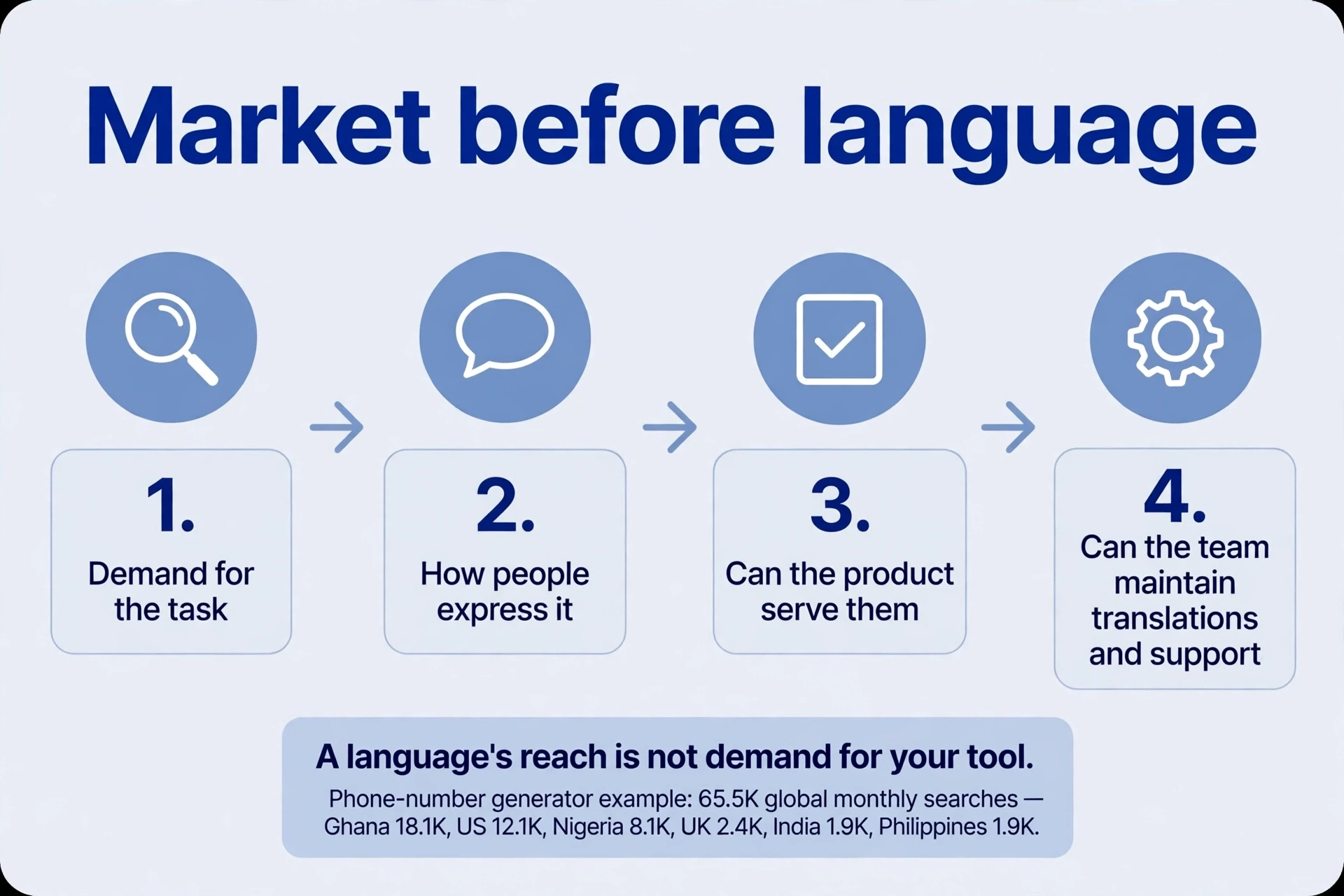
Don’t choose languages only by asking AI for the most widely used languages. The candidate list in the archive — English, Chinese, Spanish, Hindi, Arabic, French, Portuguese, Russian, Bengali, Indonesian — can prompt investigation. Priority depends on where your task has demand, how people express it, whether the product can serve them, and whether you can maintain translations and support. A language’s reach is not demand for your tool. A billion speakers with no need for your converter are worth less than a million with an urgent one. A tenfold gain in someone else’s anecdote is no promise for yours.

The phone-number language generator example is more specific. A keyword-tool screenshot dated October 21, 2023 estimated 65.5K monthly searches globally, listing Ghana at 18.1K, the United States at 12.1K, Nigeria at 8.1K, the United Kingdom at 2.4K, India at 1.9K, and the Philippines at 1.9K. English is widely used across those six markets. The author therefore acknowledged that English might suffice initially — Hindi and Filipino were added mainly to teach the process. These are historical language keyword estimates, not visits the site earned or a current market ranking. Read the countries, the date, and the metric first. A search estimate is demand for the task. It says nothing about who won it.
Separate shared language maintenance from independent markets
Two positions from 2023–2026 pull in opposite directions, and both have evidence behind them. The 2023 and 2024 articles favour language subdirectories on one domain: English at the root, separate paths for other languages, one small team sharing templates, styles, product features, and releases. In July 2026, a speaker at a talk argued the reverse from experience: eight sites, each serving one language, can be stronger than one site translated into eight languages. His background includes export commerce, a Japanese degree, and search work from around 2016; at the talk he reported at least eighteen profitable sites and more failures. That describes one operator’s experience and sample, not a randomised comparison. Eighteen wins and uncounted losses tell you the language approach can work. They don’t tell you it works better.
Both approaches fit one decision framework. When functionality, brand, pricing, and service scope are largely shared, and more users need the same task, language folders on a shared site are often easier to maintain. When a country needs its own product range, language content, brand, payment flow, and language support, and the team can sustain domains, content, links, infrastructure, and compliance work, an independent site deserves consideration. Either address structure still requires language localisation. A separate domain cannot turn translated copy into a local product by itself. The domain is an address. The product is the work.
| Option | Problem it can solve | Cost to plan for |
|---|---|---|
| Subdirectory, such as /ko/ | Share the product and release process while testing language demand | Maintain paths, language switching, translation versions, local language keywords |
| Subdomain, such as ko.example.com | Separate applications, deployment, or team responsibilities | Separate configuration, monitoring, operations; a tool’s reporting scope doesn’t establish ranking ability |
| Independent or country domain | Operate a genuinely distinct market business | Fund multiple sites and local operations; a country domain can also narrow geographic targeting |
To explain subdomains, one article used the scope of backlink-tool reports, console properties, and separate free-hosting sites, then argued that each subdomain starts from zero and a redirect to the www host loses some link effect. Those observations cannot quantify the search engine’s internal signals. The practical conclusion is narrower: choose a stable canonical hostname and permanently redirect equivalent alternatives correctly. Don’t migrate because of an unproven fixed loss rate. A Domain property in the console can cover multiple subdomains — a reporting boundary is not an algorithmic boundary. The search engine’s own language guide compares country domains, subdomains, and subdirectories, recommends distinct URLs for language versions and user language choices rather than relying only on cookies, language browser settings, or inferred location — and establishes no fixed subdirectory bonus or independent-domain victory rule. Choose a structure the team can sustain, then evaluate language page and market results — sustainability over ranking theory. A structure nobody maintains rots in every language equally.
Find local words from the task, not a literal language translation
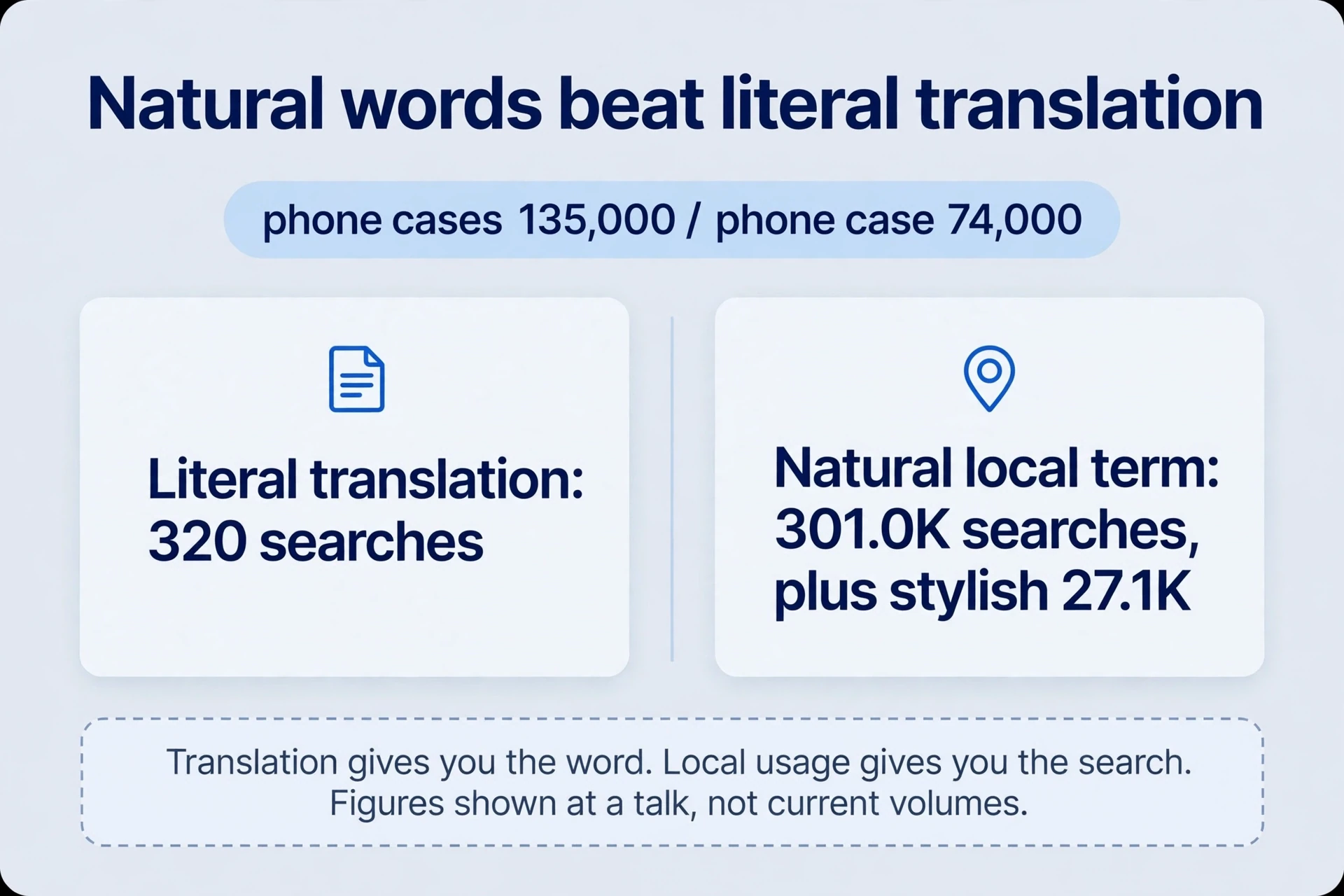
A phone-case slide from the 2026 talk makes the distinction concrete. It shows estimated volumes of 135,000 for “phone cases” and 74,000 for “phone case,” while the literal Japanese language translation has 320 searches — against 301.0K for the natural local term and 27.1K for the natural term plus “stylish.” The screenshot doesn’t disclose all region, period, and language database settings, so these remain figures shown at the talk rather than current volumes. The lesson survives the caveat: a natural local term can matter far more than a dictionary language translation. Nine hundred times more, in this case. Language translation gives you the word. Local usage gives you the search.
The Korean language image-compression example turns this into a repeatable process. First state the task: a photo file is too large and needs to be smaller for uploading or sending. This concerns file size — reducing several megabytes to hundreds of kilobytes. Changing pixel width and height is a different task. A file-compression tool should not target resizing merely because that language wording seems more popular. Popularity for the wrong task is worse than obscurity for the right one: it brings visitors whose problem you don’t solve.
Ask AI for candidates, with the task stated and an instruction not to invent search volumes. AI supplies candidates to verify, not search data. The candidates included the Korean phrases for “image compression” and “reducing photo file size.” Examine real results in the target region and the language wording on those pages. Set the search region to South Korea, filter results to Korean, use a Korean browser environment, and keep automatic language translation off. To investigate local ordering further, use an appropriate Korean network exit and record the location recognised at the bottom of the language results page — one search still depends on its environment, and the environment is part of the evidence. Compare titles, headings, and explanations across several relevant results rather than copying the first result. The first result is one language page’s answer. The pattern across five is the market’s vocabulary.

A local tool site provided several expressions for the same task: a heading saying image compression, copy about reducing photo size, email attachments, and upload limits. That suggests investigating the scenario “the photo is too large to upload.” Advertising tools, local forums, question sites, and ecommerce language reviews point the same way: study how people search, complain, compare, and buy. Record whether the results are tools, articles, brand sites, or stores, so a language page without buying functionality doesn’t target a purchasing task — match the language page to the result type. A language tool page competing with stores for a language buying query loses to every store, however good the tool.
Compare candidates consistently, then apply them to one language page
With an available ads account, open the keyword planner through the planning tools, choose the new-keyword discovery option, and enter both candidates together. Set the location to South Korea, language to Korean, and network to the search engine itself, keeping the period fixed. Don’t mix this with a combined search-and-partners scope — a different scope is a different measurement, and the comparison breaks. Review average monthly searches and suggestions, exclude mismatched intent first, and then compare demand. If the account displays ranges, preserve the ranges instead of inventing precise values. A range is the honest answer. A precise number invented from a range is fiction with decimals.
If the planner is unavailable or a new phrase lacks data, continue with the trends tool. Compare both phrases in the same request, selecting the search-term option for both, South Korea, the past twelve months, web search, and the same category. In the chart saved with the source, the file-size phrase stays above the image-compression phrase, leading the author to prefer the former for this language page. Don’t run separate requests and conclude the phrases are equally popular because both independently peak at 100. Each separate chart rescales itself to its own peak. Two peaks of 100 from two requests mean nothing together — one request, one scale, or no comparison. That rule alone invalidates half the trend charts shared in meetings.
The trends tool’s own data notes confirm the limit: the chart represents sampled searches normalised for time and geography and scaled to 0–100. It is relative interest, not an absolute search count. Low-volume phrases may lack enough data; no chart doesn’t establish no demand. Keep them on a verification list and revisit local language pages, keyword suggestions, and actual language queries after launch.
After choosing the language wording, express the task naturally on one complete language page. The worked example uses the file-size phrase in the title alongside the compression phrase, the file-size phrase as the main heading, and an instruction sentence: upload a JPG or PNG photo, reduce the file size, and download it. Retain PNG only if the tool supports it. There is no need to repeat both phrases in every paragraph or immediately create nearly identical language pages for synonyms. One page, one task, one primary phrase — with the synonym present where it helps a reader recognise the tool, not where it helps a counter.
Complete one static language version end to end
The manual process in the archive helps beginners understand language paths. Keep the English index and country language phone-number pages at the root, create Hindi and Tagalog folders alongside them, and copy the prepared HTML into each folder. Keep the shared stylesheet at the root. The example uses hi for Hindi and tl for Tagalog while labelling the button Filipino. A new project should confirm the actual language and required standard. Don’t confuse the Philippines country code PH with a language code, and don’t skip verification because AI declares a choice completely fine. Language codes are facts, checked against the standard, not against the chatbot.
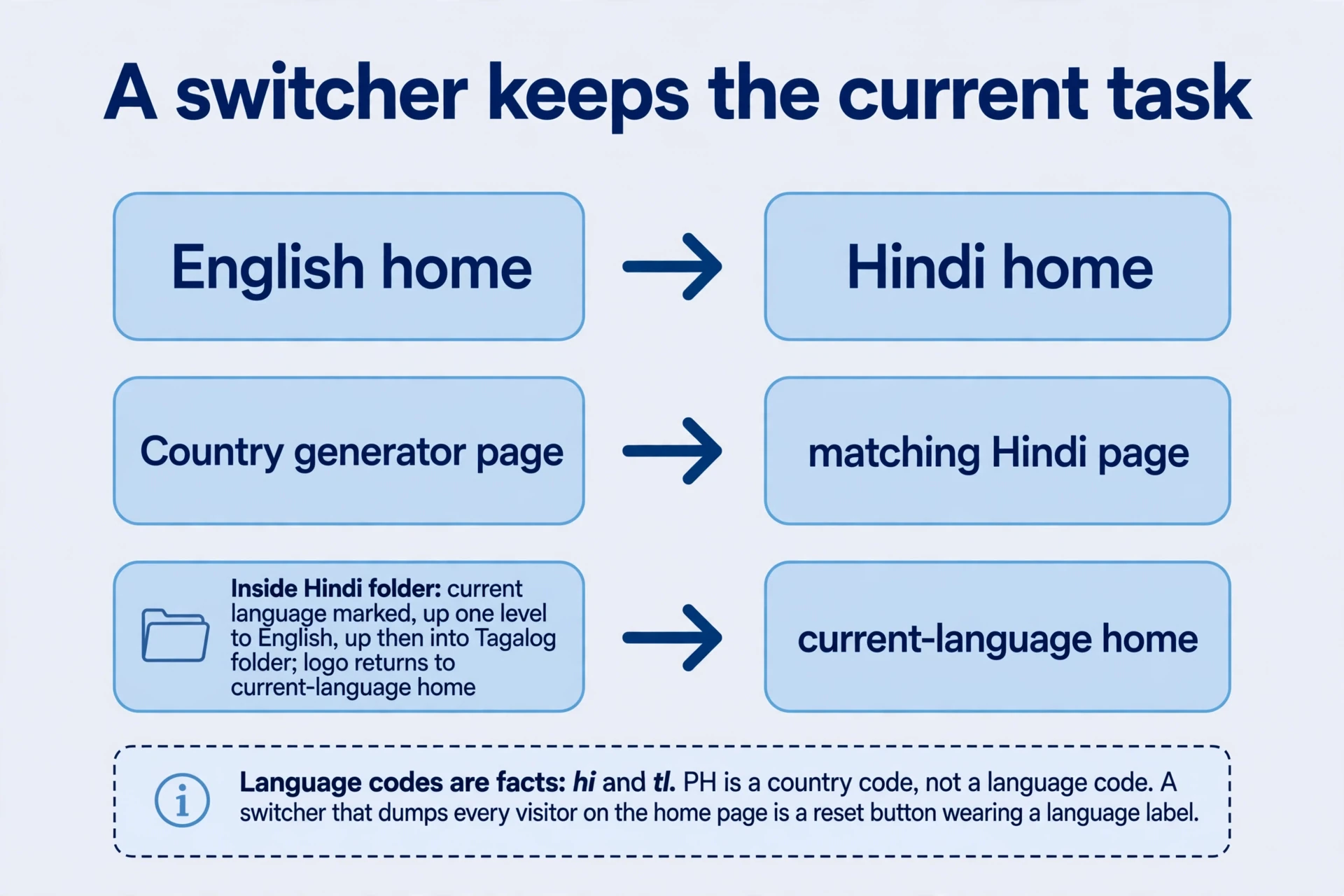
Language switching should preserve the current task. Switch the English home page to the Hindi home page, and a country generator page to its Hindi counterpart, rather than sending every inner-page visitor to a home page. Inside the Hindi folder, mark the current language, use the matching page one level up for English, and go up then into the Tagalog folder for Tagalog. Home and logo links should also lead to the current language’s home page. A switcher that dumps every visitor on the home page is a reset button wearing a language label — and every reset costs a visitor who was mid-task.
Translate the title and meta description, visible navigation and title attributes, each section’s subheadings, explanation, buttons and supporting text, and then the remaining pages. Tell AI to preserve URLs and HTML structure and replace only localisable text, so it doesn’t corrupt link values, filenames, or class names. Set the HTML language attribute for browsers and assistive technology. The search engine primarily identifies language from visible content, so changing the attribute alone doesn’t create a language version. The attribute helps machines. The translated text is the language version.
The source opens another window to translate the Hindi title back into English as an initial check. Back-translation can expose omissions or meaning shifts but cannot prove natural language wording, technical accuracy, or local search demand. Compare local evidence afterward, and have important language pages reviewed by someone who understands the language or industry. Claims such as “valid” and “verification” in the phone-number demo must match the real feature: a plausible number format doesn’t establish that a number exists or can receive a code. A generator that formats numbers convincingly is not a verifier, and its copy must not claim otherwise.
The source postponed mobile adaptation. That pause is not a release criterion. Before publishing, click language switches, the logo, country links, and buttons on each page, and check shared styles, mobile layout, long-text wrapping, and form errors. Long German compounds, long Finnish words, long translated buttons — text expands, layouts break, and the breakage is invisible on the desktop English page where everything was first built. For genuinely corresponding language versions, follow the localised-version guidance: list the page itself and its counterparts, use absolute URLs, and provide reciprocal annotations. Language versions can cross domains. The language annotation expresses the relationship. It cannot substitute for language translation or repair a broken page.
Once the manual flow is clear, extract templates, language JSON, or a Markdown translation pipeline: write the source, generate language drafts, render separate HTML, and preserve language versions. This also underlies a product idea in the archive: upload or paste Markdown, translate it, and download packaged HTML. Automation is most valuable when it reduces repeated path errors, while language drafts still receive review — automate paths, review words. The machine is reliable at folder structures and hopeless at judgement calls — assign accordingly.
Carry language localisation through reading, contact, and payment
Localisation that stops at the copy stops before the purchase. In Japan, investigate name fields, amounts, punctuation, politeness, units, brands, and language delivery promises. Poland, Brazil, Japan, and Southeast Asian markets should not inherit an identical set of payment and chat options — some customers prefer consulting before purchasing, and a checkout without a language consultation route loses them before the form loads. Brazilian tax fields are a useful warning from the source, but a slide treating two tax identifiers as universally required together is not current legal authority. Verify fields for the customer type, transaction, and provider, and have someone familiar with local operations review the form. A form field is a legal claim as much as a language design choice. Get it wrong and the error message is the kindest outcome.

Arabic requires checking right-to-left reading and interaction, not simply replacing words. Layout mirrors, navigation flips, icons reverse, and a language page that reads correctly but interacts backwards feels broken in a way no language translation fixes. Validate promotion names, holidays, colours, and imagery for the particular country and language audience. A caution about promotional language wording in some Muslim markets should not become a universal cultural prohibition. The source also reports compliance complaints affecting hosting and domains, but preserves no country, industry, complaint evidence, or ruling. The actionable language lesson is to verify local restrictions before launch. The missing facts cannot support a more specific attribution, and a warning without a country is a worry, not a plan.
Ask AI to research the market before drafting: what users care about, what competitors emphasise, what forums and language reviews complain about, and which differences in payments, language delivery, aftercare, sizing, materials, or certification need verification. Explain structure and business goals in Chinese if convenient, while supplying verified target-language keywords directly. This avoids drafting entirely from Chinese assumptions and translating afterward. AI market reasoning remains a research lead to check against local evidence and the real business. Language Industry review should check materials, product capability, language examples, promises, images, and limitations one by one. AI may assign another company’s service to yours or invent materials or certification. Fluent grammar doesn’t establish accuracy — and a fluent lie ships faster than a clumsy truth.
English text in images, dollar coupons, American units, and mismatched language video settings can also interrupt the experience. Prefer authentic product, factory, and team material, then add suitable subtitles, dubbing, and lip adaptation where needed. Don’t invent a team, address, or product evidence to appear local. A fabricated local presence is a trust debt that compounds: one customer visit, one phone call, one address check, and it comes due.
One country first: connect keyword research, competitor analysis, language content review, image preparation, publishing, discovery and indexing, links, and conversion into a repeatable process before entering a second market. This is the transferable part of the one-country-one-site experience. The number of sites is an organisational language choice. The work is serving local users throughout the journey — and a repeatable process for one country beats eight half-finished launches every time.
Check crawl rules against every real language path
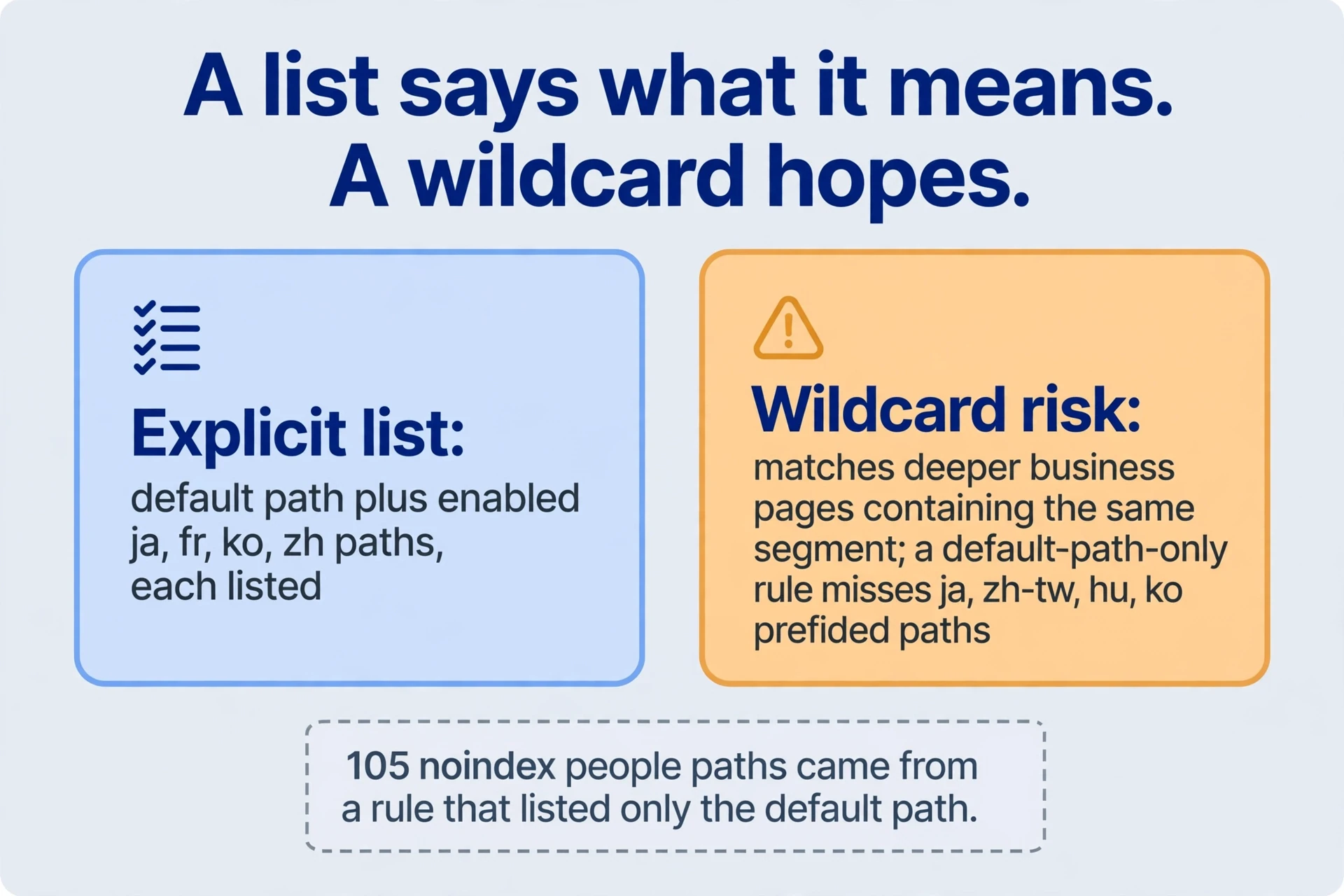
In one investigation, more than a hundred language noindex pages appeared in the console. The screenshot shows 105 affected URLs, including language people-directory paths under Japanese, Taiwanese, Hungarian, and Korean prefixes. The team had only written a rule blocking the default path, leaving language-prefixed paths unmatched. Reading actual reported URLs is more useful than changing sitewide rules merely because many pages are excluded. The report told them exactly which language paths were involved. The fix followed the evidence, not the count.
If the goal really is to prevent crawling these language people paths, explicitly list the language default path and the enabled languages. The example retains Japanese, French, Korean, and Chinese language paths. If the site actually uses Taiwanese or Hungarian prefixes, include those real paths. Don’t assume a copied list covers the site. A rule language matching paths beginning with the default prefix doesn’t skip a preceding language folder, and it doesn’t match the same path without the trailing slash — whether that needs a separate rule depends on routing and redirects. The pattern with a wildcard is not unpredictable either: under the matching specification, an asterisk matches zero or more characters including slashes, so it also matches deeper paths that happen to contain the same segment. If a language business page at that deeper path should be crawled, the pattern blocks too much. A list says what it means. A wildcard hopes — explicit lists are easier to audit.
For generation, derive language paths from the same enabled-language list the site actually uses. After generation, inspect the live crawl-rules file and test intended language paths, similar allowed pages, and newly enabled languages. The key is to state the goal first: crawl rules control crawling, noindex controls indexing, and private pages require authentication. In this case the language pages were crawled and their noindex was read, so exclusion by noindex may match the intended indexing outcome. The engine must be able to crawl a page to read its noindex — a crawl block can hide the very directive meant to exclude the page. The source’s claim that every page not intended to earn traffic should be blocked is too broad. Useful language help pages, brand information, and rendering resources may still need access. Decide by purpose, language path by path, not by slogan.
Protect validated local language wording and keep checking results
A Korean site registered eight hundred users one day and one thousand the next, followed by a sudden traffic loss. The investigation found that editing English copy automatically updated the Korean text and replaced previously targeted local phrases. The eight hundred and one thousand figures concern registrations, not search clicks or visits. The archive doesn’t supply complete release records or language query curves to exclude other changes — but it clearly motivates protecting validated local wording during language translation updates. One automated sync erased the language wording the market research had chosen. The traffic followed the words out the door.
Keep a record per language: candidate phrase, meaning, supporting local language pages, data tool and comparison language settings, chosen placement, verification date, and owner. Store source text awaiting retranslation separately from reviewed local terminology. Generate a diff when the source changes and decide which sentences to retranslate rather than replacing the whole pack. Preserve previous versions and a language rollback path for titles, headings, and key explanations that already earn impressions or clicks. Treat a validated phrase as an asset: versioned, owned, and never overwritten by an automated sync that can’t tell it apart from a draft.
In the console performance report, add a language page filter. Use URLs containing the Korean folder for the language scope, or an exact URL for one language page, then inspect queries. Keep the same language page scope and comparable periods before and after publishing. Observe which phrases earn impressions and clicks, and use product analytics for task completion and registrations. A language path doesn’t establish the user’s country — add a country filter if relevant. Don’t rewrite every sentence because clicks are absent for a short period. First check discovery and query relevance, then investigate content and conversion. Absent clicks in week one usually mean absent discovery, not failed copy — and rewriting copy that was never seen fixes nothing.
Produce a language version that another person can review
-
Should one compression tool use a folder or an independent site? Assume the tool is free, functionality is shared, and one team maintains it. Choose South Korea first and publish a complete language tool page under its folder, sharing the backend and styles. Document local language keyword evidence, capability, ownership, and task-completion measures. Reconsider a separate site if local paid plans, language support, and branding become necessary and sustained resources exist. The answer follows business assumptions, not a fixed ranking bonus for folders.
-
How should Korean keyword evidence be built for files too large to upload? List both candidates and explain file compression versus pixel resizing. Save titles, headings, and task explanations from several relevant local language pages. Compare both search terms together in the trends tool with South Korea, the past twelve months, and web search. If using the planner, fix country, language, network, and period, preserving ranges. Put the chosen language wording in the title and main heading, use the synonym to explain the feature, and avoid duplicate language synonym pages. One comparison, one language page, one primary phrase.
-
How should three key links be checked on a Hindi inner page? On the Language Hindi country-generator page, the stylesheet should resolve one level up, English should resolve to the matching page one level up, and Tagalog should resolve up then into its folder, while the current-language button stays on the current page. Click the logo back to the Language Hindi home page, inspect the language attribute, visible copy, title, and description, and complete one tool task on mobile. Three links, one task, one device — the whole language version in miniature.
-
Does the default people-path rule cover the Japanese language people path and a deeper language path containing the same segment? No. Neither language path begins with the default prefix. To block only the default and Japanese language people pages, explicitly list both and test that those are blocked while the deeper path remains allowed. A wildcard pattern would match the deeper path too. If the goal is exclusion from indexing, use a crawlable noindex workflow rather than treating a crawl block as guaranteed exclusion from results.
-
How should a release handle English edits that would replace a Korean title? Export queries for the Korean URL with comparable periods and save its title, heading, terminology record, and language version. Have translation produce proposed diffs while protecting reviewed primary language wording. Review feature promises with a domain expert and natural phrasing with a language reviewer, then test paths and the tool before releasing. Afterward, examine impressions, queries, and task completion for the same URL scope. Compare anomalies with changes and indexing status, rolling back if warranted. The release protects the language wording first and measures second — in that order, because the measurement is meaningless if the language wording is already gone.
A language version is a promise to a specific group of people: your task, in their words, working end to end, maintained after launch. Choose the market on evidence, find the wording in local pages, build the whole language version before publishing, and guard the words that earn their keep. Translation opens the door. Language localisation is what makes anyone stay.
Comments
Join the conversation. Comments are reviewed before appearing.
Loading comments…