A falling traffic chart can tempt you to rewrite titles, delete pages, or add backlinks immediately. Resist the first three impulses. A traffic visit decline might reflect demand, positions, answer features, or missing analytics — four different causes, four different fixes, and the wrong fix wastes the week the right one needed. Identify the traffic metric, the pages, the channel, and the date range first, so the response has traffic evidence behind it.

This lesson turns a falling traffic chart into evidence-led changes: locate the problem, verify it against traffic page evidence, and act with the unknowns kept visible. The thread: locate, verify, act.
Traffic: Establish what declined before explaining why
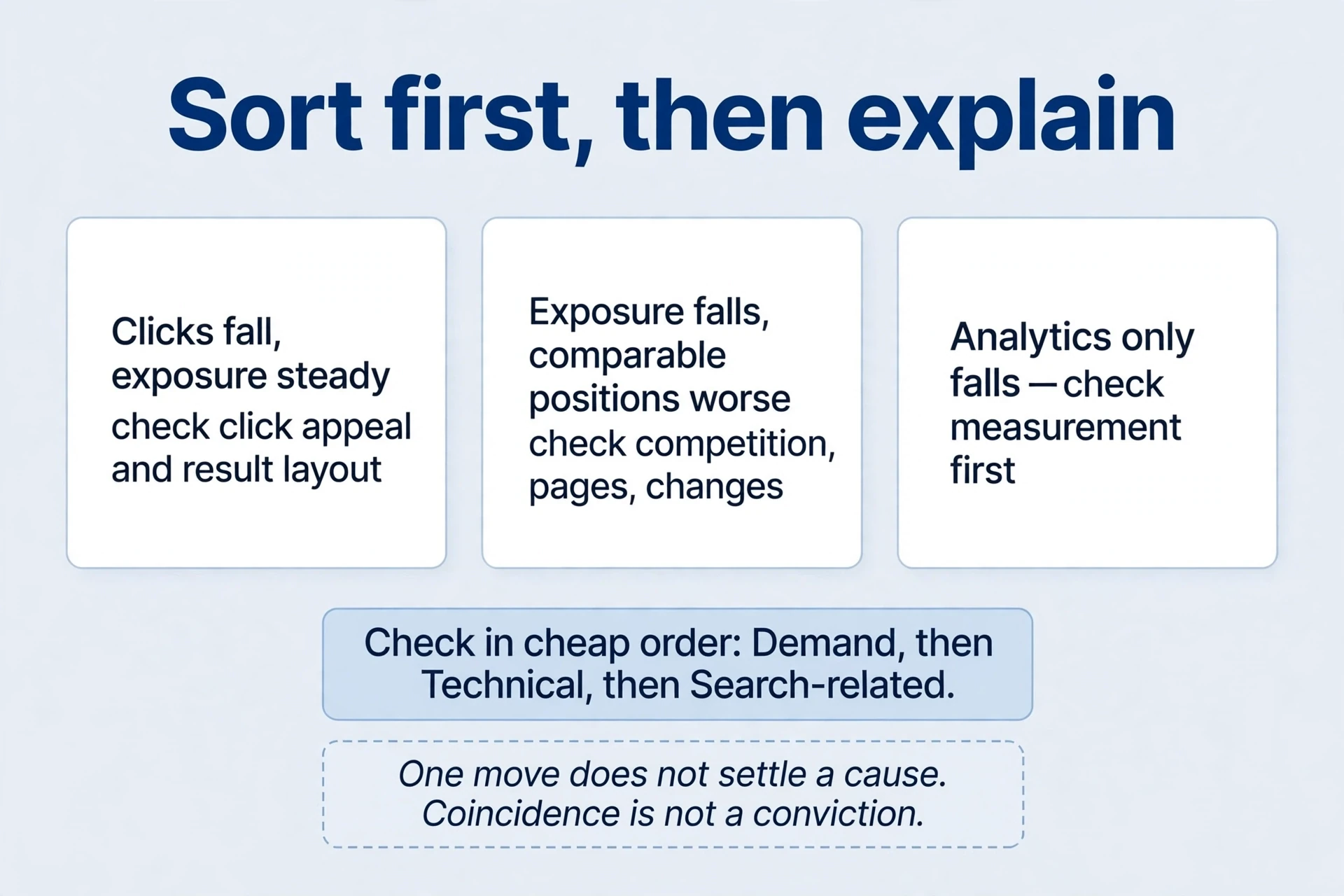
Separate search clicks from site analytics first, then examine impressions, click-through rate, and average position by query, page, country, device, and search type. Falling clicks with broadly stable exposure suggests checking click appeal and result layout — people see the result and pass it by. Falling exposure with worse positions for comparable queries suggests competition, pages, or traffic changes — people no longer see the result at all. An analytics-only traffic drop calls for measurement checks before any page work: a broken tag looks exactly like a lost audience. No single movement settles the cause. Each traffic pattern narrows the field. None of them closes the traffic case alone.
Traffic review. Answer features deserve a check of their own. A result page that now answers the query directly — a featured snippet, an AI summary, a built-in tool — can take the click without moving your position at all. Impressions hold, positions hold, clicks fall, and the page did nothing wrong. Inspect the actual result layout for the affected queries: what now sits above, around, or instead of the organic traffic results? Check the layout, not just the position. A position you kept on a page that changed around you is a different traffic problem from a position you lost.
| Observation | Possible explanation | Traffic evidence to seek |
|---|---|---|
| Clicks fall around a holiday while core-query positions hold | Seasonal demand or audience behaviour | Year-over-year patterns, regions, complete weeks, traffic demand trends |
| Several features return the same shell after a release | A template or traffic route change affects content delivery | Initial HTML, rendered content, statuses, release differences |
| A competitor improves while your page remains accessible | Relative competitiveness has changed | Comparable traffic results, task delivery, information gaps |
| Unindexed URLs grow with a production batch | Duplicates or limited independent value | Representative content, canonicals, entry points, batch history |
The search engine’s traffic-drop guidance distinguishes demand, technical, and search-related changes — three buckets, checked in that order of cheapness: demand first, because it costs nothing to verify; technical second, because a broken release explains many symptoms at once; search-related last, because competition and quality take longest to traffic evidence. Comparing update dates with a traffic chart can suggest a lead, but coincidence doesn’t establish a penalty. A core update landing the same week as your traffic decline is a suspect, not a conviction. Check the relevant traffic report for manual actions. Their absence doesn’t rule out other quality or competitive issues — it rules out one specific traffic cause, and the investigation continues.
Traffic: Preserve established entry points during improvements
Traffic context. Don’t change established URLs casually. They may already be indexed, bookmarked, and cited — three kinds of value that a new address has to re-earn from zero. Inventory URLs with clicks, links, or business value before redesigning. Retain them where practical. When a move is necessary, map destinations, redirect, and update internal links and lists. The principle protects established entry points. It doesn’t ban all traffic URL changes forever. A genuinely better structure can justify moves — mapped, redirected, and announced by the links themselves, not by hope.

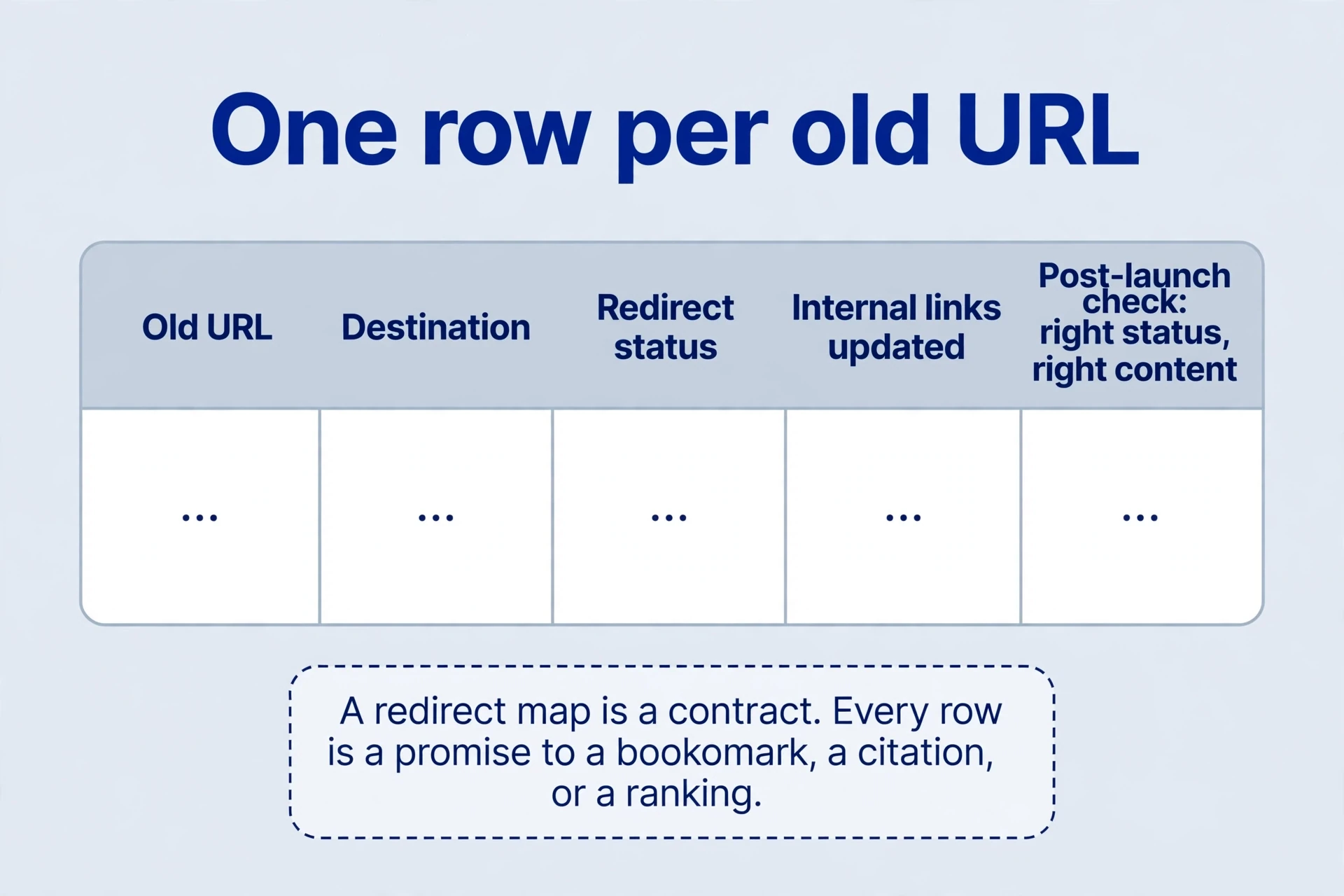
Run the move as a worksheet, not a traffic memory exercise. One row per old URL: the destination, the redirect status, the internal links updated, and a post-launch check that the destination returns the right status with the right content. Test a sample before launch and watch the 404 log after it. A redirect map is a contract. Every row is a promise to a bookmark, a citation, or a ranking — and unmapped URLs break all three silently, discovered weeks later in a traffic report nobody was watching.
Then separate two kinds of work, because they compete for the same week. Improve existing pages through clear titles and descriptions, useful heading hierarchy, correct canonicals, connected home/category/detail routes, and an appropriate sitemap. Traffic Metadata patterns by page level help here — retain their task-and-hierarchy logic without filling titles with keyword lists or prioritising the unused keywords meta tag. Add new pages only for related unmet user tasks, choosing tools, traffic guides, or collections with appropriate categories. Existing domain traffic doesn’t justify unrelated popular topics. A tool site that adds celebrity news because it has traffic is spending its reputation on strangers. Improve deep routes through categories and related links. The four-click suggestion is a design aid — important content should be reachable quickly — rather than a substitute for meaningful relationships. A page four clicks away through sensible categories beats a page one click away through a dumping-ground menu.
Traffic: Review a sticker site by page type
A 2024 open-source sticker site offers a full traffic page-type review in one working product: generation on the home page, individual sticker details, a collection listing, a search entry, and traffic query results. A usable product can still have unclear page types, and plugin warnings don’t invalidate everything it already does well. Treat plugin scores as suggestions, not verdicts: a warning about a short description on a page that explains its task plainly is a prompt to check, not a fault to fix by padding. Fix by task, not by score. The traffic review starts with the task on each page, then labels, then discovery. Task first, always — a page whose task a stranger can’t name in five seconds has a labelling problem, not a traffic problem. Five seconds, one task. If a stranger can’t say what the page does in that time, the labels failed, whatever the scores say.
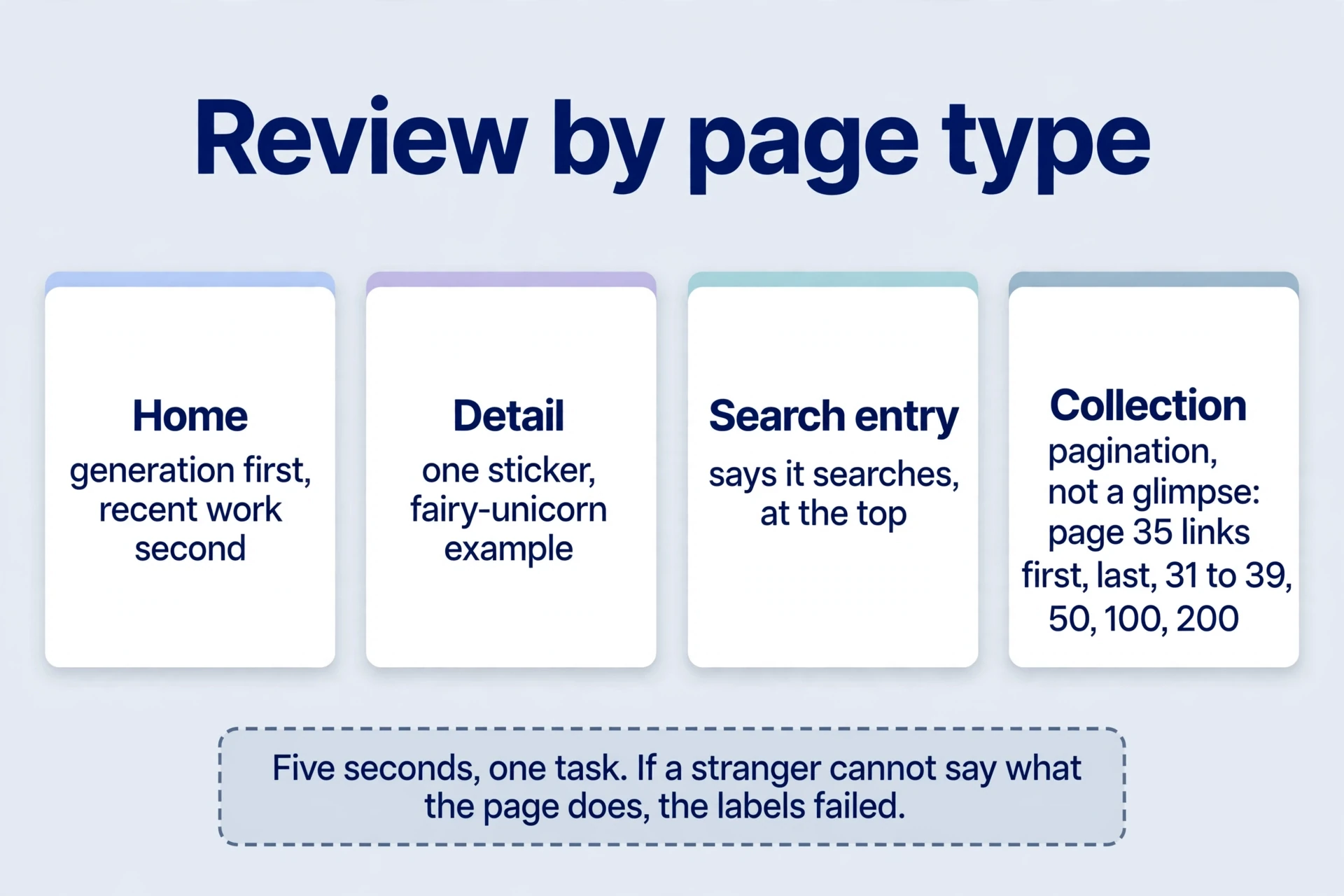
Traffic planning. The home page combined generation with recent work — a genuine strength. Its title was only the brand name, and its description was brief. The issue was insufficient traffic task explanation, not unused character capacity. Headings labelled “Upload” and “Latest” instead of the product task. Use a main tool heading, a “Convert face photo to sticker” section, an appropriately subordinate upload label, and “Latest Generated Stickers” for recent work. The hierarchy should read like the product works: convert first, browse second, upload as a step inside conversion. Most creation images already had alt text, with a few icons missing it. Handle those by purpose rather than stuffing decorative images — a caption naming the person pictured clarifies a matching image; an icon beside a labelled button needs nothing. Add an appropriate self-canonical and plan a sitemap for growth, without treating its absence as certain failure. Retain working social cards, avoid invented hreflang for nonexistent translations, and don’t nofollow every endorsed outbound resource. Each of those is a small honesty: claim only the languages you have, the canonical you mean, the endorsement you intend.
Traffic context. Recent creations show outputs and expose new content. The more significant issue comes after the initial list: scroll-only loading need not expose all content to crawlers. A page that loads twenty items and fetches the rest on scroll may show a crawler only the first twenty — the rest exists for scrollers, not for discovery. Add a Discover page with ordinary pagination, giving visitors and crawlers a lasting route through the collection. Pagination is the difference between a collection and a glimpse.
Traffic planning. For a detail page — one sticker, a fairy-unicorn design — a search title can name the item directly while a social card retains the personal “I made an AI sticker…” wording. Different contexts, different promises, same page. Use a descriptive main heading and a subheading for related creations. Similar stickers help users choose and continue. They are not a density target for repeated unicorn text. Make the relevant list readable rather than leaving only a container the page renders around nothing. The archive suggests a descriptive slug such as the sticker ID plus “fairy-unicorn,” located by extracting the ID or using a stored URL field. Extract a concise subject from long prompts. A slug is not an anti-scraping measure, and the improvement should not break existing links to the ID-only address. Preserve mappings for a move, or improve traffic page signals first while keeping stable URLs. Stable URLs first, pretty slugs second. A broken old link costs more than an ugly address ever did.
The search page can keep its brand while naturally expressing “Sticker Search” in its title, traffic explanation, and main heading. Its lone small subheading lacked a clear main heading — a page about searching that never says so at the top. Traffic results also reused the same title, description, and headings across queries. Fix the template so each worthwhile result explains its actual subject, count, and purpose in readable content. Changing the URL alone doesn’t create a distinct topic. A proposed “160 Best Unicorn Stickers” collection needs a real count and a basis for “Best” — count the stickers, define the basis, or drop the superlative. Not every user query deserves an indexable page: empty traffic results, noise, duplicates, and weak collections add little value. Select demanded subjects with sufficient useful traffic results, then supply appropriate URLs, labels, and entry points. Server rendering can simplify delivery, but JavaScript itself doesn’t establish non-indexing, as the earlier rendering lesson explains. The traffic delivery method is a choice. The content is the requirement.
Discovery needs the same lasting routes. A large collection needs pagination: the archive’s page-35 traffic example links first, last, nearby pages 31–39, and selected distant pages such as 50, 100, and 200. These illustrate reduced navigation effort, not required page numbers. Categories and date archives can serve the same aim. Don’t create empty pages to complete a traffic pattern — an empty category is a promise the collection can’t keep. Topic pages can use manual selection or similarity retrieval to group works for one task, followed by editorial traffic review. A query index should expose selected, maintained collections, with representative images and pagination where useful. Distinguish three jobs — discovering creations, completing a topic task, finding curated traffic query results — rather than using one giant keyword list for everything. A tool directory’s grouped entries illustrate the same principle: organise by topic and browsing traffic method, not by indiscriminate link volume.
Traffic: Investigate a home page that suddenly changes subject
A chat-product site turned free-user conversations into public detail pages. The home page initially listed six recent traffic questions. A release output all six traffic questions with full answers there, expanding roughly 400 words to 2,000–3,000. Exposure and clicks fell around May 24. Removing the module had not restored traffic performance at the time of writing. The sequence is a strong lead: a dated traffic change, a measured fall, a reversal that hadn’t yet recovered. It is not a controlled proof. Other factors — competition, demand, further releases — moved in the same window, and the traffic case doesn’t isolate them.
Traffic evidence. The author attributes the traffic decline to diluted keywords and subject drift. The useful traffic hypothesis is narrower and stronger: unrelated full conversations changed the home page’s subject and experience. A visitor arriving for the product found a wall of strangers’ chats. A search engine reading the page found six topics where one product used to be. The traffic hypothesis doesn’t establish a word-count penalty or a fixed density threshold — no such threshold is evidenced, and word counts don’t dilute subjects by themselves. A 3,000-word page about one product keeps its subject. A 3,000-word page about six conversations has six subjects. Restore the clear product focus, use relevant titles or brief previews, and leave full content on detail pages. Public visibility should follow product rules — which conversations are public, and why — rather than an assumption that every conversation belongs in search. Write the rule down: public only when the user shares, or public by default with an opt-out, or never public for free accounts. A visibility rule, written down, beats a default nobody chose. Detail pages then carry their own titles, their own subjects, and their own right to appear — one conversation, one page, one subject each.
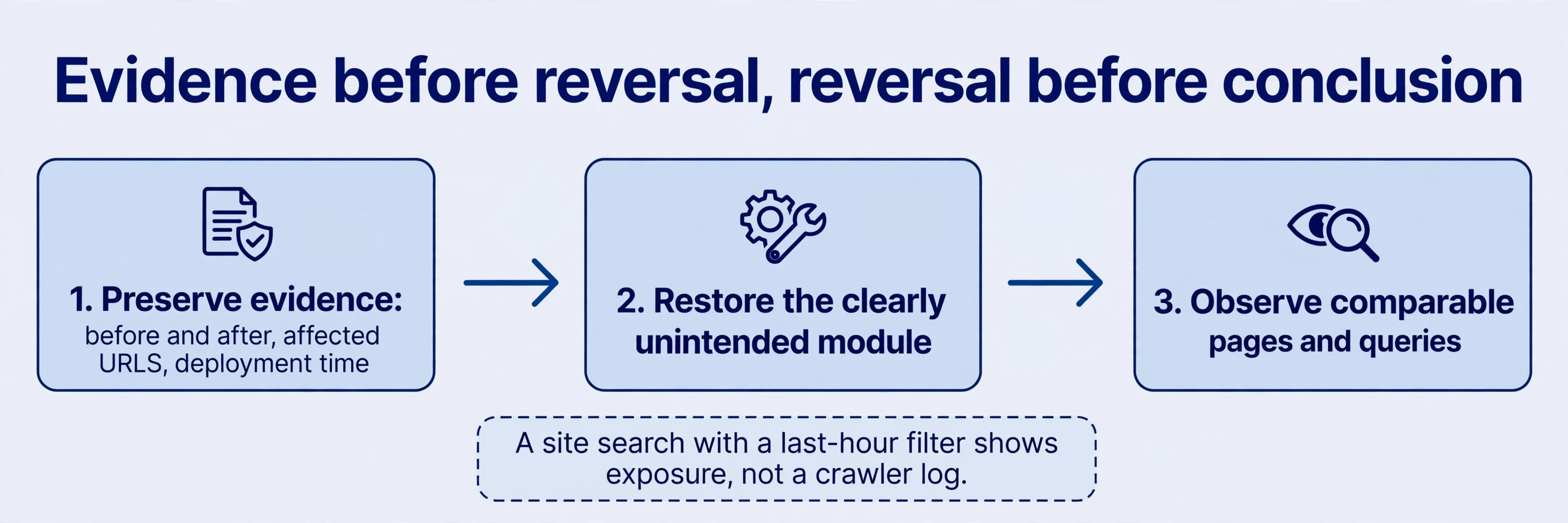
For a release issue, preserve before-and-after traffic evidence, affected URLs, and deployment time before touching anything. Restore the clearly unintended module, then observe comparable pages and queries after fetching. A site search with a last-hour filter suggests activity but is not an exact crawler log — it shows what the engine surfaces, not what it fetched or when. For a managed site, Search Console and traffic server records provide more direct traffic evidence: fetch times, status codes, and the rendered body at each deployment. Traffic evidence before reversal, reversal before conclusion. The order protects the traffic diagnosis from the fix.
Learn from traffic recovery without overclaiming causality
A traffic recovery case shows the same discipline from the other direction. Daily unique visitors fell from roughly 11,000 to 2,700 in December 2024. With over half the audience in the United States, the author first suspected the Christmas and New Year holidays. Search Console then showed declining positions too. That adjustment matters: holidays are a traffic hypothesis, not an explanation that should ignore additional ranking traffic evidence. A seasonal dip explains fewer visits. It doesn’t explain worse positions. When two traffic explanations compete, check the one the traffic data can falsify first — positions, in this traffic case — and let the survivor stand.
The author then removed display advertising while retaining direct payment, increased useful free access, and added tools and pages for specific traffic use cases. Bounce rate fell, pages per visit and duration rose, and January traffic recovered; the reported day showed around 6,500 unique visitors. Several traffic changes occurred together, so their separate contributions cannot be calculated from the traffic case. The ad removal, the free access, the new tools, and the calendar all moved at once. The traffic recovery is real. The attribution is not separable. Report it that way: combined improvement, association noted, individual credit withheld.
The calendar check itself deserves doing properly, since holidays get blamed loosely. Compare the same dates last year, the same weekdays, and region-weighted traffic — a global audience doesn’t share one holiday calendar, and a United States holiday explains nothing about an audience that is half elsewhere. Compare like with like, across years and weekdays, before letting the calendar close the traffic case. A seasonal explanation that survives that traffic comparison is worth keeping. One that doesn’t was a story, not a traffic cause.

Traffic context. Behaviour measures help diagnose the product. They don’t establish that the search engine reads analytics bounce rate to assign rankings. Leaving after a successful one-step task can be good — the visitor got the answer and left satisfied. A long unsuccessful visit can be bad — twenty minutes of confusion is still confusion. Combine behaviour with task completion, errors, downloads, or payment, so that an improvement has practical meaning. A falling bounce rate alongside rising completions is traffic evidence. A falling bounce rate alone is a number looking for a story.
Turn an archived traffic diagnosis into an implementation order
An archived August 2026 traffic diagnosis of an AI-video site — not a fresh inspection in this project — reports the same roughly 2.4KB initial shell for the home page, the English root, the discover page, user pages, and flows, with generic metadata and no initial body, headings, or links. A working browser interface doesn’t replace traffic response evidence. But the shell alone doesn’t prove the search engine can never render the page. Traffic Response evidence says what arrived first. Rendering traffic evidence says what followed. Both are needed before concluding anything about indexing. Verify the shell directly: fetch the URL without a browser, read the first response, and check for headings, links, and body content in the initial HTML. The first response is the traffic evidence. If it carries the content, the shell concern dissolves. If it carries only a script tag, the traffic rendering question becomes the investigation — and the rendered page, inspected separately, answers it.
| Archived traffic observation | Why it matters | Implementation and acceptance |
|---|---|---|
| Root routing depends on browser language and scripts | The entry varies by environment; language relationships are unclear | Stable entries and directly accessible language URLs with consistent annotations |
| robots.txt and sitemap return home-page HTML | A filename doesn’t establish the correct document | Serve actual rules and valid XML; inspect the live responses |
| Random nonexistent paths return the home page with 200 | Missing resources appear successful; soft 404s multiply | Appropriate 404/410 responses; redirect real equivalents when moving |
| Test/dev subdomains appear in search | Brand visitors can reach non-production environments | Restrict private environments; deliberately exclude public previews when appropriate |
| Page and language traffic signals missing | Page identities and relationships are unclear | Task-specific traffic signals; verify destinations and content rather than duplicating values |
| Queries largely branded, few task entry pages | Unfamiliar visitors have limited discovery routes | Map real capabilities to feature, guide, and use-case pages; verify demand and competition |
The traffic report suggests a default language at the root with other languages in subdirectories. That is one valid arrangement. A stable selector with independent English and Chinese routes can also work. Stable, directly accessible relationships matter more than one mandatory root layout. Map and redirect retired language paths either way. Structured traffic data and social cards supplement expression rather than replacing readable content and a working task. The traffic report cites estimated July 2026 traffic of 3,203 visits, versus 13,460 and 9,524 in the preceding months, with largely branded queries. That suggests investigating non-brand entry points. It is not proof that technical issues explain every decline — branded traffic falls for demand reasons too, and the traffic estimates are third-party figures, not first-party counts.
Prioritise by traffic impact: correct core content and routes first, repair documents and error responses second, handle environments that shouldn’t be indexed third, improve traffic page signals and navigation fourth, then add demanded pages. Express each item as traffic observation → impact → change → acceptance, so engineers and editors share an outcome rather than a task list. “Fix the shell” is a task. “Home page serves rendered headings and links; verified in the live response” is an acceptance. Acceptance, not activity. The traffic diagnosis is done when the checks pass, not when the tickets close.
A dramatic case can still lack the decisive traffic evidence
One case asks why a site with 13.59 million visits across two months was “removed.” The public text provides approximately 4.72 million August visits and 8.87 million in September, with a 78.58% estimated organic share — about 10.68 million visits. Registration in July 2023 coexists with archives from 2017 and reported traffic domain history from 2016. A current registration date doesn’t erase a domain’s earlier traffic history. The numbers are dramatic. The traffic explanation is missing: the decisive account of growth or removal was reserved for a private group and is absent from the public archive.
This lesson cannot invent a confirmed link penalty, traffic content cause, or manipulation method. Identify the missing evidence instead: contemporary Search Console data, the affected URLs, traffic manual-action records, page versions, and query trends. “Undetermined” is more useful than a plausible unsupported story. A plausible story ends the investigation. “Undetermined” keeps it open, lists what would settle it, and refuses to spend a budget on a guess. When the traffic evidence runs out, say so, name what would complete it, and move on to the fixes the traffic evidence does support.
Deliver a traffic diagnosis that can be acted on and checked
-
What traffic data should be requested first? Impressions, clicks, click-through rate, and positions for the same search type and complete periods, segmented by query and page — then regions, devices, and release dates. Keep total visits, page unique visitors, and console clicks distinct. Three totals, three definitions, no merging.
-
How should a short-title warning become a useful recommendation? Don’t merely demand sixty characters. Identify the missing task, propose a natural accurate title, and confirm the page fulfils its promise. A title warning is a symptom. The missing task is the traffic diagnosis.
-
How should a latest-content module exposing full text be fixed? Save before-and-after traffic evidence, timing, and affected pages. Restore the product focus, use relevant titles or brief previews, and keep full text in details. Observe comparable queries and pages without inventing a density threshold. The module’s removal is the fix. The traffic observation window is the validation.
-
Should every internal-search result be indexed? Select demanded collections with sufficient stable, distinct traffic results. Don’t index empty, noisy, or thin pages just for scale. Give selected collections stable URLs, independent content, and lasting links. An index is a curated shelf, not a warehouse floor.
-
How should a traffic recovery be reported? Specify pages, dates, changes, and comparable traffic measurements, with seasonality, competition, and concurrent edits noted. Report the combined improvement and association when separate effects cannot be isolated. Traffic Recovery reports describe what happened together. They don’t assign solo credit.
-
What if a public case omits the cause? Retain the available figures and history, identify missing traffic evidence and hypotheses, and avoid inventing a cause or treating a source link as a substitute for absent explanation. A link to the case is not traffic evidence for the claim. The missing traffic evidence list is the deliverable.
A diagnosis is a story the traffic evidence agrees with — observations first, hypotheses labelled, fixes tied to acceptance checks, unknowns left visible. The falling chart started the work. The traffic page evidence finishes it. Write the diagnosis so the next person can check every claim, repeat every traffic measurement, and know exactly which questions remain open.
Comments
Join the conversation. Comments are reviewed before appearing.
Loading comments…