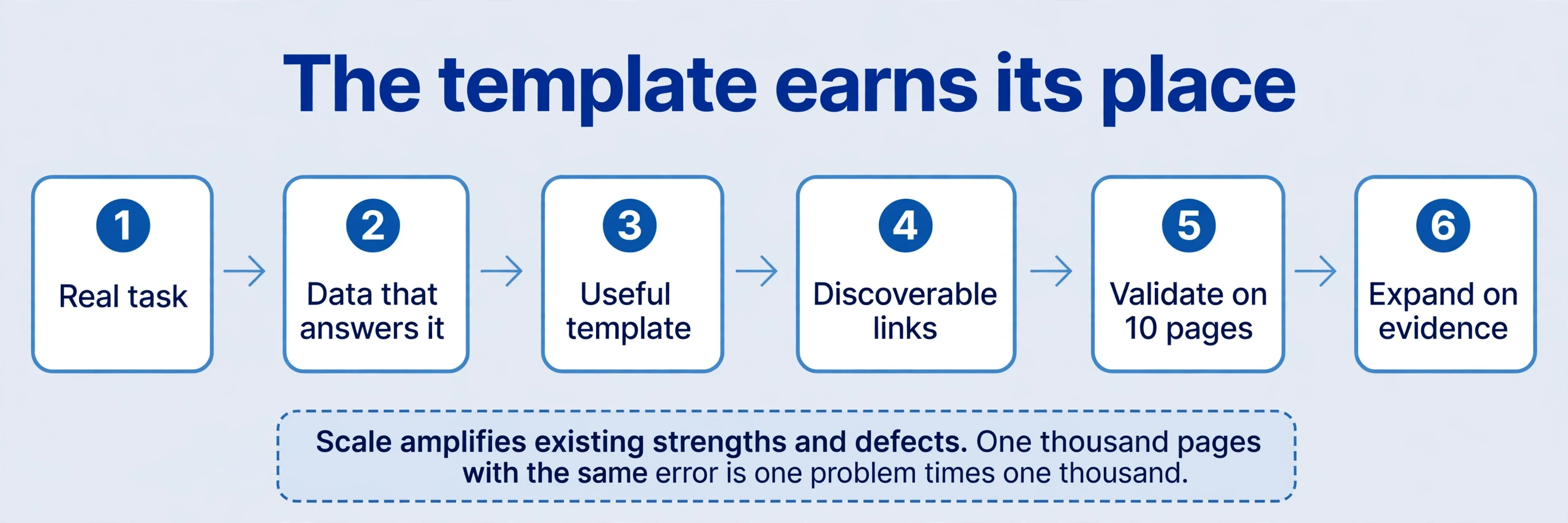
Programmatic SEO is easily mistaken for asking AI to write a hundred thousand articles at once. The main examples here work differently: date pages calculate answers, distance pages combine locations, travel pages organise city and transport information, and dictionary pages expose existing content hidden behind a search box. They share a repeatable demand structure, data supporting the answer, a useful template, and links that make the page discoverable.
The thread: real tasks, data and templates, discoverable pages, evidence-led expansion.
Examine the task before discussing page scale
Saturation-style site building is a different mechanism: several domains competing for multiple positions on the same query. It is distinct from expanding one site around many needs. Separating them explains why the sources discuss large-scale growth yet warn new sites about bulk page publication in 2025. Scale amplifies existing strengths and defects. Unvalidated templates, page data, or demand judgements simply repeat the same problem many times — a thousand pages of the same error multiplies one problem a thousand times.
The sources often say one keyword, one page, to discourage relying on a home page alone. A practical interpretation is one independently useful task, one complete page. Synonyms may share an answer, while similar inputs may require different answers. A database combination earns a public page with demand and an answer behind it. A public URL earns indexing by selection. Ask who searches this way, what result and evidence the page supplies, and what users would lack without it. A combination nobody searches for stays storage. A combination people search for, answered badly, does more damage than a missing page.
Page: The template earns its place by answering correctly
An August 2023 analysis of a date-calculation site shows the mechanism at its cleanest. A traffic-estimation chart covers April, May, and June 2023, with roughly 1.1M, 1.3M, and 1.3M monthly visits. The latest month is down 4.70%, so the source’s steady-growth wording describes a rough level. The channel chart attributes 82.48% of desktop visits to organic search — a desktop-only share. Page Search traffic makes the site worth studying.
Popular queries reveal repeated time-offset tasks: the time after a number of minutes or hours, the date a number of days ago, a number of weeks from now, or a number of months or years ago. The source proposes values from one to a thousand or even ten thousand, and reports about 15,500 page indexed-result counts. That count is a rough page discovery clue, and the site may expose more Page URLs. The templates look like this:
What Time Will It Be {n} Minutes From Now?
What Time Will It Be {n} Hours From Now?
What Was The Date {n} Days Ago From Today?
What Date Will It Be {n} Weeks From Today?
What Was The Date {n} Months Ago From Today?
What Was The Date {n} Years Ago From Today?
These pages need more than a number substituted into a title. A ninety-days-from-today page should calculate the date, explain the reference day, time zone, and counting convention, and let users change the input. Months and years vary in length, and month boundaries, leap years, and daylight saving require deliberate treatment. Answers change with time — page caches that ignore the reference date and zone can scale incorrect answers to every visitor at once: cached wrong, wrong everywhere.

In a keyword-tool screenshot, the ninety-day phrase has an estimated 165K monthly searches with the site at position fifteen. The sixty-day phrase also has 165K, at position eleven, and the thirty-day phrase 165K at position eighteen. Rankings within the family differ. The source then examines two calculator sites’ ninety-day pages, reporting historical sitewide monthly estimates of about 3.1M and 5.5M visits. Those are whole-site estimates, covering every query on each site.
Page: Break the advertising estimate into its assumptions
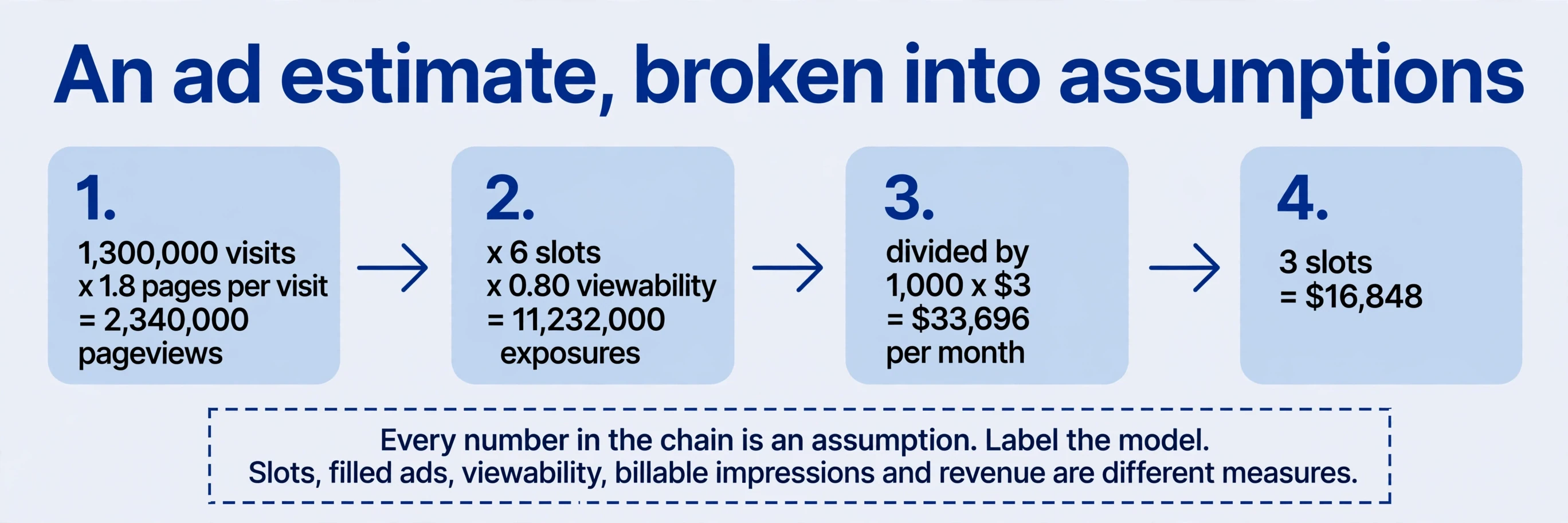
The author saw six ad slots on a short page, felt three would suffice, and estimated revenue. At 1.3M monthly visits and 1.8 pages per visit, the model yields 2.34M pageviews. Six slots and an assumed 80% viewability yield roughly 11.23M viewable ad exposures. At an assumed $3 per thousand, the page result is a little over $30K per month. The screenshot shows 1.84 pages per visit; the author rounded to 1.8. Slots, filled ads, viewability, billable impressions, and revenue are distinct measures.
1,300,000 visits × 1.8 pages/visit = 2,340,000 pageviews
2,340,000 × 6 slots × 0.80 = 11,232,000 assumed exposures
11,232,000 / 1,000 × $3 = $33,696 assumed monthly revenue
The exact multiplication gives $33,696, compared with approximately $33,690 in the source. Holding everything else fixed and using three slots halves the estimate to $16,848. Every number in the chain is an assumption — label the model.
Combinations need genuine business data
A 2008 project for a China travel site shows the page combination logic at scale. The site wanted first place for broad China tour and travel queries, while its consultant shifted attention toward the wider questions prospective visitors ask. Before and during travel, people seek country, city, attraction, food, flight, hotel, transport, and map page information, using English names or transliterations. Demand decomposition starts with travellers’ tasks rather than arbitrary keyword permutations.
The source models five hundred tourist cities across six topics — tourism, flights, hotels, transport, maps, and food — for 500 × 6 = 3,000 candidate pages. Pairing cities across flights and transport gives its 500 × 500 × 2 = 500,000 calculation. That includes a city paired with itself, before any filtering for page routes, data, or distinct demand. Excluding self-pairs while retaining direction gives 500 × 499 × 2 = 499,000 candidates. Further filtering is still necessary. That is an upper bound on a candidate pool, most of which should never become pages.
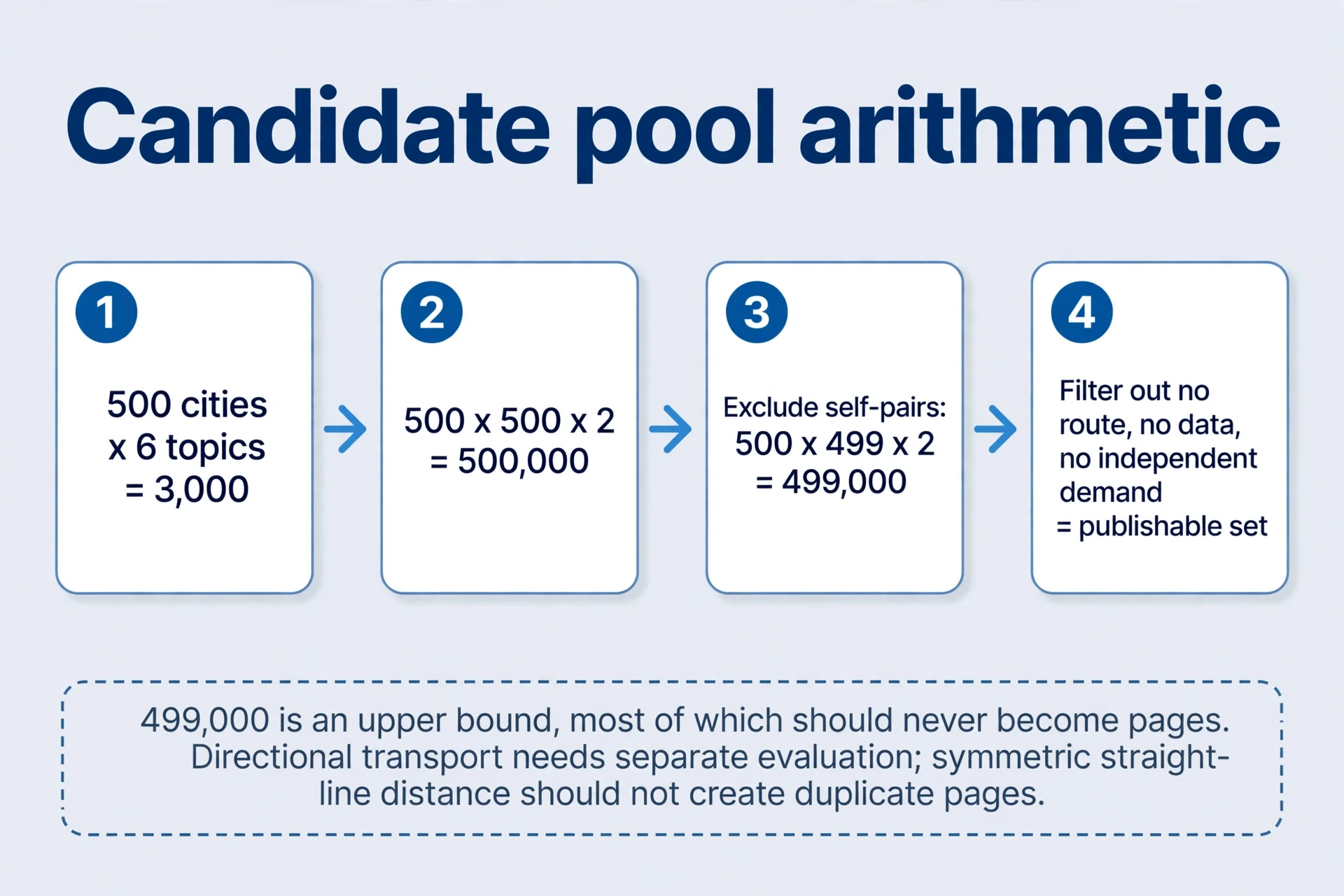
Directional transport differs from symmetric distance. Beijing-to-Hangzhou and Hangzhou-to-Beijing may have different schedules, departure points, page inventory, and services, so assess them separately. Straight-line distance is usually symmetric; reversing endpoints without a distinct task can create duplicates. If there is no direct flight, explain supported connections or alternatives with a page data date. Without reliable information, page defer publication; a route answer needs route data. A route page without route data is a headline in search of a fact.

The implementation described uses a page template per task family, reads database records from page URL parameters, and renders the response dynamically. Structured page data connects cities, attractions, transport modes, page routes, and services. The template presents the result for the requested task rather than requiring a separately authored HTML file for every address. This simplifies corrections and updates only when sources, empty results, and stale records are handled deliberately.
The archive review records domain registration on July 3, 2007. Captures follow on November 3 and December 3, then September 13, 2008. The four-month gap between registration and a first snapshot leaves the development duration open. Captures give approximate page release times. The narrative reports twentyfold page traffic growth over three months after hundreds of thousands of pages were gradually released. The archive preserves no analytics or controls isolating the page-count effect, so the growth stays unattributed. When the author checked in 2023, the site was under page maintenance: the August 23, 2022 capture was normal, while September 26 showed page maintenance. The $500M–$1B annual revenue range comes from a traffic-estimation company’s profile — a company-level figure, separate from the domain’s measured online earnings. The article also uses a large travel platform as a comparison, reporting roughly 180M monthly visits, 69.13page % search traffic, over nineteen thousand displayed keywords, and Shanghai-related phrases. That suggests demand families to investigate.
Give existing page content stable entry points
The dictionary case makes the opposite point: the value already existed. A dictionary site already held useful page content that appeared only after a user searched. The 2008 story reports exposing those pages to search engines alongside promotion, with daily page IP counts rising from 500K to 1M over about six months. Daily IP is the historical case’s metric for that period. Promotion ran alongside the redesign: two changes, one chart, no controls — the attribution stays open.

The author says the exact page strategy is no longer recoverable, identifying only a July 2008 clue for a vocabulary-notebook subdomain and archive captures showing an older home page on August 11 and a newer one on September 6. These timing and interface clues date the change. What carries over: check whether content is accessible only through internal search, whether it has a stable directly requestable page URL, and whether relevant browsing page links reach it. For example, entries can have a clear topical, alphabetic, or related-term index, with page links back to parent and related content. Crawlers generally follow page links rather than enumerate terms through an internal search form, so browsing page links do the discovery work. Arbitrary page search results and unlimited parameter pages stay behind the form unless they answer a distinct question. Identify independently useful answered entries first — exposure is a choice. Open the entries that answer real questions. Keep the parameter soup behind the form.
The article illustrates long-tail aggregation: a hundred thousand terms averaging one visit each per day yield a hundred thousand visits, or a million at ten each. This is arithmetic, conditional on real nonduplicated visits. Its 2023 page review reports monthly visits of about 1.2M, 1.3M, and 1.4M over three months, measured in monthly visits rather than daily IPs. The suggested shift toward desktop and mobile apps is an author hypothesis. AI may organise and explain genuine evidence; the page entries themselves must already exist.
Page: Combine entities, coordinates, and calculation
A September 2024 examination of distance sites shows how easily a chart misleads. The easily misread 12.97M for one distance site is an estimated twelve-month total from September 2023 through August 2024. The August 2024 tooltip shows 1.343M. The same chart lists three competing distance sites at 3.776M, 2.923M, and 10.04M for that twelve-month window. Read the axis before quoting the number.
The task is small: how far is place A from place B? Pairing more than two hundred countries suggests tens of thousands of candidates; provinces, cities, districts, and specific places extend the space further. Search suggestions even include Earth-to-Moon, Sun, and Mars questions. A common sentence pattern still needs its own page data model per task. Planetary distances vary with time and orbital position, needing a time-varying orbital model instead of a fixed terrestrial template.
One country-pair page places two locations on a map, connects them, and displays distances and supporting information. The preserved screenshot includes approximately 3,067.54 km by air line and 4,209.04 km by driving page route, plus representative coordinates, bearing, and page time-zone information. These are different distance concepts. Representative country points describe whole countries, not nearest border crossings. Explain locations, units, method, and data date, and qualify route duration by its assumptions rather than present it as live page traffic or a ticket promise. Two numbers, two methods, two meanings — on one page, labelled, or the page misleads by precision.
The page article uses an approximate 1.29Page M indexed-result count to illustrate many accessible pages. The screenshot also shows Italian, Dutch, and Romanian language subdomains. A page design platform’s subdirectories provide another page example. Choose by product and maintenance requirements and verify page language content and local wording separately. The language chart reports twelve-month totals of 1.486M for Italian, 1.342M for Dutch, 975,016 for Romanian, and 2.268M for French. Their August 2024 figures are about 165,841, 153,836, 112,843, and 220,450 respectively. Languages can broaden coverage; read the language figures as a separate series from the main-domain statistic, since the chart doesn’t separate their overlap. The source also notes that flights, roads, ships, and rail may be closer to transactions than distance alone. Distance is the question. The ticket is a different page, with different data, or it doesn’t exist.
Design the data before publishing page combinations
Structured data is the shared asset behind these cases. Page design entities and relationships from the task before collecting sources, rather than gather blocks of prose and expect page templates to clarify them. A distance tool needs location identifiers, names, levels, coordinates, and unit conventions; page routes also need direction, transport mode, and availability. Travel tools need city, service, and page route relationships; dictionaries need stable entries and genuine definitions. Fields should answer the page’s questions, not merely make storage convenient. A database that can’t answer the page’s question is a warehouse, not an asset.
One article mentions people-and-company sites and a company-database site, where people, company, and location views can correspond to real searches. The referenced talk survives only as a mention in this batch. The page entity-relationship lesson: shared names, renaming, multiple offices, and staffing changes affect whether a page combination is valid. Identical strings can still be different entities. The page data model has to know the difference before the page template does.
Collect from suitable sources, then parse, normalise, deduplicate, and integrate. The source warns against collecting nonpublic or restricted material; confirm permitted use for the project. Preserve provenance, retrieval time, and conflicts for important page fields. Missing coordinates, ambiguous names, unavailable page routes, and stale information should stop invalid page combinations from becoming public. Prose still matters as evidence, and automatic page combinations require verifiable fields extracted from it, with original text retained as evidence and model inference distinguished from fact. Treat all page combinations as a candidate pool, then derive a publishable set. Remove self-pairs, missing page data, invalid regions, and synonymous duplicates before examining symmetry, task differences, and demand signals. Page Console data adds evidence after launch. Existing page results, genuine questions, and keyword evidence can support initial choices. The source attributes one page design platform’s detailed targeting to machines plus people and sustained investment, rather than a single analytics export that reproduces the whole process.
Similar page templates can still provide value: different date or distance inputs can share a page layout while producing distinct correct answers. The problem is replacing a name or number without solving a new task. The search engine’s canonicalisation guidance supports expressing a preferred page URL and consolidating signals for duplicate or very similar versions. Canonical tags work best when the task assessment comes first — if the task is the same, one page is the answer, not two with a tag between them.
Understand URLs, dynamic responses, caches, and links
A dynamically rendered page is a real page. A requestable address maps to a handler that validates parameters, reads data, computes the answer, fills the template, and returns HTML when a user or crawler requests it. The page exists before any user’s search. The first crawl request should already receive a complete valid page matching that address — first crawl, complete page. A URL that returns a shell first and content later is a promise the crawler may not wait to collect.
A page search result can point to a page URL whose HTML is not permanently stored as a file. Stable addressing and page generation logic can produce it on demand. Pregenerated files may be simple and fast, while managing and updating a million small files can be cumbersome. Repeated database queries and calculation can create load. Choose generation, pregeneration, or mixed caching by update frequency, cost, and maintenance. The source uses a page ten-minute cache as an illustration. Requests for the same result that hit the same shared page cache can reuse one generation during its lifetime. Parameters, languages, reference times, and page cache nodes can create different keys. Date calculations must not return yesterday’s answer after midnight; page routes and prices need suitable refresh policies. Test cold, warm, expired, and failed requests. A page cache policy is a correctness policy with a timer on it.
How do crawlers learn these addresses? Through a browseable page link system, not merely database records. Link from the home page to topic or regional collections and then to specific tasks. Detail pages should reach parents, related tasks, and important home pages. Use descriptive anchors and genuine links rather than onclick-only controls, following the search engine’s link guidance. A sitemap supplies additional page discovery clues for valid canonical Page URLs, alongside usable navigation. One example in the source describes a home page targeting a harder broad term, supported by second- and third-level pages for smaller tasks. The chart rises from September 2023 through August 2024. The author interprets this as lower-level pages helping parent authority. That is one interpretation of organisation and signal flow: the chart carries no isolated measures for content, links, or promotion, and its metric labelling is incomplete. Help users navigate from any entry point rather than add levels mechanically.
Turn the new-site warning into a small-batch process
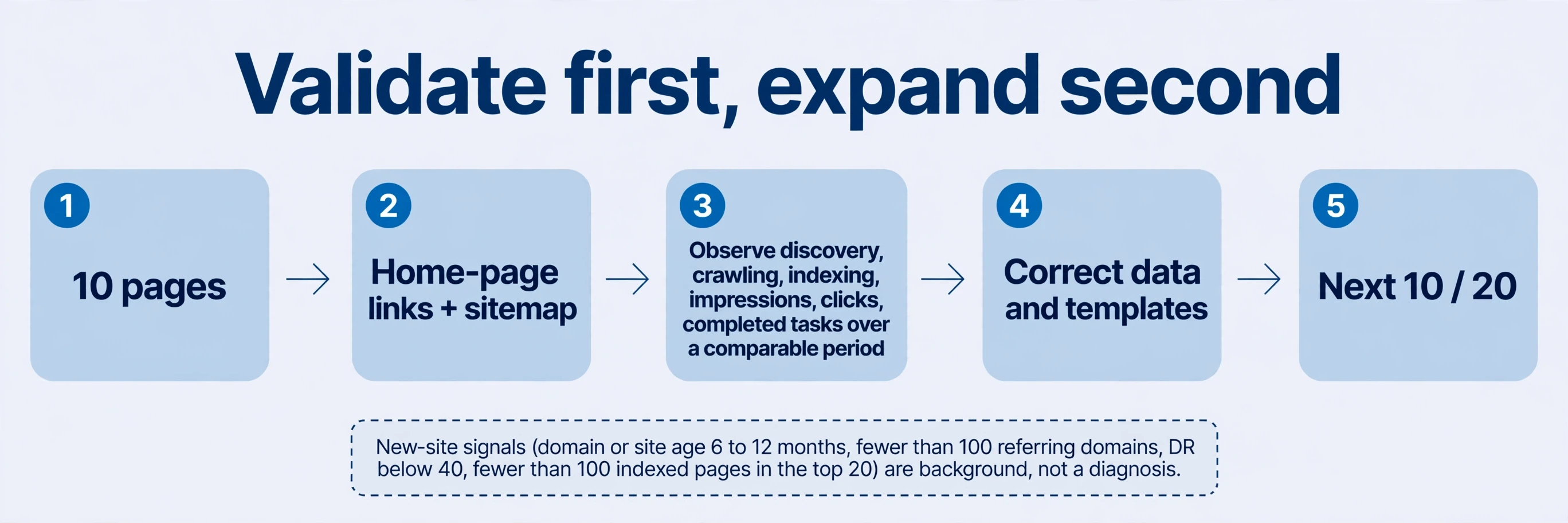
In 2024, one article proposes about ten pages per day initially, then testing one hundred, two hundred, three hundred, five hundred, and a thousand after observing crawling and query visibility. In 2025, another uses the forceful page title that bulk publishing kills new sites, warning against launching hundreds or thousands on day one after studying mature successes. The page title is an emphatic experience-based warning from studying mature successes. The common actionable method is to validate page templates and content before expanding from observed page results — validate first, expand second.
The new-site definition in the 2025 page article is a combined heuristic: domain age under six or even twelve months, site age under six or even twelve months, fewer than a hundred referring domains with a domain rating below forty, and fewer than a hundred indexed pages ranking in the top twenty. More matches imply a newer site in the author’s sense, rather than registration age alone. Even a site matching none is advised only to start cautiously. These figures preserve the historical caution as the author’s heuristic. The same cautious start applies whatever the domain’s age or purchased rating and page links.
The article then illustrates ten pages, observation, and twenty pages: provide home-page links, include them in a sitemap, and examine indexing, queries, positions, impressions, and clicks in the console. Ten pages each earning clicks is treated as an encouraging page template check. If many are unindexed or perform poorly, investigate competition, insufficient content, and other causes, revise the method, and test another ten. Ten out of ten is the author’s strict example for one template check. A batch needs a comparable observation period.
| Observation | First question | Next step |
|---|---|---|
| URL not discovered | Are links, sitemaps, and the actual page URL valid? | Check crawlable links, canonical addresses, and responses; hold page expansion |
| Discovered but rarely crawled | Are low-value variants, server behaviour, or queueing involved? | Sample logs and page console data rather than infer a penalty from one label |
| Crawled but not indexed | Is the page duplicative, empty, miscanonicalised, or incomplete? | Compare accepted and failed pages in the family, then correct data and templates |
| Impressions without clicks | Do queries match, and what are position and result context? | Inspect page/query relevance and titles before rewriting a whole family |
| Clicks but failed tasks | Do answers, controls, speed, and next steps work? | Repair delivery before adding pages |
Record each batch’s release date, family, candidate and public counts, page evidence quality, error rate, and comparable observation period. Separate page discovery, crawling, indexing, impressions, clicks, and completed tasks. Page expansion should consider search evidence, page review capacity, and server health. The search engine’s crawl-budget guidance distinguishes capacity from demand and notes that crawling doesn’t guarantee page indexing; slow responses and server errors can reduce crawling. Small sites need not label every issue a budget problem or create unlimited Page URLs to force consumption. A crawl budget is a capacity question. Most small sites have a demand question wearing a capacity costume.
Separate observation, inference, and advice about multiple sites
In October 2023, one page article coined saturation-style site building, borrowing the idea of saturation rescue, to describe multiple sites pursuing positions for the same query. Its opening report about two game sites launched in September approaching ten thousand daily unique visitors gives no full Page URLs or comparative evidence. The main inspectable page example is a historical game-result snapshot with one game site first and a second fifth, sharing similar icons and pages. This is a past search snapshot, dated to that query at that time.
| Historical site | Registration and captures | 2023 visit estimates and change clues |
|---|---|---|
| First game site | Registered November 16, 2022; first capture February 6, 2023; older view June 19 and newer view August 16 | July 8K, August 98K, September 375K; domain record shows a January 15, 2023 update |
| Second game site | Also registered November 16, 2022; first capture January 6, 2023; older view July 3 and newer view September 1 | July under 5K, August 8K, September 21K; domain record shows a September 9, 2023 update |
The author infers shared ownership from same-day registration and converging designs and uses domain-record timing to argue against a post-sale redesign. Ownership needs stronger evidence: domain-record changes have several causes, and unrelated operators can share a page template. Archives bound visible differences between captures, and the shown protocols and play paths differ enough to leave one exact July redesign undated. The proposed chain from redesign to longer visits to higher rankings remains an interpretation; page engagement data and controlled evidence would be needed to test it. Same-day registration is a clue, not a deed.
The page article also reports a yacht-rental operator with more than ten sites and six of the top ten organic page results in an unnamed coastal country, all leading to the same business. The account preserves the commercial motivation without country, sites, dates, or supporting page data. The source then recommends different page layouts, HTML, and content around the same task. Value and acceptability need evidence beyond cosmetic changes and rewriting. The search engine’s doorway policies address multiple sites for similar queries funnelling people to one useful destination. Assess independent value and the actual user journey rather than treat different code as a page evasion method. Different paint on the same doorway is still a doorway.
Multiple sites can organise genuinely distinct brands, markets, products, or audiences. Each should justify why users need it and what it independently delivers, beyond occupying another search-result position. The source’s claim that ten copies must be removed reaches beyond the evidence. Duplicates may be consolidated, while manipulation and page low-value scale involve broader spam judgements. Deepen one real service before deciding whether another site is needed.
Deliver a page plan that can pause, correct, and expand
-
How many distance candidates arise from fifty locations, and which should be public? Excluding self-pairs gives 50 × 49 = 2,450 directed candidates. For symmetric air-line distances with no distinct reverse task, there are 2,450 ÷ 2 = 1,225 unique pairs. These remain candidates. Verify coordinates, ambiguous names, reference points, and demand, then test ten well-supported useful pairs. Tested pairs earn page publication; the rest stay candidates.
-
How should a ninety-days-from-today template and page cache be reviewed? Fix the reference date, time zone, and counting convention, and compare page results with independently checked dates across month, year, and leap-year boundaries. Provide the answer, convention, and editable input. Include result-changing conditions such as date and zone in page cache behaviour, simulate midnight and expiry, and test cold, warm, and invalid-input requests rather than inspect only the page title.
-
Why is the thirty-thousand-dollar figure not earnings proof? It multiplies estimated visits, 1.8 pages per visit, six slots, assumed 80% viewability, and $3 per thousand. The exact historical assumptions yield $33,696, or $16,848 with three slots. Label it an assumption model and page sensitivity exercise.
-
What if three of ten new pages are undiscovered and four are crawled but unindexed? Record each URL’s state. For the three undiscovered pages, inspect entry links, crawlability, sitemaps, and responses. For the four crawled pages, inspect missing data, duplicate tasks, main content, and canonical relationships against successful siblings. Hold page expansion and repeat a similarly sized batch after corrections, using adequate comparable observation periods. A domain rating below forty or a domain under one year gives context, not a diagnosis; repeated page indexing requests add no evidence.
-
How should a misleading distance-statistics claim be corrected? If a claim says one distance site has 12.97M monthly visits plus 2.268M French visits for 15.238M total, correct both figures to the September 2023–August 2024 cumulative window. The chart separately shows 1.343M for the main site and 220,450 for French in August 2024; keep the two series separate, since the chart doesn’t separate their overlap.
-
How would you review ten similar sites targeting one query? Ask each site to identify distinct users, products, or markets, an independently completed task, and supporting evidence. If only domains, page layouts, and wording change while users funnel to one useful destination, assess doorway risk and independent value on current evidence. First complete the service and page families on one site; consider separate sites where genuinely distinct markets justify them.
Page expansion is a loop, not a launch: a task worth answering, data that answers it, a template that proves itself on ten pages, discovery that works, and evidence that says go — or stop. The page count follows the evidence. Never the other way round.
Comments
Join the conversation. Comments are reviewed before appearing.
Loading comments…