When rankings fall, dramatic algorithm explanations spread fast: niche sites are finished, links no longer work, AI content is banned. Four articles anchor this lesson, dated 30 September 2023, 27 January 2024, 18 October 2024, and 29 April 2026. The dates themselves teach the method. The 2023 piece argues about a live algorithm update. The 2024 pieces interpret an algorithm model chart and a new trend. The 2026 piece starts from an official status page and then piles on eight industry interpretations. Same question each time, different algorithm evidence each time: what does this algorithm claim rest on, and what would test it? Together they teach one discipline: assess competing algorithm explanations before touching a page. The thread runs through all four: classify first, change second.
The thread: classify algorithm evidence, inspect competition, test changes.
Sort every algorithm claim by what can support it
Keep Google’s search-traffic troubleshooting guidance beside the algorithm claim being assessed. It provides a source for the diagnostic categories; an individual site’s export supplies the evidence for that site. Record both before choosing a change.
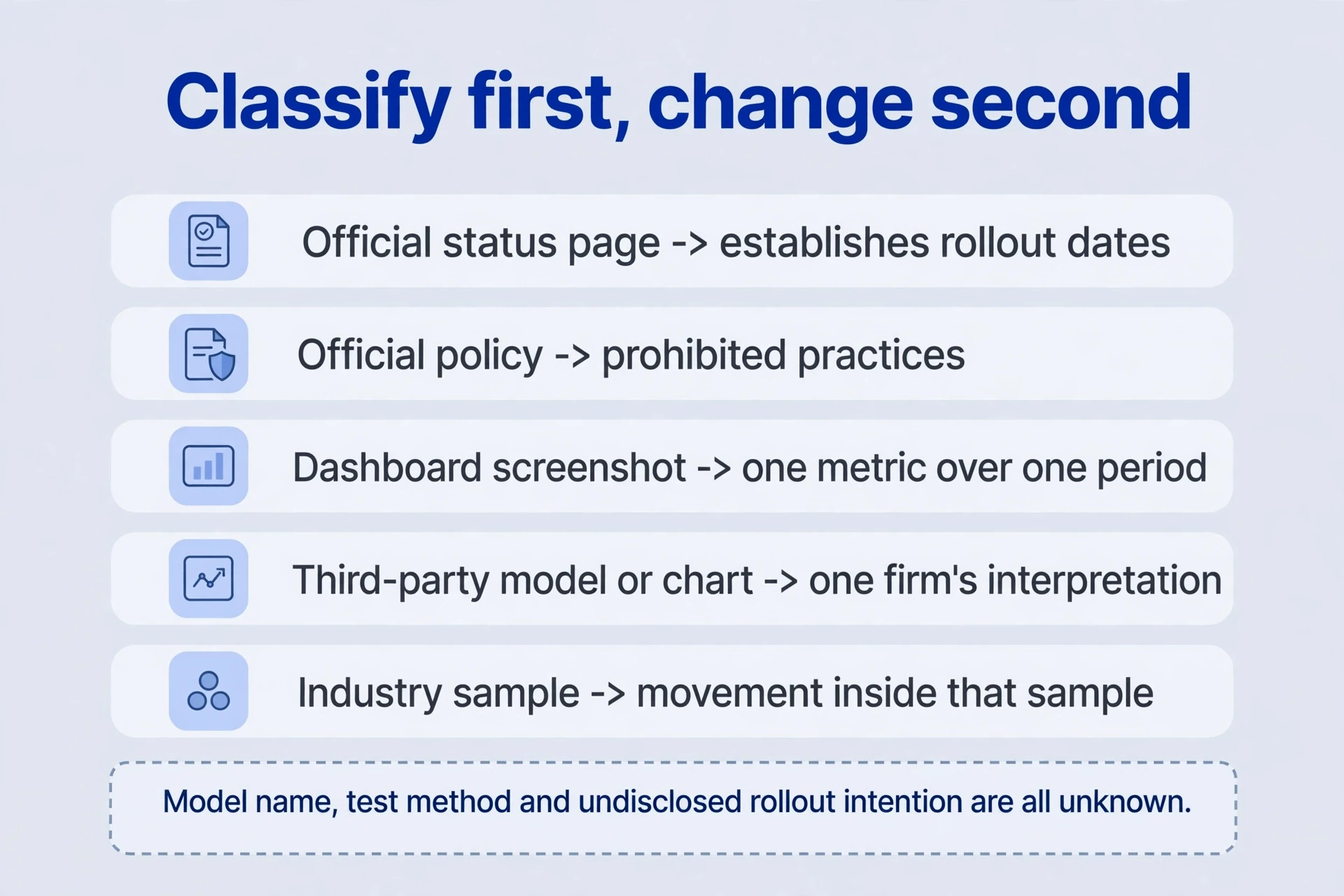
Start with the algorithm evidence type, not the conclusion. An official status page establishes rollout dates. An official policy defines prohibited practices. An author’s dashboard screenshot shows a metric changing over its displayed period, usually without identifying a single cause. Third-party estimates, industry samples, and personal observations can generate algorithm hypotheses. They stay hypotheses until tested on your own pages. Model names, testing procedures, and deployment intentions that the search engine never disclosed stay unknown. Work with the disclosed algorithm record instead.

| Algorithm evidence | What it establishes | What it leaves open |
|---|---|---|
| Official status page | Rollout occurrence, dates, duration | Why any single site moved |
| Official policy page | Which practices are prohibited | Whether a given page crosses the line |
| Dashboard screenshot | One metric changing over one period | The cause; other concurrent changes |
| Third-party model or algorithm chart | One firm’s interpretation | Weights, sample, controls |
| Industry sample | Movement inside that sample | Whole-web probabilities, your site’s risk |
The lesson’s official checks were made on 21 October 2026. An algorithm explanation is only as strong as the algorithm evidence behind it.
The 2023 helpful-content update: a label settles nothing
One 2023 article relays an industry commentator’s concerns about traffic losses among publishers on two ad networks. Most of his sites fell while a few rose. He questioned the prominence of three large discussion platforms in results, yet advocated staying calm, taking a long view, and continuing to operate. Another writer rejected the “niche site killer” algorithm conclusion while agreeing with that response, citing another operator’s new sites that were still growing. Mixed outcomes cut against any all-sites-must-die algorithm claim. Both directions need the same caution: one dataset holds the rises and the falls, and the next algorithm update stays an open question.
A niche simply narrows the topic or audience. A working music-transposition tool and a site assembling advertising articles around instrument keywords may both be called niche sites, yet offer very different value. Ask what the visitor is trying to do: can they transpose the music, understand the output, and recover from failure? Run the task yourself. Paste in a melody, transpose it, read the result, and try a broken input. The tool either survives that run or it does not. A site category gives you the label. The answers live on the page. Check the task, not the label.
The article interprets losses as the search engine reassessing useful results and urges sites to serve searchers. That works as an operating principle. A drop on its own carries several possible readings: demand is seasonal, result layouts change, competitors improve, and a short visit can mean the answer arrived immediately. A converter returning the correct answer at once may deserve a short session. Separate demand, impressions, position, clicks, and task completion before naming a cause. Five metrics, five algorithm questions. Check each before naming a cause.
The algorithm update also has a historical boundary. In 2023 it was a separately announced helpful-content update. The search engine’s records show it became part of core ranking systems in March 2024. Later diagnoses should use contemporary announcements and page evidence. The separate helpful-content switch belongs to 2023. Old labels outlive their algorithm updates. Current announcements govern current diagnoses.
A 2024 factor chart: prompts, not weights
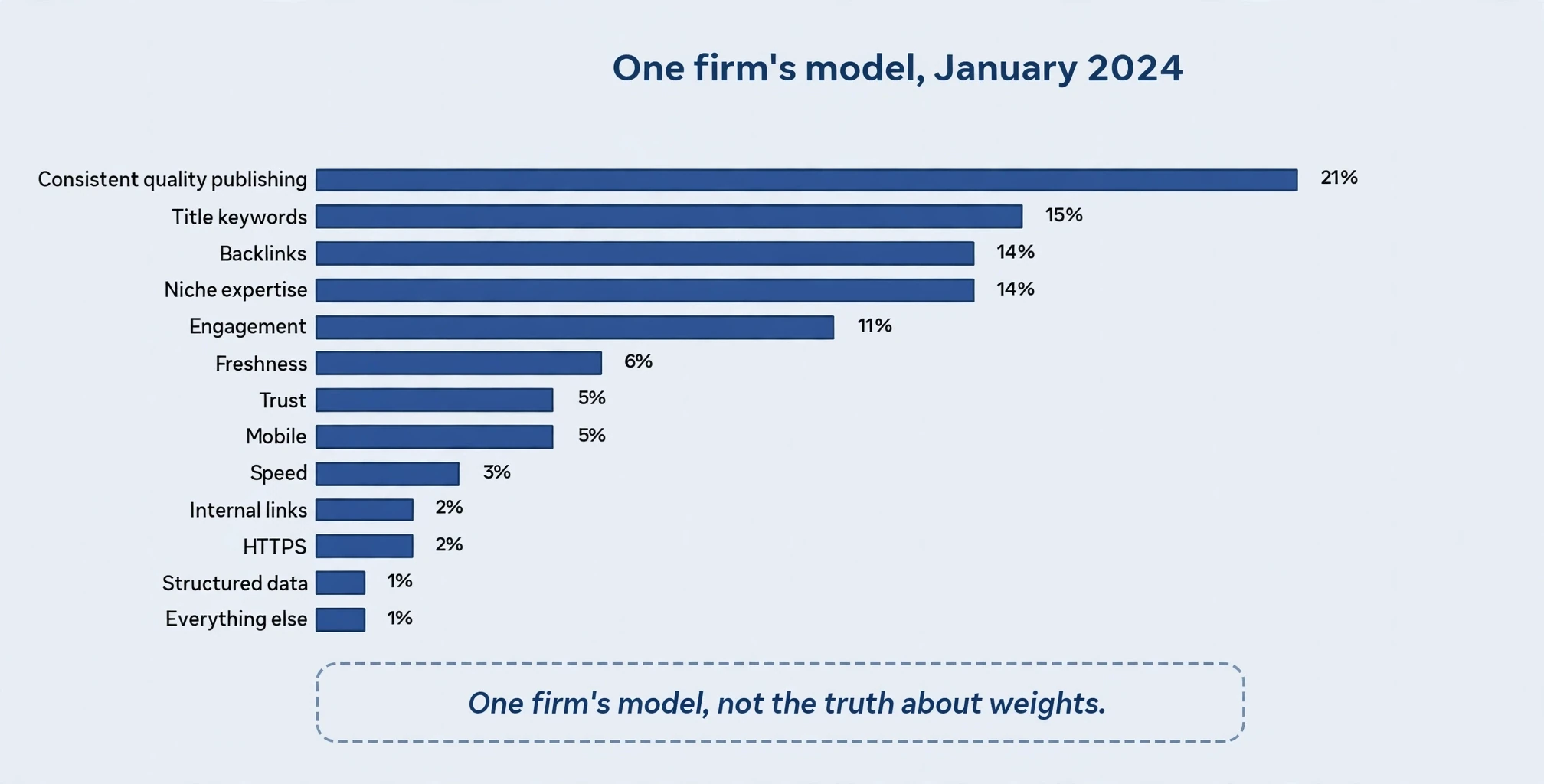
A January 2024 article interprets a marketing firm’s algorithm chart — a third-party model. Its algorithm chart assigns 21% to consistent quality publishing, 15% to title keywords, 14% each to backlinks and niche expertise, 11% to engagement, 6% to freshness, 5% each to trust and mobile, 3% to speed, 2% each to internal links and HTTPS, 1% to structured data, and 1% to everything else. The parts add to 100%. The total describes the algorithm chart’s arithmetic. The percentages belong to one firm’s model. The text also reports year-on-year changes inside the same model. Treat each algorithm factor as a prompt for a page question, and keep the percentages attached to their source.
Ten interpretations, ten page questions:
- Freshness, 6%. The rise from under 1% to 6%, and an average 4.6-position gain for pages updated at least yearly, are third-party observations. Treat them as a prompt to audit: Update the facts — obsolete prices, broken instructions, old APIs, incorrect answers. Freshness work means new facts, not new dates. Tool sites also need maintained help and working functionality. The article mentions an undisclosed paid-community method; with nothing in the archive to rebuild it from, it stays out of the advice.
- Trust, 5%. The 5% is the model’s number. Read it as the firm’s estimate for the year. A patent shows an idea was documented; deployment is a separate algorithm question, and perfect detection of falsehoods is a further one still. YMYL describes topics that can materially affect health, finances, or safety — a topic description to apply to pages, not a separate algorithm update to await.
- Backlinks, 14%. The decline from 15% to 14% belongs to the same model. The article’s rejection of “100 links for $80” still holds: buying links to manipulate rankings differs from earning editorial references. Judge each link by its purpose.
- Engagement, 11%. The move from 12% to 11% is a model revision. Completion over duration: completion rates, repeated failures, and feedback describe practical value better than artificially prolonged sessions. A visitor who finishes fast succeeded fast.
- Niche expertise, 14%. The idea suggests a hub linking genuinely distinct related tasks: an audio-conversion overview linking to format conversion, compression, and troubleshooting. Distinct related tasks earn their links. Duplicate pages built to look comprehensive add pages without adding tasks.
- Mobile, 5%. Mobile-first indexing concerns the content version used for indexing and ranking. Check that phones expose equivalent main content: titles, images, links, and tool operations matching the desktop version. A responsive framework helps implementation. The check is whether phones expose the same main content.
- Publishing cadence. Publishing helps when it serves new real needs. Frequency alone adds pages, not demand. The article’s “15% new searches” describes new queries appearing. Traffic per new page follows demand for that page, not the 15%. New real needs first, calendar second.
- Titles, 15%. Titles tell people and search systems what a page solves. The 15% is the model’s share for the year. Judge a title by whether it tells people what the page solves. The examples “buy webcam / buy webcams” and “2024 calendar / calendar2024” warn against mechanically splitting synonymous forms. Check the overlap: actual result overlap still needs checking before merging or splitting pages.
- Internal links, 2%. The move from 3% to 2% is a model revision. Make routes work: overview to task, result to next step. A link earns its place by carrying a visitor somewhere useful.
- Page signals, mixed. The article mixes titles, descriptions, URLs, and meta keywords. The search engine’s algorithm documentation states meta keywords are not used in web ranking. Titles and meaningful URLs still deserve care. Descriptions can supply search-snippet wording. Sort the algorithm signals before optimising any of them.
The article also says a keyword in a new domain “definitely” produces a higher rank. Choose a recognisable, memorable domain suited to the business. A domain is a business asset first and a keyword container second, if at all.
Algorithm: New sites: read the competition before reading the calendar
An October 2024 article uses emerging terms to explain different launch speeds. An invented, unused brand term may be easy to rank for once indexed. It brings customers only if people beyond its creator search it. The 2024 clay-filter trend combined public interest with initially limited competition: attention creates a shared concept, people search for it, and a page can then serve that demand. Early arrival is an opportunity to serve demand while the field is thin.
Work in sequence. Decide whether a trend is a brief joke or a durable task. Inspect whether results lack a usable direct solution. Publish a working page explaining inputs, outputs, and limits. Then track non-brand queries, actual use, and failures. As competitors arrive, compare functionality, speed, instructions, distinctive output, and credible references. For established difficult queries, waiting several months adds calendar time, not improvement. The article describes the search engine sending a little traffic, observing whether a site handles it, then increasing exposure. Read that as one publisher’s experience, illustrated — a story from one site, useful for generating a test on yours. A private video mentioned in the article is absent from the archives. Teach from what survives checking — the article’s own pages and results.

Make backlink research repeatable. Select three sites, one need. Inspect each referring source, the asset it cites, and why the reference is useful. Classify genuine reviews, resource listings, partnerships, user discussions, and paid promotion. A resource listing cites a page because visitors need it. A genuine review cites it because the reviewer tested something. A partnership or paid placement cites it because money changed hands. The three look alike in a backlink export. They differ in what you must build to earn one. Pursue opportunities where you can offer equivalent or better value. Treat advertising relationships accordingly. Copy a competitor’s link opportunities only where you can earn an equivalent reference. Research shows where value could be cited. Buying the citation is a different act, judged under the rules on manipulative links.
March 2026: the official algorithm record first
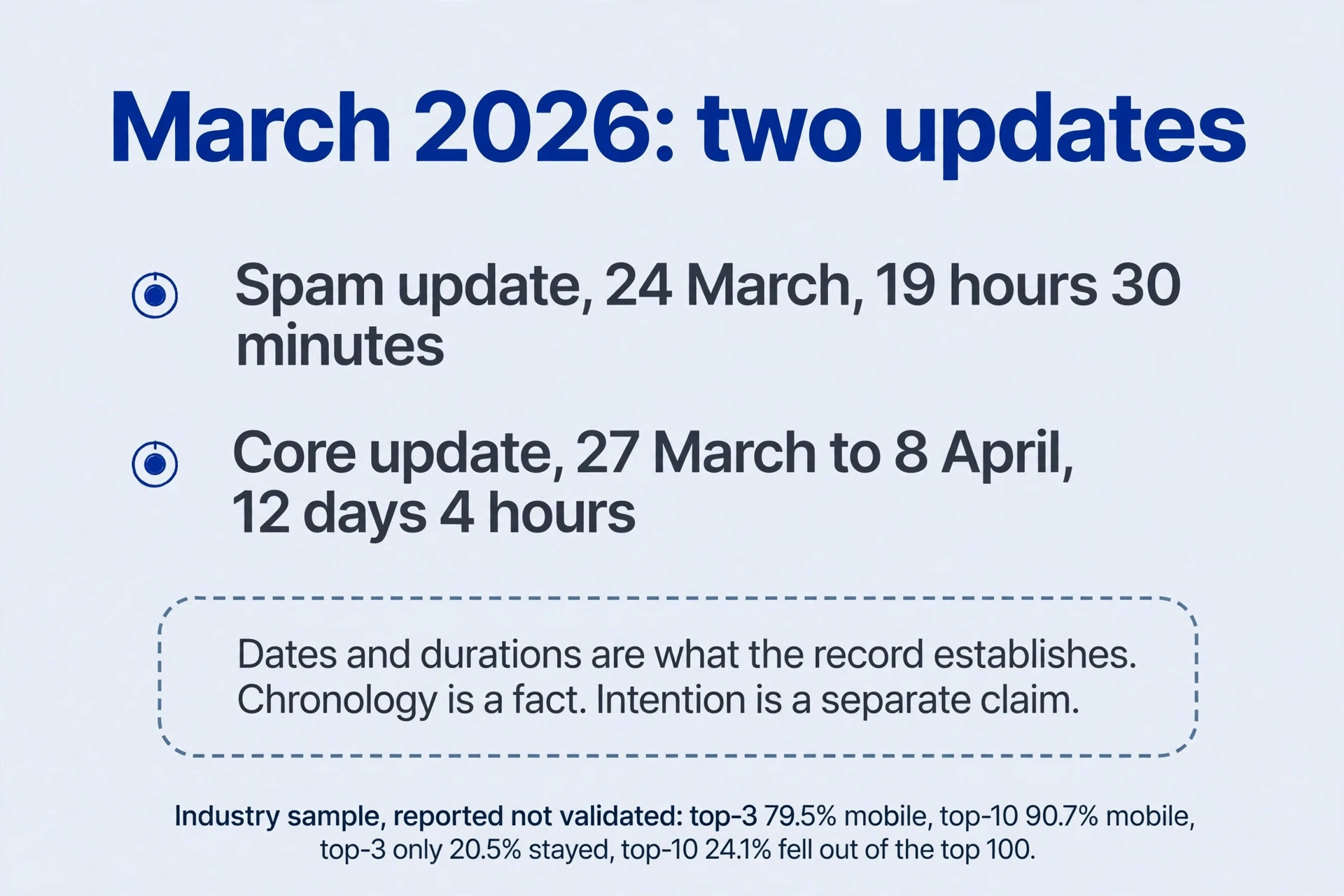
The April 2026 article starts correctly, with the search engine’s status page. Official algorithm records confirm the March 2026 spam update began on March 24 and lasted 19 hours 30 minutes. The March core update ran from March 27 to April 8, lasting 12 days 4 hours. Read dates in the dashboard’s time zone. Dates and durations are what the algorithm record establishes. Every proposed internal explanation beyond them needs its own evidence.
| Update | Dates | Duration |
|---|---|---|
| Spam update | Began 24 March 2026 | 19 hours 30 minutes |
| Core update | 27 March – 8 April 2026 | 12 days 4 hours |
 |
The first algorithm interpretation argues a shift from reference pages toward direct answers, using a new video-generation model’s alternatives and a “best AI video generator” query to favour product sites over intermediary lists. The saved result mixes an algorithm discussion platform, an AI answer, an automation platform’s list, and a design platform. One algorithm observation: one query, one place, one time. Repeated checks decide whether it generalises.
Ask whether the user is choosing or executing. Someone comparing three products can benefit from a trustworthy hands-on comparison. Someone ready to generate a video may prefer an immediately usable tool. Keep comparison pages that do the choosing job well. Replace unsupported compilations with actual tests, constraints, examples, and selection reasons, then give people who want to act a clear route to the tool. Choosing or executing decides the page shape.
Algorithm: Calibrate the 2026 claims one by one
The second algorithm claim calls information gain a major ranking algorithm signal. The third proposes the first large-scale deployment of a possible new semantic filter able to identify human editorial oversight. Both came from third-party articles summarised with an AI tool. The official announcements checked here describe the rollout and its timing. The model, the first deployment, the detection capability, and any new algorithm weight appear only in third-party summaries. Information gain still works as an editorial algorithm question: what verifiable tests, data, functionality, or practical judgements do you add beyond existing results? A patent name or industry term names the idea. The algorithm question measures the contribution.
The fourth algorithm claim treats city swaps, product comparisons, and “Best X for Y” templates as automatically abusive. That overstates the policy. The official scaled-content abuse policy concerns many pages made chiefly to manipulate rankings with little user value, regardless of AI or human production. A shared template is one fact about production. The algorithm policy question is the pages’ value to users. Genuine city-specific inventory, prices, hours, and local verification differ from swapping a place name. Independent comparison tests differ from swapping a product name. Distinct service per page is the test. Count pages second.
The article contrasts three large-scale-page sites with falling curves against a tool site with roughly 500 indexed pages, inflated by multilingual versions and only a few dozen pages per language. A few dozen per language across many languages is a small site wearing a large number. That supports a practical preference for carefully developed pages, on the algorithm evidence of these curves and counts. Site identities, change histories, and controls would be needed to say more. A site launched in 2024 and surviving two years is an survival example. Survival shows durability under past conditions; the next algorithm update tests it again. The comparison to draw is narrower: pages with distinct tasks and maintained data held up in this sample; pages produced at scale without them did not. A controlled look at the sites themselves would be needed to go further.
The fifth algorithm claim emphasises experience within E-E-A-T, citing two product-review publications with laboratories, methods, and original measurements, while reporting 35%–55% losses for generic comparison sites. Show the work: test subjects, methods, dates, results, and failures. Rewriting manufacturer specifications adds words without adding experience. E-E-A-T works as an assessment framework for raters. The official material checked here describes it that way. Any special strengthening of its first E in this algorithm update appears only in third-party claims.
Preserve the identity of the figures in algorithm claims six through eight. The article reports negative algorithm effects for 71% of affiliate sites, losses of 40%–55% for finance affiliates, 25%–40% for AI travel lists, and 35%–55% for generic comparisons, plus deindexing of some coupon sites. It also relays a rank-tracking firm’s sample through an industry publication: 79.5% of top-three URLs changed position, 90.7% of top-ten URLs moved, only 20.5% of top-three URLs held position, and 24.1% of top-ten URLs fell outside the top 100. The previous December’s top-three movement and retention were 66.8% and 33.1%. These are industry sample claims quoted in the archive. Reported, not validated: industry samples, quoted second-hand, awaiting independent checks.
The spam update preceding the core update is a verified chronological fact. A deliberate plan to remove false algorithm signals and then jointly rerank sites appears only in third-party interpretation — the official record gives sequence and duration. “Two warning signs mean inevitable losses” is commentary. Operational scoring needs a stated rule and a sample behind it. Growth screenshots from the author and community show differing outcomes, without isolating redesigns, demand growth, links, or result-layout changes. Separate those variables before attributing any gain. Chronology is a fact. Intention is a separate algorithm claim. Keep them in separate columns.
Turn diagnosis into a reviewable work cycle
Before attributing a decline to an algorithm update, follow the traffic-drop diagnosis sequence and export a consistent Search Console comparison. Record an algorithm hypothesis only after checking affected URLs, query demand, delivery errors, and competing results. When a third-party chart supports the hypothesis, use the tool-metric guide to identify its denominator and scope.
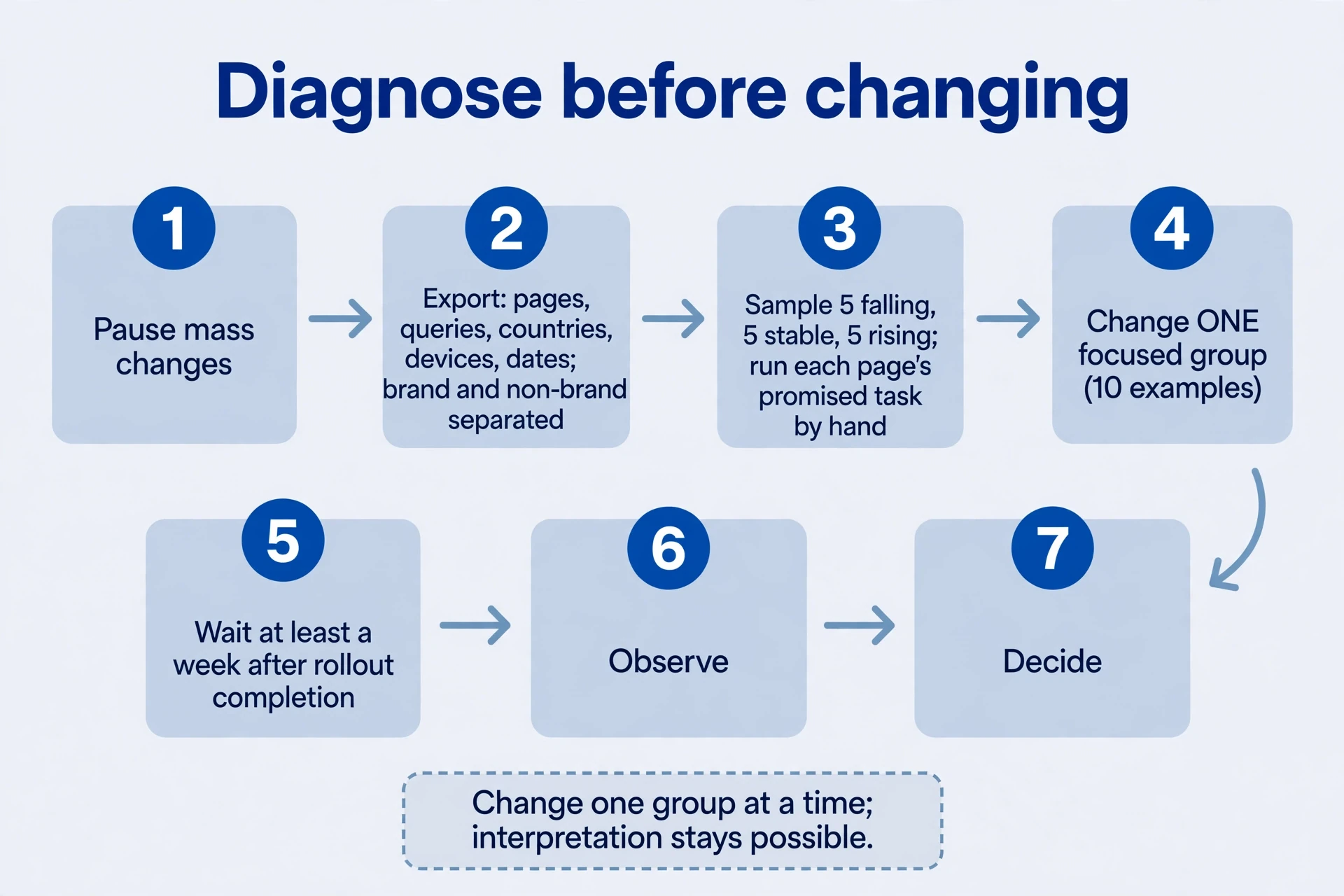
Consider a teaching scenario: a resume-tool site loses 30% of organic clicks after an algorithm update, and the team wants to delete all template pages. Treat the 30% as an teaching assumption. Pause mass changes and export first: pages, queries, countries, devices, and dates, separating brand and non-brand terms. Brand queries follow the site’s reputation; non-brand queries test its pages. Mixing them hides which half moved. Check release logs, indexing issues, manual actions, seasonality, and result types. A release shipped the same week, a seasonal dip, or a new result layout each explains part of a drop without any content judgement. If old resume examples lose traffic while the generator stays stable, fix the examples. The generator’s stability points at the algorithm example pages, not the whole site. If impressions hold but clicks fall, examine position, snippets, and result layouts before alleging a content penalty. Let the export decide which pages are sick.
Next, sample five, five, five: five falling, five stable, five rising pages. Manually complete each page’s promised task. record working functionality, outdated data, distinctive examples, mobile completion, and superficial word-swapping, then compare current leading results. Fix one focused group first: add real job context, revision steps, and downloadable outcomes to ten examples, retaining other pages as observational references. Do not refresh every date for “freshness,” and do not simultaneously migrate URLs, rewrite titles, and buy links. Change one group at a time; algorithm interpretation stays possible.

Use two acceptance layers. Delivery checks ask whether sample tasks work independently, data and methods are inspectable, and internal routes and mobile interactions function. Outcome review compares consistent impressions, clicks, positions, and business completion, documenting the algorithm observation period, concurrent activity, and unresolved variables. The search engine’s algorithm core-update guidance recommends waiting at least a week after rollout completion before comparison. Improvements can take time, and former rankings stay an open outcome. When growth does not appear, revisit the algorithm hypothesis and implementation before expanding or changing course. The cycle is the algorithm method: hypothesise, change one group, observe, decide.
Practice: produce a diagnosis others can challenge
-
Turn “6% freshness and 4.6 positions for yearly updates” into actionable advice. Label it a 2024 third-party model and correlational algorithm observation. Audit ten pages for obsolete content. Fix three factual or functional errors first, recording old and new values, algorithm evidence, and dates. Preserve URLs. Compare consistent metrics for edited and unedited pages. Record the 4.6-position figure as the model’s algorithm observation, not a forecast.
-
How would you assess a colleague’s algorithm claim that all templated pages violate policy? Sample three city pages. Verify meaningful differences in local inventory, locations, hours, original images, and task outcomes. If only place names change and no extra purpose exists, stop expansion and rework them. If each page delivers a distinct service, keep the template and improve data and access. Assess purpose and user value rather than HTML similarity.
-
Plan a week of work for an emerging clay-filter query. Day 1 verifies public demand and result gaps. Days 2–3 produce a working mobile-friendly page with clear limitations. Day 4 observes real task completion and fixes failures. Days 5–7 check indexing, non-brand queries, usage, and competitors. If people like it but do not search, test distribution. A first-place brand result shows the brand ranks. Demand needs its own check.
-
What can and cannot be established about the two March 2026 updates? Official dates, sequence, and duration are established. A new semantic filter, a fixed information-gain weight, a deliberate combined signal-clearing procedure, and a unique cause for any site’s loss stay open algorithm questions. File quoted industry percentages as reported figures, and identify the samples and site-change records needed to validate them.
-
How should doubled visit duration with falling completion be assessed? Flag a possible experience problem. Re-run three real task paths and check loading delays, forced pagination, and errors. Accept the fix using completion, error rates, and feedback, then observe search outcomes. Completion is the acceptance measure.
Diagnosis is a loop: classify the algorithm evidence, inspect the competition, change one small group, and let the observation period speak. The next algorithm update will bring new claims. The evidence types stay the same.
Comments
Join the conversation. Comments are reviewed before appearing.
Loading comments…