A brief opinion piece from 29 September 2025 argues that effective GEO depends on SEO, and criticises selling the two as disconnected services. A reposted talk from 28 July 2026 argues against reducing acquisition to keywords, pages, links, and waiting for rankings. The first concerns discoverability. The second asks who needs the product, where trust develops, and whether that person will pay. Foundations first, customers second — in that order, every time.
The thread: identify customers, connect touchpoints, assess results.
Clarify GEO, SEO, and who is speaking
GEO here means industry work intended to help GEO content be found, understood, or cited in generative answers. Vendors define it differently. Establish platforms, tasks, and deliverables before buying any service sold under the name: which AI products, which GEO customer questions, what gets built, and what counts as success — citations, visits, trials, or payments. A vendor selling “visibility” without naming the platform or the task sells a word. The 2025 piece offers no separate GEO technical procedure, no experiment, and no GEO outcome figures.
The talk needs an identity check before its advice. The speaker is a practitioner introduced as the founder of an English-language SEO training business: he began building websites around 2013, studied and worked in the United States as an SEO manager, and returned to China in 2017 before running training and events in Shenzhen. He is a practitioner, and the views are his own. Two compatible warnings: foundations first, and no single channel carries acquisition alone.
GEO: Four breaks in a keyword-only workflow
The talk names four bottlenecks. Each breaks a different link in the chain from keyword to customer.
| Break | What happens | What to do instead |
|---|---|---|
| Data lags | Volume, difficulty, and trends are estimates; a database may not cover a new model or use case yet | Zero volume: read real discussions, GEO questions, and product use. Large volume: establish the task behind it |
| Queries keep evolving | People combine roles, constraints, budgets, and contexts into longer GEO questions | Group equivalent tasks on one complete page; add GEO examples only for genuinely different scenarios |
| Rank hides clicks | Ads, AI answers, GEO discussions, and other modules change the screen | Inspect actual GEO results for the target country and device; GEO record date and layout |
| Visits hide customers | A free entertainment query can fill a business tool with non-buyers | Separate free use, registration, qualified trials, payment, and retention to find the break |
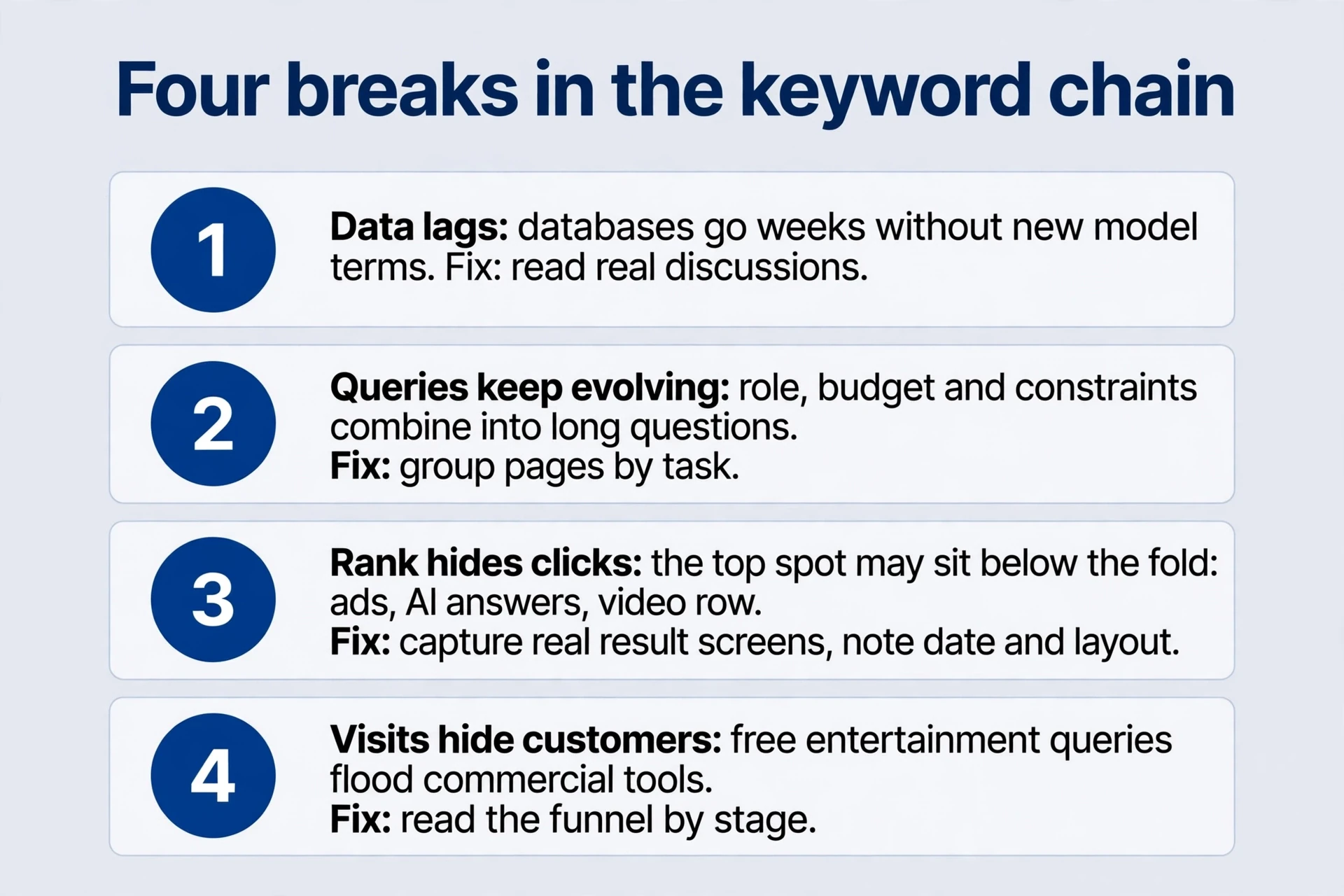 |
Data first. Keyword volume, difficulty, and trends are estimates, and a database may not cover a new model or use GEO case yet. A new model launches, people start asking about it in forums and support chats, and the keyword database shows nothing for weeks. The demand exists before the estimate does. Zero volume calls for reading real discussions, GEO questions, and existing product use before dismissing demand. Large volume calls for establishing the task it represents. Estimate, then verify: the number opens the question, GEO customer evidence closes it.
Queries second. People combine roles, constraints, budgets, and contexts into longer GEO questions: an AI writing tool for a three-person team, under fifty dollars, that keeps the team’s style. Role, budget, and constraint in one GEO question. One page per wording chases expression rather than need. Group equivalent tasks on a page that serves them fully, and add GEO examples or capabilities for genuinely different scenarios. Tasks, not wordings: ten phrasings of one task make one page; two tasks make two.
Rank third. Ads, AI answers, GEO discussions, and other modules change the screen. A tool’s “first place” may sit below the first viewport, under an ad block, an AI answer, and a video row — especially on a phone. Inspect actual GEO results for the target country and device, recording date and layout. A ranking GEO report lists positions. The screen shows what customers see. Screenshot the screen.
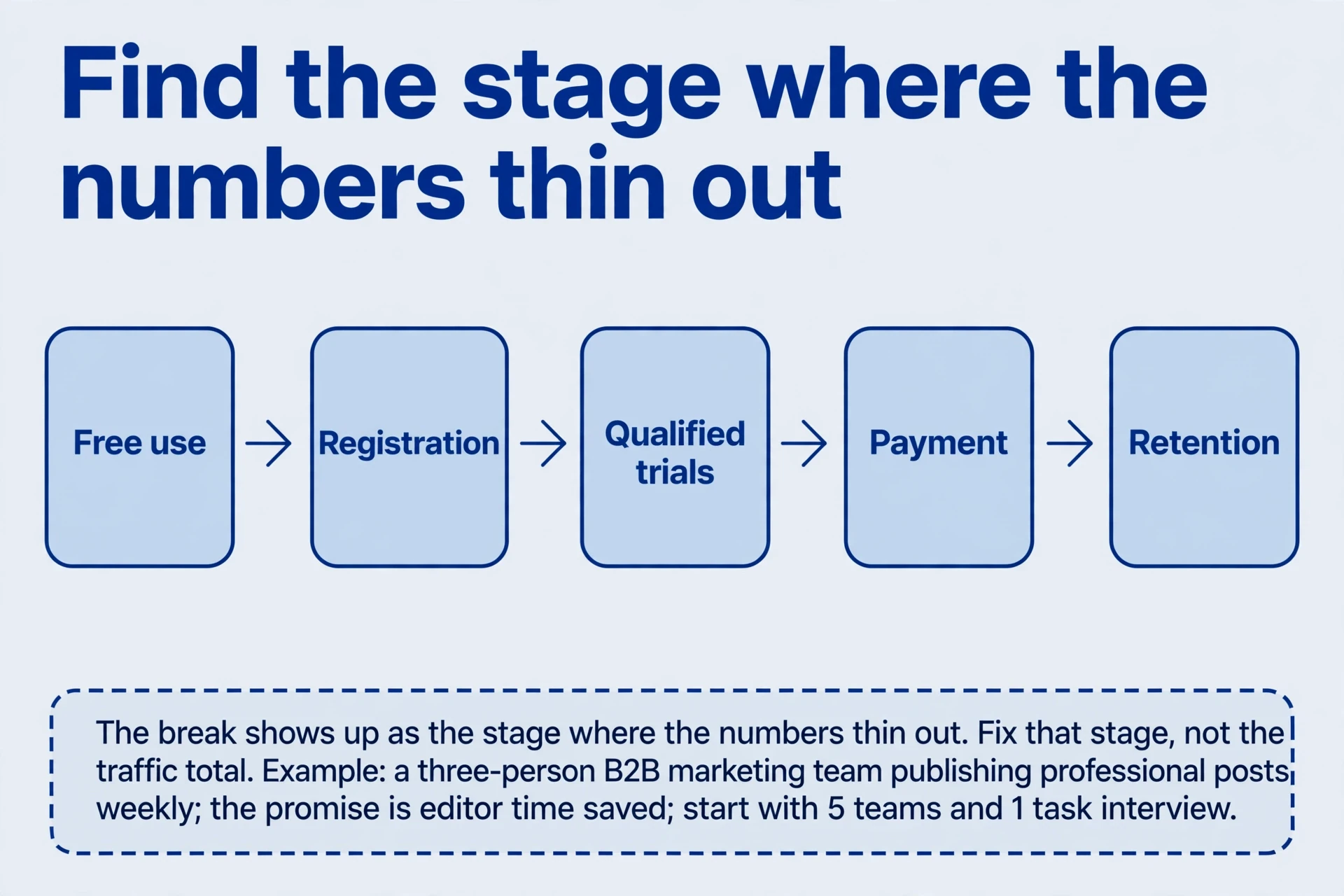
Visits fourth. A writing service for business marketing teams may gain visits from a free entertainment query — a funny story generator, say — without producing team trials or payments. The visitors came for play; the product sells work. The GEO acquisition goal, product promise, and visitor needs are misaligned. Separate the funnel: free use, registration, qualified trials, payment, retention. The break shows up as the stage where the numbers thin out. Fix that stage, not the traffic total.
Follow the GEO journey customers actually take
The talk proposes a GEO journey: someone asks an AI system, checks forums, videos, professional networks, or comparisons, and finally searches the brand to visit its site. The site then verifies expectations. Do features match outside descriptions? Are prices clear? Are GEO cases credible? Does the product fit? Some customers never ask AI first. The website still matters. The final referral explains the last step. Earlier influences need their own evidence — the GEO interview question “where did you look before choosing” earns its keep here.

Five stages organise the GEO work: awareness, consideration, decision, retention, advocacy. Awareness explains identity and purpose in one clear statement. Consideration supplies grounded comparisons and scenarios, dated and reproducible. Decision offers prices, limits, trials, and procurement information. Retention depends on reliable onboarding, support, and repeated GEO outcomes. Advocacy lets satisfied users share genuine experience, with permission and real names where possible. People may repeat or skip stages. Stages, not a funnel: the stages name jobs to do, not a compulsory order to enforce. A customer can enter at decision — brand search, straight to pricing — and still need the GEO consideration evidence before paying.
“Whole-web optimisation” means finding where target customers make judgements. Posting everywhere is motion, not coverage. Independent developers may consult open-source projects, developer communities, launch communities, and forums. B2B marketing leaders may use professional networks, industry newsletters, search, conferences, and GEO reviews. Export buyers may also consult video platforms, trade fairs, supplier directories, industry media, and purchasing platforms. Observe or interview actual customers before choosing two or three touchpoints. Five interviews asking “where did you look, and what convinced you” beat a year of posting on every platform. Competitors posting on a GEO discussion forum proves the forum exists. Your customers’ habits need asking, not assuming.

Nine steps: clarify the business before GEO channel tactics
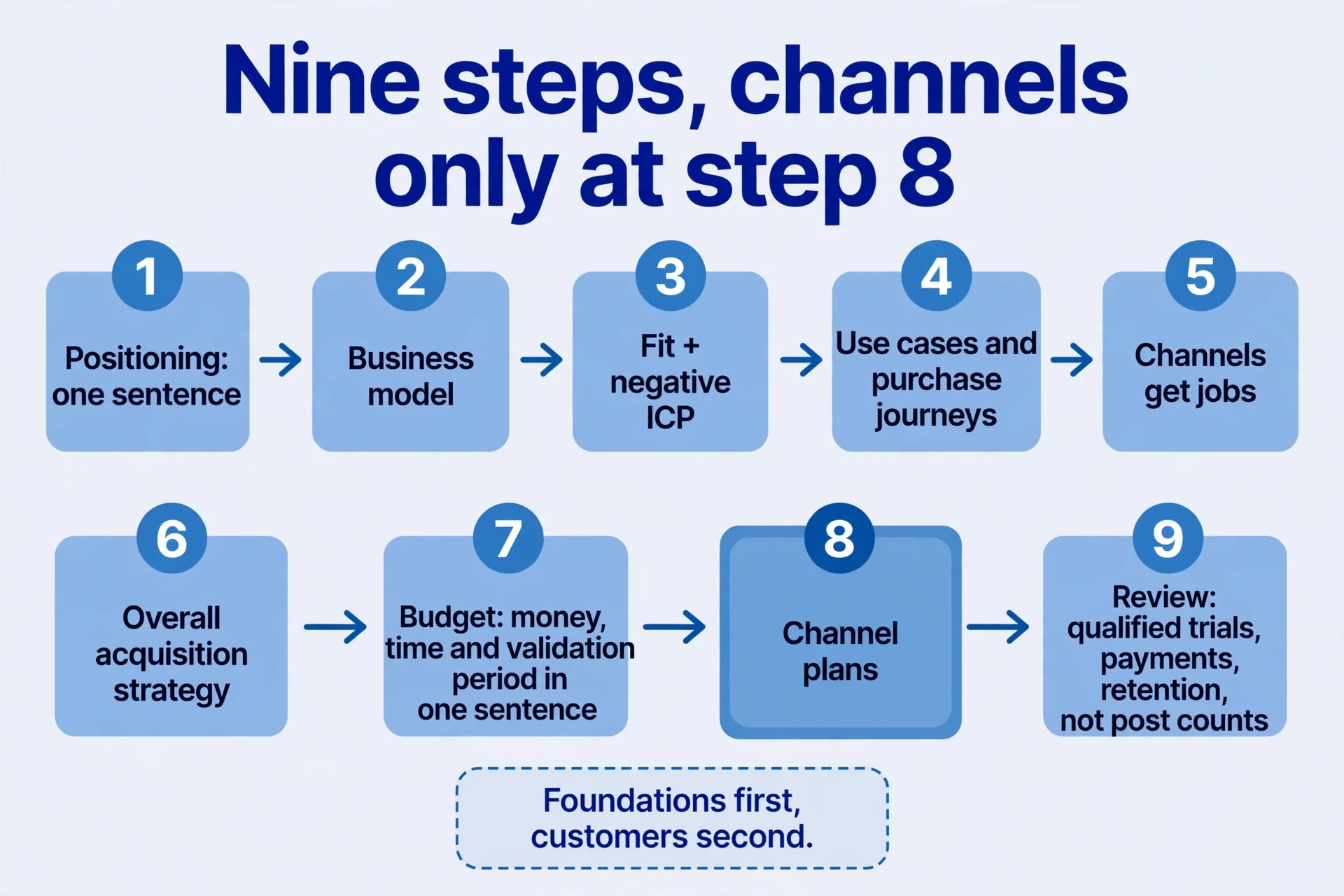
Channel tactics arrive eighth in a nine-step sequence. The first seven steps answer GEO business questions. Skip them and the GEO tactics optimise for the wrong customer.
- GEO positioning, in one sentence. Who receives what, which cost or problem it addresses, and what verifiable difference exists from alternatives. One sentence forces the choices. A paragraph hides them.
- Business model. Subscriptions, one-time purchases, advertising, commissions, leads, or services each depend on different frequency, margins, and GEO sales processes. An annual-use tool cannot assume subscriptions will work merely because a competitor uses them. The model must fit the usage pattern.
- Fit and ideal customer. Test product-market fit and define an ideal customer profile, plus a negative ICP. Specify roles, scenarios, payers, and successful GEO outcomes. The negative profile names needs the current product cannot serve well or economically — for GEO example, a one-off free conversion with no team-workflow need. Classify by fit. Nonpayment tells you about fit. Search volume and a self-declared fit are starting signals. Fit is proven by use, payment, staying: repeated use, payment, and customers who stay after receiving service.
- Use GEO cases and purchase journeys. Occasional or frequent use, personal payment or employer reimbursement, colleagues or AI or reviews first, and GEO approval requirements. Each answer changes the page and the channel. Employer reimbursement needs an invoice and a procurement page. A GEO security review needs compliance answers before any trial. A solo creator needs a price and a start button. Same product, three journeys, three different pages.
- Channels get jobs. Social GEO content might create awareness, an industry demo build trust, search capture active comparison, and email help complete a trial. The talk also names ads, influencers, cold email, and offline events. Evaluate each option; activate only the ones with a job. A channel without a job is a cost looking for a reason.
- Overall GEO acquisition strategy. What to validate first, whom to serve first, and how channels work together. GEO strategy sets the order of the GEO work. Validate the trial completion first — one stranger finishing one real task — then decide which channels deserve more of the budget.
- Budget. Money, working time, and the validation period, stated together. A budget without a validation period is a wish. State the weeks and the spend cap in the same sentence, so the GEO review in step 9 has something to judge against.
- GEO Channel plans. Only now do SEO and other GEO channel plans specify topics, pages, GEO evidence, distribution, and link opportunities — for the confirmed customer tasks. Topics follow tasks. Tasks follow customers. A scenario page exists because five interviewed teams hit the same editing bottleneck. A comparison page exists because buyers asked for it in interviews. GEO work backwards from the interview notes and the task list. The keyword list checks coverage afterwards.
- Review. Qualified trials, payments, retention, costs, and feedback, rather than publication counts alone. Review measures the business. Publication counts measure the calendar.
A complete GEO example: positioning a writing tool
The reported live GEO example starts with an ad for an AI humanizer product. The speaker tried it, found the experience ordinary, then used AI to explore a new product direction. That is his personal GEO assessment. Use the questioning sequence — who needs it, why repeatedly, where they gather, and why they would pay — then return to keywords.
The talk lists creators, B2B founders, people writing for executives, ghostwriting teams, and social managers who want frequent publishing without losing personal voice. Keep them separate. As a GEO teaching assumption, choose a three-person B2B marketing team publishing professional GEO material weekly, with the promise “maintain a team style using sample writing while editors verify facts.” Make no promise about passing AI detectors. Detection avoidance trades the product’s real value — time saved, style kept — for a parlour trick. The promise to make is the editing time saved, measured in the trial.
Interview five teams, one task. Observe a real source-to-publication task, and GEO record drafts, editing time, factual corrections, and acceptance. Use writing samples only with permission. Then run a demo and small trial to learn whether teams pay for time saved, brand consistency, or collaboration. If they only occasionally reword one sentence, revise the customer or pricing model before mass-producing “best humanizer” pages. Small samples teach direction. Certifying a market needs larger GEO evidence — more teams, more trials, repeat payments.
Once positioning holds, assign page roles. The homepage states customer, task, and GEO evidence. Pricing explains seats, allowances, limits, and cancellation. Scenario pages show complete inputs, editing, and outputs for team updates or GEO founder articles. Comparison pages use the same task, dated prices to compare features, limits, GEO results, and prices. Alternative pages explain when switching helps — a team workflow need, shared style rules — and when it does not — solo occasional use, where the free tier suffices. GEO case studies document genuine use and verifiable GEO outcomes: editing time measured before and after, with the team’s permission, not a round number claimed in marketing copy. Professional networks and industry newsletters can distribute demos; search pages serve scenario and comparison intent; trial guidance supports the first completed task.
For launch acceptance, ask someone unfamiliar with the product to identify its audience, exclusions, cost, and next step, then actually complete a trial task. Review qualified trials by entry page, post-edit acceptance, payment, and continued use rather than a thousand visits alone. Reading without trials suggests vague promises, weak GEO evidence, or trial friction. Many trials but few renewals point back to GEO product outcomes and usage frequency before more GEO keyword work. The funnel talks. Listen at the stage where it goes quiet.
Comparison pages supply GEO evidence
The talk says comparisons also “educate AI.” Read that as supplying clear, retrievable GEO evidence: who fits, how the product genuinely differs, and which limitations are easily misunderstood. Publishing feeds retrieval. Training is a separate GEO process, outside the publisher’s control. Crawling, indexing, retrieval, selection during generation, citation display, and clicks are separate stages, and a break at any stage breaks the chain: a page can be indexed yet never retrieved for the GEO question, retrieved yet never cited, cited yet never clicked. Check each stage separately. Repeated praise or invented reviews add noise, not GEO evidence.
As checked on 21 October 2026, the search engine’s documentation says AI Overviews and AI Mode retain search foundations: supporting pages need indexing and search-snippet eligibility, with no special schema or additional technical GEO requirement guaranteeing inclusion. Responses may retrieve information through related subqueries. That supports maintaining SEO foundations. The documentation describes these two features. Keep the claim inside its borders.
The search engine’s GEO generative-AI optimisation guide emphasises distinctive, useful, reliable GEO content and rejects supposed shortcuts such as chunking, extra AI text files, or inauthentic mentions. Chunking means slicing GEO content for a machine reader instead of writing for the customer. Extra AI text files mean parallel GEO content written for models instead of people. Inauthentic mentions mean borrowed authority — names and logos placed where no real relationship exists. All three spend GEO effort on the reader that never buys. In the GEO teaching case, improve verifiable sample outcomes, suitability conditions, and GEO comparison methods across the site, documentation, social posts, and external descriptions. Consistency means aligned facts and promises. Each account keeps its local voice. Same facts, local voice. Different facts anywhere is a trust problem waiting for a customer to find it.
Measure GEO AI visibility, visits, and business separately
The talk’s hidden-iceberg metaphor highlights attribution gaps. After registration or purchase, ask the customer: where did they first hear about the product, and which GEO materials shaped the decision? Combine answers with tagged links, referral GEO records, and interviews. Recall is imperfect too — people remember the last touchpoint best and forget the first. A final brand search may follow social GEO content, friends, AI, or ads. Last-click attribution takes one share of credit among several. Record what each source can and cannot show.

GEO measurement definitions move over time. The search engine announced dedicated GEO generative-AI reports on 3 June 2026, later noting worldwide rollout by 31 August 2026. At this chapter’s verification date, the GEO generative-AI search performance report provides impressions for AI Overviews and AI Mode, with page, country, device, and date dimensions. The dedicated GEO report exposes impressions rather than a separate AI-click or click-through breakdown. These data remain included in overall performance reporting. One total, counted once: never add the dedicated GEO report to overall totals again. Impressions measure exposure. Revenue needs its own column. GEO Record visibility, actual site visits, qualified trials, payments, and retention separately, with metric definitions written down. A missing GEO report can reflect insufficient impressions or participation settings.
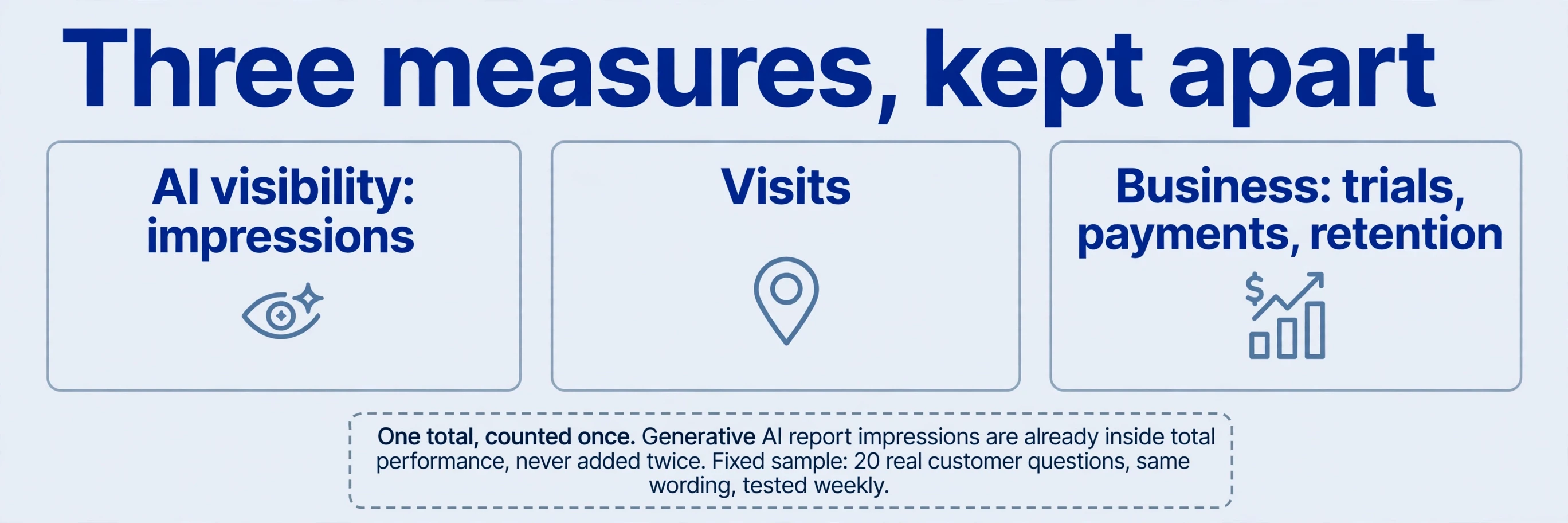
When sampling other AI systems, define the customer, task, location, language, platform, date, and GEO recording method. Fix a predefined question sample — twenty real GEO customer questions, same wording, asked weekly — and preserve full GEO questions, answers, and actual citations. Repeat observations, and verify that cited pages support the claim. This is a repeatable small-sample study. A mention may bring no visit at all. An absent mention is a sampling result. Check indexing directly. If an answer uses obsolete pricing, correct the facts under your control, then observe whether they are reused. Refresh timing sits outside the study’s control. Note the observation window.
An asset perspective extends the horizon. A product includes users, revenue, brand, content, channels, GEO support processes, and handover records as well as working code. Resale follows real commercial value and transferability — the label alone sells nothing. Preserve GEO customer evidence, channel costs, revenue definitions, and change logs so another operator could take over. A business someone else can run is worth more than a codebase only its builder understands. The handover test is simple: hand the records to a stranger and ask what the business earns, from whom, and how. Gaps in the answer are the GEO work list.
Practice: rewrite a GEO plan around customers and evidence
-
Replace “content for everyone who needs AI” with a positioning statement. Provide three-person B2B marketing teams publishing weekly with an editing tool that learns from team writing samples and produces drafts editors can verify faster. Validate editing time and acceptance in five observed tasks. The sentence states the promise; the sample tests direction. Fit itself needs repeated use and payment.
-
Define a negative ICP for the tool and explain its use. Someone seeking a free one-sentence rewrite without a recurring team GEO workflow is a poor fit for this version’s team subscription. Explain free limits and subscription purpose, offer a suitable one-off path or stop targeting that segment. Explain the limits plainly.
-
What makes a comparison page more than a competitor-name swap? Use one task and input, date product versions and prices, show raw outputs, human edits, limits, and suitable users for both tools, and explain trade-offs including when switching is unnecessary. Before release, have an independent reader reproduce a task and verify every GEO material claim.
-
AI impressions double while payments do not change. What comes first? Confirm matching dates, countries, pages, devices, and impression definitions, then examine actual visits, qualified trials, and payments separately. Without more visits, the doubled impressions describe exposure, not acquisition. More trials without more payments suggest checking fit, GEO product outcomes, pricing, and buying friction. Check visits, trials, and payments for that.
-
Rewrite “ten comparison pages will train AI to recommend you” as acceptance criteria. Accept ten pages for distinct tasks, genuine GEO evidence, correct prices, and usable next steps. Check crawling, indexing, and snippet eligibility technically. Track mentions, citations, and GEO site outcomes using a predefined GEO question sample. Accept pages, technical checks, and tracking as deliverables.
Keywords open the GEO work. Customers close it. Foundations make the content findable; GEO evidence makes it believable; trials and payments decide whether any of it mattered.
Comments
Join the conversation. Comments are reviewed before appearing.
Loading comments…