The previous lesson taught how to judge a citation. This one plans the backlink work: what to fix first, what to create, whom to approach, and how to review the backlink spend. The order matters more than the backlink budget. Promotion poured onto a broken foundation buys attention for pages that can’t use it. Backlink promotion aimed without a destination wastes the readers it reaches.
The backlink plan runs in four stages: set the goal, prepare content worth citing, find the people, review the batch. Give each backlink promotion round a destination page and a reason for the investment. A round with neither is shopping, not marketing.
Choose the problem before choosing a backlink source
Apply the previous backlink lesson’s distinctions to action. Finish an unusable product first. Fix inaccessible important pages next. Then consider media coverage, backlink reviews, or community participation — when a working product needs backlink visibility. That sequence creates a more useful starting point than looking for another place to paste a URL. A link to a page that fails its task is a referral that teaches the referrer not to send people again.
Two routes lead outward, and neither must always come first. Prepare genuine launch information for journalists and editors — the press route. Or use relevant backlink search results to find authors already discussing the problem — the author route. A clear launch can justify backlink media work: something happened, on a date, with verifiable facts. A demonstrable product in a field with active reviewers may suit author backlink outreach first: no news event, but a tool reviewers can test today. Choose by what you actually have — news, or a testable product — not by which route sounds more impressive.
Before either route, define three things in writing: the intended audience, the destination page, and the useful next action. A home page, a backlink research article, and a specific tool serve different purposes, and each needs a different backlink pitch. The home page introduces the product. The backlink research article supplies evidence. The tool completes the task. Even a link that reaches the right readers wastes the backlink opportunity when the destination cannot fulfil their task. Audience, destination, action — in that order, before a single email goes out.
Read impressive backlink case numbers carefully
Impressive cases teach questions, not formulas. Read three of them the way an auditor would: what was counted, what changed at the same time, and what the author actually showed.
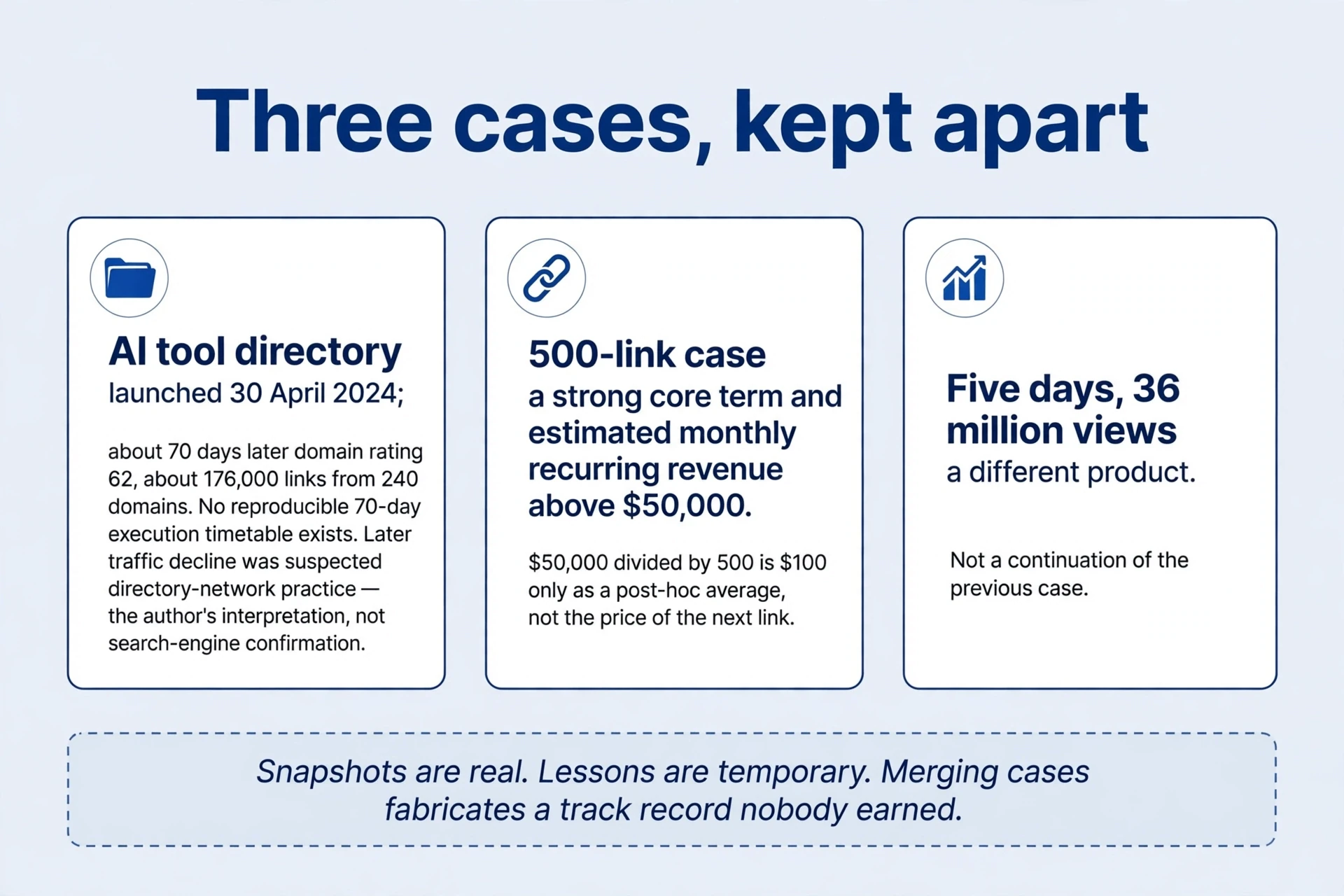
An AI-tool directory launched on April 30, 2024, and reached a third-party domain rating of 62 roughly seventy days later. Its screenshot showed about 176,000 backlinks and 240 referring domains. Different counts again: many links from few sites. The backlink article mainly promotes a July 3 replay and discusses topics including a content management system. It publishes no reproducible seventy-day link schedule — no dated list of what was done, in what order, with what result. Don’t assign a nearby payment-dashboard revenue screenshot to this site without backlink evidence, and don’t infer revenue from a domain rating. A later backlink discussion of the same site’s traffic decline suspects sitewide links and private network practices. That is the author’s interpretation, not a search-engine-confirmed penalty. Together the two stories show why an upward snapshot cannot establish lasting effectiveness. Seventy days up, then down, with an interpretation in between. The snapshot was real. The backlink lesson is temporary.
A different community member added about five hundred links and reached strong positions for core queries, with an estimated monthly recurring revenue above $50,000. The revenue figure is an estimate, not a verified record. Dividing revenue by links gives an arithmetic ratio — $50,000 divided by 500 is $100 — not an extra $100 from the next link. Ratios describe averages after the fact. They don’t price the marginal link, and they don’t survive the removal of the product, the timing, and the market that produced them. The backlink article’s separate example — thirty-six million pageviews in five days for another product — belongs to a different product, not a continuation of this site’s backlink results. Keep cases apart. Merged backlink cases manufacture a track record nobody earned.
The suggested split — 40% demand research, 20% development, 40backlink % promotion — is useful as a reminder to reserve real backlink promotion time, not as a universal allocation. Percentages don’t know your product’s state. More backlink promotion doesn’t establish willingness to pay, and it doesn’t finish an incomplete minimum viable product. A 40% backlink promotion share on a product nobody can use is 40% wasted. Reserve the time, then spend it where the dependencies allow.
Give the backlink budget a functioning foundation
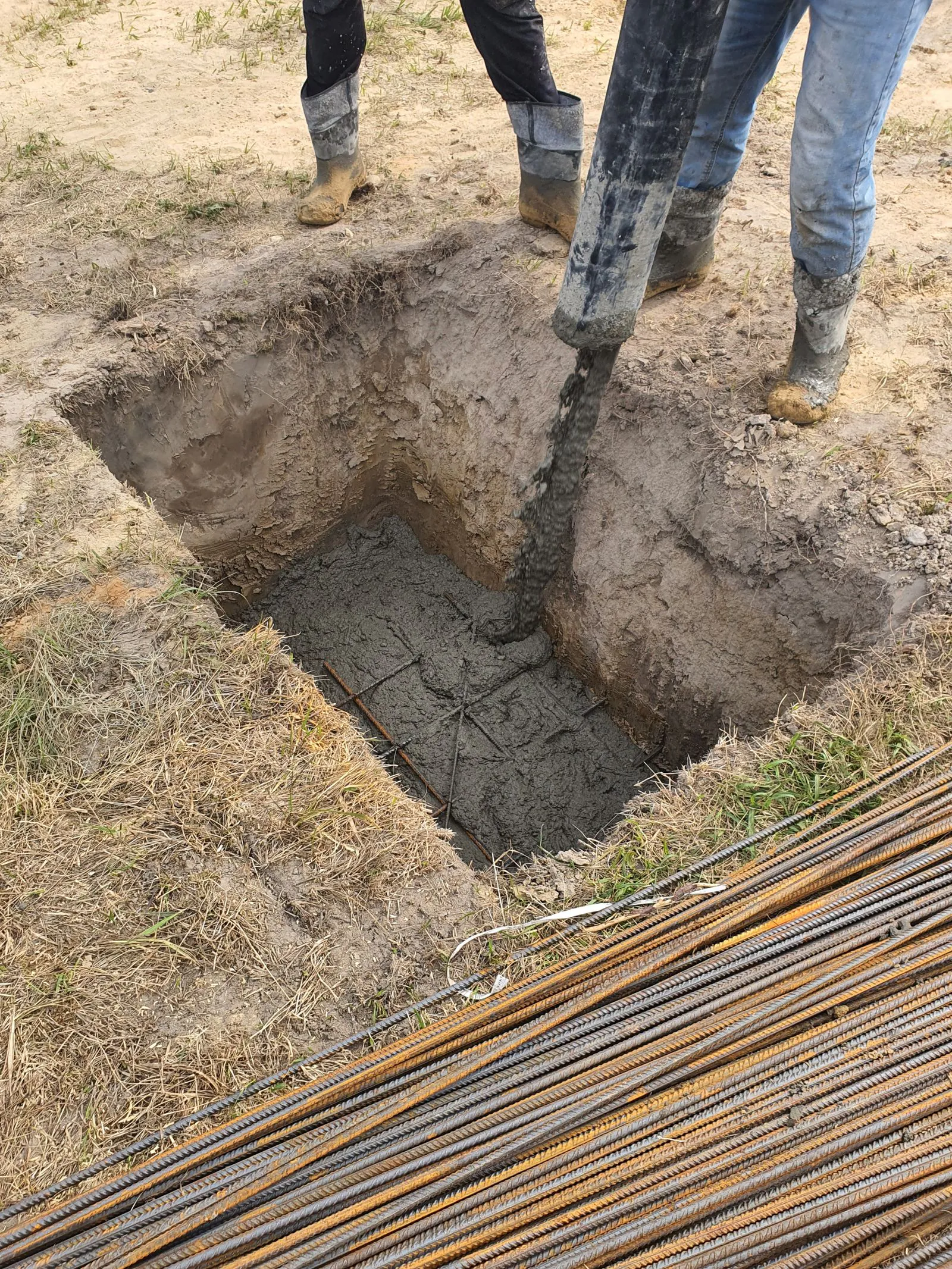
A backlink large-budget case makes the dependency order concrete. One operator spent about $300,000 over ninety days across public relations, content, links, external providers, and page-related backlink work, excluding internal technical and product development. The domain rating rose from 30 to 71, organic traffic reportedly grew roughly one hundredfold to about a million monthly visits, and about thirty thousand pages were indexed within a month after one technical optimisation. Read that last clause carefully: one technical optimisation, thirty thousand pages indexed within a month. The technical fix and the traffic growth happened together, alongside content, backlink brand work, and links. Concurrent backlink outcomes don’t establish that purchased links caused all the growth. The backlink budget bought many things at once. The credit belongs to the bundle, not to any single line item.
The sequence is more useful than the backlink spending total:
- Address technical and brand foundations.
- Create representative content.
- Seek relevant citations.
- Connect existing visits and links to target pages internally.
- Expand programmatic pages after validating a smaller set.
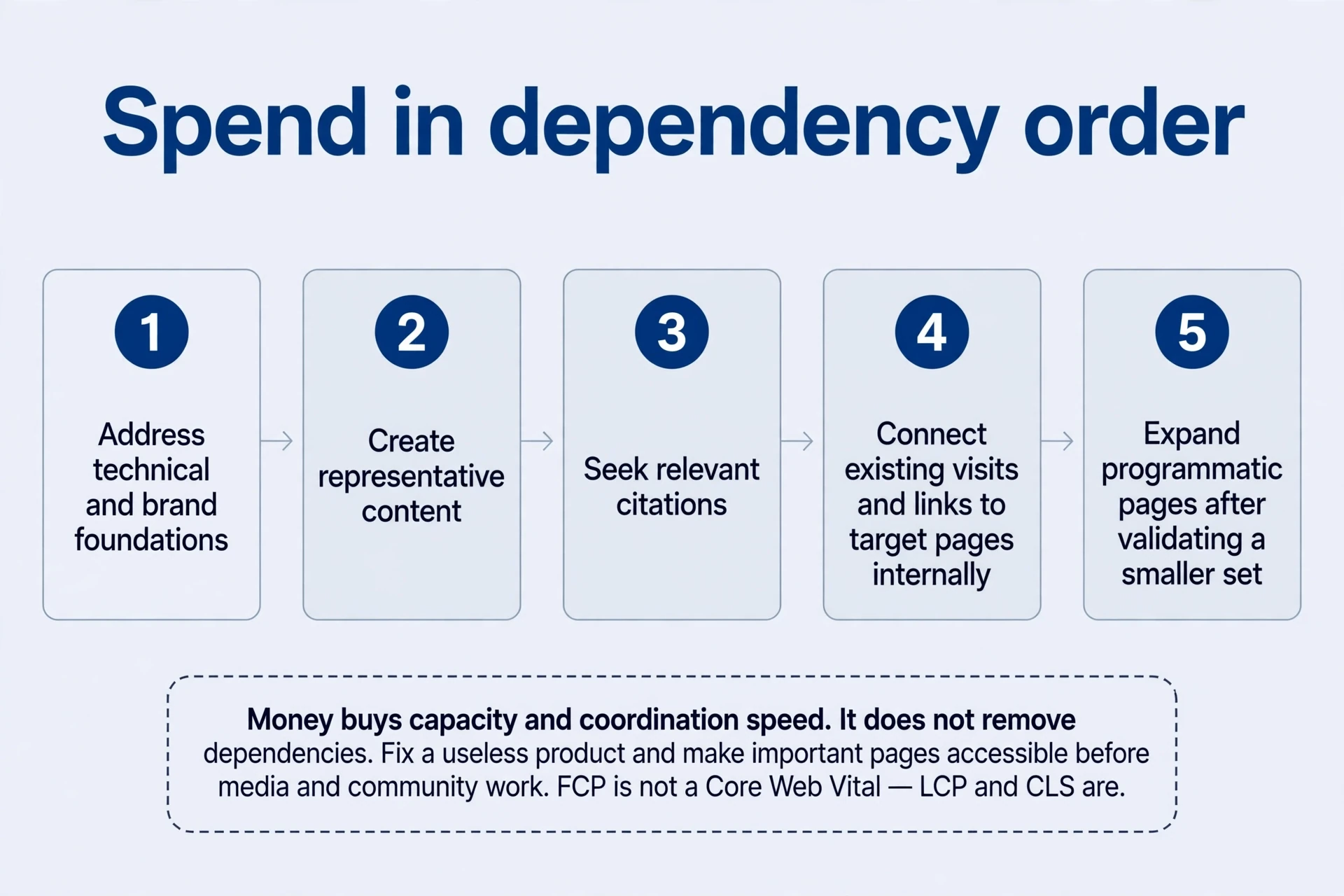
Backlink context. Money can buy capacity and coordination speed. It cannot remove these dependencies. A site with inaccessible pages doesn’t need links; it needs access. A site with no citable content doesn’t need outreach; it needs something worth citing. Spend in sequence, and each round’s money lands on ground the previous round prepared.
The technical backlink checklist covers the smaller set of issues that materially affect backlink outcomes. Check important-page access first — can crawlers and visitors actually reach the pages that matter? Then intended sitemap URLs, consistent canonicals, and corresponding language versions. Then metadata, headings, structured data, image descriptions, URLs, and the loading experience. The backlink loading metrics — largest contentful paint, cumulative layout shift, first contentful paint — can inform backlink performance work, with one correction worth stating plainly: first contentful paint is not a Core Web Vital. The other two are. Knowing which backlink metrics count prevents optimising a number nobody grades.
Brand foundations should be concrete, not aspirational. A stable name, a consistent description, clear team and contact information, and public information that establishes who made the product. Brand-query trends can indicate awareness over time. Manufacturing searches is not the task — awareness follows a product people talk about, not a backlink campaign that simulates talking. Once these foundations exist, assess whether the content gives an unfamiliar author a reason to cite it. If the answer is no, the next backlink spend is content, not outreach.
Backlink: Create a reason to cite, then plan the route
Content in the backlink large-budget case serves more than keyword coverage. It answers subject questions, receives search visitors, provides citation destinations, and leads readers onward to the tool. Four jobs, one asset. Begin with human writing or reviewed human–AI collaboration, validate the informational backlink value of a smaller set, and then increase output. The reported backlink cost of more than $100 per backlink article is a case expense, not a universal backlink quality threshold. Expensive content can be thin. Cheap content can be citable. Judge the article, not the invoice.
A format-conversion tool shows the citable-content pattern at its clearest. Publish a real compatibility test: samples, conditions, failures, and reproducible backlink results. A reviewer can cite the data. Readers can reach the relevant converter from the same page. The route has a clearer rationale than unrelated links to generic posts, because the citation carries backlink evidence the host’s readers can check. Research may gain backlink visibility through search, authors, or AI answers — without a guaranteed citation formula. There is no formula. There is useful backlink evidence, placed where the people who cite things already look.
Free utilities, organised directories, factual product comparisons, and interactive backlink examples can serve the same purpose. Choose them for how they help readers select, verify, or complete a task — not for adding friction to increase time on site. Friction as backlink engagement strategy backfires twice: readers leave, and the ones who stay resent the design. Further browsing should follow a meaningful connection between the explanation and the tool’s result. The reader who just read the compatibility test wants the converter. Give them the converter, not a maze.
Build the backlink internal-link worksheet alongside the content: target URL, backlink source article, anchor, and the passage to revise. Start with relevant older pages that already receive visitors, and add a useful next step in each. On-site edits can be completed quickly, but recrawling and search performance require subsequent observation. There is no one-hour ranking deadline — edits made at noon don’t produce positions by one. Bounce, time, and page-use measures help diagnose tasks without becoming direct ranking inputs from analytics. They tell you where readers struggle. They don’t vote on positions.
Place programmatic expansion after demonstrated long-tail demand, distinct backlink page value, and a validated smaller backlink batch. The speaker’s references to brand searches, sitelinks, topical development, domain rating, and traffic are operating judgments, not entry requirements from the search engine. A useful page need not wait for sitelinks before publication. Validate the template on a small set, confirm the pages get indexed and used, then expand. Expansion multiplies whatever the template does — good or bad. Validate first.
Backlink: Give the media a verifiable launch story
Press coverage fits a usable product with a stable name and a genuine launch event. A release primarily serves journalists and editors, not every paying user. It creates verifiable public information — the launch, the facts, the quotes, the contact — and immediate direct conversions are only one possible backlink outcome. A release that earns no sales but establishes the public record did part of its job. Judge it on the record it creates, the coverage it earns, and the referrals it sends, separately.
Backlink planning. A roughly four-hundred-word English draft can follow the reader’s questions. State the news in the headline. Explain who launched what, for whom, and why now, in the opening two paragraphs. Use subheadings for demonstrable differences — features you can show, not adjectives you can claim. Close with access, team, and contact details. AI tools can polish language without inventing world-first or revolutionary claims. A polished falsehood is still a falsehood, and it travels faster than a plain truth.
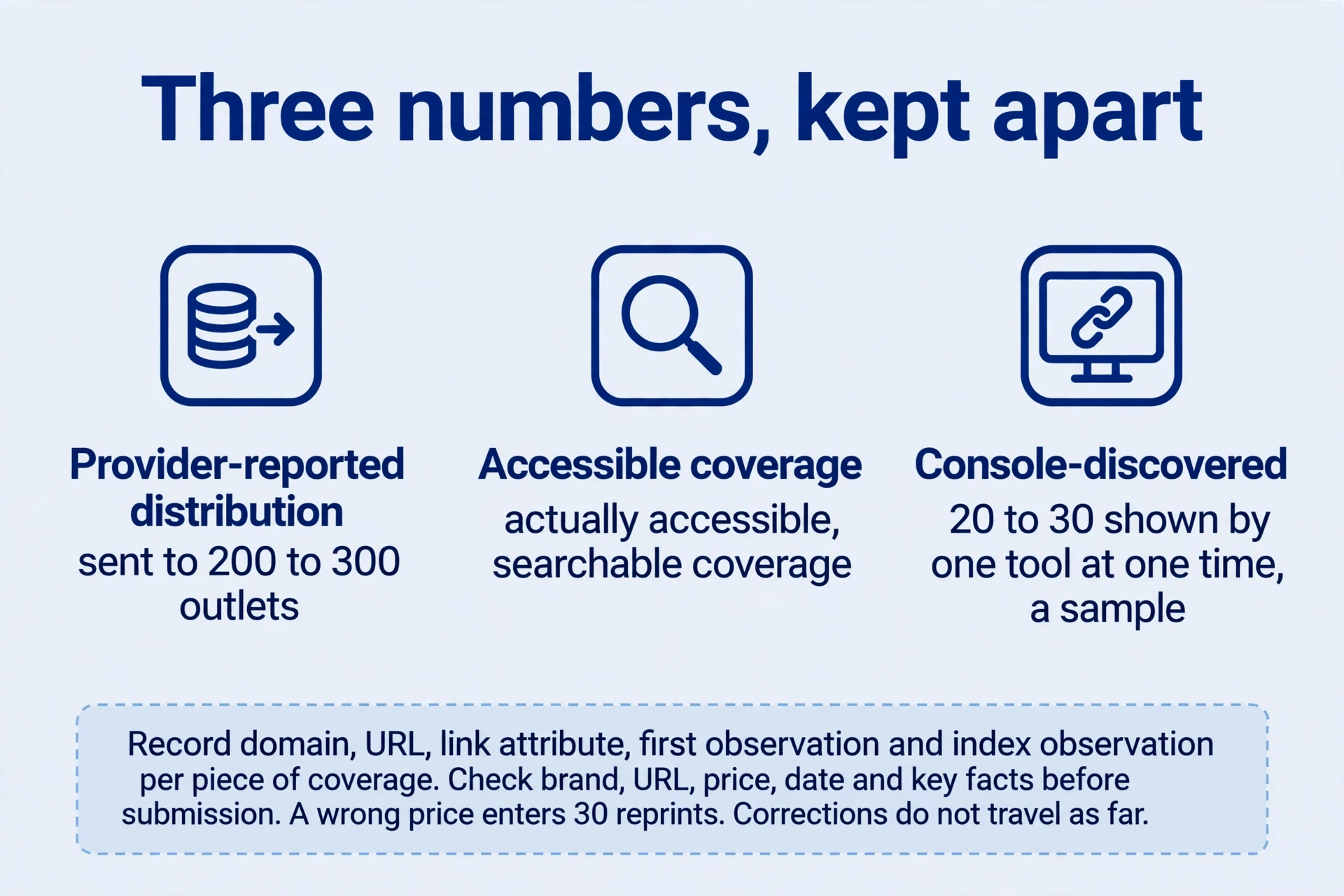
Assess region, outlet coverage, fees, link presentation, and whether previous releases remain accessible and discoverable, before choosing distribution. The backlink source’s typical twenty-four-hour publication and subsequent twenty-four-to-forty-eight-hour pickup describe experience, not guaranteed service times. Verify the brand, URL, prices, dates, and key facts before submission, because one error can be copied widely. A wrong price in a release becomes a wrong price in thirty pickups, and corrections never travel as far as the error.
Distribution arithmetic needs the same care as link arithmetic. Distribution to two or three hundred outlets doesn’t establish the same number of effective referring domains. Pickups may lack links, use different attributes, or remain unindexed. Twenty or thirty links later shown in the search console are not a complete live inventory either — the console shows a sample, discovered by one tool, at one time. Distinguish three numbers: provider-reported distribution, accessible and search-discoverable coverage, and links discovered by a particular tool. For each coverage page, record its domain, URL, link attributes, first observation, and indexing observations. Observe public brand information, relevant referral visits, and independent editorial citations separately. A release backlink supplies material. It guarantees no rankings, AI citations, or purchases.

Backlink: Find authors already helping the intended audience
Without a newsworthy launch, work backward from the query. Inspect the first ten or twenty backlink results for a relevant query. Set aside direct competitors’ product sites and examine videos, forums, user contributions, and independent backlink articles. Identify who answers the question and whether their readers need your contribution. Strong positions suggest relevance. They don’t settle backlink quality or author suitability — a top-ranked page can be outdated, thin, or wrong, and an author can be prominent without being the right partner.
Screen each format on its own terms. For videos, review current relevance, genuine backlink discussion, and ongoing activity — a channel silent for a year isn’t a partner, whatever its subscriber count. For forums, understand community rules and context rather than mechanically posting across a platform list. For backlink articles, identify a specific outdated passage, an omitted test, or a useful dataset. A bare request to add a link explains no reader benefit. The specific gap is the backlink pitch: “this passage, this test, this data.”
Evaluate the topic, the author, and the actual page before discussing domain rating, price, or link attributes. Inspect accessibility, updates, backlink placement, and surrounding outbound links. A page surrounded by unrelated paid links tells you what the neighbourhood is. Give reviewers sufficient demonstration or test access for an independent backlink judgment, without requiring praise or making a link a condition of trying the product. Access with strings attached produces praise with strings attached — worthless to readers and risky to everyone.
The backlink source’s possibility of one reply from a hundred targeted contacts is an anecdote, not a forecast for every field. Begin with ten genuinely relevant candidates, tailored supporting backlink material, correct contact channels, and working demo access. If a backlink batch receives no replies, improve selection, backlink material, and demonstration before multiplying volume. A hundred templated emails teach you nothing that ten tailored ones didn’t — except how it feels to be ignored at scale. One backlink outreach example shows the shape: “Section three of your format comparison mentions losing transparency. We tested these three inputs and included the samples and results for you to verify, if useful for an update.” Backlink evidence offered, judgment preserved. Tailor every real message to its specific backlink article. Record the contact, the backlink source page, the contact and reply dates, and the next action.
Backlink: Assess sponsorships and networks by their actual practices
Open-source sponsorship shows how easily a price tag attaches to the wrong measure. Named links through sponsorship ranged from five or ten dollars to pictured annual tiers of $1,000 on a sponsors page and $5,000 on a home page. A domain rating of 85 doesn’t establish backlink value for $5,000. Consider genuine support, audience fit, backlink visibility, affordability, and the link’s attributes — in that order, with the rating last, if at all. Sponsorship buys support and backlink visibility arrangements. It doesn’t buy a rating-based ranking return, whatever the tier is called.
Community self-promotion follows the same honesty rule. Disclose your relationship to the product, respect the community, and improve through feedback. Building a product doesn’t justify dropping links everywhere. Community contribution, commercial backlink visibility, and independent citation can coexist — as distinct relationships, labelled as such. A forum post that discloses authorship and answers the question earns its link. The same post without disclosure spends the community’s trust.
A private blog network is defined by purpose, not by appearance: controlled sites used primarily to influence rankings, often assembled with expired domains, bulk content-management setups, and scraped content. Purpose and linking practices matter more than whether links are sold to others. Linking only to your own product, or changing logos, templates, or brands, doesn’t automatically remove manipulation. The network’s reason for existing is the test. Multiple tools can have legitimate independent uses, real content, and real users, with relevant editorial cross-references — those qualities establish backlink value rather than serving as a recipe for avoiding detection. The archive’s figure of roughly 13% for links comes from a third-party breakdown, not a fixed weighting published by the search engine. Treat it as one analyst’s slice, not a rule.
Likewise, backlink foundation links, press coverage, anchor variety, publishing pace, and type distribution describe a backlink case. They don’t establish legitimacy. Mixing paid ranking links with ordinary ones, or changing anchor ratios, doesn’t change the underlying arrangement. The spam policies discuss purchased ranking links, ranking-oriented exchanges, and paid backlink placements with optimised anchors. Ordinary ads and sponsorships can use sponsored or nofollow qualifiers — the qualifier is the disclosure, and disclosure is what separates advertising from manipulation. Call the arrangement what it is. The label doesn’t make it legitimate. The backlink practice does.
Backlink: Make each batch reviewable
Split the backlink budget by objective rather than a target number of purchased links. For an initial small backlink batch, explain the audience, the backlink placement, the money and staff time, the proof of publication, and the observation of visits and use. Feedback can be valuable even without an independent citation — a reviewer who replies “your format test is wrong in this case” just gave you product research. Weak referrals call for reviewing the audience and destination, not merely checking whether the domain rating increased.
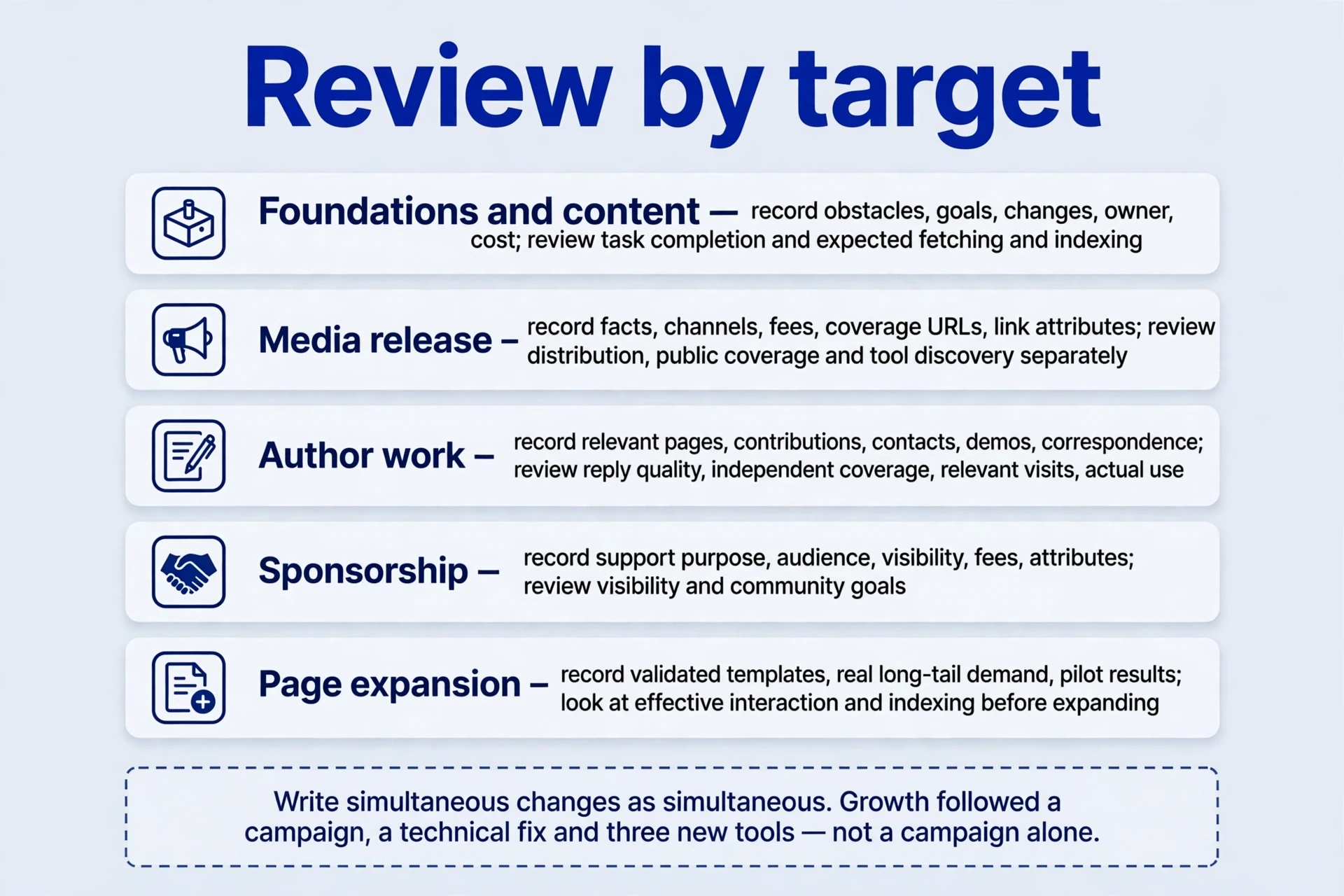
| Backlink work | Record first | Review |
|---|---|---|
| Foundations and content | Obstacle, target, change, owner, cost | Task completion and expected fetching/indexing |
| Media release | Facts, channel, fee, coverage URL, link attributes | Distribution, public coverage, and tool discovery, separately |
| Backlink Author work | Relevant page, contribution, contact, demo, correspondence | Backlink Reply quality, independent coverage, relevant visits, actual use |
| Sponsorship | Support purpose, audience, backlink visibility, fee, attributes | Whether visibility and community objectives were met |
| Page expansion | Validated template, real long-tail demand, backlink pilot results | Useful engagement and indexing before further expansion |

Backlink Record batch dates alongside content, technical, product, and internal-link changes. Brand-query or organic growth may relate to backlink promotion — but concurrent changes should remain described as concurrent. This prevents overstatement and makes the next investment easier to judge. A backlink batch record that says “growth followed the campaign” invites repeating the backlink campaign. A record that says “growth followed the campaign, a technical fix, and three new tools” invites the harder, better question: which part earned the next dollar?
-
Why are a domain rating of 62 and over a hundred thousand backlinks insufficient? Inspect independent sources, destinations, relevant visitors, actual use, indexing, and search performance. Large counts may come from sitewide backlink placements on relatively few sites. backlink Third-party metrics supplement rather than replace product and business backlink evidence. A count is a starting point for inspection, not a conclusion.
-
With a small budget, should press or backlink author outreach come first? Assess relevant media when there is real news, a usable product, and complete information. With a demonstrable use but no news, begin with a few authors found through relevant queries. Choose by audience and backlink material rather than a universal press-first rule. News decides the press route. Testability decides the author route.
-
Is three hundred distributed releases but twenty console links a failure? Determine whether three hundred means distribution or published coverage, then inspect pages and link attributes. The console is not a complete live inventory. Assess coverage, relevant visits, brand information, and independent citations separately rather than subtracting incompatible counts. Distribution, coverage, and discovery are three numbers. Don’t do arithmetic across them.
-
Why is a $5,000 domain-rating-85 sponsorship not automatically a bargain? The rating promises neither rankings nor revenue. Evaluate support purpose, audience fit, backlink placement, duration, attributes, and affordability. Calling a purchase sponsorship doesn’t replace assessing an arrangement aimed at passing ranking signals. Price the backlink visibility and the support. Nothing else is on backlink offer.
-
Should concurrent hundredfold growth justify an backlink all-link budget? No. Technical, content, brand, external and internal links, and page expansion changed together, while the backlink budget excluded internal development. Address your own dependencies, validate a small batch, and record concurrent backlink work before increasing investment. The bundle grew. The bundle gets the credit.
-
What follows a backlink batch of author contacts with no replies? Recheck topic fit, the specificity of the contribution, delivery, and usable demo access. Improve these before another small backlink batch, rather than treating an anecdotal response rate as a volume quota. Silence is feedback about the backlink offer, not an order to send more of it.
Give each backlink promotion round a destination worth reaching and a reason worth the money. Fix the foundations, create the citable thing, approach the people whose readers need it, and review the backlink batch against evidence — not against the count that made the last backlink case look impressive.
Comments
Join the conversation. Comments are reviewed before appearing.
Loading comments…