The previous lesson connected pages within a site. This one looks outward: what does a backlink from another site actually offer? The word “backlink” hides the answer inside a count. A backlink starts as a citation — one page introducing another to its readers, for a reason. Judge the backlink and the count takes care of itself. Judge only the count and every bulk package on the market looks like a bargain.

Separate backlink value from counting units first. Then check relevance. Then choose backlink opportunities with a rationale you could defend to the reader who clicks.
Define the backlink outcome before counting links
Separate the intended backlink outcomes before doing anything else. You may want relevant visitors to try a tool, greater product recognition, or a stronger long-term search foundation. One backlink placement can serve several purposes. One backlink outcome cannot stand in for all the others. A link that brings a hundred trial users and no ranking movement succeeded at its job. A link that moves a position and brings nobody failed at a different one. Name the job before judging the result.
| Desired backlink outcome | Evidence to examine first | What it does not establish |
|---|---|---|
| Immediate product use | Referral visits, completed tasks, registrations, purchases | Clicks necessarily improve organic rankings |
| Brand recognition | Relevant backlink discussion, mentions, subsequent searches | A mention guarantees an AI recommendation |
| Longer-term search competition | Relevant citations, referring domains, backlink destination pages, query performance | A purchased link quota secures a top-ten position |
Don’t declare a backlink worthless merely because it brings no immediate visits. A backlink can help discovery, communicate relationships, and contribute to longer-term signals — and referral visits are a separate observable pathway with their own numbers. But long-term potential is not a blank cheque. Record the location, the relevance, the cost, and the subsequent evidence, and review them on a date you set in advance. “It might help eventually” without a review date is how budgets leak.
A good backlink starts as an intelligible backlink. Three questions, asked of every candidate: why would this backlink source introduce your page? Why might its readers need the destination? Does the link belong in that passage, at that sentence? Metrics narrow an investigation. They don’t answer these questions. A high-metric source with no reason to cite you is a billboard, not a recommendation — and readers treat it accordingly.
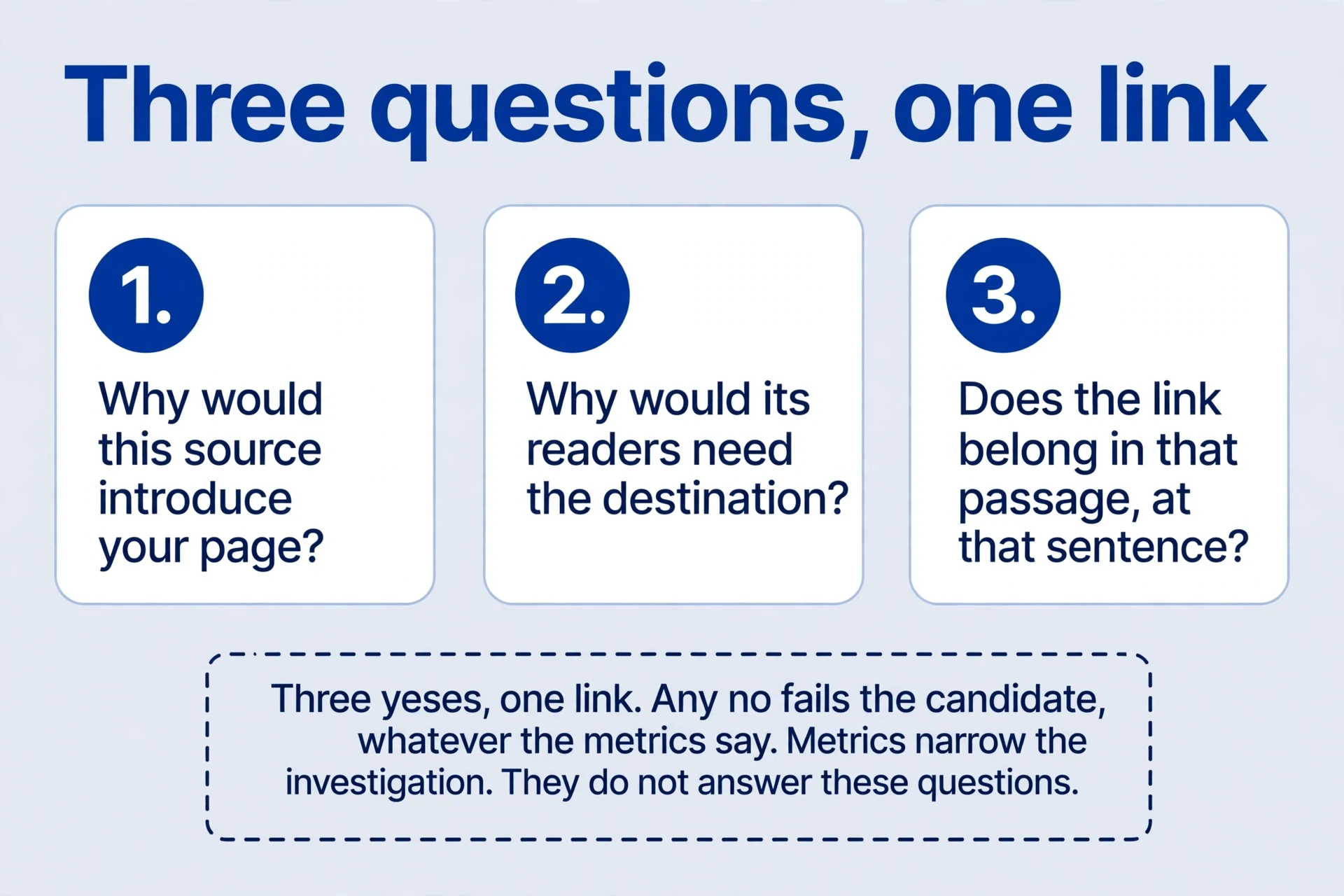
Run the test on one candidate to feel how it works. A renovation blog, mid-article, explains room-by-room heating loads and reaches the sizing step. Its readers need a worked example before hiring an installer. Your estimator supplies the example, with limitations stated. The link belongs at the sizing sentence, because that’s where the reader’s next question lives. Three yeses, one link. Any no — wrong readers, wrong passage, wrong backlink destination — and the candidate fails no matter what the backlink metrics say. The test takes two minutes. The wrong link costs months of explaining a backlink traffic source that never converts.
Unpack the 4,700-link launch story
Four days after launch in 2023, a directory of custom GPT assistants showed approximately 4,700 backlinks from 33 referring domains, with a domain rating of 37 in the tool screenshot. Read the units before reacting to the total. Many pages on one site can link to the same backlink destination. 4,700 links are not 4,700 independent recommending sites. Thirty-three domains averaging more than 140 links each is a very different picture from thousands of separate endorsements — and the picture matters more than the number. Examine referring domains and the actual backlink destination pages alongside the total, every time. Links count pages. Domains backlink count sources.
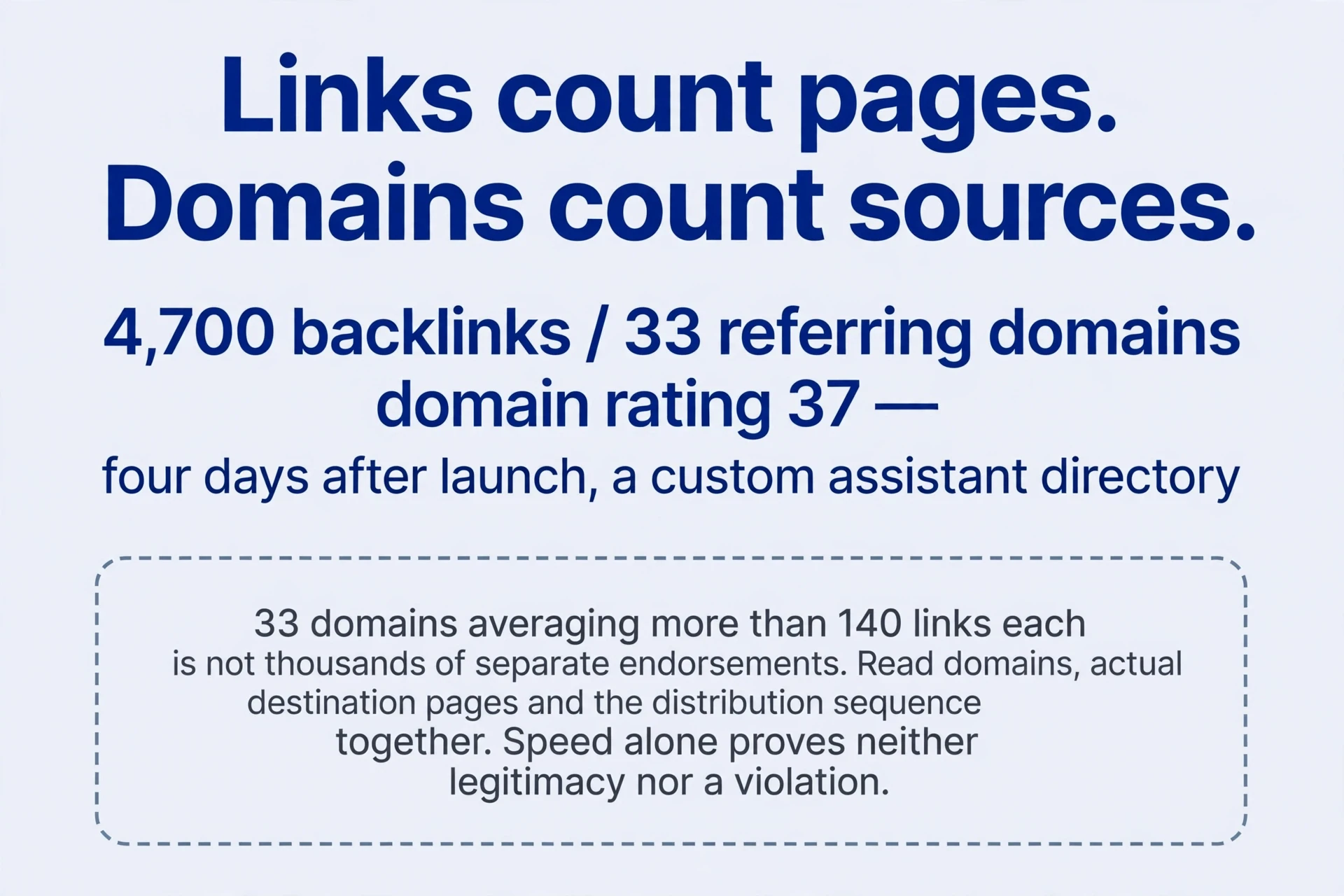 The backlink source count is the one closer to recommendations.
The product and distribution sequence is more instructive than the total. The account describes a one-day, single-page minimum viable product, JSON data, scheduled static generation, and static hosting. It met new demand for GPT discovery around a developer event, was introduced to relevant communities, and spread further through people who encountered it. Timely delivery plus shareable backlink value, distributed where the interested people already gathered. Learn from that sequence rather than manufacturing a matching backlink link count. A count without the sequence is backlink cargo-cult work: same number, none of the reasons.
Notice what made the sequence shareable. A single page that loaded instantly, answered one new question, and needed no explanation beyond its title. Communities spread it because sharing it made the sharer useful — “here’s the directory everyone’s looking for” — not because anyone was paid to post it. Shareable means useful to the sharer. The static stack helped: fast load, no login, no friction between the link and the backlink value. Speed wasn’t a ranking tactic here. It was the difference between a link people forwarded and a link people abandoned.

The backlink case also undermines a fixed rule that one hundred new links in a month automatically penalises a new site. News, launches, and useful resources can attract concentrated natural attention — a launch week looks nothing like a steady month, and the pattern is the point. Investigate backlink sources, editorial reasons, and whether links exist primarily to manipulate rankings. Velocity can prompt a backlink review. It cannot establish legitimacy or a violation on its own. A hundred links from launch coverage and a hundred links from a purchased package share a velocity and nothing else. Read the backlink sources, not the speedometer.
Separate traffic, brand demand, and citations in a backlink large-site case
A personality-test site offers a bigger backlink case, examined through third-party estimates for February 2024: roughly 20.58 million visits, about 28% desktop and 71% mobile, 3.9 pages per visit, 5 minutes 43 seconds per visit, and a 49.72% bounce rate. The United States, Japan, and South Korea accounted for about 35% combined. Treat every figure as an estimate with a purpose: together they indicate substantial demand and the importance of mobile use. They are not precise backlink first-party audience counts, and no decision should rest on the second decimal place. The shape of the numbers — mobile-heavy, long visits, concentrated in three markets — is the useful part. The precision is borrowed.
The channel breakdown attributed about 63.48%, or 13.1 million visits, to organic search and about 27% to direct traffic. Direct traffic is not a pure loyalty measure. Typed addresses and bookmarks mix with app navigation, missing attribution, and suppressed referrers — the “direct” bucket collects everything the analytics couldn’t attribute, loyal visitors among them. Nor does a roughly half bounce rate establish that half of searchers left satisfied. A visitor can read one page, get the answer, and leave happy; another can leave in ten seconds, disgusted. The metric and task completion answer different backlink questions. A bounce is an exit, not a verdict. Judge satisfaction by whether the task completed, measured separately.
The mobile share — about 71% — carries its own instruction. A site whose audience arrives mostly on phones must be tested on phones first: the test itself, the backlink results page, the forms, the loading time on a mid-range device. Desktop checks catch desktop problems. They miss the thumb that can’t reach the button and the table that forces sideways scrolling. Test where the audience lives. When seven in ten visits arrive on a phone, the phone is the primary device, and the desktop is the secondary check.
The backlink article further separates branded and non-branded demand. Its tool classifies about 75% of organic traffic as branded and 25% as non-branded, placing terms such as mbti, intj, and infj in the branded category. The useful backlink lesson is that brand and topic demand interact as a site grows: a site that becomes synonymous with a topic starts receiving its generic terms as brand traffic. This classification does not prove that the search engine officially treats these generic terms as the site’s brand keywords. A third-party tool’s categories are its own. Read them as one analyst’s view, useful for pattern-spotting, not as the platform’s determination.
For the INFJ page, the historical screenshot shows a domain rating of 84, roughly 4,600 backlinks, and approximately 1,300 referring domains, with backlink examples of anchors describing the INFJ type. Separate backlink domain metrics from page evidence: a domain rating estimates domain-level link strength, while page citations require their own inspection — which pages link, from what context, to this backlink destination. A first-place search screenshot captures one observation, not permanent leadership, and not proof that a particular anchor caused the ranking. Positions move. Anchors correlate. Causes need more than a screenshot.
Use the same order when studying competitors: identify the demand first, examine traffic and brand patterns second, then inspect citations to specific pages. That order produces researchable backlink questions — which resources cite the explanatory page, what do they say about it, what backlink destination do they choose — instead of a purchasing quota based on a competitor’s total. Study the citations, not the total. The total is the least informative number in the report.
Establish relevance, then use metrics
Relevance comes before backlink metrics, because metrics without relevance mislead efficiently. A heating and cooling service may fit within renovation, building, or local-living coverage — the article, the audience, and the backlink destination task connect sensibly. An unrelated technology or food page needs a stronger explanation even if its backlink metrics look attractive. A high rating on an irrelevant site is a stranger’s compliment: pleasant, useless. Relevance doesn’t require every page on the backlink source site to share a topic. The specific article, its audience, and the destination task should connect. One sensible connection beats a hundred shared keywords.
For an initial backlink comparison, examine three important current competitors: backlink domain metrics, referring domains, key linked pages, and anchors. Express gaps as missing resources, content, or relationships that explain why competitors are cited — “they have the sizing guide everyone references” is a gap; “they have 200 more referring domains” is a scoreboard. A ten-point domain-rating difference is insufficient on its own. It says nothing about which pages are cited, for what, or by whom. And anchors: brand names, bare URLs, and natural descriptions can all be appropriate. Uniform exact-keyword anchors are not a quality target. Natural backlink varies. Manufactured citation repeats.
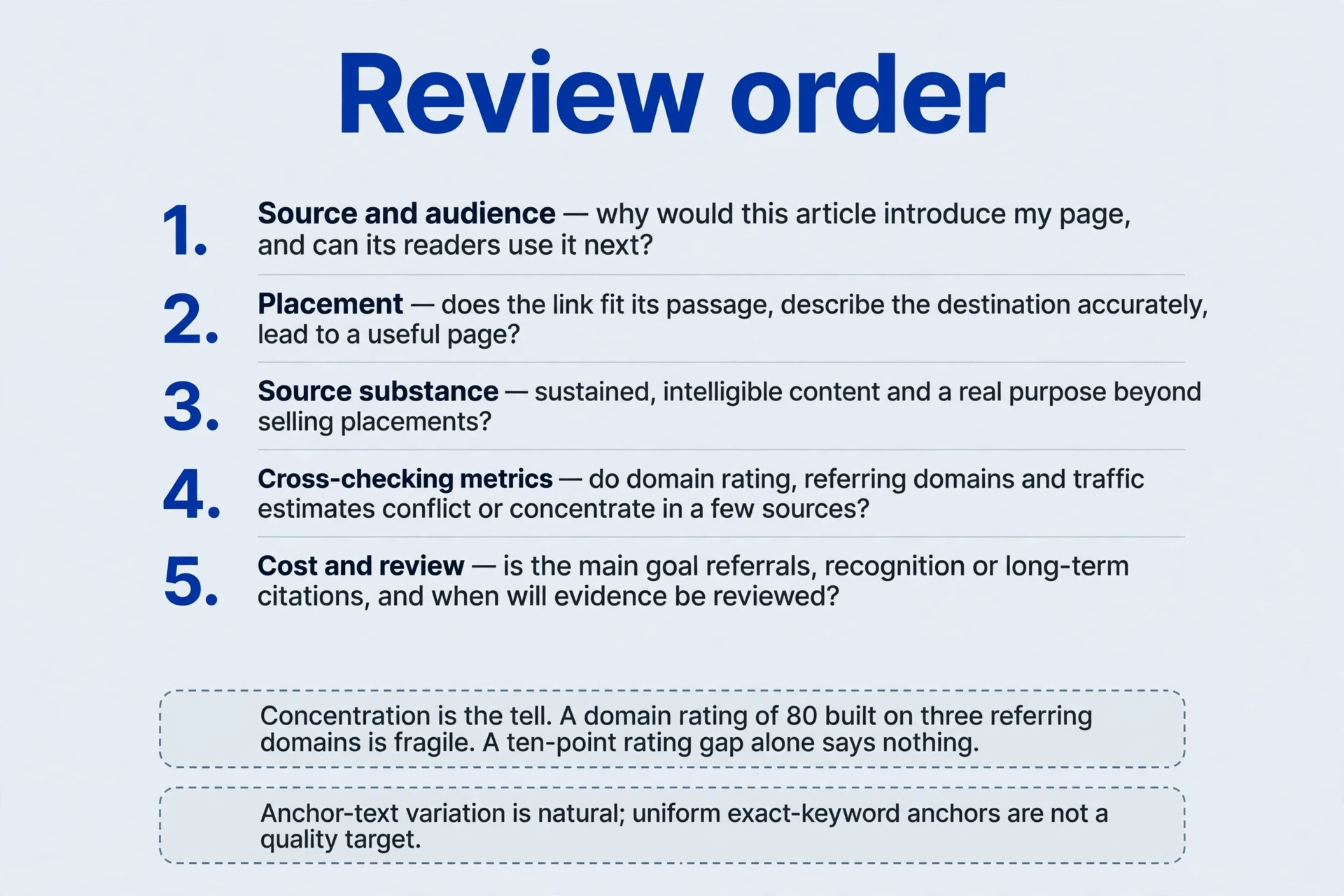
Cross-checking backlink metrics means hunting for concentration. A domain rating of 80 built on three referring domains is fragile — one lost backlink source removes a third of the foundation. A traffic estimate that triples in one month with no new content deserves a question about what changed: a viral page, a measurement shift, or bought traffic dressed as growth. Concentration is the tell. Healthy backlink profiles spread across sources, backlink destinations, and time. Concentrated ones lean on a few pillars, and pillars fall.

| Review order | Question to answer |
|---|---|
| Backlink source and audience | Why would this article introduce my page, and can its readers use it next? |
| Placement | Does the link fit its passage, describe the destination accurately, and lead to a useful page? |
| Backlink source substance | Is there sustained, intelligible content and a real purpose beyond selling placements? |
| Cross-checking metrics | Do domain rating, referring domains, and traffic estimates conflict or concentrate in a few backlink sources? |
| Cost and review | Is the main goal referrals, recognition, or long-term citations, and when will backlink evidence be reviewed? |
One more caution, from a case whose method was shared privately rather than documented in the public archive: a keyword difficulty of 81 and 374 referring domains sat alongside an accessible backlink technique nobody could reconstruct from the backlink evidence. There is insufficient evidence to rebuild a site list or a full procedure, and this lesson doesn’t invent one. Tool-based difficulty and backlink referring-domain counts don’t prove a technique works. When the method is private and the numbers are public, the numbers are the only part you can check — and they check the backlink outcome, not the method. Undisclosed methods stay undisclosed. Don’t buy a technique you can’t inspect.
Interpret link attributes and ranking claims in backlink context
A teaching simplification splits ranking into three ideas: title and heading establish candidacy, backlinks help reach the top ten, and experience determines position. Read it as a reminder to consider topic, citations, and use together — not as three independent algorithmic gates that operate in sequence. It doesn’t establish that backlinks guarantee a top-ten result, or that a revised title removes the need to inspect content, fetching, and competition. Simplifications teach. They don’t decide.
The same material discourages dismissing a link solely because it is nofollow. Relevant readers and brand exposure don’t disappear because of an attribute. A backlink community discussion that sends fifty qualified visitors to your tool delivered backlink value with or without a ranking signal. However, treating nofollow as a hint doesn’t guarantee ranking backlink value for every link, or make it identical to an unqualified link. Distinguish possible search treatment from observed referral backlink value. The referral value you can measure this week. The search treatment you can only infer, over months, mixed with everything else that changed. Measure what’s measurable. Note the rest as inference.
The search engine distinguishes three relationship values: sponsored identifies paid or sponsored relationships, ugc can identify user-generated content, and nofollow covers other backlink cases where endorsement is not intended. Values can be combined — a paid user-submitted link can carry two:
<a href="https://example.com/estimator" rel="sponsored ugc">Community member's sizing tool</a>The backlink attributes describe the relationship, not the backlink destination. They don’t switch destination indexing on or off, and they don’t launder a paid backlink placement into an editorial one. Paid advertising or sponsorship should disclose the relationship instead of promising ranking credit. Disclosure is the point of the backlink attribute. A sponsored link presented as an editorial recommendation misleads the reader, whatever the search treatment. Qualify the relationship honestly, and the reader decides what the link is worth.
The archive’s suggestion that a backlink approach is acceptable as long as it involves no intrusion is insufficient. Buying ranking credit, automated link creation, or paid promotional backlink placements with optimised anchors is not justified merely by the absence of intrusion. Intrusion was never the test. Manipulation is. If the link exists to simulate a recommendation that no editor made, the absence of spam comments doesn’t redeem it. No intrusion is not permission. Judge the link by whether a real reader, in that backlink context, would find it a genuine recommendation.
Choose a citation-worthy backlink destination before a channel
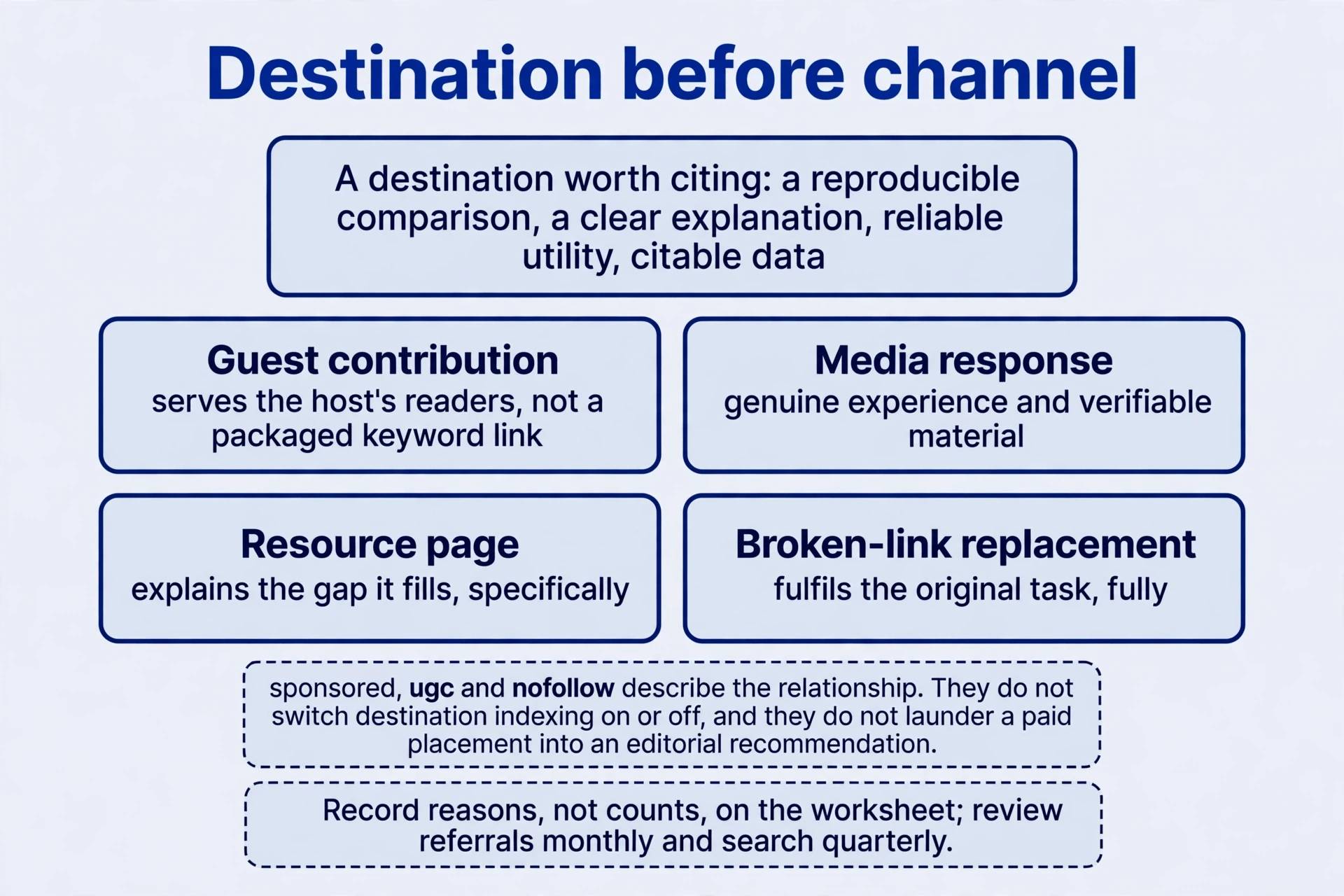
For a tool site, choose a backlink destination that stands on its own first: a reproducible comparison, a clear explanation, reliable utility, or citable data. Then find the content that would use it. Backlink destination before channel, always. Outreach without a citable backlink destination is asking for a favour with nothing to offer — and the rejections will say so, politely or not.
Four outreach contexts, each with its own test:
| Context | The test |
|---|---|
| Guest contribution | Does it serve the host’s readers, rather than package a keyword link? |
| Media response | Is there genuine experience and verifiable material behind the answer? |
| Resource page | Does the suggestion explain the missing contribution, specifically? |
| Broken-link replacement | Does the replacement fulfil the original task, fully? |
A guest contribution should serve the host’s readers. A media response needs genuine experience and verifiable material — a quote you can stand behind, data you can show. A resource-page suggestion should explain the missing contribution, not merely assert that your page belongs. A broken-link replacement should fulfil the original task, the one the dead link promised. If the backlink destination is unsuitable, improve it before treating a willing seller as a backlink opportunity. A seller’s willingness is not a backlink relevance signal.
The backlink source mentions guest-placement prices of $200–$400 and contrasts ten links with a thousand, or prominent media with ordinary blogs. These are the author’s contextual comparisons, not current quotations or fixed exchange rates. Prices move, markets differ, and a 2023 comparison doesn’t price a 2026 placement. Cheap bulk packages, domain-rating-only selection, and demands for exact-match anchors substitute attractive backlink counts for real citations. Fund the backlink destination and its content first, then evaluate a small set of relevant backlink sources — three to five, for one quarter, each with its own written rationale. Small is a discipline, not a limitation: each backlink source needs a tailored case, and tailored cases don’t scale to a hundred templated asks. Mass outreach produces mass rejection, or worse, mass acceptance from sellers who accept anything. Communities, video, media coverage, and backlink brand discussion can help people discover a product — but multichannel mentions don’t guarantee rankings or AI recommendations. Backlink Record sources, destinations, relevance, relationship attributes, costs, and expectations. Review referral use, brand response, and search changes separately. Three to six months may be a backlink review window, not a return guarantee. A window is when you look. A guarantee is a promise nobody made.
Practice choosing opportunities for a new tool
A teaching scenario, not a reported result. You have built an equipment-sizing estimator with a working calculation, example inputs, and clear limitations. Three potential sources emerge: a backlink renovation guide, a local homeowners’ discussion, and a seller offering a high-rating backlink technology-site placement. Before comparing prices, establish who would arrive, why they would click, and what they could do next. Price is the last backlink question, not the first.
A backlink renovation guide explaining preliminary room requirements may benefit from a usable example. Read its existing explanation, check that your method and limitations fit, then describe the precise contribution — the worked example, the backlink edge cases, the limits. If it already offers a better resource, your desire for a backlink doesn’t justify replacement. The outreach rationale is useful supplementation, not an available backlink placement. Supplementation means the guide gets better. Placement means you get a link. Lead with the first.
A local discussion may offer backlink value even with nofollow links. If someone is comparing equipment, explain why an estimate doesn’t replace an on-site backlink assessment, and share the tool only when relevant and permitted by the community’s rules. The first test is useful understanding and use, not promised ranking credit. Unrelated insertion or prohibited promotion defeats the reason for the backlink — the community’s trust is the asset, and spending it on an irrelevant link bankrupts the account that made the link valuable.
The backlink technology placement needs a clearer case: does the article discuss a relevant calculation, would its audience use the service, and how would payment be disclosed? High domain rating cannot supply missing backlink relevance. If you choose a suitable sponsored advertisement, assess referral and conversion goals rather than also booking a guaranteed organic-ranking gain. A sponsored backlink placement is advertising. Judge it as advertising: backlink cost per visitor, cost per completed calculation, cost per customer. The ranking gain, if any, is a bonus you didn’t pay for and can’t count on.
The worksheet should retain the reasoning, not merely “two new links.” Record the cited estimator, the backlink community question, the relationship attributes, and whether visitors completed calculations. When reviewing search performance, also note page edits or new content during the period. If several things changed, attribution to the newly acquired links alone is unwarranted. Backlink review on two cadences: referral use monthly, search changes quarterly. A community link that sends users who complete calculations proves itself in weeks. A backlink’s search contribution needs a quarter, and even then it shares credit with everything else that moved. Record the reasoning, not the backlink count. A worksheet that says why will teach the next round. A backlink count will only tempt it.
Turn backlink judgment into five answerable questions
-
Do 4,700 links in four days establish 4,700 recommending sites? No. The same report shows 33 referring domains — the difference between page-level links and backlink source sites. Deduplicate domains, then inspect citing pages, backlink distribution context, and destinations rather than copying the total. A launch story is a distribution story. Read it as one.
-
Should a relevant community link be rejected because it is nofollow? Examine whether community readers need the destination and whether the discussion fits. Referral and recognition backlink value can stand independently. Don’t guarantee ranking credit, and don’t automatically assign the link zero backlink value. The attribute describes the relationship. The readers decide the backlink value.
-
How would you assess a high-rating food site linking to a heating service? Look for a real connection: ventilation in a restaurant kitchen could fit, while an arbitrary keyword insertion would not. Review content, audience, placement, backlink destination, and paid relationships. The rating supplements this backlink judgment rather than replacing it. Backlink relevance is a sentence you can write, not a score you can read.
-
Does a high branded-traffic share make every topic term that site’s brand? No. The branded share and the classification of generic terms come from a third-party tool. They suggest a relationship between brand and topic demand, not the platform’s official classification or permanent first place. Tools classify. Platforms decide. Don’t confuse the two.
-
What makes a first backlink round evidence-based? Choose a useful destination, compare relevant citations to three main competitors, and approach a few justified sources. Backlink Record attributes, cost, and expectations, then review referral, brand, and backlink search evidence separately. No immediate sale doesn’t mean no value — but absent evidence doesn’t justify unlimited spending. Set the review date before the first dollar goes out.
A backlink is a recommendation, and recommendations are judged by their reasons. Backlink Build destinations worth recommending, place them where readers need them, record what happened, and let the evidence — not the count — decide the next round.
Comments
Join the conversation. Comments are reviewed before appearing.
Loading comments…