A site can look successful because its content covers many questions, because users remember its brand, or because a third-party database began tracking more keywords. The six cases below site examine categories, news timeliness, tool pages, brand identity, URL migration, and acquisition channels. For each, record the object, data source, period, and alternative explanations before choosing actions for your site.
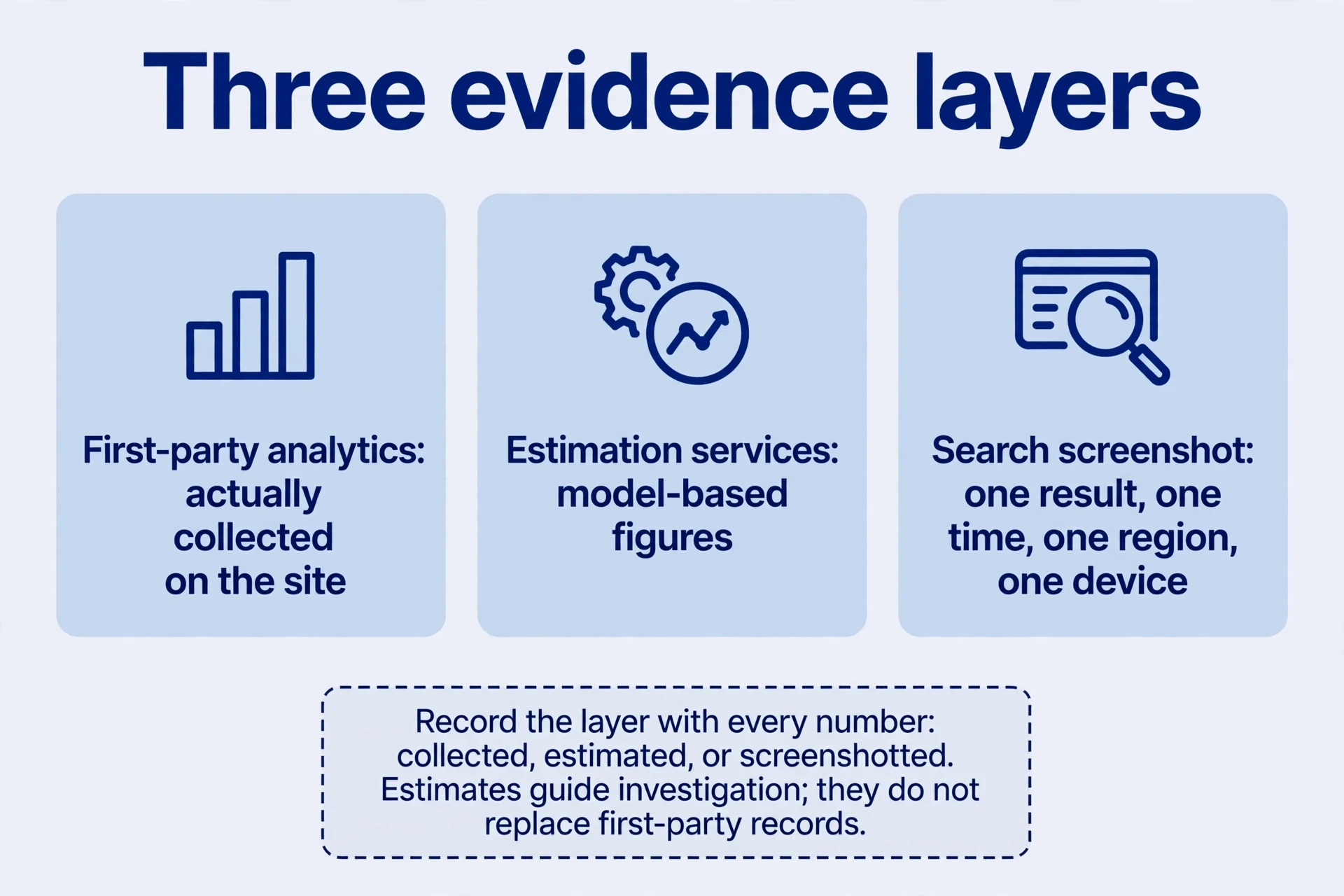
Distinguish three evidence types. First-party analytics record the site measurements actually collected on the site. Estimation services provide model-based figures. A search screenshot records one result at one time, region, and device. Estimates guide site investigation. Record the layer with every number: collected, estimated, or screenshotted. All numbers are historical.
Explain a topic through site categories and assess click opportunity
A classical-Chinese reference site offers the first lesson in categorisation. Its domain was registered in 2008. Domain age is the registration date; the site dates to May 2020. Estimated visits in the latest three months were 1.72M, 1.69M, and 1.4M, already declining, with 89% attributed to search. Two search engines’ result interfaces then showed roughly 4.84M and 1.93M indexed results. Read the counts as rough clues for how much is indexed.
One estimation service put daily visits from the Chinese search engine at 150K–390K. For one idiom query — overcoming obstacles — the site appeared first among ordinary web results but below an encyclopedia answer panel. The position-based click estimate looked too high, so a 20% reduction was proposed, giving roughly 30K daily. Estimate clicks from the actual site result page, not from a universal rate. Answer panels, news, video, and ads all shape the actual click opportunity on the site result page.
The useful pattern is how the idiom site home page explains “a complete idiom collection.” It groups idioms by zodiac animals, seasons, numbers, animals, plants, colours, and directions; by forms such as AABB, ABAB, A-li-AB, and AABC; and by structures such as coordinate, subject-predicate, and compound sentences. The page also offers length and initial-letter site navigation. Each label need not repeat the word idiom. The taxonomy shows readers what exists and where to go. A 2014 site comparison article uses the same principle, listing number idioms, animal names such as rat, ox, and tiger, plants, and body parts, then real entries. Meaningful categorisation plus actual site content beats repeating a term — site categories, not keywords.

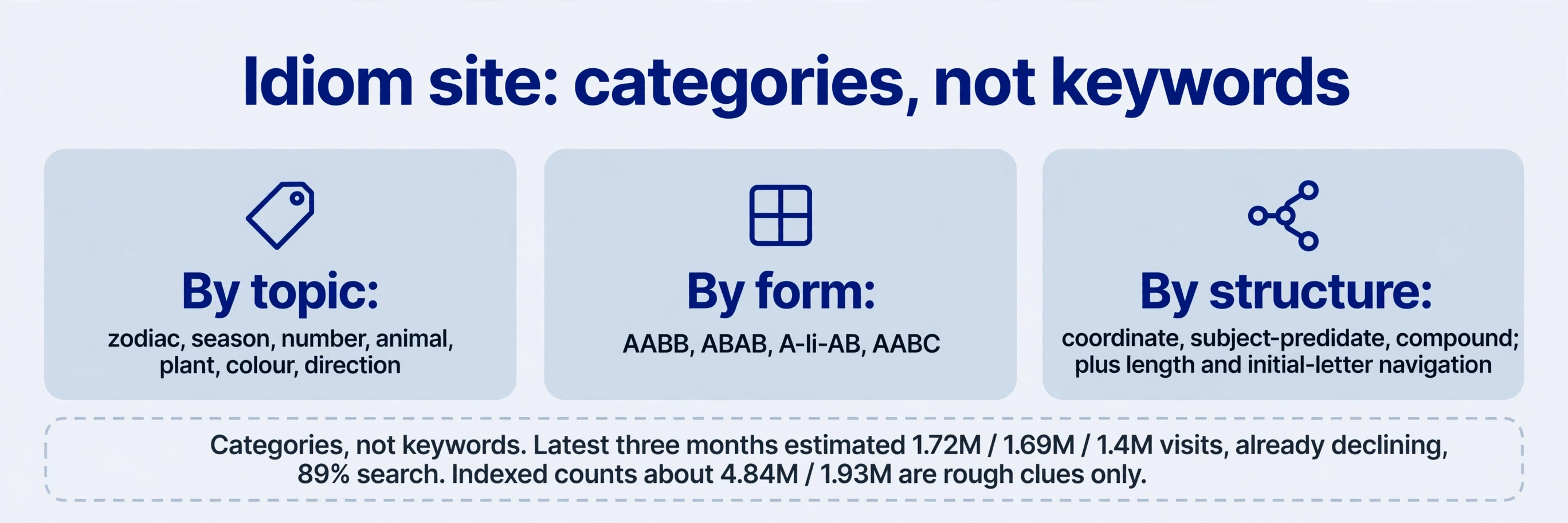
Historical positions cover two queries: about fourth for the broad site idiom query and first for the site complete-collection query. Evaluate which questions the taxonomy covers, the clicks actually available on the result page, and the quality of detail pages.
The site places its dictionary, lexicon, and idiom sections on separate subdomains. A 2023 opinion credited subdomains with more authority than directories. Take it as one 2023 opinion; decide by topic independence, ownership, branding, and site navigation. Start an improvement project by site mapping categories and paths, checking useful entries, detailed explanations, and related content, then choose the technical structure.
Timely coverage requires an editorial process, not cosmetic dates
A 2024 analysis of a major news outlet’s election coverage concerns surging site news queries — two candidates’ names and election 2024 — rather than ordinary tool terms. Seven observed actions: new daily site live-page URLs, dates in URLs, LiveBlogPosting markup, continuing news updates, timestamp updates, clear relevant images, and home-page links to priority coverage. The transferable lesson is an editorial and discovery workflow, not daily Site URLs as a template for every site.
Read the first two actions together. October 13, 14, and 15 had separate dated live site pages, each collecting that day’s events. URL dates help identify archives. Creating a new URL for unchanged site content fragments references and maintenance. Older site pages stay eligible; check the current carousel behaviour before assuming a 24-hour cutoff.
Actions three through five form a genuine site update record. LiveBlogPosting describes ongoing rolling coverage and can specify coverage start time, coverage end time, and individual updates. One estimate put daily updates at forty to fifty; one archived site page shows 51 posts. Individual updates carry timestamps, and the site page time follows substantive updates. Top Stories has no structured-data requirement, and the markup does not by itself add a Live badge. The modified date should change only with substantive new information.
The sixth action is a clear, relevant candidate image that helps readers identify the story. Images help readers identify the story; the site update record does the rest. The seventh is a trending-topics home-page link to the election coverage and other priorities, exposing updates to readers and crawlers. Linking supports discovery; crawling and indexing still need checking. A small team covering an ongoing event can maintain a real narrative, evidence for changes, clear dates, accurate markup, and crawlable links. Without sustained editorial capacity, a useful site summary page may fit better than a live site page updated for show — substance first.

Turn brand capabilities into specific task entry points
A 2025 analysis explains site growth in a note-taking product’s estimated organic search by the addition of dozens of AI rewriting, transcription, and related site tool pages. Some pages started in March, others in April, and a surge followed in June. Archived curves also show different Site URLs growing at different times later on. Give each site URL its own launch date. A “new” status in a backlink tool’s database is a comparative data status; check the publication date separately.
These site pages do more than announce that the product has AI. Each matches a need and an output: rewriting handles rewording; audio-to-text and video-to-text handle transcription; image-to-text and link-to-text expand input types; text-to-voice, detector, and PDF conversion serve other tasks. Spanish, Portuguese, German, and Italian site pages extend the capabilities to other expressions and markets. Assess real task completion and independent site page value alongside page counts.
The sample below records twenty-three URLs with site traffic estimates from an image dated 26 September 2025. All are tool estimates. Another page-list screenshot shows 10,586 pages and total traffic of 1.1M, covering the tool’s site-wide page list, not just these twenty-three pages. Keep the 23 rows and the site-wide list separate; neither sums to unique users.
| Path | Traffic estimate |
|---|---|
| /ai-rewrite/reword/humanize | 171,975 |
| /es-es/ai-transcribe/audio-to-text | 82,303 |
| /ai-transcribe/video-to-text | 80,399 |
| /ai-text-to-voice | 73,145 |
| /es-es/ai-transcribe/video-to-text | 65,052 |
| /ai-transcribe/audio-to-text | 48,689 |
| /pt-br/ai-transcribe/audio-to-text | 44,731 |
| /es-es/ai-rewrite/reword/humanize | 26,646 |
| /es-es/ai-detector | 24,962 |
| /pt-br/ai-transcribe/video-to-text | 23,629 |
| /es-es/ai-transcribe/image-to-text | 18,846 |
| /pt-br/ai-detector | 14,839 |
| /ai-transcribe | 14,332 |
| /ai-transcribe/link-to-text | 13,080 |
| /pt-br/ai-transcribe/image-to-text | 8,030 |
| /ai-transcribe/image-to-text | 4,816 |
| /ai-detector | 4,727 |
| /de-de/ai-transcribe | 3,202 |
| /pt-br/ai-rewrite/reword/humanize | 3,097 |
| /pt-br/ai-transcribe | 2,194 |
| /it-it/ai-transcribe/link-to-text | 2,191 |
| /it-it/ai-transcribe/audio-to-text | 1,262 |
| /it-it/ai-rewrite/reword/humanize | 1,023 |
The other page list also preserves traffic estimates of 26,212 for image-to-PDF conversion, 37,740 for the Japanese site home page, 21,089 for the Portuguese site home page, and 20,820 for the Spanish site home page. These are comparison items, not additions to the twenty-three rows or the site total. Examine task pages, language home pages, and the general entry point together instead of selecting only the largest value.
The sample shows large differences for audio-to-text across languages, so tasks and markets need separate evaluation. The rewriting site page’s estimate even exceeds the screenshot’s 170,068 for the site home page. The working cycle runs: choose one real task, complete the feature, explanation, examples, and related paths, observe page-level search and completion events, then plan the next cycle — one task, one site page, one cycle. New pages start without that site brand history; plan for a slower build.
First reconstruct separate site timelines for both domains
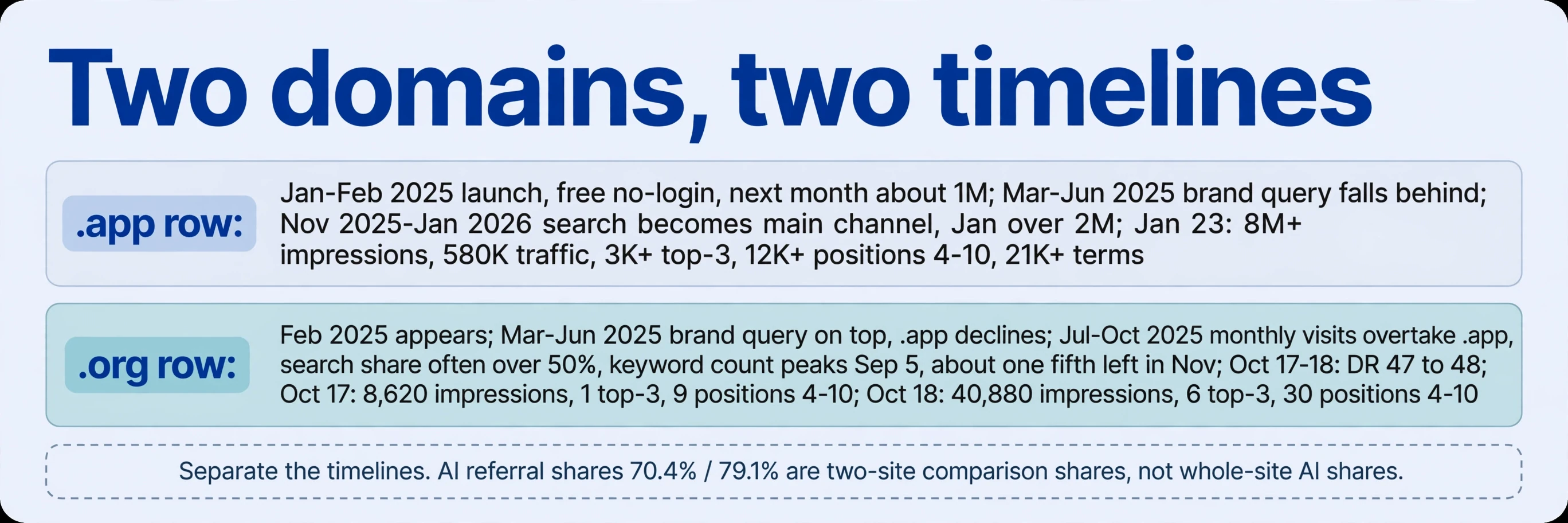
A long case study built from estimation services and site page observations follows two easily confused AI image sites: one on a .app domain, an AI image product, and another on a .org domain. Brand confusion is an evidence question: compare rankings, names, and entity classifications, then check site ownership records.
| Period | Reported phenomena | Reading limit |
|---|---|---|
| Jan–Feb 2025 | .app launched in January with free no-login generation and paid advanced site features; reported visits reached about 1M the next month. Domain rating reached 22 early, with discussion-board and user references. The .org site appeared in February, described as free site traffic monetised by ads and many popups, with video and social promotion | Visits are estimates. Check paid promotion and conversion with site first-party records |
| Mar–Jun 2025 | .org held top or first positions for the site brand query; .app visits declined. April 16 versus October 16 comparisons show different market-specific positions | Positions are market-, date-, and query-specific; verify displaced clicks in Search Console |
| Jul–Oct 2025 | In one estimation service, .org monthly visits overtook .app; .org search share stayed generally above 50% from launch while .app was mainly direct. The .org ranking-keyword count peaked around September 5 and stood at roughly one fifth of that peak in November | Opposing totals site warrant investigation; do not assume a one-to-one transfer |
| Oct 16–18, 2025 | Domain rating moved 47→48. October 17 showed an estimated 8,620 impressions and one top-three term, plus nine terms in positions 4–10. October 18 showed 40,880 estimated impressions, six top-three terms, and thirty in positions 4–10 | These are tool-database estimates; confirm in Search Console. Concurrent new links are candidate factors only |
| Nov 2025–Jan 2026 | Search share rose for .app, becoming its main channel in December; reported January visits exceeded 2M. Brand terms moved from outside thirty to first, and two generic site image-generator queries reached the top ten or twenty across markets. On January 23 one tool estimated 8M+ impressions, 580site K traffic, 3K+ top-three terms, 12K+ terms in positions 4–10, and 21K+ total terms | 70% is the share of top-ten keywords; check registrations and payments separately |
Finer keyword comparisons show roughly 5K ranking terms for .org, with its top-volume terms centred on the site brand query. Some .app brand terms sat outside the top ten in April, with some smaller-language brand rankings lost by October. Smaller-language and lower-difficulty top-ten results appeared on October 17–18, followed by broader European and US visibility and harder site queries, focusing on difficulty-90+ terms such as the generic site image-generator query. The difficulty score is a tool metric. Treat the market sequence as a lead to investigate.
Separate AI referrals as well. The .org site led on two AI answer services’ referral site traffic in August–October 2025, with .app improving in November. In January 2026, one service’s row assigns about 70.4% of the two-site comparison to .app, and the other about 79.1%. These are competitive shares for specified referrers, not a claim that 70% of all site .app traffic came from AI. AI referrals and search moving together is a lead to investigate shared discoverability, not a rule about every AI service. The search engine describes retrieval augmentation and query fan-out for its own generative search, supporting continued work on discoverable, usable, distinctive site content. Use that description for the search engine’s own generative search only; a rank does not guarantee a citation. Track branded search, nonbranded search, AI referrals, direct visits, registrations, and payments as separate series — separate the timelines.
Clarify identity without treating a score as an ownership switch
The useful work is examining evidence layer by layer. The researcher saw the brand name as the .org site’s first-line site name while .app showed its domain, and recorded similar title and description text, familiar favicons, supposed app-download buttons returning to the site home page, and a video creator pinning the correct domain. A university resource screenshot also mixes an .app URL with the other site’s icon. These observations support possible user confusion. Whether a download button delivers the promised app is a directly testable product question.
Social channels provide a separate line of evidence. A video platform became the .org site’s largest social referrer from April 2025 in one estimation service, with promotional site content and clarifying comments visible in search and on the platform. A useful funnel runs: see a video, remember a name and icon, search, identify the domain, use the feature. Videos are one step in the funnel; validate each step with clicks, surveys, and site behaviour records.
An actionable fix is consistent names, domains, site home-page copy, icons, about information, official accounts, and genuine download destinations. Provide verifiable URLs, product images, and organisation details when a partner’s listing is confused. Home-page WebSite markup can express name, URL, and an optional alternate name, with Organisation markup describing the real organisation. The search engine generates site names automatically using the site home page and references across the web. Markup expresses a preference; the platform still generates the site name. If the name is not selected, check consistency, crawlability, and syntax, then allow recrawling and recheck.
Separate facts and hypotheses in the link analysis too. September brought references from an indie-maker community and an art community — the latter then described as having 93M monthly visits — two discussion-board appearances, and new links between October 1 and 16. A backlink tool first saw a university link on October 15, showing domain rating 69; a publishing platform at rating 85 also had a followed link. The hypothesis runs that the university link pushed the rating to 48 and triggered platform recognition. “First seen” is the tool’s first sighting; check publication and discovery dates separately. Concurrent changes and database coverage remain alternatives. Treat the university link as a hypothesis, not a cause. Timeline correlation starts a site investigation; the method closes it.
Domain rating is the backlink tool’s relative logarithmic metric on a 0–100 scale, largely based on unique referring domains with followed links, their relative strength, and how many other domains they link to. A thousand links from one domain are not a thousand rating contributions; source strength and outbound breadth matter separately. Read the scale as relative; judge a link by its source, not its suffix. The rating’s decline from 48 to 45 in January while site traffic stayed high reinforces avoiding a single-score target.
The prose compares more than three minutes on .app with under one and a half on .org, while one archived result-page plugin actually shows about 3:02 and 1:42. Dates and scope are unclear, so preserve the discrepancy. Third-party visit duration varies naturally by task. Check completion, satisfaction, and retention directly.
Ranking uses multiple page and site signals. Keep exact-match, schema, and site category claims as hypotheses; test them against demand, pages, indexing, markets, and database changes.
Product iteration offers firmer actions: continued free, high-quality generation, uncrop, AI video, localisation, and site performance work, plus open-model research, tuning, automation, and more than nine hundred generation styles. An ecommerce site comparison in the case has limits too: after copied materials and molds in early 2024, the seller focused on new products, differentiated site positioning, and existing customer needs, eventually operating four shops with repeat buyers. It is one seller’s story, not a controlled site experiment; the lesson is to keep iterating after the copy. Validate value through completion, retention, referrals, payments, and costs.
Treat an observed site URL combination as a hypothesis to test
A June 2026 article examines an academic AI search site. Its prose gives about 5.1M monthly visits, while a result-page plugin in another image shows 5.74M. Keep the two figures in their own dates and sources. The earlier architecture used a site marketing home page and a /search/ site product page. The current home page offered search with the old site /search/ content and functionality; its canonical pointed to /search/, which redirected to the site home page with a 307 status. The archived “core evidence” images are explanatory cards. Read the cards as explanations; full response logs would settle the redirect chain.
The author’s explanation is retaining accumulated value on the old site product URL while making the root immediately usable: a crawler requests /search/, follows the 307 to the site home page, and sees a canonical preference for /search/; a user clicking the old result also reaches the working site home page. Official guidance supports the possibility that temporary redirects retain the source in results, but the platform still evaluates the final canonical across signals. Test the combination: check what the crawler and the user each reach, what the selected canonical is, and whether rankings hold.
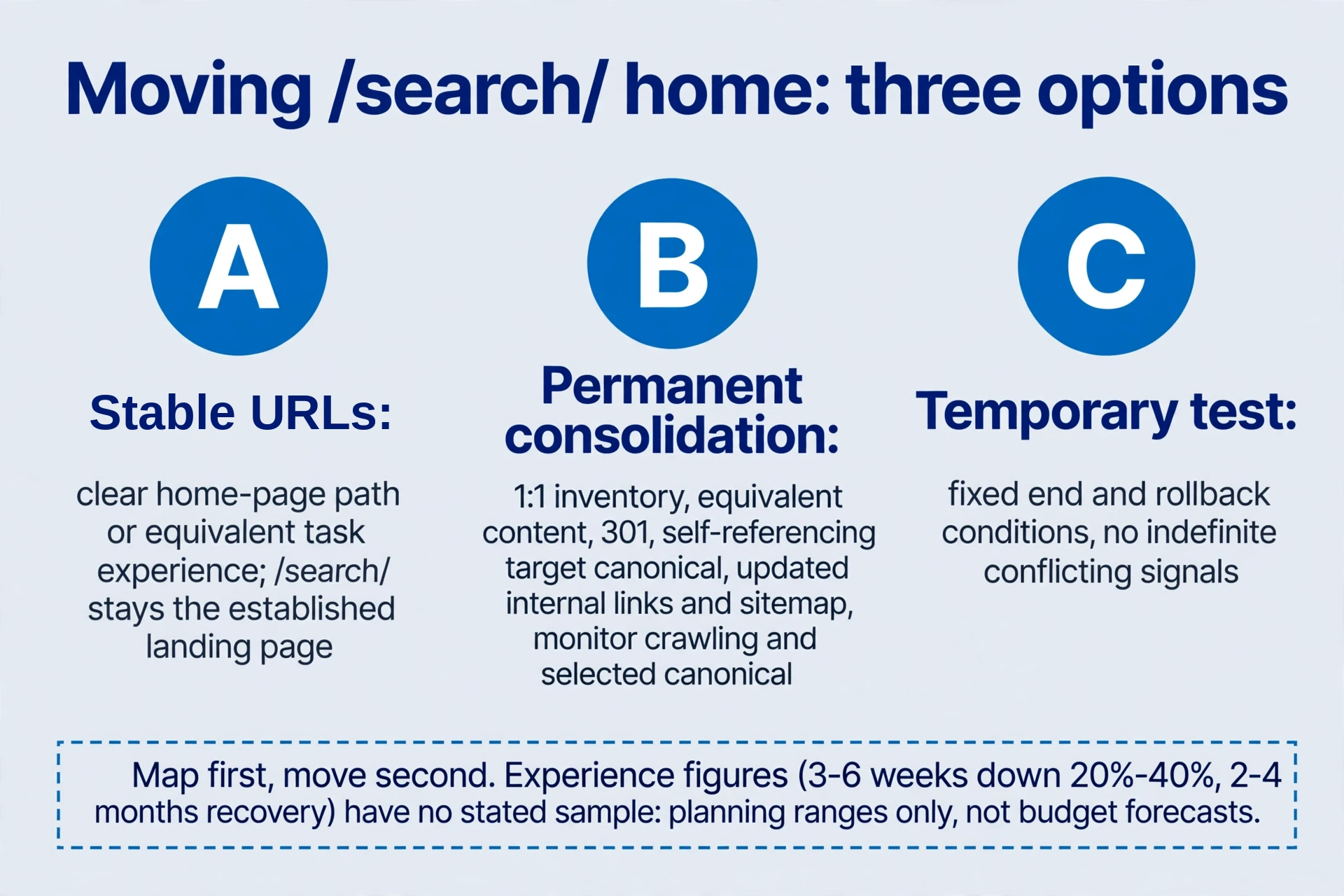
Experience-based numbers follow: the old index for weeks one to two, a 20%–40% drop in weeks three to six, recovery in two to four months; one to two weeks of loss for a new site, a 30% drop and three-month recovery for a six-month site, difficult six-month recovery for a two-year site, reluctance to change a five-year site; and 60%–80% of links naturally going to the site home page. These numbers have no stated sample; use them as planning ranges, not budget forecasts. Settle click, duration, and conversion claims with the site’s own data. Assess migration risk from important URLs, links, traffic, server capacity, and scope rather than an age-based loss table.
Platform guidance states permanent redirects signal a target canonical, while a temporary redirect does not itself signal that the target should become canonical. Permanent redirects such as 301 cause no PageRank loss, although visibility can fluctuate during site migration processing. For a real permanent /search/-to-home move, map Site URLs one to one, verify equivalent site content, update self-referencing target canonicals, internal links, sitemaps, and language annotations, keep suitable permanent redirects, and monitor crawling, selected canonicals, and search changes for source and target. For a temporary product test, define an end and rollback condition rather than creating indefinite conflicting signals to imitate a case. A small team prevents most of this pain by defining the core landing task early — map first, move second: a single tool may benefit from immediate home-page use and one fewer click, while a multi-feature brand needs clear site task pages and loses nothing inherently from a /tools/ path. Links distribute references through actual relationships, not a fixed deduction per slash.
A $10K brand site: review SEO, ads, and profit separately
A July 2026 review concerns an unnamed all-in-one image and video tool. Here a brand site uses its own name and domain rather than a model or need keyword. Its first seven monthly revenues were $6K, $8K, $5K, $6K, $7K, $7K, and $10K: a decline in month three, several months at $5K–$8K, then a breakthrough in month seven. Site growth was not linear. $10K is revenue before advertising, model, payment, and staffing costs. Revenue is not profit.
The author identifies two causes of stagnation: inconsistent site link work and periods of neglect, and too many campaigns during cold start, which he believed confused audience learning and led him to pause ads. Take the campaign claim as the author’s account-review interpretation; test it with per-campaign budgets. The practical lessons are clear site ownership, concentrated resources, and defined goals, conversion events, landing site pages, and affordable costs before each test, reducing variables the team cannot explain.
The site SEO evidence is a weekly search-console chart with 141K clicks, 1.67M impressions, 8.4% CTR, and 10.3 average position. The author says a dedicated person began buying paid links in mid-July, though resources remained spread across projects. The text does not align that July, the publication year, and the seven revenue months, so invent no calendar. Continued site task pages and internal connections are site reviewable work. Do not buy links by default; use appropriate relationship attributes for paid and sponsored links.
The paid-search site learning timeline exposes a management issue. After advice in April 2024, a community member ran ads in that member’s account. In early 2025, despite recognising its importance, the author still delegated part-time to a former colleague. The narrative says he discovered the old site strategy problem only after running from June to early October, reduced the old budget in mid-October, then studied advertising in person in two cities. A new-site exercise achieved cold start within a week and spent up to $8K in one day. That was another site’s spending, not this brand’s profit. After practising on several sites, he closed the brand’s old account before a meeting and ran a new one for two weeks with daily orders, while return on investment was not yet fully positive. The month-seven revenue increase followed these concurrent actions.
Closing and reopening an account is one team’s move, not a reset rule. Account compliance and platform rules still apply. A sound site teaching plan preserves budgets, creative, audiences, conversions, revenue, and costs; limits test spending and site observation windows; and compares cost per paying user, refunds, repeat purchases, and contribution profit. SEO supports lasting discoverability while paid search can provide faster user and conversion feedback. Both depend on fulfilling a task users will pay for. Translate “start ads early and continue pages and links” into timely small site experiments and a steady delivery rhythm, rather than indiscriminate site pages, link purchases, or spending — small tests, steady rhythm.
Practice: turn cases into evidence and an implementation plan
-
How would you design site categories without merely repeating keywords? Teaching example: organise English-learning materials by task — listening, writing, vocabulary — then by level and format into maintainable collections. Include real materials, selection criteria, examples, and detail links; avoid empty site categories. Borrow the semantic, pattern, and structural classification from the reference-site case, then test whether readers can find suitable material within two clicks. Choose directories or subdomains for organisation and maintenance rather than an assumed site authority bonus.
-
Can a site page imitate the news outlet if only its timestamp changed? Record substantive new facts, reporting sources, and individual update times first. Consider live coverage only for an ongoing event, and daily site archive pages only when the real schedule warrants them. Align visible dates with published and modified dates, provide relevant images, and link from the site home page. Review new information, date accuracy, HTTP status, and discovery rather than promising results from forty to fifty updates, a new site URL every twenty-four hours, or a Live badge.
-
How would you choose the first site tool pages from the note-product sample? Choose tasks your product genuinely supports, such as audio-to-text and video-to-text. Give each distinct inputs, outputs, site examples, limits, steps, and working functionality, linked to the transcription hub and related tasks. Validate language in the target market rather than copying every path. Test completion before launch and measure URL-level search, completion, and registration afterward. The 171,975 figure is a historical estimate, not a launch target; check the publication date separately.
-
If a similarly named site ranks above yours, what should you deliver first? Build a site identity and confusion evidence pack: records supporting the organisation and domain, your site home page, accounts, and download list, dated region-specific result screenshots, and site partner pages with exact errors. Then fix your own name and WebSite preference, provide verifiable information to relevant partners, and test whether users recognise the destination and reach real functionality. Build the evidence pack first; ranking alone does not settle brand rights. The rating move from 47 to 48 and a university link are timeline correlations, not an algorithm unlock. Track AI-referrer competitive shares separately from the site’s total AI channel share.
-
How would you propose two options for moving a successful site /search/ feature home? Option A keeps URLs stable: provide a clear home-page path or equivalent site task experience while retaining /search/ as the established site landing page, reviewing duplicates and canonical signals. Option B permanently consolidates: inventory important old Site URLs, equivalent destinations, and links; use suitable permanent redirects, self-referencing target canonicals, and updated internal links and sitemaps; back up, assign monitoring ownership, and define failure rollback. Temporary redirects need a real temporary test and end condition. Validate responses, search-console-selected canonicals, and completion rather than promising a fixed 30% loss on a permanent redirect or ranking preservation on a temporary one.
-
A brand earned $10K in month seven. How much more ad budget should it receive? The site record supports no budget amount. Split SEO, paid, and other channels; collect ad spend, model costs, payment fees and refunds, orders, and repeat purchases; calculate contribution profit and cost per paying user. Separate month-seven revenue from future net cash. An illustrative site plan is one affordable small test, one landing task, and a correct conversion event, with a predefined limit and stopping condition before scaling.
Read the layer, test the mechanism, choose the site plan — in that order. A case earns its lesson only when its numbers keep their windows and its claims keep their site evidence.
Comments
Join the conversation. Comments are reviewed before appearing.
Loading comments…