Tool-site growth stories create two illusions: a ranking gain must come from the latest code change, and a large growth number in another article must be the same site’s later result. Separate sites, dates, and growth metrics first. Then identify actions worth testing.
The thread: verify the opportunity, execute by intent, review with comparable windows.
Put each case back in its own growth measurement window
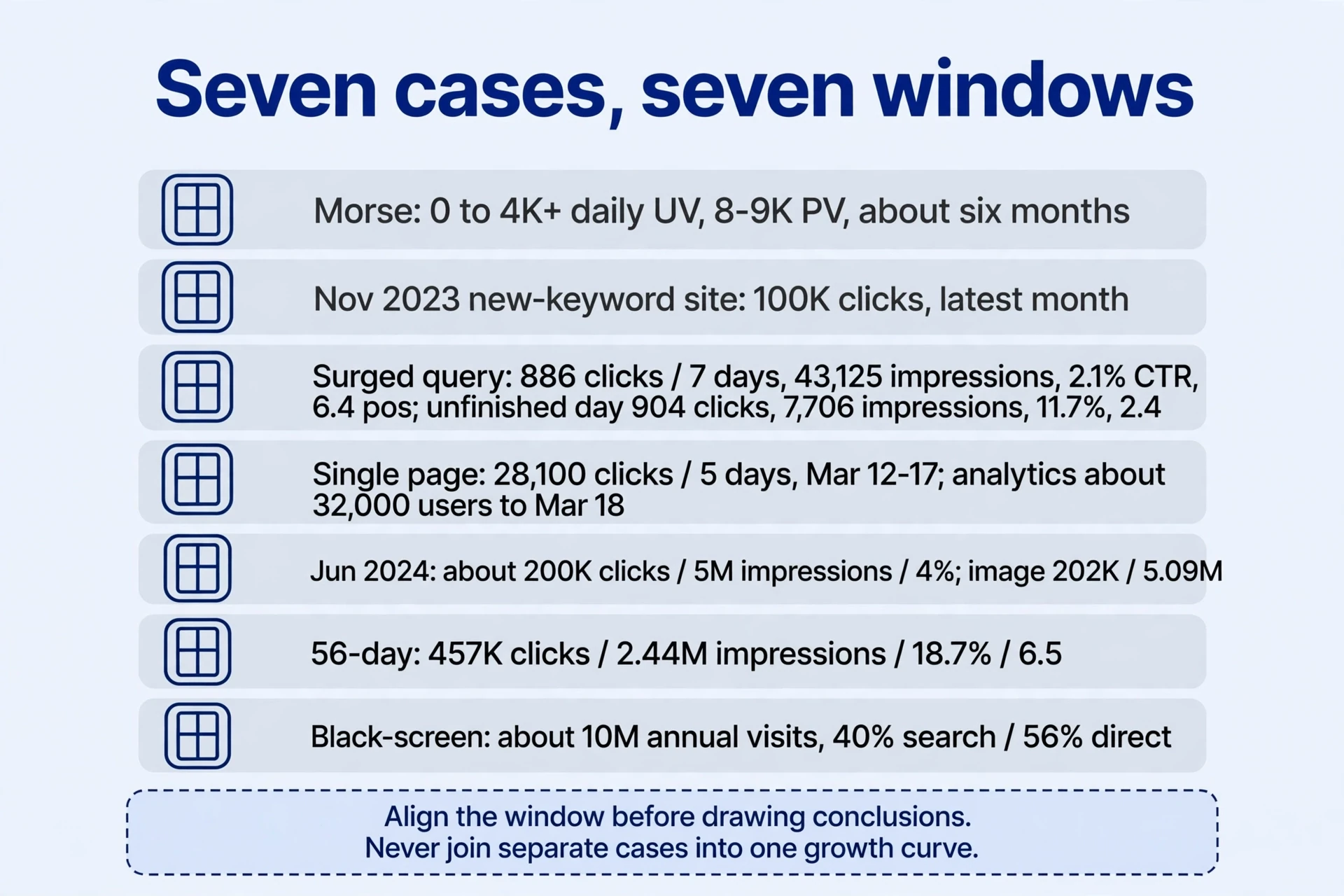
Seven cases, seven windows. Read each row on its own terms before comparing anything.
| Case | Result on record | Reading rule |
|---|---|---|
| Morse Code tool, established keyword, date unknown | Zero to 4K+ daily UV and 8–9K PV over roughly six months; later prose says about 4–5K users; the introduction describes 4,000+ daily visits from search | The only successful site among roughly 10–20 the owner built. UV, users, and search clicks are three different counts |
| Unnamed new-keyword site, Nov 2023 | 100K search clicks in the latest month; another site reached 10K daily UV | Two cases. Compare monthly clicks with monthly clicks and daily UV with daily UV, within matching windows |
| Surged query, Mar 2024 | Title says 1,000 additional daily UV; the body shows 886 clicks for one query over seven days and 904 clicks on an unfinished day | Title and screenshots use different growth metrics. Record 1,000+ full-day clicks and the extra 2,000–3,000 at position one as forecasts; record 886 and 904 as measured clicks |
| Single-page launch, Mar 2024 | 28,100 search clicks in five days; an analytics screenshot shows about 32,000 users | The Search Console window covers March 12–17; the growth analytics window extends to March 18. Compare only within one window and one system. Record the difference as a window difference |
| Unnamed site, Jun 2024 | Roughly 200K clicks, 5M impressions, 4% CTR over three months; the image shows 202K and 5.09M | Record it as an independent case. Keep the prose’s rounded growth numbers alongside the screenshot’s precision |
| 56-day-old site, Jun 2024 | 457K Search Console clicks, 2.44M impressions, 18.7% CTR, 6.5 average position; domain registered May 1 | The screenshot filter spans the last three months while the site is 56 days old |
| Black-screen tool, Feb 2025 | Roughly 10M annual visits, about 40% from search and 56% direct | Record it as visits. The 40% and 56% are shares of visits |
Speed becomes interpretable once windows are separated. Launch time measures how long the product existed. The Search Console window identifies the selected search period. Analytics users are people recognised by that growth measurement system. The three are related. Convert between them only within one system and one window. The platform’s own documentation notes differences in growth metrics, time zones, attribution, and collection. Align the window — pages, countries, devices, and dates — before drawing conclusions.
An established keyword: validation, prototypes, and iteration
The Morse Code case answers whether an established keyword is still worth pursuing. An Android engineer first tried ecommerce on a content platform, found the business operations too broad, and moved to a tool better suited to an individual developer. Use only the relative sequence — late April, late May, late August, mid-October — and assign no calendar years. The reported sequence runs: development in late April, launch in late May, around 500+ daily clicks in late August, around 1,000 daily users in mid-October, and eventually roughly 4,000–5,000 daily users.
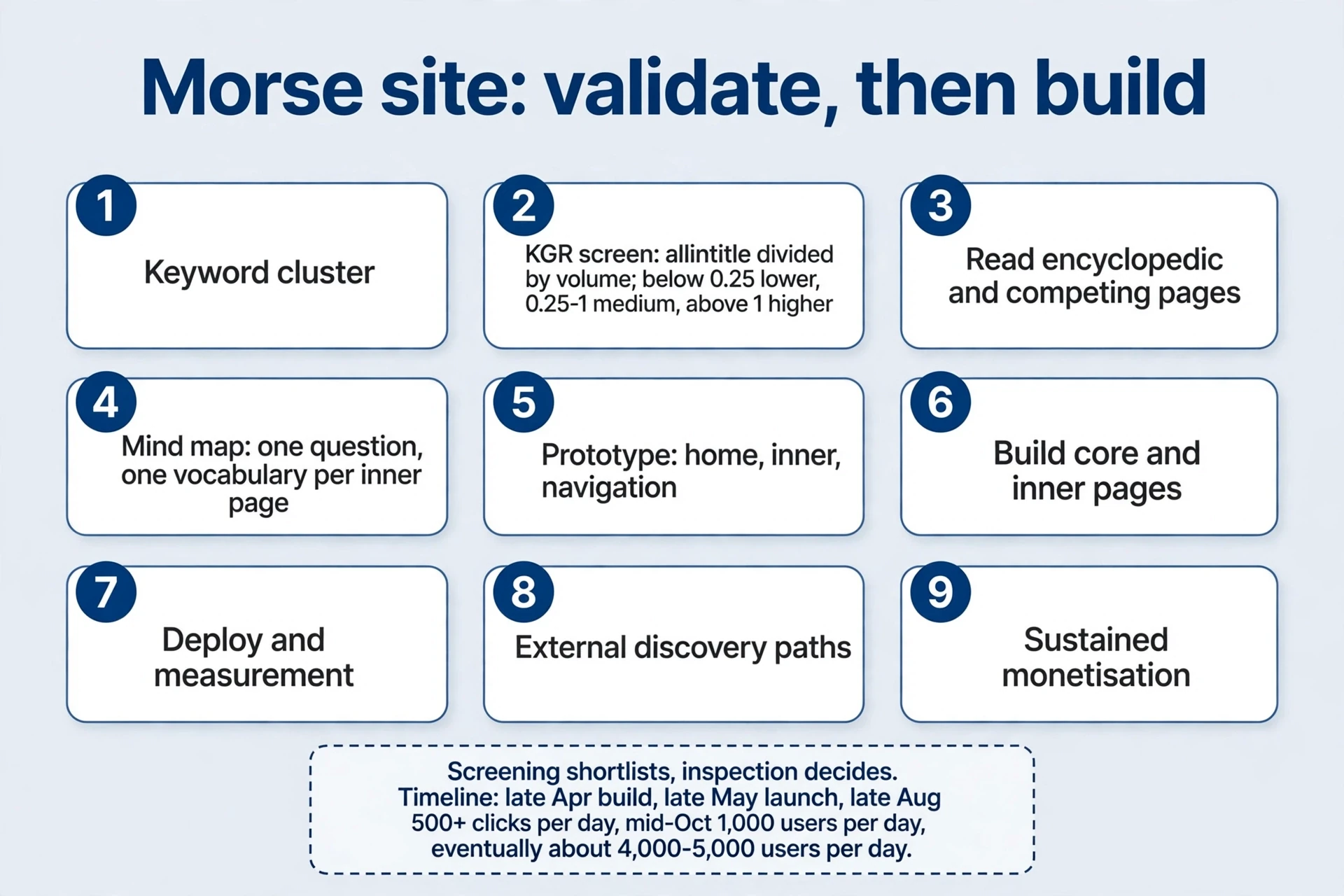
He began by validating a keyword cluster rather than coding immediately. After noticing Morse Code in a community case, he listed related high-volume terms in a keyword tool and calculated KGR for each: allintitle result count divided by the tool’s estimated search volume. His historical heuristic classified below 0.25 as lower difficulty, 0.25–1 as medium, and above 1 as higher. The head term scored higher while some long tails scored lower. Use KGR as a growth screening hypothesis only. Result counts and volume estimates fluctuate. Judge intent fit and ranking ability from the growth results page. Screening shortlists, inspection decides — the number shortlists, the growth results page decides.

He then read encyclopedic and competing pages to understand the topic, converted the exported keyword list into a mind map, and assigned a question and vocabulary to each inner page. Drawing on Android product development, he prototyped the main pages in a prototyping tool and used a leading tool site for the same task as a structural reference. The sequence is worth copying: map needs to pages, expose navigation and feature gaps in a prototype, then build core functionality and inner pages, deploy, install measurement, create external discovery paths, and only then work on sustained monetisation.
Growth was not immediate. Early traffic was only a few dozen clicks a day. He applied for an advertising account in late August, earned fractions of a dollar daily, switched ads off after a dozen or so days, then restored them around the National Day holiday. When traffic and revenue provided positive growth feedback in mid-October, he reviewed the content and found short pages resembling keyword stuffing, with self-reported keyword densities in the teens or twenties. He used an AI chatbot to rewrite every page around its core terms, and traffic grew again during that period. Fix unclear explanations and repetition. The rewrite and the growth happened in the same period. Record them as correlated, and test page by page before discussing cause.
For distribution, he initially posted on a product-launch site, two discussion platforms, and a few directories. He later collected roughly 100–200 possible submission sites but actually submitted to only around 10–20 directories. He described link building as a weakness and his domain authority as low. Keep the distinction between an opportunity list and growth work performed. Record only the 10–20 directories actually submitted. Growth opportunity lists and link counts stay in separate columns. The ending mentions another favourable ranking explanation discussed only in the community. Count submissions made, links earned, and pages improved — growth work performed, not lists.
Turn fifteen new-keyword tips into an execution sequence
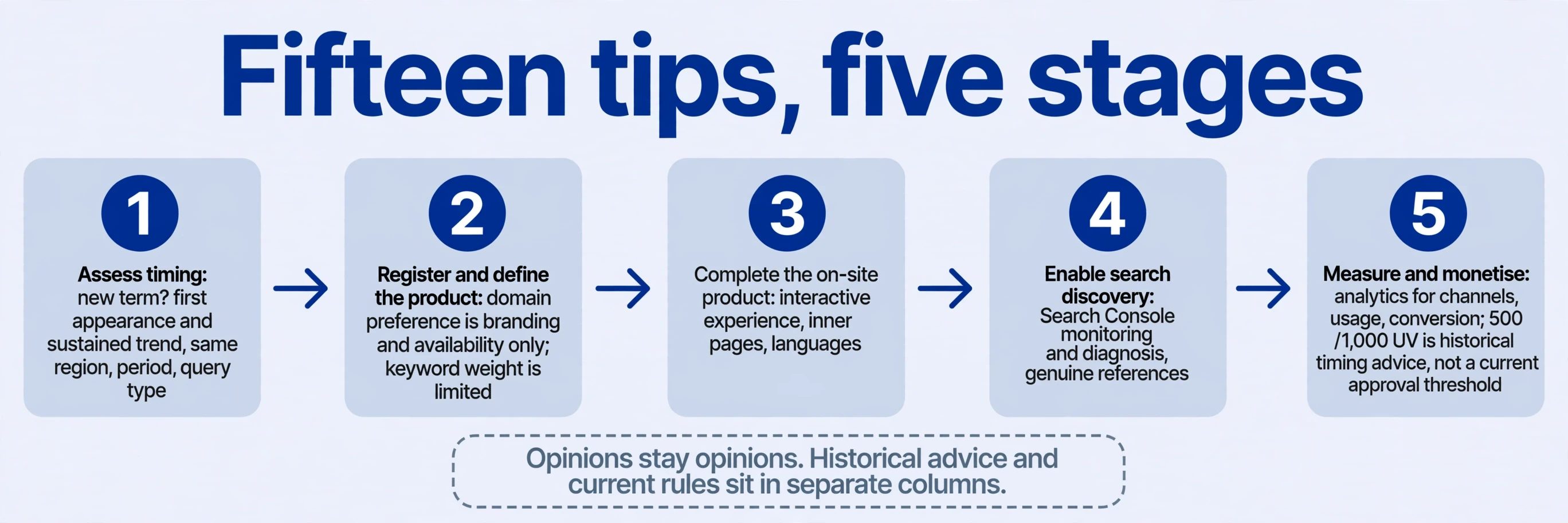
The new-keyword article reports 100K search clicks for one site in the latest month. Read it as one site, one month. Its fifteen growth tips arrange into five stages below. Historical ranking and advertising opinions are marked as such; current rules are stated separately. New terms can carry unsettled competition, sparse growth data, and rapidly changing intent. A single trend spike commits no entire budget.
Stage 1: assess timing — check whether the term is new. Check growth data coverage first, then compare the term with one of known volume. Record first appearance and sustained trend using consistent region, period, and query type. Relative interest helps estimate scale.
Stage 2: register and define the product — the author’s domain preference runs unhyphenated .com, then hyphenated .com, then .net or .org. Treat that order as a branding and availability preference. Establish whether users need to read, generate, convert, or experience something. Choose the suffix for branding and availability; judge ranking by content and intent fit. The search engine’s starter growth guide states domain keywords alone carry little ranking weight, and generic top-level domains follow no preference-based scoring order.
Stage 3: complete the on-site product — offer an interactive experience where useful. Add inner pages to explain the topic, link them sensibly, and add languages. The feature must complete a real task. Add pages for distinct growth questions or intents, provide crawlable paths, and maintain language versions for their audiences. Longer visits are observable behaviour. Set length by the task, with no universal word-count target.
Stage 4: enable search discovery — add the site to Search Console, consider other search engines for the target market, and build external links. Use Search Console for monitoring and growth diagnosis. Seek relevant, genuine references and distribution paths. Posting builds discovery paths; monitor indexing and clicks after.
Stage 5: measure and monetise — install analytics. The growth article links analytics with ranking and advertising-account approval, and suggests applying above 500 daily UV, preferably 1,000. Use analytics to assess channels, usage, and conversion. Check approval eligibility against current rules separately. The eligibility page lists no 500 or 1,000 threshold; the figures stay historical growth timing advice. For advertising approval, review original and useful content, policies, site control, and applicant eligibility. The checklist works when historical growth advice and current rules sit in separate columns — opinions stay opinions.
Five days on a single page: queries beyond the head term
The single-page timeline is specific: register the domain at 10 a.m. Beijing time on 13 March 2024, code until lunch, resume at 2 p.m., publish the finished page, and post in several places to create discovery links. Around 4 p.m. the author noticed it was indexed, before adding the site to Search Console. Reuse the process of logging publication, discovery, and first ranking.
The head term initially appeared on page eight, moved to page four, reached page two the following day, and then stalled. The author attributed the stall to a newly trending subject also covered by major media, making the head query difficult for a new site. Clicks came from related expressions of the same task: if the core term is A, people may search AB, ABC, or BA. The page matched these expressions and ranked well for several. One example query recorded 6.66K clicks, 14.2K impressions, and 2.2 average position over seven days. The author reported a recent first position, while the historical average had not immediately become one. Search Console totals for the growth launch window were 28.1K clicks and 194K impressions. Report 2.2 for that related query only.

When one page can fully solve a shared intent, complete it first. Create separate pages for genuinely different tasks, objects, or outputs. Growth review query clicks, impressions, CTR, and landing pages, and test the relevant feature. Watching only the head term misses productive long tails, while forcing every term into one page can undermine the core task. Shared intent, one page; different growth tasks earn different pages.
Links aid discovery, and sitemaps aid new or complex sites. Record each one’s role; neither guarantees crawling or indexing. Keep important URLs accessible and linked, and repair a failing sitemap you intend to use.
Queries already ranking: diagnose before editing or adding a page
A growth review needs a decision, not just a larger chart. Use the traffic-estimate and tool-metric checks to label the measurement, then inspect the internal links leading to the affected page. If a query already matches an existing task, improve that page and its entry routes before creating a second page for slightly different wording.
The surged-query case began with demand that had surged for more than a week. The existing site ranked and had many impressions but few clicks, so its owner considered making a dedicated page. Over seven days it recorded 43,125 impressions, 886 clicks, 2.1% CTR, and 6.4 average position — about 126 daily clicks. According to the author, a twenty-minute code change quickly appeared in search, with a manual growth check moving from sixth to second. The unfinished day’s row showed 904 clicks, 7,706 impressions, 11.7% CTR, and 2.4 average position. A manual second position and a 2.4 growth report average are compatible: one is a spot check, the other an average over many searches.
Start from a working growth hypothesis: filter the query and landing page, check intent fit, and inspect the main message, snippet, and functionality. Improve the existing page for a shared intent, and consider a new page for a distinct task. Preserve the earlier version, deployment time, and crawl evidence, then assess complete, comparable growth windows.
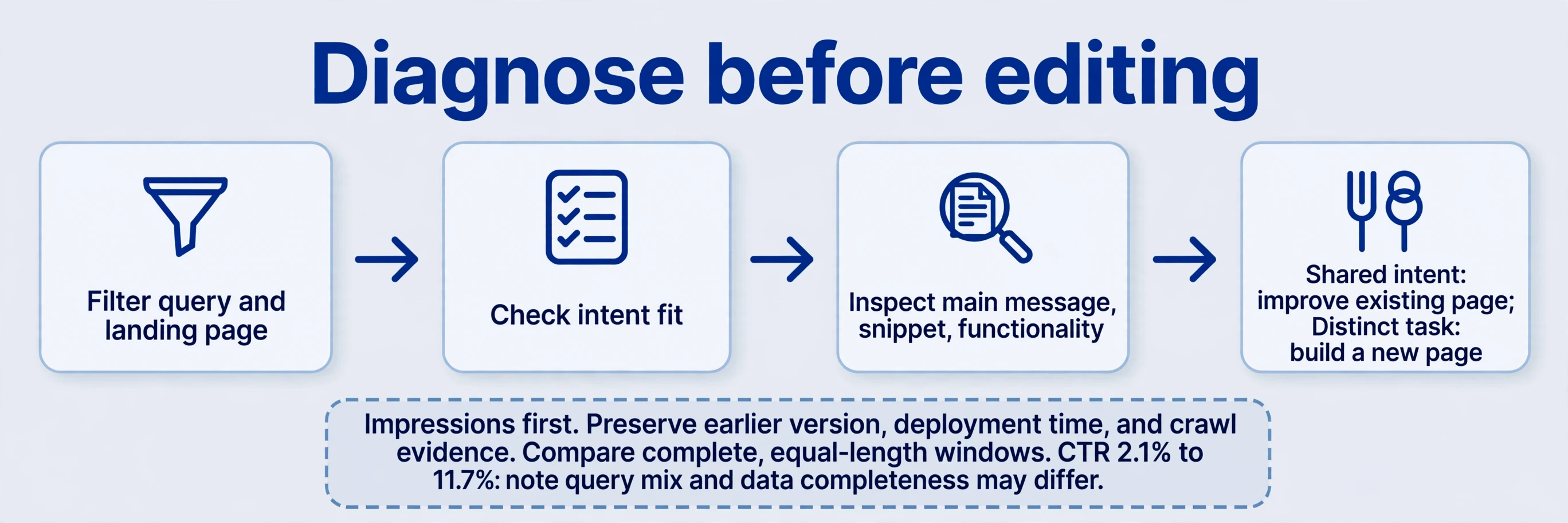
Demand growth, frequent crawling, and changing positions occurred together. Record them alongside the twenty-minute change, and assess with comparable growth windows. A CTR rise from 2.1% to 11.7% is a strong growth observation. Query mix, result presentation, and growth data completeness can also differ between dates. The most reproducible action is finding opportunities in existing impressions and keeping testable records — impressions first: diagnose first, then edit.
Three months and 56 days: read growth results without inventing methods
The three-month article argues new needs may create openings faster than mature, heavily contested ones. Its roughly 5M impressions and 200K clicks at 4% CTR follow the arithmetic of impressions multiplied by click-through rate; the image gives 5.09M and 202K. Search reads as a potentially substantial ongoing channel. Treat 99% as a motivational slogan. Use the 200K, 5M, and 4% arithmetic, and draw no success rate from it. Established terms remain possible too: the Morse Code case shows a different path involving time and content iteration.
The 56-day case belongs to a different owner. The domain was registered on 1 May and was 56 days old at the talk. Dividing 457K clicks by 2.44M impressions gives roughly 18.7%, matching the screenshot. An average position of 6.5 aggregates relevant impressions. Report the aggregate as an aggregate. Growth results without methods teach reading, not building. Ask for the method before copying the growth outcome.
Forty words still require complete product judgment
The black-screen tool’s core output is a black screen. It works as soon as the user opens it, and the screenshot is almost entirely black. The growth article says the site has about forty words, hidden visually as black text on black. That describes its historical implementation. Keep text visible on other sites. For this need, the feature itself is the desired result, and a long essay may not improve task completion.

The historical growth comparison runs between a black-screen site registered in 2020 and a newer black-screen site registered in June 2023, reportedly among the top two growth results for the black screen query within two years. The author interpreted the older site’s roughly 40% search and 56% direct traffic as ongoing acquisition plus retention. That reading is a plausible growth hypothesis. Test that retention reading against returning users, campaign tagging, and missing referral information.
A free growth research workflow has two steps: enter a seed in autocomplete and collect task expressions such as black screen, then use related queries in a trends tool to discover adjacent needs and compare candidates within the same region and period. The archived autocomplete mixes films, holidays, backgrounds, and other intents; the trends list includes black friday, black and white, and black ops. A related-query score of 100 is a relative score, not one hundred searches. Return to growth results and user situations, eliminate terms unrelated to a feature you can provide, then build a version that immediately completes the task. A suggestion is a lead — the growth results page decides whether a task exists behind it.
Monetisation needs a separate calculation. The black-screen site ran no ads. Calculate revenue separately; visits serve as scenario inputs only. The growth article also lists two comparable screen sites at 1.6M and 397K monthly visits as growth estimation exercises. Without geography, monetisable pageviews, ad impressions, and revenue per thousand pageviews, visits support only scenario ranges. Ads may also interrupt the growth black-screen task: test successful usage first, then compare revenue and return behaviour.
Practice: deliver an actionable, reviewable growth plan
Give the growth plan a downstream measure as well as a search measure: a completed conversion, a usable download, or a paid export. The revenue-chain example shows how to keep arrivals, completion, and receipts separate. State the observation window and the proposed change before launch so the next growth review compares the same quantities.
-
Can two large results be combined into one growth curve? Do not join the five-day single-page case’s 28.1K clicks to the three-month case’s 202K clicks. Record two rows: the single-page case, launched 13 March 2024 Beijing time, Search Console screenshot March 12–17, 28,100 clicks; the three-month case, published 22 June 2024, 202,000 clicks over the previous three months. Combining them requires confirmed site identity, complete dates, and matching scope.
-
Plan the first work cycle for an established keyword using the Morse Code case. Teaching example: choose a conversion task you can implement, export terms, and group distinct tasks such as conversion, rules, and practice. Keep KGR as a screening column while manually inspecting the top ten growth results for features, intent, and gaps. Read reliable topic material, prototype the home page, one distinct inner page, and navigation, then build a working minimum feature. After launch, log deployment, discovery sources, Search Console data, and completion events. Assess discovery, task completion, and query coverage in the first cycle, and leave the 4,000 UV figure out of the growth plan.
-
A query has 43,125 impressions and 886 clicks. What should change next? First calculate about 2.05% CTR, then fix the query, page, country, device, and complete date window, and verify the feature matches the intent. For a shared intent, inspect the main message, title and snippet, and feature explanation, propose a specific edit, and preserve the previous version. For a distinct task, design a separate page. After recrawling, compare complete growth windows of equal length for clicks, impressions, CTR, position, and feature completion, while noting demand changes.
-
With a single page and a head term on page two, should you immediately add ten pages? Export queries and landing pages and group them by task rather than wording. If AB, ABC, and BA express the same feature, clarify inputs, outputs, and examples and verify the long tails already reaching the page. Add pages only for distinct content needs such as learning rules versus online conversion, and link them meaningfully. The growth five-day case shows head-term position summarises no total acquisition. Group by task, then set the page count.
-
Write a free demand-validation and revenue scenario for a black-screen tool. Collect black-related autocomplete expressions, remove unrelated holiday and film intents, and compare candidates such as black screen and white screen in a trends tool for the same region and period. Inspect growth results and test immediate task completion on mobile and desktop. Use only an illustrative growth revenue assumption: 100,000 monthly visits, 1.2 monetisable pageviews per visit, and a $2 page RPM yield about $240. Replace RPM, monetisable share, and traffic with your own growth data. Visits alone set no growth income figure. Then test whether ads disrupt usage.
-
What evidence should you request for “450K clicks in 56 days”? First request site identity, launch date, complete Search Console filters, and exports to establish the scope of 457,000 clicks. Second, request query, page, country, and device breakdowns to distinguish trends, brands, and long tails. Third, request build and distribution growth timelines, external sources, task completion, revenue, and costs. The growth record holds only totals and feedback, so report growth results without inventing paid steps. If growth records are unavailable, retain the testable questions in the growth review.
Verify the window, execute by intent, and review with comparable windows. Growth numbers travel well. Methods travel better. Carry the growth method.
Comments
Join the conversation. Comments are reviewed before appearing.
Loading comments…