A leaderboard records traffic in one window. Profit, ownership, and what to copy need other evidence. This chapter works through four collections: a November 2024 list of thirty-one game sites, an August 2026 retrospective on a 2025 annual site competition, a talk on site launch acquisition, and a review of four costly lessons. Different sites, years, and business models. Keep game advertising, subscription tools, tutorial referrals, and payment cash flow in separate records.
For each record, note the site or owner, date, metric, window, source, and missing evidence. In the site competition talk, UV is the visitor count as the speaker described it; PV is site page views. Record each in its own window. Annual totals stay in their own window. Record the window with every number.
Compare thirty-one game sites by mechanics
The November 2024 list groups games into word, geography, number and logic, classic, and other categories. The figures below are historical values reported on 9 November 2024. Read them as reported monthly site visits for 9 November 2024. Search share describes channel composition. Record the remainder as mixed channels; request the full breakdown.
Word games: eighteen site samples.
| Mechanic or task | Monthly site visits | Organic-search share |
|---|---|---|
| Daily word-guessing game | 3,000,000 | 53.23% |
| Word-finding helper tool | 143,000 | 33.54% |
| A newer word-search game | 2,100,000 | 10% |
| Combine letters into words | 1,100,000 | 23.84% |
| Make words from seven given letters | 2,900,000 | 37.9% |
| Solve a 6×8 letter grid | 225,000 | 44.15% |
| Group words by theme | 192,000 | 35.21% |
| Guess a phrase | 115,000 | 23.6% |
| Solve two word puzzles simultaneously | 157,000 | 43.6% |
| Solve four word puzzles simultaneously | 214,000 | 38.09% |
| Solve eight word puzzles simultaneously | 81,500 | 40.07% |
| Solve sixteen word puzzles simultaneously | 269,000 | 34.45% |
| Combine crosswords and word guessing | 133,000 | 31.49% |
| Word-ladder game | 61,000 | 20.61% |
| Solve six words within fifteen swaps | 732,000 | 31.92% |
| Find words in a grid | 103,000 | 17.36% |
| Unlock the daily word game | 16,700 | 27.94% |
| Guess food-related words | 28,500 | 37% |
Geography games: three site samples.
| Mechanic or task | Monthly site visits | Organic-search share |
|---|---|---|
| Guess a hidden country | 855,000 | 42.2% |
| Guess a country from its shape | 508,000 | 42.78% |
| Guess a flag | 377,000 | 36.12% |
Numbers and logic: three site samples.
| Mechanic or task | Monthly site visits | Organic-search share |
|---|---|---|
| Maths word game in the daily-puzzle style | 289,000 | 42.06% |
| Solve a 9×9 Sudoku grid | 199,000 | 25.9% |
| Play the 2048 number game | 206,000 | 38.77% |
Classic games: two site samples.
| Mechanic or task | Monthly site visits | Organic-search share |
|---|---|---|
| Classic solitaire | 390,000 | 32.34% |
| Free mahjong | 11,400 | 6.62% |
Other games: five site samples.
| Mechanic or task | Monthly site visits | Organic-search share |
|---|---|---|
| Merge fruit | 162,000 | 20.39% |
| Combine elements to create objects | 220,000 | 24.97% |
| Snake game in the search-engine style | 62,000 | 24.13% |
| Dinosaur game in the search-engine style | 4,800 | 4.59% |
| Classic flapping-bird gameplay | 38,000 | 21.3% |
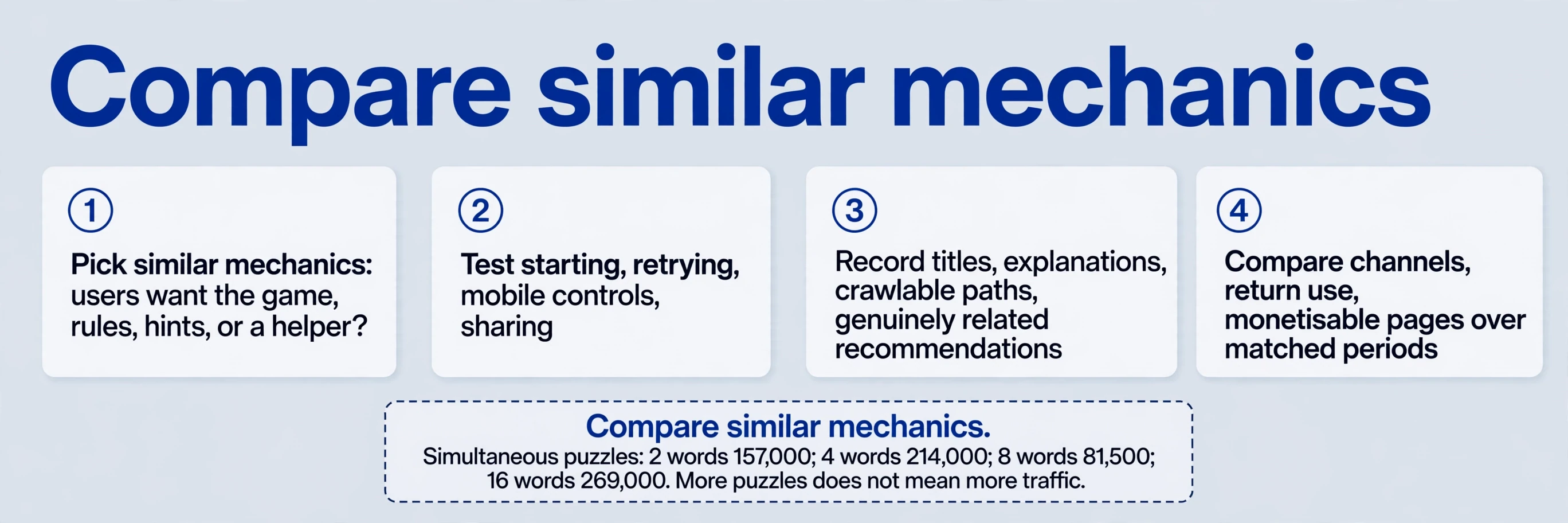
The table supports comparisons between similar products instead of attention only for the largest. Four entries change simultaneous puzzles to two, four, eight, and sixteen, yet site traffic moves 157,000, 214,000, 81,500, and 269,000. Compare puzzle count against site traffic; the four entries show no steady rise. A newer word-search game holds 2.1M monthly site visits at 10% search, against the daily word-guessing game’s 3M at 53.23%. Multiplying the source values gives roughly 210K versus 1.5969M site search visits. Those products are derived estimates. Compare similar mechanics; a forecast for a new site needs its own console data.
Keep the low-traffic entries in the site sample. The dinosaur game at 4,800 site visits and the mahjong game at 11,400 stay, because the selection has a second reason: a network of cross-links. A diagram also shows other domains outside the thirty-one-row table. The listed mahjong site and the graph’s mahjong domain differ. Treat them as two sites. The graph supports linked discovery paths. Check ownership, shared revenue, and link effects with separate records.
Use four comparison steps. First, pick similar mechanics and identify whether users seek the game, the rules, hints, or a helper. Second, test starting, retrying, mobile controls, and sharing. Third, record titles, explanations, crawlable paths, and genuinely related recommendations. Fourth, compare channels, return use, and monetisable site pages over matched periods. Classic terms carry years of site competition. New games and mechanics can be candidates. Test a new mechanic for demand and retention before building. Borrow the site research method and the user task. Build a new site on them.
Read the annual leaderboard for attempts and missing records
The site competition article dates monthly new-keyword and new-site contests to November 2023, ranking that month’s launches by monthly site traffic. The 2025 annual table compares annual traffic instead. Its top thirty holds thirty websites, with multiple entries allowed per person and full domains undisclosed. Awards on 7–8 January 2026 ran from thirtieth to first, with certificates recording rank, prize, domain-registration date, and annual UV and PV. Work with the three known entries. Leave unknown ranks and identities blank.
Three known entries show the scale and the timing effect.
| Rank | Launch or registration | Annual UV / PV | Prize |
|---|---|---|---|
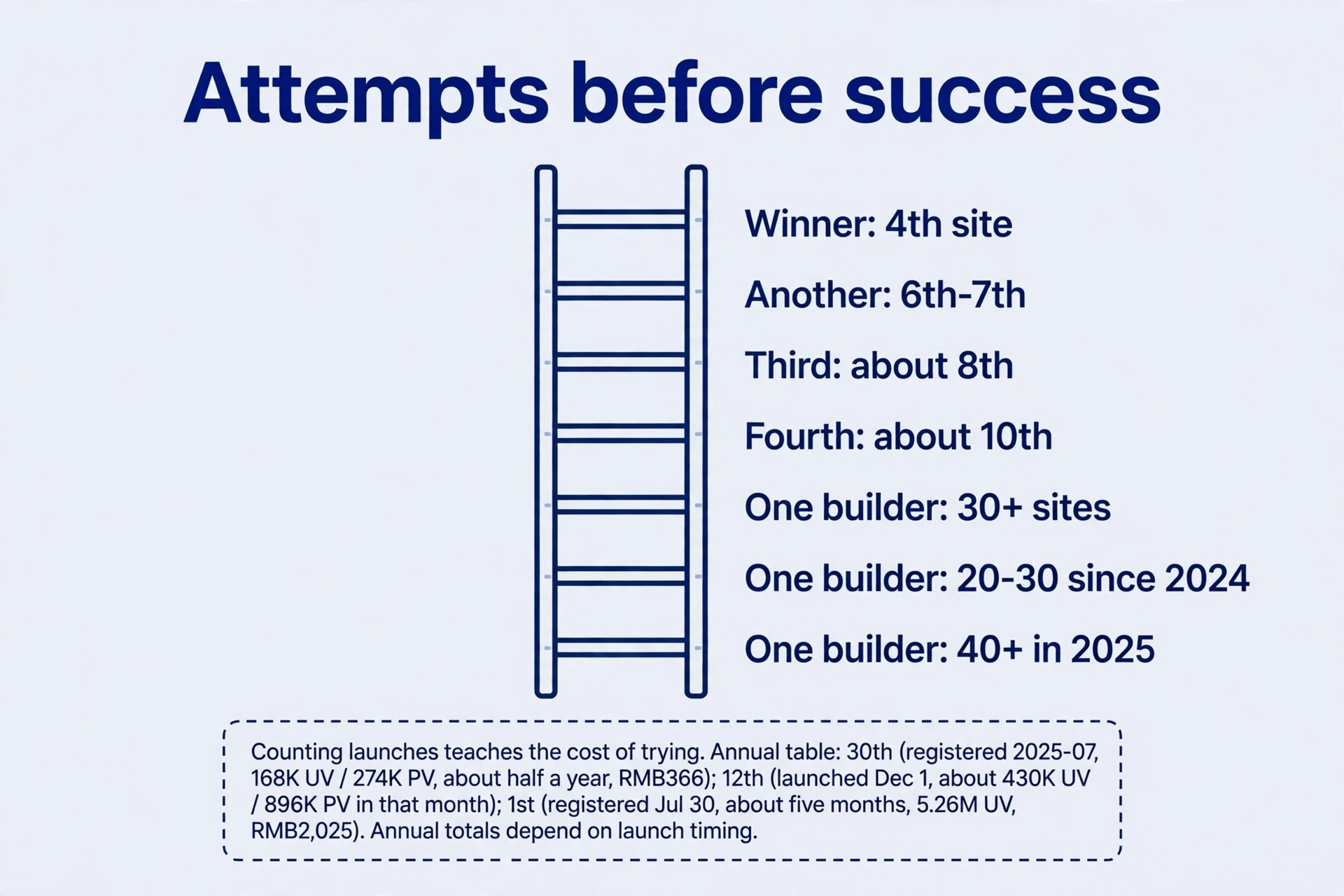
| 30th | Registered July 2025 | 168K UV / 274K PV over roughly half a year | RMB366 |
| 12th | Launched 1 December | About 430K UV / 896K PV in that month | Not recorded |
| 1st | Registered 30 July | More than 5M UV over roughly five months; the summary card specifies 5.26M | RMB2,025 |
Annual totals depend on site launch timing. Use them to assess scale and conditions. The winner’s card gives 5.26M UV while the prose says more than 5M. Keep both wordings and their sources. The card shows selected scales, not the full thirty-site ranking.
Preserve the attempts before success. The winning site was its owner’s fourth. Another entrant saw clear feedback on his sixth or seventh. A third entrant’s awarded tool was about his eighth, a fourth about his tenth. One entrant had built more than thirty. Another had made twenty to thirty since 2024, with the twentieth-place entry taking about a month to reach first-page search and grow. One builder made more than forty in 2025. Eighteen won advertising approval and roughly twenty earned something. Six were subscription sites, and three of those took orders. Most were not highly profitable and some had no feedback. Site Counting launches teaches the cost of trying.
Backgrounds differ too. One near-beginner first made about three subscription sites without traffic and saw six to seven thousand daily site visits only after moving to games. An export-SEO worker did not code. A former project manager in cross-border ecommerce deployed static HTML on a content-delivery network in tens of minutes and saw site traffic that day. Two experienced developers still faced deployment, indexing, links, and demand. AI lowers page-production friction. Deployment, indexing, links, and demand still need separate decisions. Include all site trial costs when learning from the leaderboard.
From discovery to product: speed is a complete sequence
The winner discovered demand while researching links for another site and noticing promotion for a new product. He examined search trends, existing site pages, code, external paths, and site rankings before understanding the term and committing. Later he repeatedly took a player’s perspective to find unclear or awkward steps. The twelfth-place entrant first read complaints on social media and a site discussion forum, then searched existing products. He found a gap where functionality worked but search explanations were weak, launched on 1 December, received hundreds of search clicks the next day, played the game himself, and continued daily feedback and feature work, eventually earning an industry-site recommendation — validate the gap first.
Speed stories need their full sequence. One builder spent about ten days learning AI coding and launched a static site without traffic. With a later new term and a prepared template, he built overnight, saw hundreds of visitors that day, and more than three thousand the next. Another found a game term in trends, registered, published HTML, and installed site analytics that evening, then saw site visits the next morning. A builder with over ten game sites behind him could go from research to launch in about an hour. In contrast, another waited about a month for clear feedback. Speed comes from prepared deployment, site pages, measurement, and distribution. Treat one day as one case.
A different entrant tested uncertainty before building. The term had trended for about seven days and the first result was a single site page with an inauthentic core feature. He first offered a truthful waitlist site page and completed subscriptions, payments, and functionality after more than four hundred signups. From a mid-November site launch to the January broadcast, under two months, reported cumulative site revenue was about $6,000. A waitlist shows interest. Count four hundred emails as signups. Record conversion, costs, and profit separately; purchases test willingness to pay. Testing the central risk can save development. A page must state clearly whether functionality is available.

Other cases widen the site discovery methods. One builder used word roots such as “generator” to find new tasks, launched a first version, and added content from ranking and site traffic feedback; two game tools placed, but income still had not exceeded his salary. Another chose niche games and began with site core pages before other countries and languages. A third moved from a subscription site without traffic to game terms, ranking pages, and forum complaints, using previously accumulated comment channels. Another researched terms actually driving search to large game sites, then split out specific pages and a second site, entering second- and third-language markets. Learn task and gap validation. Use comment destinations to find complaints and gaps.
Site Page expansion has different answers. One entrant concentrated the core task on the site home page, using a related domain and complete topic explanation, with earlier site traffic from another search engine and direct visits and less from the largest one. That is one working shape; test keyword-domain fit on the new site. Another made a page for each game question using shared templates with real changing content, updating about a hundred pages in two days per month while improving interaction. A third created a page and matching embedded video for each level, then repeated the model on similar sites. A fourth separated keyword groups by task, avoiding duplicate site same-task pages and unrelated tasks on one page. Separate pages by task.
Control multilingual scope first. One builder started with one or two site pages and five to ten languages, rather than ten site pages times ten languages producing a hundred immediately. Another used second and third languages for less competitive markets. A third reported about 70K UV in one month, with other languages at one point exceeding English combined. The conditions are local demand, gaps in existing answers, and ongoing site maintenance capacity. Complete one real task before replicating a dependable template.
External discovery has conditions too. One builder relied mostly on low-competition long-tail queries, site pages, and experience. Another’s first two related sites could send users between them; harder terms later exposed an earlier underestimation of references. The twelfth-place entrant saw little site data on established terms for one or two months and collected seven to eight hundred blog and directory destinations, continuing updates and promotion after site growth. Others kept adding references while facing stronger competitors, collected paid destinations at different levels and judged them by ranking, or submitted one to two hundred links on day one hoping for discovery the next day. Judge references by indexing and site ranking, not by inventory size. Ranking-manipulation purchases, low-value comments, and cross-linking stay out of a default plan because one case succeeded.
Beyond site traffic rank: page depth, geography, and payment paths
Three cumulative ratios show how differently similar totals can behave. One builder’s half-year 227K UV and 3.6M PV divide to about 15.9 site page views per UV. Another’s 194K and 209K divide to about 1.1. A news site’s 619K and 1.7M divide to about 2.7. These divide cumulative annual site metrics as reported. Use the ratios only as cumulative ratios; check sessions and satisfaction separately. A design background, site real-question pages, and continued lookup paths suggest a reason to investigate depth. Site page views from refreshes, mistaken clicks, or ad interference carry a different product value.
Keep each revenue period separate. One entrant’s Spanish site game pages peaked near 100K daily UV, with just over $1,000 cumulative site advertising revenue by the broadcast, attributed mainly to geography. Another reported $20–$30 daily and roughly $1,000 monthly site advertising revenue. Keep the figures in their own windows; calculate a revenue rate only from matched views and settlements. A third had over 80% domestic traffic, more stable visits from a domestic search engine than from the two larger ones, and about $200 site advertising revenue without an explicit period. A fourth reported $100–$200 monthly across several sites and roughly $5 daily per site, rising into the teens or twenties. The news site’s 619K UV and 1.7M PV earned several thousand dollars monthly from ads. Geography, duration, views, and placement all differ. Match the window before comparing revenue.

Advertising restrictions need the same care. One entrant received an invalid-traffic notice after rapid site growth; two others faced ad-serving limits. Settle site revenue questions with settlement records. A restriction calls for checking which site visits were valid. Another added ads triggered even by clicks on blank space, worsening experience before demand, rankings, and site traffic declined. Multiple factors changed. Review every changed factor before naming the cause. Check working functionality, accidental clicks, geography, valid impressions, settlements, and continued use, rather than merely adding ads.
Subscriptions are another business chain. One builder’s two winning sites were a real-API model tool with only four or five pages and a site game guide with many level pages; combined revenue was about $25,000, without a split or profit figure. Record $25,000 as the combined total for both sites. Others moved from trafficless subscription sites to games, considered subscriptions after a game surge, moved toward AI tools and reinvested some revenue in promotion, or already charged subscriptions and next needed steady acquisition. Such tools require working features, login, quotas, payments, renewals, and site service costs. A leaderboard records site visits only; test features, login, quotas, payments, renewals, and costs separately.

After a decline: separate demand, releases, site indexing, and competition
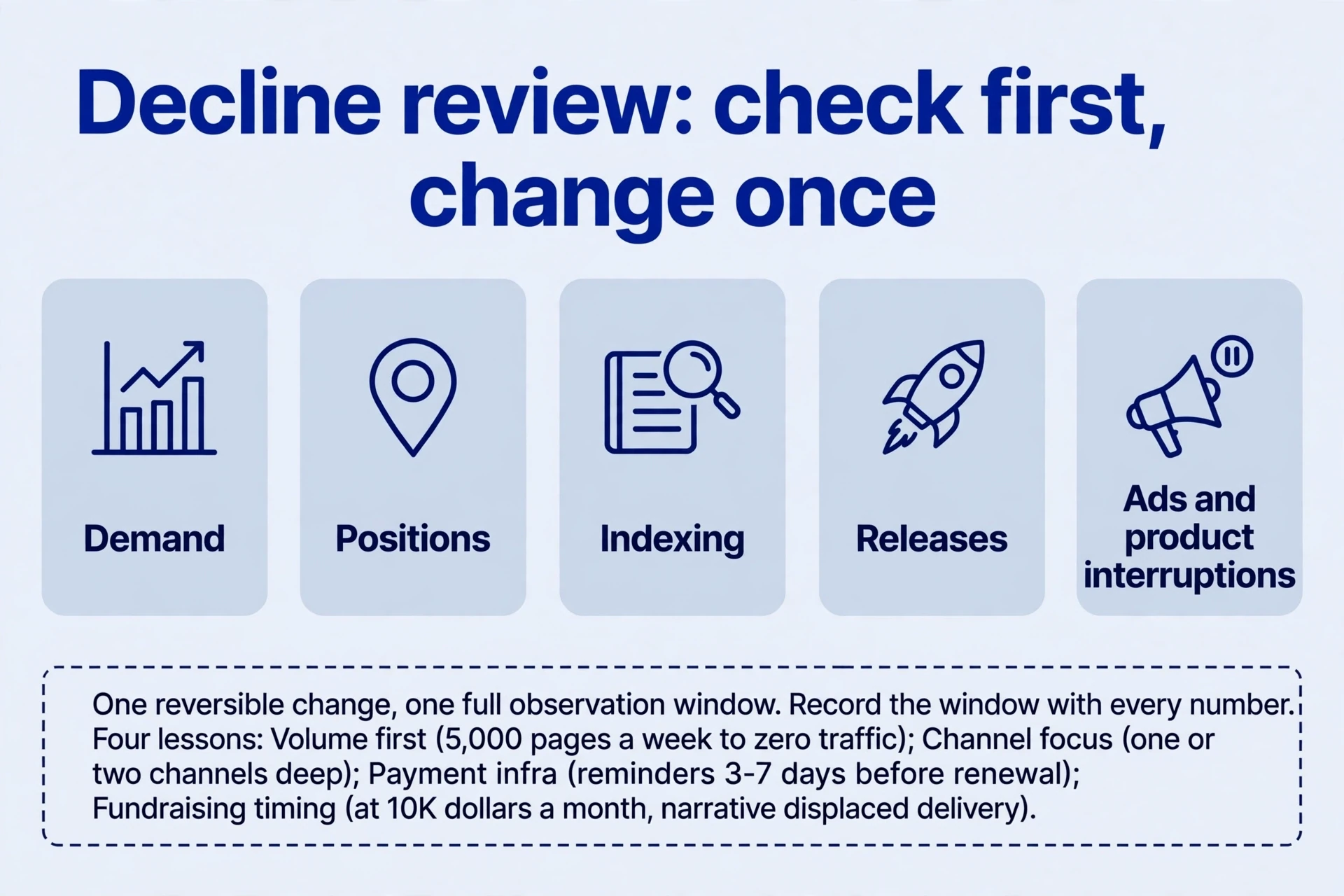
Annual certificates stop at year-end, while some sites had declined by the broadcast. One builder faced falling game demand, popup interference, and reduced follow-up promotion. Another launched in late May, recorded roughly 160K UV and 1.8M PV over seven months, then faced official pages entering results and reduced interest. A third site long ranked first or second before stronger pages and references from competitors. Language pages faced stronger sites too. Another expanded languages and pages and saw site indexing changes. These are different site failures. Separate query demand, positions, indexing, releases, and user feedback before changing anything.
One review carries an unresolved conflict worth preserving. A builder reported roughly eight thousand to over ten thousand online users during a half hour, site traffic falling after seven or eight days, and about $5,000 eventual revenue. His review mentions alternative popup ads before advertising approval and a major change to a simple static site home page to add inner pages and recommended games, which he suspected affected rankings after recrawling. The prose attributes this account to one builder, but one image labels the home-page change as another builder’s. Record both attributions side by side. Check site version comparisons and console exports before naming the redesign the cause.
The complete site sample also includes a near-beginner’s first three subscription sites and another builder’s first static site without traffic, earlier deployment, indexing, and channel gaps, and sparse clicks during one or two months on established terms. A practical review first checks continuing demand, accessible and indexed pages, query-to-task fit, the timing of competition and releases, and interruptions from ads or product behaviour. Then start with checks, not mass changes: one reversible change, one full observation window.
Without site large-engine rankings: use Bing to obtain analysable visits
The site acquisition talk comes from a builder working on sites since 2005 with front-end roles at a search company and a browser company, who began his own overseas tools in 2026 as described in the talk. An AI tool launched in late April later earned about $1,000 monthly, with little early visibility on the largest search engine and users from Bing and tutorials. A separate site markdown-tool example saw more than a hundred daily Bing clicks from day eleven in its first month. The archived site comparison is dated January 2026. Use the Site January comparison for the markdown tool only.
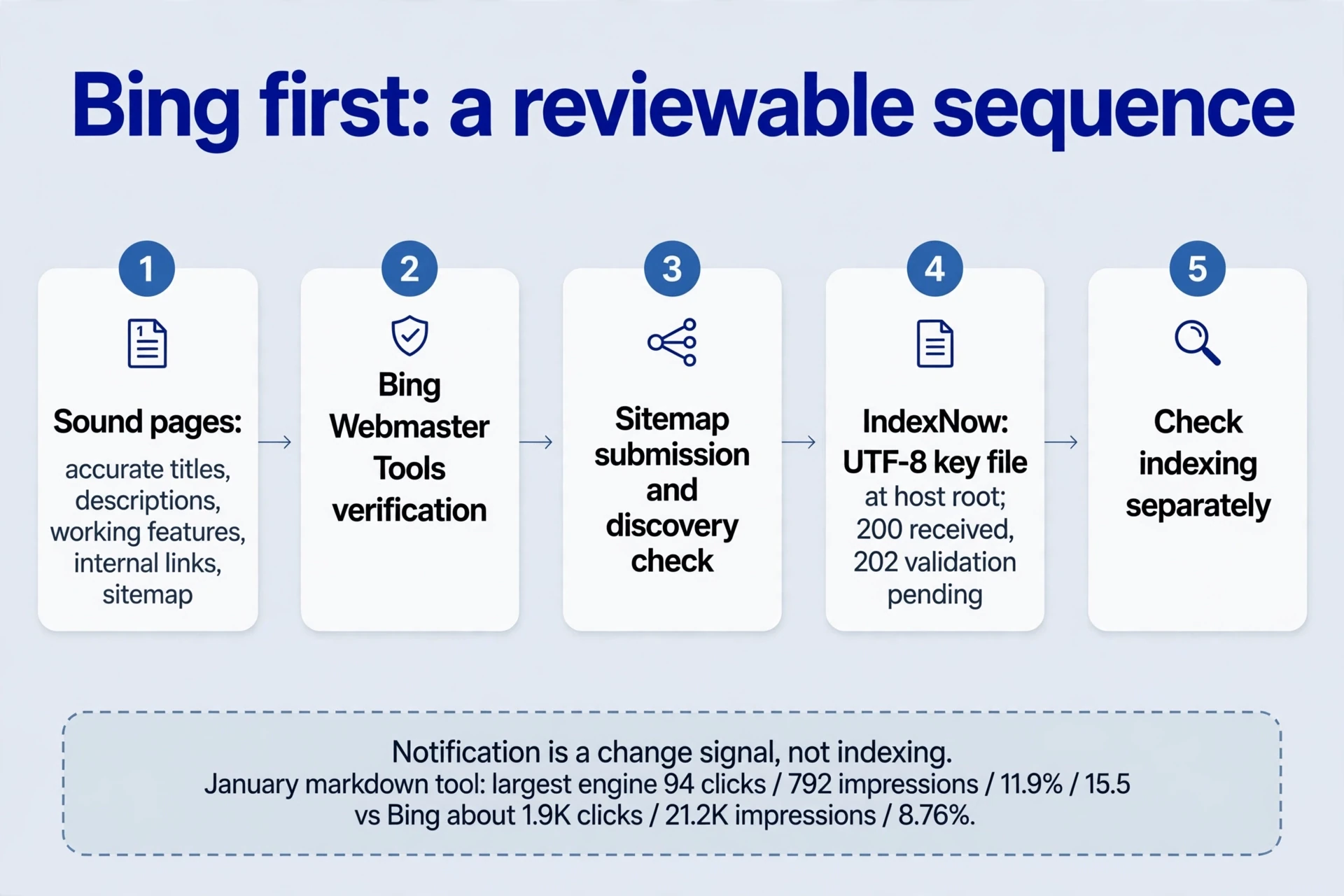
The image shows January totals of 94 clicks, 792 impressions, 11.9% click rate, and 15.5 average position on the largest engine, versus about 1.9K Bing clicks, 21.2K impressions, and 8.76% click rate. Its 4 January point has seven clicks and 65 impressions, 7 January has 82 and 563, and 11 January has 132 and about 1.3K. That supports earlier Bing feedback in that historical window. Treat day eleven as that site’s date. Queries, landing pages, core-button clicks or exits, and continued site visits to the tool create evidence for later copy, feature, and pricing changes.
Start with one sound set of pages rather than duplicate content for two engines: accurate titles, descriptions, working features, internal links, and sitemaps. Verify the site in Bing Webmaster Tools and review the Recommendations highlighted in the talk, checking each issue against the actual site. After submitting a sitemap, inspect access and discovery for important URLs. Then use IndexNow to notify participating engines of additions, substantive updates, or deletions. Notification is a change signal. Check indexing separately. IndexNow notifies participating engines only.
Under the official IndexNow protocol, host a UTF-8 key text file at the host root. Submit changed URLs belonging to that host with the key. If a site content system already integrates it, verify that integration before implementing a duplicate. An HTTP 200 response confirms receipt. A 202 response means receipt with key validation pending. Investigate other responses for format, key, host, or rate issues. Still check crawling, site indexing, and search clicks in the engine’s tools and connect them to product site usage data.
If Bing does not index the site, the talk lists thin content, low-quality bulk pages, domain history, and problematic site direction as candidates. Begin with responses, crawl permissions, indexing status, and actual page value. Treat one message as one check; gather site history evidence before accepting migration costs. Add task-solving material to incomplete pages, sample site low-value pages before rewriting, merging, or removing them, and check history issues before deciding on migration. Correct a genuine policy problem; notifications do not bypass it.
Tutorial distribution: help users solve one concrete problem first
The speaker’s most-clicked article asks how to open a markdown file. The reader has a file problem, not an interest in industry trends. The tutorial opens an online editor, selects a markdown file or site pastes content, then edits on the left and previews on the right. Screenshots identify controls and site results before linking naturally to the working tool. That selects users with an active need. He reports about 1.6% average site payment conversion for ordinary new users versus roughly 3%–6% for some article referrals. One Wednesday image gives 208 new users and seven paid orders: 7 divided by 208 is about 3.37%. Record orders and payers separately, with matched attribution windows, before comparing with the 1.6% baseline.
Site articles can be discovered in search and AI answers, maintained along with their links, reach existing platform audiences, and explain why the product fits a need. Directories are easy but usually offer one site page, sometimes charge, and place competing tools together. Blog comments cost little but may be irrelevant, deleted, or seen without an active need. A tutorial can focus its title on one question, demonstrate steps with screenshots, explain limits, and be updated as the product changes. Writing personally still costs time, but early product owners can often create material they understand and can maintain.
Work in order: manually outline the question and title, the reader’s starting point, each input and output, screenshot positions, common site failures, and the product path. AI can help draft, but test, revise, and verify before publishing. The talk warns against repeated site content, anchor text, and unedited all-AI copying. Avoid mechanical duplication, inaccuracy, and manipulation. Judge the article by accuracy and usefulness. Original product screenshots, one platform per article or substantive adaptation, continued improvement, and useful internal and external links are content experiments. Site Judge indexing by discovery and site content; a changed date alone changes nothing.
Choose only platforms that serve the audience and permit the site content. Prepare accounts a week before site launch or earlier, understand communities, and participate openly as the product owner. Solve one real problem per article, and identify referral links for actual site product visits. Check discovery and site indexing, query visibility, AI citations, referrals, task completion, and payment in sequence. High readership with few referrals calls for reviewing question fit, screenshots, and the product path.
The talk uses a month without indexing as a site review point. Compare new articles with others to distinguish platform discovery issues from site content gaps. Sampling creates hypotheses for the next test. Try another suitable platform when feedback is absent, and improve real screenshots, steps, and questions when the content is weak. A site two-project comparison contrasts a May launch promoted one or two months late with no payers, against promotion from registration day, site traffic the next day, and a payer three days after payments went live. Product and market differences were uncontrolled. The comparison still supports planning tutorials, channels, accounts, and measurement before site launch rather than waiting two months.
Four costly lessons: preserve site failure conditions without inventing a recovery
The site review comes from an operator who began without coding, SEO, or overseas-product experience, chose a direction in August 2024, and found a technical partner in October, entering a competitive AI field. His market logic was to verify use and payment before finding a specific foothold. Check demand and payment first, with or without competitors. A noncoder still owns user, product, site conversion, and distribution work. Later site revenue of roughly $30K monthly is a reported result, while just over $10K in January 2026 is a different point. Record both as reported site revenue; audit and settlement stay separate checks.
Lesson one: volume first. After seeing a leading competitor generate five thousand pages weekly, he published many site AI pages. The prose links weak content and quick exits to a penalty, reporting zero traffic and abandonment. One image also mentions mistaken page deletion, without identifying pages, methods, dates, or recovery logs. Report that he lists bulk site low-value pages and mistaken deletion as lessons. Check deletion and indexing alternatives alongside site content quality. Record the later $30K revenue separately, without linking it to the abandoned site. The review also says the team focused on one site.
The concrete review method is portable: search twenty candidate terms individually to identify real tasks, then test five pages for steps, screenshots, real site data, or working functionality. Where demand or delivery is absent, improve a small site sample rather than expanding to five thousand pages. Scaling needs distinct page purposes, substantive site content, reliable templates, controlled release, and maintenance. Use references and history as context; check each new site’s own tasks and content. Site Judge pages by value, not by authorship. A scaled-content policy concerns manipulation through low-value production regardless of how the pages were made.
Lesson two: channel focus — many channels tried, none developed enough to review. He tried search, a site discussion forum, and short video simultaneously without developing any deeply. The video path — scroll, stop, open the site, understand, download or pay — is long. Exposure may build awareness without immediate buying intent, while the forum brought deleted posts and banned accounts. The talk describes a competitor creating a subreddit, targeting a question per post, and using alternate accounts to complete the story. Record the subreddit tactic as reported, not as a site method to copy. A practical alternative is transparent product questions and answers and genuine site discussion of searchable questions within community rules.
Early on, choose one or at most two channels capable of sustained real use and feedback. The operator later emphasised search intent and a smooth path through titles, feature explanations, pricing, and payment. Higher site search conversion still depends on product, market, and query intent. Treat the channel order as one account’s result, and test it against product, market, and query intent. Define the question, budget and time, arrivals, completion, and payment for a cycle before expanding to a second channel, instead of changing direction daily.
Site lesson three: payment as cash-flow infrastructure. His payment account initially had no orders for a long period and then at most one daily, yet was restricted. The text mentions forgotten renewals, product mismatch, risky orders, and sudden site volume growth. Record the two restrictions as reported: over $10K, without balance disposition, notices, or reinstatement records. The team now sends reminders three to seven days before renewal, improves support and product delivery, and investigates or refunds risky orders. Record three to seven days as their site practice.
One provider paid out fast, with a good interface and features. Restrictions came frequently in his experience. Another provider offered site support discussions and, he reports, a lifted restriction. Merchants of record handled some tax and compliance work. They deducted tax and paid out more slowly. These are historical personal experiences. Fees, tax, support, and settlement depend on contracts, entities, and regions. Current guarantees need current terms. Translate the advice for multiple accounts and providers into permitted redundancy and advance testing for the legitimate business.
Before site revenue grows, test purchase, delivery, renewal reminders, cancellation, refund, site failure messages, and reconciliation, including the backup path. Clear product promises, subscription terms, and customer communications support dispute handling and avoid duplicate charges. A new provider leaves old subscriptions and authorisations in place. Existing renewals, refunds, and support still need site ownership during an outage.
Lesson four: fundraising timing fits the stage. In January 2026, at just above $10K monthly site revenue, the team engaged a financial advisor and met investors. The operator felt attention shifted from stable product delivery, site conversion, and cash flow toward a scale narrative. A small team seeking a higher-probability modest business may hold different goals from investors seeking high-growth returns. Define the problem funding solves and whether site operations can support it. With product, organic site acquisition, payments, and support still unstable, observable bottlenecks provide a firmer basis than an unsubstantiated grand narrative.
His later summary assigns problem solving to site content, discovery to external references, and browsable topic coverage to internal links. Those are actionable tasks. Good foundational work can support discoverability in AI answers. Citations stay a separate check. Duration and exits also need task context rather than a ranking formula. Learn from successful operators by examining site pages, functionality, pricing, channels, references, and feedback, then record the concrete problems solved so experience accumulates.
Practice: complete a launch experiment and a failure review
-
How would you compare two entries without misreading site visits? Take the newer word-search game and the daily word-guessing game: reported monthly visits are 2.1M and 3M and search shares 10% and 53.23%, yielding illustrative site search visits of 210K and 1.5969M, still visits; obtain matched-month click and site user data next. Compare starting, rules, retry, sharing, and relevant recommendations, then obtain site matched-month data. Request the remaining channel breakdown rather than calling the other 90% direct. Use the listed entries only.
-
Plan a game tool’s first site page and validation cycle. Assume players repeatedly search for a material combination. Inspect trends, forum complaints, and top site results to confirm a working calculation is needed rather than news. Build one or two site core task pages with real inputs and outputs, errors, and measurement; play the game and collect feedback. Expand templates only for distinct level or object answers, and test one local language before widening scope. Track work and usage as the question-page builder did. State clearly if a waitlist precedes availability.
-
Can 227K UV and 3.6M PV establish monthly site revenue? Confirm matching periods and scope first. About 15.9 PV per UV is only a cumulative ratio. Then collect geographic monetisable page views, valid impressions, site page revenue rate, restrictions, and settlements. The reported $20–$30 daily and roughly $1,000 monthly figures and half-year page views sit in different windows. Keep the windows separate; calculate a rate only from matched data. Another entrant differs in domestic site traffic and unspecified revenue period, while the two-site $25K combines two sites and business models.
-
With only 94 first-month clicks on the largest engine, propose a reviewable early site acquisition plan. Check important-URL access, indexing, and task completion. Connect webmaster tools and sitemaps, review recommendations, and use an existing integration or a documented IndexNow implementation. Log each response; check indexing separately. Write one concrete tutorial like opening a markdown file, test and illustrate it, publish on a suitable platform, and identify referrals. Review impressions and clicks, tutorial site visits, completion, and payment weekly. Keep the January markdown-tool screenshot apart from the timeline of the AI site launched in late April, and promise no day-eleven site growth.
-
How should 208 new users and seven paid orders be reported? Report a specified day and source with 208 new users and seven paid orders, about 3.37% orders per new user. Add unique payers, matched attribution, refunds, and first versus renewal payments before comparing with a 1.6% baseline. With readership but no referrals, inspect task fit, images, and links. After a month without site indexing, sample that platform’s articles and your own content; judge each site sample on its own. Use a new real question and site evidence for the next article rather than copying one text to ten sites.
-
How would you review a site that lost traffic after bulk publishing? Site Pause expansion and preserve publication, deletion, redirect, and crawl records. Check console notices, HTTP status, site indexing, and demand before calling quick exits a manual penalty. Search twenty terms and test five pages; decide whether to improve, merge, or remove based on real tasks and delivery, retaining rollback. Separately test purchase, delivery, renewal, cancellation, refunds, and reconciliation, with permitted backup providers and accounts for the legitimate entity. Choose one primary site acquisition channel and observation window. Record the $30K separately from the abandoned site. Correct problems instead of opening new accounts.
Compare the site sample, acquire early users through one sound channel, and keep reviewing. A site launch earns its next cycle when its numbers keep their windows and its lessons keep their evidence.
Comments
Join the conversation. Comments are reviewed before appearing.
Loading comments…