Building and expecting users to appear confuses publishing with user acquisition, while million-visit headlines can confuse temporary attention with a durable business. The six cases serve different experiments: a new social platform and a trend experiment user test speed around trends; a game site connects user requests in social comments to a web page; an open-source chat project distributes through code; an image watermark illustrates channel and user long-tail research; and one developer converts repeated work into operating assets.
Choose the goal first: user publishing practice, experiencing a trend spike, validating a user task, or validating payment and durability. The goal determines speed, budget, and observation period. Record launch date, analytics start, channels, unique visitors, user visits, pageviews, search impressions, search clicks, and revenue. Each measures something different. One person may visit repeatedly. One user visit may include several pages. Search clicks and site-level unique visitors are separate counts.
User: Threads: turn nine days of search changes into hypotheses
Dated 15 July 2023, the opportunity begins with a new social platform’s launch. The author expects a platform backed by a large photo-sharing service may grow, and suggests examining proven services around older social platforms, then asking whether similar user tasks emerge. One builder searches social-platform products on a launch directory, cites a high-traffic video downloader, and discusses domains containing the platform’s name. The record calls one downloader’s monthly user audience more than ten million unique user visitors, but the archive lacks enough context to independently validate that definition. Treat user third-party visit figures as estimates. Unique-user counts need first-party measurement. Adding a brand word to a domain is historical user behaviour. Permission and ranking advantage need separate evidence.
The builder registers quickly, publishes through an existing lightweight workflow, submits to a search console, and arranges external user discovery. The practical objective is shortening the user path to a usable version. Ship the narrowest working version first. Once found, the site delivers the promised user task or discloses its state. Early publication before all features are ready is encouraged in the record, alongside a requirement to genuinely meet the user task. Keep both conditions.
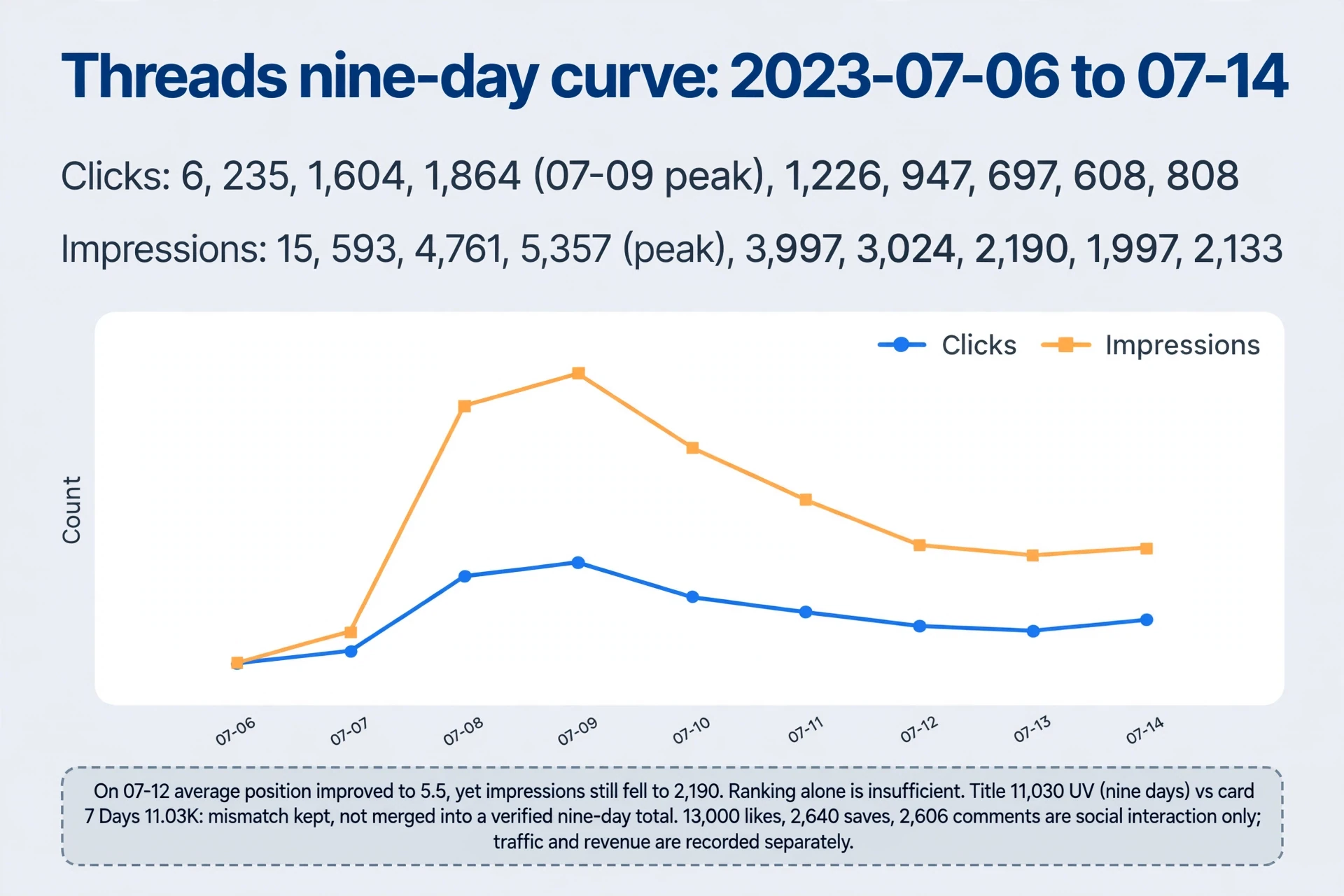
The table transcribes nine days from inspected search-console images. Impressions are the site’s appearances in user search results, click-through rate is clicks divided by impressions, and average position aggregates observations, rather than a fixed position of 6.8 for one query. The title reports 11,030 unique user visitors in nine days, but one image clearly selects 7 Days and shows 11.03K. Preserve that mismatch instead of claiming a verified nine-day unique-visitor total or substituting summed search clicks.
| 2023 date | Search clicks | Search impressions | CTR | Average position |
|---|---|---|---|---|
| 07-06 | 6 | 15 | 40% | 6.8 |
| 07-07 | 235 | 593 | 39.6% | 5.7 |
| 07-08 | 1,604 | 4,761 | 33.7% | 5.6 |
| 07-09 | 1,864 | 5,357 | 34.8% | 5.3 |
| 07-10 | 1,226 | 3,997 | 30.7% | 6.2 |
| 07-11 | 947 | 3,024 | 31.3% | 6.2 |
| 07-12 | 697 | 2,190 | 31.8% | 5.5 |
| 07-13 | 608 | 1,997 | 30.4% | 7.0 |
| 07-14 | 808 | 2,133 | 37.9% | 5.3 |
6 July has only fifteen impressions and six clicks, making the 40% click-through rate a very small sample. General user conversion ability needs larger samples. 9 July peaks at 5,357 impressions in this set before declining. On 12 July average position improves to 5.5 but impressions still fall to 2,190, so ranking alone is insufficient. The author attributes decline to fading user interest and rising competition. The trends chart peaks 6 July and then falls, offering consistent supporting evidence. Site impressions also depend on query mix, region, device, and result presentation, so a site-level drop alone is one user signal. Check query mix, region, device, and presentation before concluding a market-wide decline.
Natural links from users who actually value the tool are proposed as the user link path. A practical approach is asking successful users where they have seen the same user problem discussed, and offering accurate explanatory material, leaving recommendation to them. A recommendation can bring users and discovery opportunities. Ranking gains per link need separate evidence. Keep sharing free of paid manipulation and compulsory template links. The article’s competition and quality explanations for changes on days five, seven, and eight are inferences. The screenshots name no competitors and show no algorithmic causes.
The sequence is event detection, transfer of a validated user task, a narrow usable version, user discovery, measurement, and improvement. The article also reports at least five platform-related or AI-tool sites and a light-and-shadow user AI-text post with about 13,000 likes, 2,640 saves, and 2,606 user comments despite an account with only a few hundred followers. The latter illustrates social user engagement on a small account. It measures social engagement only. Traffic and revenue need separate records.
Follow one image to user channels and long-tail traffic
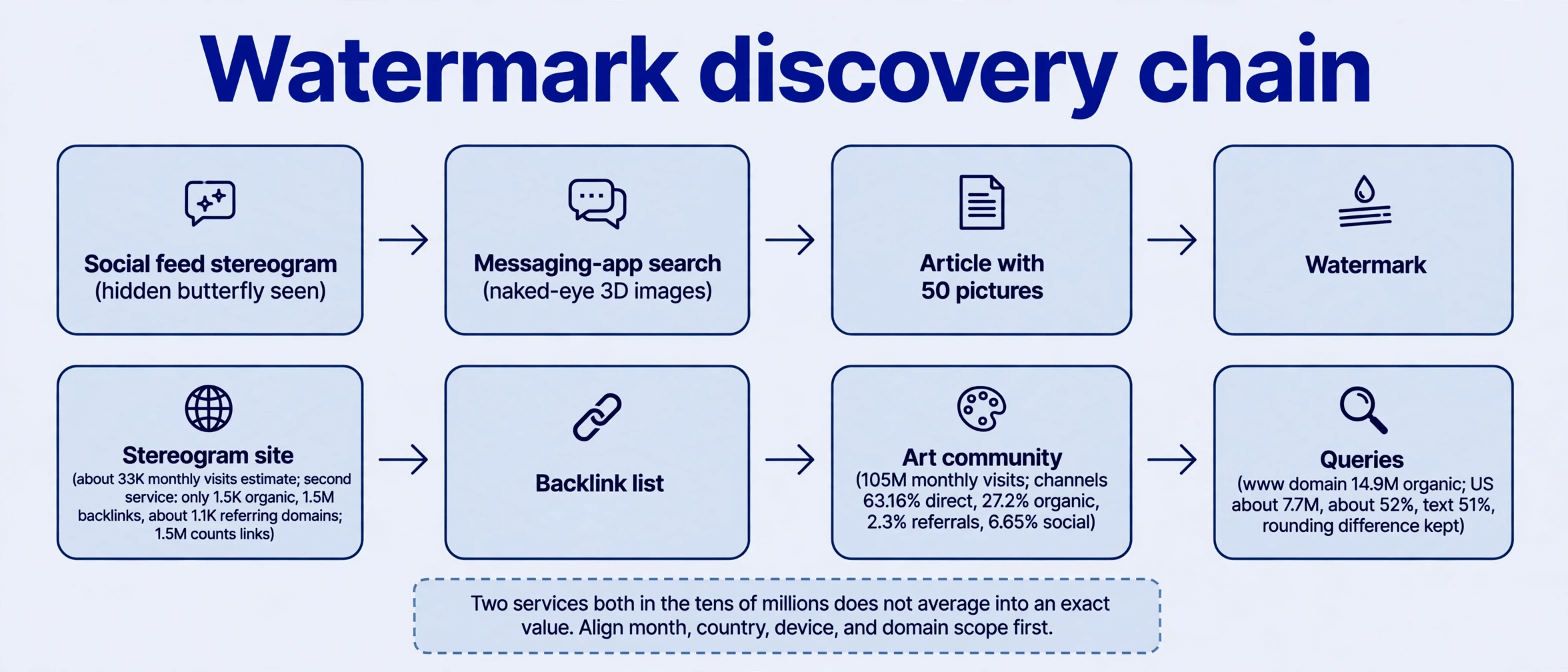
Dated 17 September 2023, the user case begins with a stereogram in a social feed. After seeing the hidden butterfly, the author searches a messaging app for naked-eye 3D images, finds a user article with fifty pictures, and follows the watermark to a stereogram site. One estimation service reports about 33K monthly user visits, 33.2K in one image. Sparse user small-site data prompts a second estimation service: only 1.5K organic traffic, but 1.5M backlinks and roughly 1.1K referring domains. The 1.5 million figure counts links. Recommending sites number roughly 1.1K.
The backlink list reveals a large user art community. An estimation service shows 105M monthly user visits, or 105 million rather than 10.5 million. The author examines trend, countries, and similar sites, with the US leading Canada, the UK, Germany, and France, and compares another art site. The user channel chart shows 63.16% direct, 27.2% organic, 2.3% referrals, and 6.65% social. Direct traffic cannot all be equated with bookmarks. The chain from watermark to source site, referring page, user art community, and queries is now a reproducible user discovery method.

The record roughly multiplies about 100 million user visits by 27% to obtain 27 million user search visits, while 105M × 27.2% is closer to 28.6 million. Both are rough calculations from estimates. Measurements need user first-party data. One service’s visible queries are mainly brand terms, so the author switches to the user community’s www address in the second service, where one image shows 14.9M organic traffic. The tools differ substantially despite both being in the tens of millions. Preserve the discrepancy rather than averaging it into false precision. Align month, country, device, and root-domain, subdomain, or URL scope first. The historical user need to enter www describes one tool at one time. Check current user behaviour before assuming it.
The US detail shows about 7.7M, roughly 52% of the global 14.9M in one image, while the text says 51%. Retain that rounding difference. Sorted by traffic, the author estimates over two million branded and about five million non-branded traffic, with the largest visible non-brand query around 68K and many smaller contributions. User demand can be distributed, so the largest term is one opportunity among many. A hundred queries at several thousand each describe the incumbent. A new site earns its own traffic query by query. Copying art transplants nothing. Scale needs permission and original work.
User: Reduce build time and distribute through open source
Dated 20 December 2023, the user case describes an AI chat project: it adapts an open-source chat demo by replacing one model’s backend API with another’s while largely retaining the interface. The first version took less than half a day and had been online about a week. The author attributes opportunity to the new model’s near-free API, usable capabilities, and early open-source availability. These are 2023 conditions, not verified current pricing, availability, or first-mover status.
With one hour left that day, the screenshot shows 2.9K unique visitors, 3.3user K visits, and 4.8K pageviews. The author predicts more than 3,000 by day end. That is a prediction. The measured final total needs the day-end record. Analytics began 16 December, with around 1,000 user visitors on the 18th, 1,600 on the 19th, and nearly 3,000 on the 20th. The seven-day card totals 6.1K unique visitors, 7user K visits, and 10.1K pageviews, but pre-16th zeros mean no measurement. Visitor counts before the 16th are unknown. User growth suggests distribution events to investigate, while the archive lacks channel-level attribution.
A minimum reuse workflow is checking the license, running the original, replacing the provider interface, checking authentication, streaming, timeouts, quotas, and errors, updating branding and explanation, deploying with analytics, publishing repository and demo, and observing use and issues. A different API name implies different protocols, limits, errors, or costs until validated. Validate a real conversation before promising usability. These are teaching checks for the workflow, not a code-change log.
The user article says the MIT license allows removal of author information but requires continued open sourcing. Both statements need correction. The MIT license text, checked 23 October 2026, permits use, modification, distribution, and sale, while copies or substantial portions must retain the copyright and permission notices. MIT itself asks only that. Publishing derivative source and same-license modifications are separate choices. Check other dependencies and assets separately. Public source is a distribution choice in this user case, not an MIT requirement.
Why publish? Developers can try, learn, deploy, report issues, and share the repository, potentially sending user visitors to the demo. Derivative deployments may voluntarily retain a visible attribution link, but license notices, README links, and web recommendations are different things. Keyword-rich footer links serve search manipulation, not users. Leave them out. Record repository referrals, demo clicks, successful conversations, and repeat use. Stars and forks are secondary user signals — measure use, not stars.
From where-to-play user comments to two channels
Dated 5 November 2024, one builder’s account shares a runner-up result among fifty-three October competition sites. Eligibility requires a domain registered in the competition month, such as 1–31 October, excluding older sites. The title reports roughly 219K unique user visitors and 320K pageviews for this site, not the winner’s 991K pageviews or the author’s separate USD 12,000 revenue. The competition covers fifty-three attempts in one month. General returns need broader samples.
First, during the National Day holiday, the builder repeatedly sees videos of the same game on TikTok, with user comments asking where to play. The evidence is an actionable user request, beyond likes.

Second, trends rise quickly in the two or three days before building, and user search results show TikTok and YouTube videos plus internal pages on larger sites. Third, the absence of an observed dedicated site prompts registration. That result inspection leaves competition and rights-holder user questions open. Check both before building.
Fourth, build a long single page with clear H1/H2, game images, detailed instructions and description, relevant YouTube videos, further explanation, and original player videos. The record uses three videos for loading concerns while suggesting more might help. Teach the where-to-play or how-to-play user task first, then add explanation and media. Video count should depend on usefulness, permission, and performance. Treat ranking bonuses from video count as unproven. If the page only describes the game, state where it can be played. Implying embedded play misleads.
Fifth, provide clear useful images and independently written explanations. The record says to modify rather than copy text and images. The stronger operational requirement is appropriate permission and independent user value. Editing an image or paraphrasing adds no rights. Quality needs independent user value. Sixth, name the TikTok account for the relevant term, post related videos initially, and let users searching within TikTok discover the account and reach the site through permitted links. The author later still receives search traffic without frequent posting, while believing continued posting would help. That remains a user case observation.
The builder uses a development platform, progressing from limited web-framework familiarity to payments and multilingual game pages, and reports indexing around three hours after webmaster-tool submission. Reusable infrastructure and discoverability are transferable. The three-hour timing is one user case observation. Images, videos, engagement, template, domain, and user channels vary together, preventing isolation of one factor. Test the user task before publishing, then inspect the search console and site sources, recording TikTok and search arrivals, completion, and return separately.
The user article multiplies the winner’s 991K pageviews by an assumed USD 5 per thousand pageviews, yielding USD 4,955, roughly RMB 35,000 in its user conversion. This is an estimate, not confirmed dashboard revenue, and USD 5 is not a fixed game RPM. The author separately reports USD 12,000 October ad revenue from a site started in late September. These are different sites and stages. A ranking can inspire a direction without replacing country mix, eligible ad impressions, realised RPM, and cost accounting.
User: Split a trend experiment into search and functional MVPs
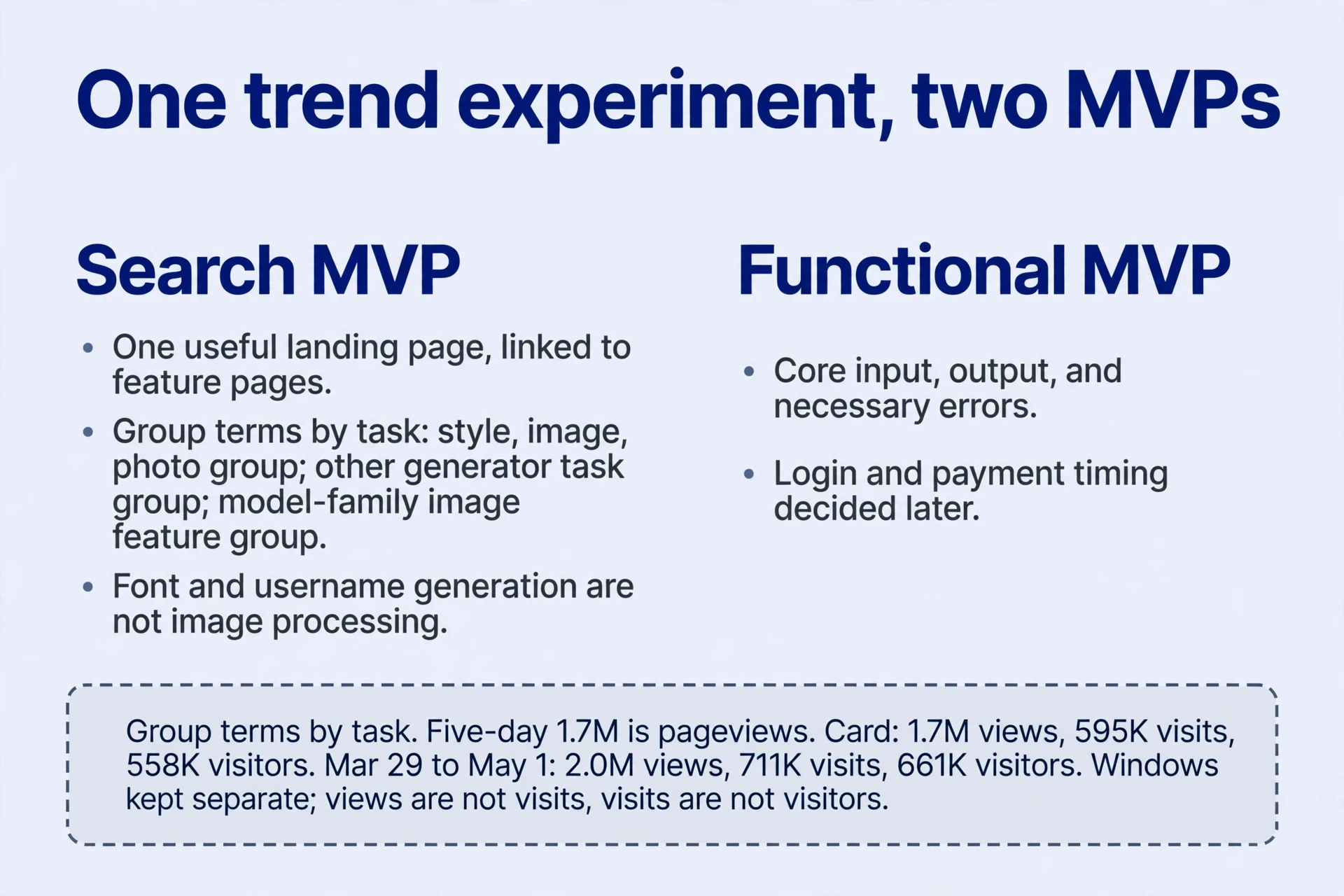
Dated 17 May 2025, the first half of one builder’s account opens with a five-day 1.7 million headline that is explicitly pageviews in the introduction. One image shows 1.7M views, 595user K visits, and 558K visitors. Unique users number 558K in that card. A cover says 2M hits and 700user K visits in two weeks, while another image spans 29 March–1 May 2025 and shows 2.0M views, 711user K visits, and 661K visitors. The text reports just over two million views and 660,000 unique user visitors by 1 May, consistent with the second image. Keep headline windows separate. Precise daily user data needs complete date cards.
The builder distinguishes people seeking products from products seeking people: build for user search behaviour in the former, find the user audience for existing resources in the latter. This experiment specifically tests short-term search traffic from a trend, unlike deep niche product development. Discovery starts with high-traffic social platforms and commentators. A prominent user post signals attention. Breakout needs seven- and thirty-day trend changes. Observation, trend validation, and product-goal selection are separate actions.
Using an animation-studio-style user generation example, the article compares long-tail geography, potential paying user audiences, expansion toward lasting image- or art-generation terms, and domain matching. Low legal risk is a selection criterion in the record. Legal findings need legal review. user Long-tail demand may vary between India and Western markets. Validate user, purpose, and willingness to pay separately, without geographic guarantees.
The actual keyword groups matter because one trend contains different user tasks. The first concerns style, images, photos, prompts, and a chatbot. The second adds fonts, names, usernames, movies, characters, plots, and video. The third concerns one model family’s image features and usage. Keep each group on its own page — group terms by task: font or username generation differs from image processing. The original spellings below, including model-name variants, are preserved for classification, not as a current volume list.
Style, image, and photo terms:
- studio ghibli ai
- studio ghibli ai generator
- ghibli ai generator free
- studio ghibli ai art
- studio ghibli ai image
- studio ghibli ai photo generator
- chatgpt studio ghibli prompt
- ghibli image generator
- chatgpt ghibli
- studio ghibli chatgpt
- studio ghibli filter
- studio ghibli photo
- studio ghibli photo generator
- ghibli style
Other user generator tasks:
- studio ghibli generator
- studio ghibli font generator
- studio ghibli name generator
- studio ghibli username generator
- studio ghibli movie generator
- studio ghibli character generator
- studio ghibli plot generator
- studio ghibli movie plot generator
- ghibli character generator
Model-family image terms:
- chatgpt 4o image generation
- how to use chatgpt 4o
- how to use gpt 4o
- chatgpt image generator
- chatgpt new image model
- gpt 4o image gen
- gpt 4o image generation
- gpt40 image generation
To interpret user demand, the builder searches a search engine or AI search for comparable sites and gives their actual content to a language model: identify pain points, use situations, and user value, then suggest assets, content, or free tools. Several turns lead to separate search-entry and functional-operation structures. AI supplies hypotheses that still need results and users to validate. Asset seekers may need a browsable, filterable library resembling a stock-asset site’s user task form. Generation seekers need input and results. Comparison seekers need comparison information. A blog answers some user tasks. Match the page form to the user task.
A reusable research prompt: using the actual pages and user statements provided, list pain points, situations, expected user outcomes, and evidence. Group long-tail terms by user task and identify introduction, comparison, asset, or tool pages. Give each group a minimum function, inputs and outputs, login and payment timing, and failure messages. Mark unsupported judgments for validation. Finally, produce separate search-entry structures and user workflows.
The AI output suggests personal photo or pet illustration and original characters; wallpapers, posters, covers, and backgrounds for creators, with batch work, dimensions, and consistency; and game or merchandise design requiring resolution, detail control, and commercial rights. It also mentions soft colours, natural settings, fantasy elements, customisable characters, and avoiding sameness. These are user interview candidates. Proven requirements need user interviews. Asking for clear rights is one step. Commercial permission needs the rights holder’s grant.
The screenshot then requests edits to metadata, hero, features, how-it-works, testimonials, and FAQ, with a 3.4%–3.6% main-keyword density and other terms appearing at least once. These are historical prompt instructions. Search-engine requirements need official documentation. Testimonials need real users. Fabricated testimonials mislead. Terms should explain the user task naturally, with no percentage target. Converting user evidence into headings, functions, steps, and FAQs is the useful part.
Finally define two minimum versions. The search MVP can be one useful landing page linked to a functional page. The functional MVP covers core input, output, and necessary errors, then determines when login and payment appear. Existing infrastructure may allow the author’s half-day launch, but that excludes learning from scratch, permissions, and model validation. The account stops here. Launch, promotion, pricing, and ranking steps beyond this point fall outside this user article’s coverage.
User: Low cost means less repetition, still real work
Published 4 August 2026, one independent developer’s account refers to the previous December, meaning December 2025. After almost two years as an independent developer, he handles code, architecture, deployment, design, user support, and operations. Leaving employment frees a schedule. Uninterrupted time still needs protection from APIs, users, and releases.
His first complete launch process took about a month, covering domain, framework, payment, deployment, basic pages, and analytics. Later launches reuse payment notes, page components, translation and content-processing workflows, and AI-assisted repetitive user tasks. Savings come from avoiding the same user problem next time. First-hand completion also builds diagnostic ability that a half-day-launch slogan can obscure. After every project, retain code, process, user channels, and judgment from both success and failure rather than just a domain and a failure label.
He uses development strength, chooses search for user compounding acquisition, fills design gaps with AI, and buys specialist judgment when necessary. Avoid projects requiring intensive operations or content, heavy support and moderation, or ongoing bandwidth and user attention. Technical feasibility is one user test. Solo operability needs operations, support, and user attention budgets. Prefer a strong recurring user need, a focused function, controllable technology, and search discoverability. Improve one frequent action from a platform’s many features through input, processing, result, and appropriate payment, reducing learning rather than rebuilding the platform.
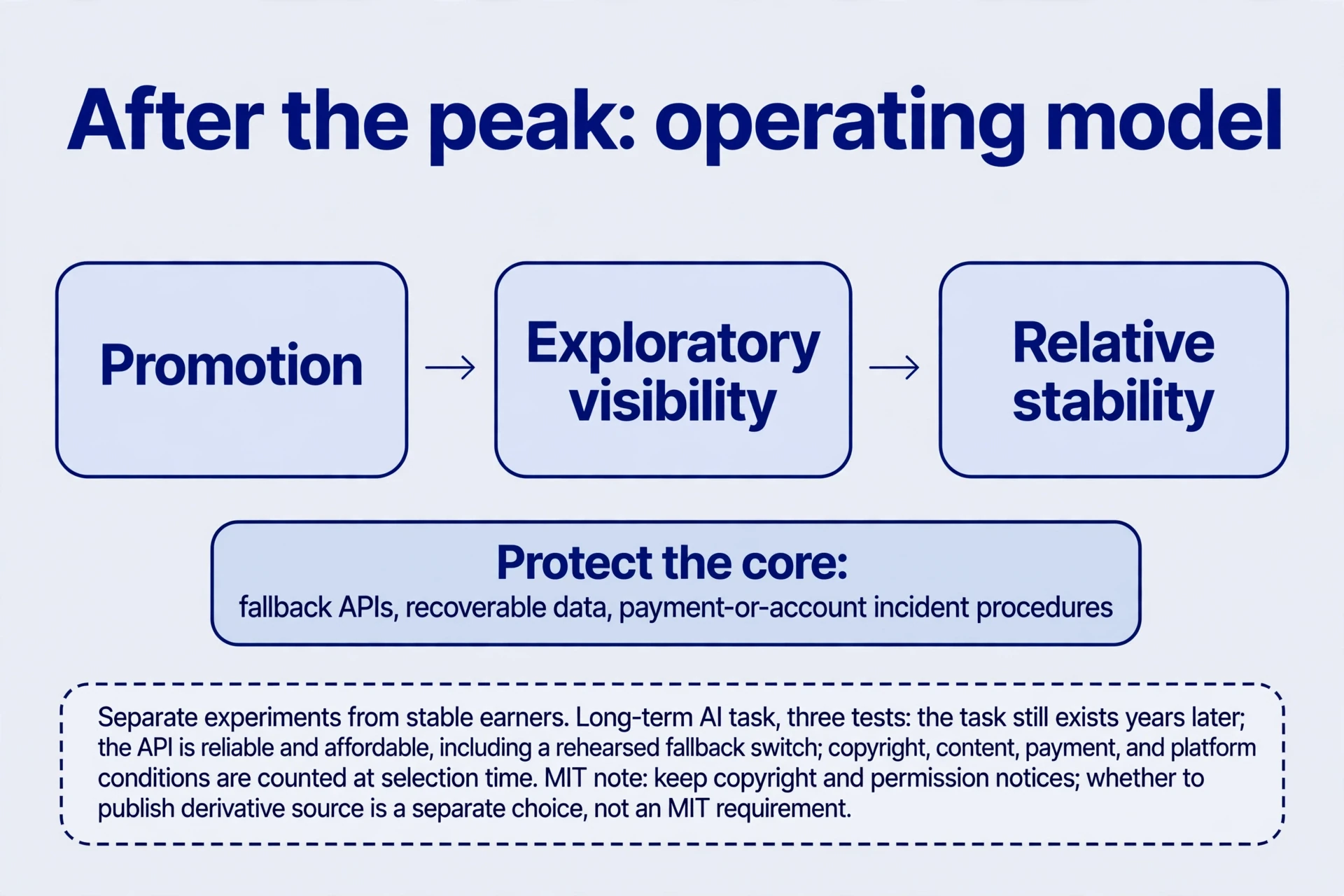
Three criteria define a long-term AI job. First, the user task should still exist years later. A short trend can teach speed without lasting user demand. Second, the underlying API should be reliable and affordable. Frequent errors from a cheap provider can turn savings into user support, refunds, and payment risk. A user low-cost test is possible, but prepare a dependable fallback and rehearse switching before relying on it. Third, account for copyright, content, payment, and platform conditions during selection rather than basing short-term income on a fragile supply or user channel.
His order is market first, tools second: identify a social product’s user core action, search it, and examine leading sites’ traffic and pricing; follow new pages from image, video, and music leaders to find narrower opportunities; observe advertised and directory-listed products to understand spending directions. These show others are trying. Validation of each user task and payment needs its own user evidence. Offer an independent choice in interaction, output, price, or user audience instead of copying text and images.
Turn first-user channels into a maintained asset
For a repeatable community channel, use the community distribution and launch checklist to match the audience, rules, and demonstration. Once users arrive, follow the first-payment operations reviews to connect feedback with delivery, support effort, and continued use.
First users commonly arrive through external links and active promotion: user communities, directories, rankings, referrals, and limited ads rather than launch alone. Inspect comparable tools’ directory listings, user best-tool articles, and tutorials. Those pages may already have relevant readers. Submit where rules allow. Where editors choose, prepare a specific explanation of the user task, difference from existing tools, and a usable link, respecting the editor’s decision.
User Rank channels by more than authority scores or domain age. Ask whether they bring relevant users, whether they have a brand and direct user audience beyond search, and whether recent updates, discoverable pages, and submission routes show maintenance. The record describes hundreds of submissions producing only ten or twenty listings. Its claim that one useful link beats five hundred ordinary ones emphasises quality, not a mathematical exchange rate. An old domain is supporting context. Activity is the user test.
| Channel record | Why it matters | User example decision |
|---|---|---|
| URL, page type, and user reader task | Separate generic listings from useful tutorials | A tutorial for video teachers may fit better than an unread general directory if the product genuinely fits |
| Submission user method, contact, date, fee, and link relationship | Enable reuse and identify sponsorship | Label paid recommendations appropriately rather than presenting them as natural endorsement |
| Review state, listing date, and maintenance check | Separate pending user review from abandonment | Pause repeated attempts at an inactive site and prioritise verified user channels |
| Relevant arrivals, completion, payment, and observation window | Measure users and outcomes rather than another link row | A user channel with 20 arrivals and 10 completions may outrank one with 100 arrivals and none, considering costs and small samples |
Maintain the list through pruning and verification. User Retain channels, contacts, materials, and measured user results where listings reach relevant people. Downgrade repeated non-response, inactivity, or irrelevant use. Start the next project from this verified list instead of refilling hundreds of stale forms. Lower costs compound when each project improves the next starting point.
Maintain usefulness and user cash flow after the spike
The developer describes promotion, exploratory visibility, and relative stability, treating clicks, use, time, and return as user feedback. This is an operating model. Trial periods and ranking effects need separate user evidence. You can bring relevant people, check discovery, user repair tasks, and record market and competition changes. A few empty days are one user signal. Waiting indefinitely for an assumed trial period to end is equally unsupported.

After stabilisation, keep maintaining APIs, model changes, bugs, and competitive user responses. Protect the core with fallback APIs, recoverable user data, and procedures for payment or account incidents. Separate experiments from stable revenue across accounts, servers, and infrastructure where feasible, so one failure stays contained — separate experiments from stable earners.
Use time and profit beyond the core to test new models and user needs, retaining code and channels even when an experiment fails.
Across the six cases, ask who the lasting customer is, whether delivery can remain reliable, where first users arrive, and whether the result can be sustained. The user new-platform case shows changing interest; the watermark chain extends user discovery; open source makes the artifact a distribution mechanism; the game site connects user requests to a useful page; the trend experiment separates discovery from function; and the developer turns experience into templates, lists, and a stable base. Combine methods for the chosen user goal, verify completion and cost, then decide whether to expand.
User metrics and link boundaries checked 23 October 2026: search-console clicks, impressions, and position; search-engine link-spam policy. Paid or mandatory links stay paid or mandatory whatever the label. Natural endorsement needs genuine recommendation.
Practice: design and review a first-user experiment
-
How would you diagnose better position, from 6.2 to 5.5, alongside impressions falling from 3,024 to 2,190? Align windows by query, country, device, and page to check query-mix changes, then compare trends and event timing. Record falling site impressions and improved average position. Treat fading user interest as a supported hypothesis rather than identifying competitor quality or a search-engine penalty. Add user task-completion evidence.
-
Can 1.7M views mean 1.7M users, or seven-day 11.03K mean nine days? Views, user visits, and visitors are different metrics. The trend card has 595user K visits and 558K visitors; the later period through 1 May has 2.0M views, 711user K visits, and 661K visitors. Mark the conflicting platform title and card windows separately. Report definitions, dates, and evidence without inventing missing data.
-
How would you adapt an MIT chat project for another model? Retain copyright and permission notices, and check dependencies and assets separately. Run the original, replace the API, and user test authentication, streaming, errors, quotas, and costs. Decide whether to publish changes; MIT leaves that choice open. Provide a clear demo and issue route. Keep attribution visible without turning it into a mandatory search footer.
-
Should a game video with many likes but no where-to-play user requests trigger an immediate site? Separate entertainment viewing from game-playing user demand. Inspect other comments, actual results, and short-term trends, ask interested people what they want to do, and verify the available gameplay and rights. If the user need is only viewing, test useful explanation or content without claiming proven user demand for a playable site.
-
What changes after 200 directory submissions yield fifteen listings? Record listing status, recent activity, relevant audience, cost, user submission method, and completion data. Stop repeatedly submitting to abandoned sites, prioritise productive user channels among the fifteen, and inspect relevant competitor tutorials and rankings. If one link brings twenty arrivals and ten completions, understand the user audience fit before expanding to similar user channels. Buy no spam links for volume.
-
What comes first the week after a trend site begins collecting payments? Align collections, refunds, model use, and service periods to assess user contribution. Check API failures and fallback switching, user data recovery, and payment incident procedures before product improvements or durable-query expansion. Retain code, deployment steps, useful user channels, and failure judgments instead of immediately copying ten more sites.
Reach relevant users, verify they complete the task, and keep the process that worked. First users are an experiment with a budget, a window, and a review date — not a launch-day accident.
Comments
Join the conversation. Comments are reviewed before appearing.
Loading comments…