This chapter contains three authors and four accounts. One records a 21-day training period in 2024 and a first payment on day 22, then ten more days from 12–21 April. Another looks back on 18 August 2025 at two sites begun in March 2024 and failed trend-driven sites. The third looks back in March 2026 on over a year of operations experiments and roughly four months of AI Web learning before the first sale. Publication dates are not event dates. Relative dates remain as recorded rather than forming one combined revenue curve.
A first dollar proves one payment loop; product-market fit takes repeat demand. “$3,000 per month” describes one author’s reported revenue at the time, while another author explicitly identifies the headline $40,000 as peak monthly revenue before costs and with substantial fluctuation, and the screenshot displays $45,959.84 gross revenue in a 30-day view. With costs, refunds, hours, and tax records absent, comparative profit margins and guaranteed operations timelines stay out of reach. Keep peak revenue and net profit in separate columns.
For each action, record the problem, the evidence available at the time, the action taken, and the subsequent observation. When content, payments, and promotion change together, record the improvement as co-occurring, since a single cause takes an isolated test to establish. The introduction calls the first author a complete beginner, but his continuation mentions programming experience: he was new to overseas Web products and Next.js/Node services, not to code. Emotion and late nights explain his situation, but priorities, affordable hours, and sleep planning still decide the schedule.
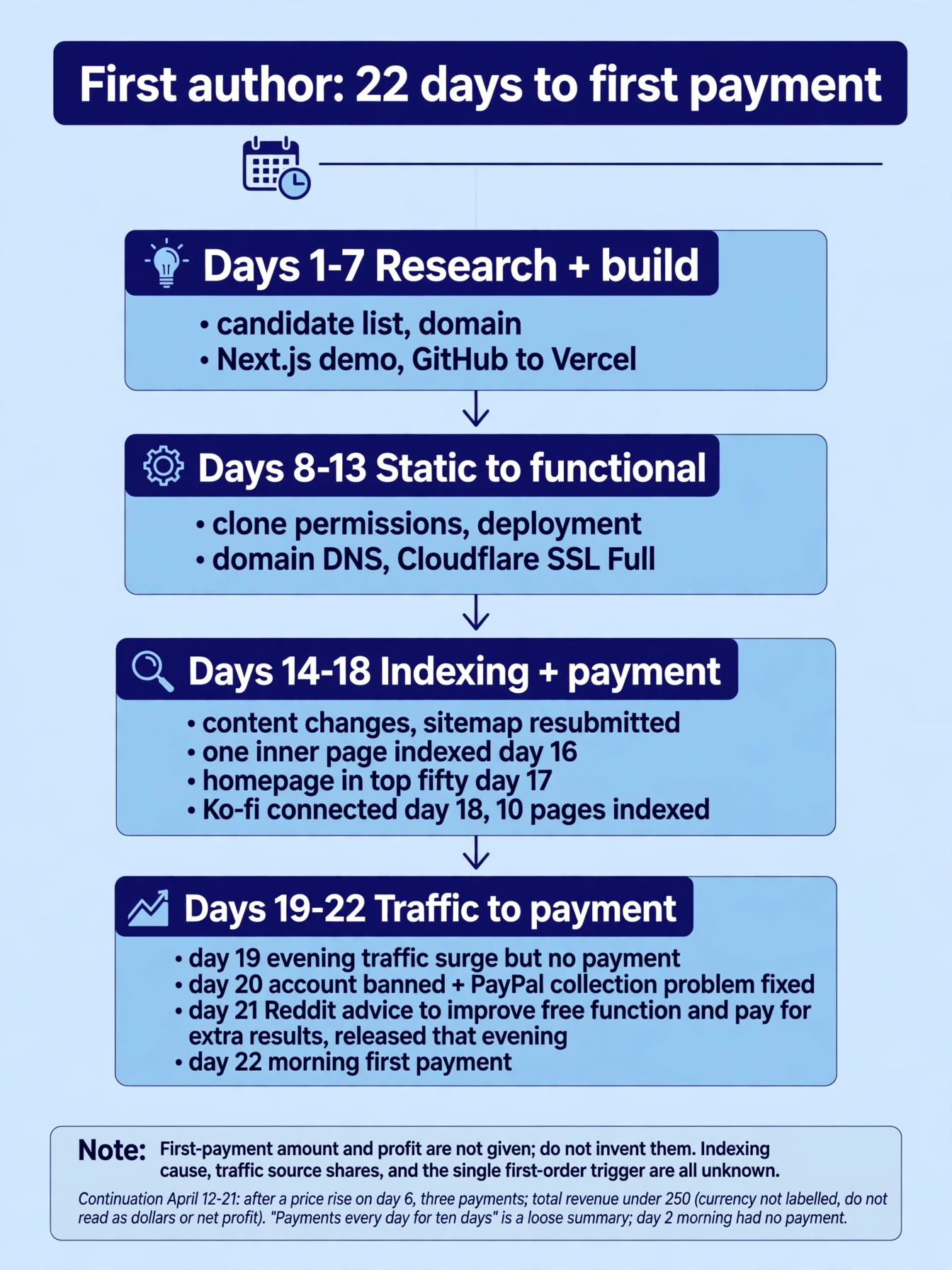
The first operations retrospective, days 1–7: research terms and feasibility together
On day 1 he browsed technology media and news, checking whether promising technology could be used rather than studying its source. Media monitoring continued throughout training. On day 2 he took operations notes during a coaching session and traced payment-entry inbound links to products and keywords, remaining dissatisfied at 3 a.m. On day 3 he checked whether he could build the corresponding function before numerical screening, while analysing intent at the same time. This avoided undeliverable choices but could also exclude worthwhile needs simply because his current skills were limited.
On day 4 he chose an existing candidate despite dissatisfaction so that he could finish the operations process. Day 5 brought domain registration, site structure, and repeated comparisons of Next.js and other options while searching continued. On day 6 he used a component library and a Next.js demo, asking a free AI chatbot how to install the local environment and following up on operations problems. On day 7 he learned GitHub-to-Vercel deployment, watched the replay after falling asleep, found a rising term, registered another domain, and completed the structure and layout of both homepages.
The reusable practice is a candidate sheet — need and intent, trend date, core delivery, technical obstacles, and next validation — and one useful minimal task finished before a second site starts. Daily observation led him to the new term, showing that research can continue alongside building. The full coaching sessions are not archived, so references to them describe context only; the missing instruction stays missing.
Operations: Days 8–13: from static pages to accessible functionality
On day 8 he sought code suited to Next.js and Vercel to turn the static page into a functioning application. An evening session clarified backlink research. Day 9 focused only on site text and implementation choices. On day 10 he resolved a private GitHub repository cloning-permission issue through research, completed some functionality, and deployed to Vercel. He learned that code commits could trigger deployments but delayed domain configuration until the site was more complete. Private repository access requires legitimate authorisation, and the exact permission fix went unrecorded.
Day 11 added inner pages, updated production, and configured the domain. His registrar lacked the needed DNS service, he struggled to find settings, propagation was slow, and JS/CSS disappeared. Setting Cloudflare SSL to Full restored access in his operations setup, though that fix covers his setup only — missing-style issues still need their own diagnosis. On day 12 a search-engine connectivity problem consumed half a day. A keyword tool then showed keyword proportions below one percent, prompting AI-assisted copy changes. Early on day 13 he added analytics, saw no morning improvement, and continued inner pages, blogs, link research, and community preparation.
Validate domain routing, HTTPS, assets, core APIs, mobile behaviour, and error logs rather than stopping at whether the homepage opens, and validate copy against the task and search language rather than chasing a universal keyword-density target. One morning after installing analytics is too short a window to judge SEO success; analytics need an adequate observation window and real events. Verify AI-written articles and add practical operations steps and examples, since quantity alone measures no usefulness.
Days 14–18: indexing questions and payment integration
For your own operations review, connect payment integration to the cross-border account and settlement checklist. Test one order from checkout through delivery and the provider’s recorded transaction, then reconcile settlement separately. The revenue-chain guide helps keep registrations, successful orders, refunds, and receipts in their own columns.
On day 14 outside posts brought visits but search indexing stalled. He changed content, resubmitted the sitemap, and suspected Next.js. On day 15 he investigated indexing statuses through AI assistance, official documentation, and coaching without finding a cause, considered doubling homepage text, and delayed his second site. On day 16 he found one indexed inner page and requested homepage indexing in Search Console. On day 17 the homepage appeared within the top fifty results, which he attributed to waiting and the request. One indexed page shows only that one route works, not what caused the homepage to follow, and indexing after a request is one sequence — guaranteed acceleration, a Next.js obstacle, and doubling-text effectiveness would each take isolated evidence to establish.
Day 17 also brought promotional posts and research into connecting and embedding Ko-fi and PayPal, with more page submissions. On day 18 Ko-fi was integrated, operations feedback from posts informed changes, ten pages were recorded as indexed, and posting continued. Track organic search, community referrals, Ko-fi page views, payment clicks, and cash received separately: payment-page views describe the payment page, not main-site users, and indexed-page counts describe indexing, not purchase intent, which takes funnel events to measure.
Operations: Days 19–22: move from traffic excitement to value and payment
On day 19 evening traffic surged, recorded as double- or triple-digit visits per thirty minutes and tentatively attributed to links, but payments stayed low despite afternoon changes. On day 20 some promotional accounts were banned. Switching to foreign-community comments worked poorly. That morning frequent Ko-fi checks uncovered and resolved an PayPal collection problem. He initially blamed the lack of payment on the channel, but without full funnel and payment logs this remains a candidate explanation.
On day 21, with visitors and payment-page monitoring but no purchases, he asked on Reddit. A user suggested a more attractive free function and payment for additional results. He changed and released it that evening. The first payment arrived on the morning of day 22. Operations feedback clearly triggered a trial/paywall adjustment, but payment repairs, ongoing traffic, and product changes overlapped, so no operations experiment identifies a sole cause. The account gives neither the first-payment amount nor profit, and this course invents neither.

To repeat this operations process, split “traffic without purchases” into unseen value, absent usage, insufficient trial, unclear pricing, and failed payments. Run a complete test order first, observe real completion of the core task, then interview users who used it without paying. Community bans are feedback about rules and promotional behaviour. Replacement accounts invite further bans. Redirect time from repeated links toward genuine answerable needs.
Operations: Continuation days 1–5: reassess fit after the first sale
The continuation account was written 21 April 2024 and published 25 April, counting 12 April as continuation day 1. Looking back at two orders the preceding day, he shifted toward traffic: community posts, content, and inner-page updates, directing inner pages to homepage functionality and submitting the sitemap at 19:45. plans included monitoring media and researching through media terms, payment inbound links, and e-commerce brand-demand patterns. Day 2 began without payment and was consumed by work meetings. On day 3 he searched older forums for immediately useful knowledge but began considering another product, making no site operations changes.
On day 4 he listed seven overseas paths — products/services, commerce, creative work/ads, investing, remote work, cryptocurrency, and overseas accounts — and felt products, creation, and remote work suited him: a personal direction list, with legal questions left to professional advice. He recognised that not every technology announcement mattered and the original term had not taken off. His three product-market-fit questions found demand and monetisation but insufficient sticky users. Operations notes from a forty-five-day/$10,000 podcast included launch-page launches, quality content, avoiding overreliance on ads, looking one to three years ahead, differentiation in crowded markets, and less attention to button colours — though the podcast is not archived and its result awaits independent verification.
On day 5 advice to practise with trends and later pursue lasting needs prompted a serious KGR calculation, which did not meet his chosen criteria. He improved the site from comments and saw visitors without apparent functionality use in deployment request paths, suspecting intent or entry-point mismatch. The operations change remained disappointing. Competitor research reminded him that suitable technology should deliver and monetise value rather than win a technical contest. KGR has no official success threshold, and low traffic has many possible causes, so one ratio explains only part of it. Request paths also need product events to establish actual usage.
Continuation days 6–10: pricing and three infrastructure revisions
On day 6 he received three payments after a price increase. That morning he aligned payment logic with market conventions and clarified the service. Orders followed, but no prices or control group are supplied. Free-tier deployment timeouts and database cost led him to a cloud provider’s free virtual machine running Debian, where browser-based access proved difficult but local-terminal SSH worked. Following an old post, he enabled direct root login, installed dependencies, built and started the service, then fixed missing port 80/443 access. The site became reachable, but the database had not migrated.
These details reveal operations migration costs, though current deployment advice takes current provider documentation. Direct root login adds operations risk without benefit for running Next.js — the provider officially supports standard SSH access with authorised sudo, and browser-based administration works in its own console. Use logs to separate timeouts, memory pressure, process exits, networking, and database issues, retaining a rollback path. Historical free access describes its own date, so current allowances take current terms.
On day 7 the deployment still crashed after running. Suspecting insufficient free resources, he spent another day moving to a paid cloud provider. Continued orders motivated further operations work. On day 8 the new deployment also briefly failed. Recognising limited Node-service experience, he split the architecture: frontend on Vercel, database on Supabase’s free tier with willingness to pay the then-$25 monthly tier, and a service-consumption worker on a free server. Further code changes and observation followed. Repeated cloud moves without a confirmed root cause leave insufficient resources as a hypothesis, not a basis for platform comparisons.

On day 9 the service stayed up and payments continued. He described total revenue as below 250 without specifying a currency — a figure that stays unlabelled until currency and costs are known, so it reads as neither dollars nor net profit. Day 10 brought more orders. Priorities were blog generation, loading and routes instead of inconvenient Markdown paths, completing an already-advertised delivery feature, and researching affordable AI integration, which was still absent. He released the first two, reviewed 16–17 April homepage changes and search trends, and observed Ko-fi visits. He remained unsure whether the site would grow or be abandoned. The headline “payments every day for ten days” summarises loosely: the operations details, including no payment seen on day 2’s morning, stay in the record, and the archive covers no complete daily ledger.
The operational lesson is specific: do not wait until payment to discover whether a promised service can be delivered. Any presale must clearly state scope and timing. Before operations migration, back up data, test functionality and payment callbacks, test background work, retain rollback, and observe a complete usage cycle. When revenue is small, track cloud spending and hours especially carefully. Free tiers leave deployment, downtime, and operations maintenance costs in place.
The second operations retrospective: from a RMB 15 domain to art-institution use
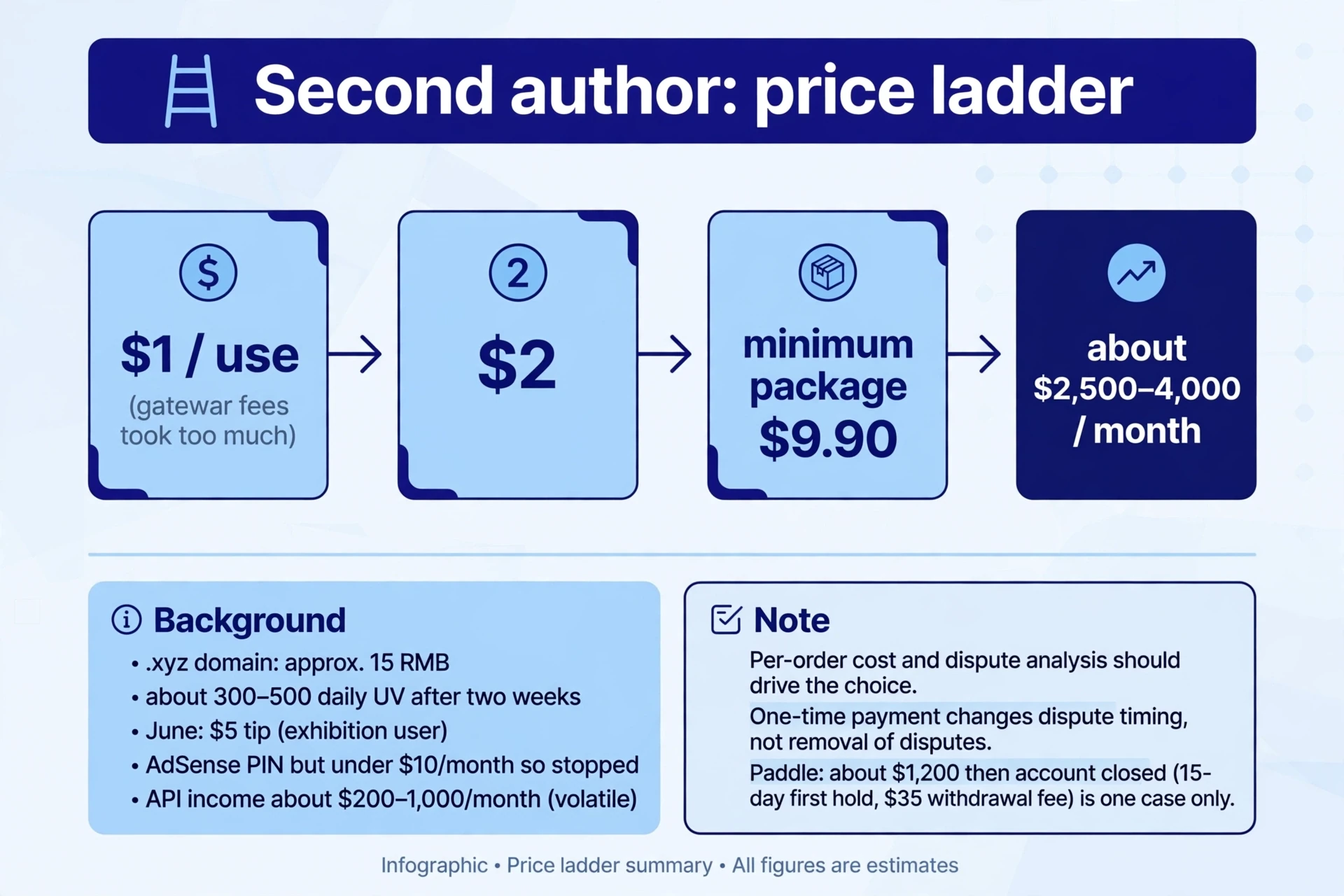
The second author’s first site began during March 2024 training. He bought a .xyz domain for RMB 15, chose image description after a few hours, and imagined an AI art-image interpretation service. Using a component library instead of the recommended template, he built a static page in a week and promoted it on a startup community, Product Hunt, and Facebook. With fewer competitors and willing media, it reached roughly 300–500 daily unique visitors after two weeks. Early traffic measured visits only; functionality, payment, and lasting demand took later evidence to establish.
He then spent a month learning from Next.js documentation and rewriting the site, added Ko-fi and image analysis, and optimised for two more months before receiving a $5 tip in June from a user preparing an art exhibition. Later redesigns added three features. He tried AdSense and received a PIN but stopped when monthly ad revenue stayed below $10. API calls became the main income, approximately $200–1,000 monthly with volatility. He reported low costs without a complete cost sheet. Shanghai art institutions using student-work critique and exhibition scenarios revealed real demand within the original invented story. He declined API/custom-software requests because of legal concerns and effort, instead explaining implementation.
The second site was inspired by a short-video post that July. He studied leading competitors’ layouts and copy, built a landing page, and provided free functionality because the model was then free. Another month added a blog, case library, about page, payments, and demonstration videos. Product Hunt featured it and short-video creators promoted its novel free functionality, but he missed and did not answer Product Hunt messages. This shows channel fit alongside a missed opportunity for user dialogue.
When the model became paid, he tried $1 per use, found gateway charges consumed too much revenue, moved immediately to $2, and gradually raised the minimum package to $9.90. Payment disputes made him worry that his sole merchant account could halt all revenue, so he researched and switched from subscriptions to one-time payments up to $299. He later reintroduced subscriptions less prominently and some users chose them. The site then reported roughly $2,500–4,000 monthly revenue. One-time payment changes dispute timing rather than removing disputes, so per-order cost and dispute analysis should drive the choice.
Several later trend sites failed. A figurine-generation site entered an already crowded market and received only thirty-something clicks in a month despite a UI and interaction he liked. He chose commercial niches he could develop carefully instead of competing on second-by-second launches. Comparing the months before the first site’s first payment with faster second-site growth reveals accumulated research, delivery, pricing, and channel experience — not a lesson that cheap domains or static pages produce revenue on their own.
Connect research, related features, and promotion into ongoing operations work
The second author researches payment-gateway inbound traffic, AI rankings, root terms, social trends, short-video platforms, and AI publications. His first site traced payment-provider inbound traffic. After gaining traffic he followed search trends and competitors’ new pages, adding only relevant subfeatures. The account cites an image-to-prompt tool at 1.4 million monthly visits as a later entrant overtaking earlier sites, a contemporary observation at the time of writing. A new audio-video model’s output illustrates how model improvements may improve an existing task, though chasing every model is a separate operations decision. Existing app needs underserved on the Web are another research path.
He used short-video discovery pages and community tag pages to inspect examples, comments, likes, and shares — attention that only payment events can turn into revenue evidence. Free frontend helper features gained traffic the following year. Another social term produced millions of impressions over days but served an intent only tangentially related to the business. A related MVP planned earlier and finally added that July attracted use without promotion. Record these separately as delayed demand, mismatched traffic, and related-feature validation. Planted features yield returns only where usage follows.
For promotion he submitted directories and tailored posts to Product Hunt, Hacker News, X, Facebook, LinkedIn, a developer community, Quora, and Medium, sometimes using AI rewriting. Media discovery through Hacker News and creator exposure after Product Hunt featuring are possible routes, with operations outcomes varying. After five Reddit bans he stopped and later only read and answered questions. The account suspects IP quality. Without a platform ruling, the cause stays unknown. He used AI coding tools for frontend prototypes and refinement, drew FAQ ideas from search suggestion features, and used analytics, Search Console, and Bing Webmaster Tools for usage, search, and discovery respectively.
Payment migrations: attach dates and entities to every constraint
The second author first used Paddle and describes passport-based registration, website review, and complete functionality, pricing, privacy, terms, payment, and refund policies at the time. He was approved after replying to an initial rejection — one approval, with current rules and approval odds left to current provider terms. After collecting about $1,200 he experienced account closure affecting users in his region, with half a month’s notice to migrate. Reports of other accounts recovering months later are anecdotal, and his thirty-day balance wait reset by refunds after inquiries, including one inquiry unrelated to his order, is personal experience; refund rules follow the provider’s current terms.
Paddle paid him through PayPal. He recalls a fifteen-day first-payment hold, a US tax-status question above $500, and a $35 domestic withdrawal fee. Believing a claim of free receiving-account withdrawals, he opened a USD account, still faced fees, and had a personal-remittance receipt rejected and the receiving account closed over source documentation. After consulting domestic banks, he received funds through one of them. He later distinguished US local banking from Hong Kong USD accounts: currency does not determine the banking route. The account’s claim about withholding is one author’s reading, with tax conclusions left to professional advice, and holds, fees, and eligibility remain pre-publication experiences.
After moving to individual Stripe he used a receiving provider’s USD account but could not link his Singapore bank or UK online-bank accounts to his Hong Kong merchant account. He reports a then-$5 Hong Kong USD payout fee, FX costs for HKD settlement, and HKD pricing with adaptive pricing shifting currency considerations toward user experience. His later combination was Stripe, Payoneer, and an online bank. He registered Creem without collecting through it, so it was not a validated route. Separate accounts may reduce operational coupling, though approval and isolation follow each provider’s operations review, so verify settlement currency, bank country, entity, and platform region individually rather than assuming a local-bank-only rule.
The account also lists several banks, receiving providers, developer accounts for advertising and gaming income, and a European bank’s video verification, alongside observations of reduced SaaS support. This is a historical attempt list, including conditions the author explicitly calls uncertain and requiring tests. Current availability needs fresh verification, and the list recommends no account opening by itself. Transferable practice is to verify business type, residence, entity eligibility, bank routing, settlement currency, fees, and evidence requirements, retain written platform responses, and then test a lawful small settlement.
Current verification boundary (23 October 2026): payout documentation defines conditions by account country and currency rather than personal anecdotes as global rules. Record displayed revenue, available payout balance, bank receipt, and after-tax profit separately.
Disputes, content, and support: preserve the repairs after failure
The second author’s historical fraud-rule examples request 3DS when IP and card countries differ; flag customers created within 168 hours using over five cards weekly; over four weekly credit cards per customer; over three cards with risk above 50; over ten daily charge attempts per IP with risk above 40; lower the risk threshold to an allowed level; and enable adaptive 3DS. These are historical thresholds, and optimal rules take current false-positive operations data — legitimate-user rejection has a cost. Claims that a dispute must occur before setting 40 and that failed cards are automatically blocked lack archived configuration evidence, so current rules take current documentation.
# Historical examples only; validate availability and false positives.
Request 3DS if :ip_country: != :card_country:
:card_count_for_customer_weekly: > 5 and :hours_since_customer_was_created: <= 168
:card_count_for_customer_weekly: > 4 and :card_funding: = 'credit'
:card_count_for_customer_weekly: > 3 and :risk_score: > 50
:total_charges_per_ip_address_daily: > 10 and :risk_score: > 40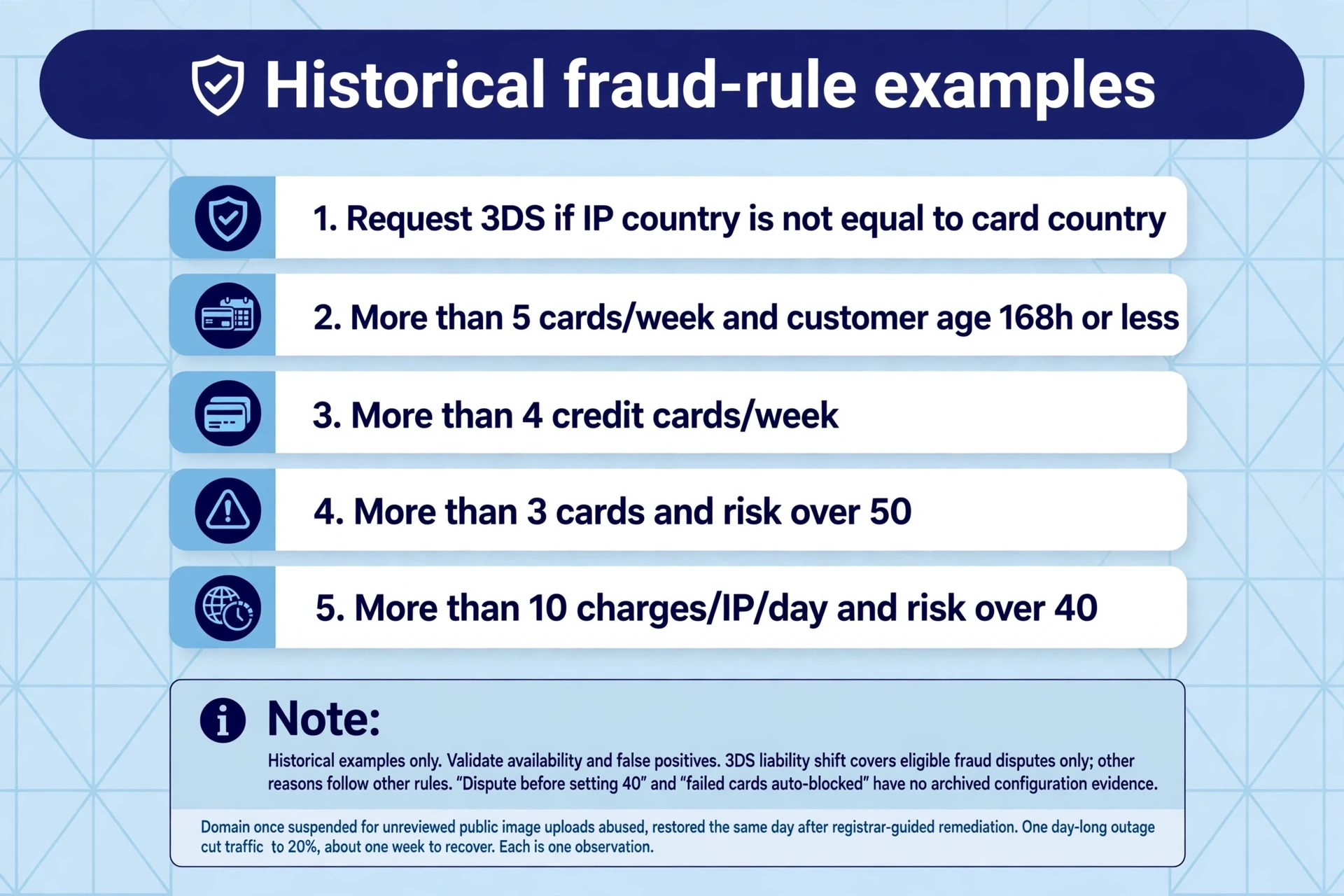
He also sends payment receipts and reminders seven days before subscription charging, monitors early fraud warnings, and reviews large repeated payments and orders without meaningful use, considering refunds and restrictions for suspected fraud. A warning flags risk rather than delivering a final finding, so blanket automatic refunds ignore context, and 3DS liability shift covers eligible fraud disputes while non-delivery and other reasons follow other rules — the account’s unconditional exemption is too broad. Dispute and countering fees and metric treatment vary by country, agreement, and event, so the historical “over $20” is one dated figure and current prices take current terms. Retain order, consent, delivery, usage, and communication evidence, since disputes are individual operations cases and discrimination claims and closure causes take operations case evidence.
Large one-time customers may need invoices. He manually created invoices, marked them paid, and sent PDFs. Reconcile real orders and accounting and use supported invoicing workflows, since a paid label alone says nothing about receipt, which takes bank records. Products also need cancellable subscriptions, usage/order administration, privacy/terms/refund/cookie information, a changelog, and contact through email, messages, or chat — changelogs that explain operations changes, with SEO gains left to measurement. For poor generated results, offer credits, assisted generation, tips, and an satisfaction check. Refund according to applicable obligations and promised policies with a clear operations timeline. Missing replies leave owed refunds owed. Pay on the promised operations timeline.
His domain was suspended after unreviewed public image uploads were abused for sexual content. He followed registrar remediation guidance, checked reputation flags, and submitted evidence. It recovered that day. Strong language is no substitute for remediation, and one scanner’s clean result covers one scanner. Safety needs broader operations checks. Routine checks also matter: an accidental day-long outage on an earning site reportedly reduced traffic to 20%, with recovery after a week. That is one outage’s observation. Recovery periods vary. Automate operations availability checks and alerts, solve your own failure, then assess whether monitoring for multi-site owners has a differentiated customer need.
For localisation he used an AI tool to translate English without researching every keyword and observed traffic. His full prompt requires natural local German based on meaning; a localised expression for image-to-video; complete semantic detail; unchanged Markdown/JSON headings, lists, and paragraphs; no extra explanation or examples; no new colons unless present; concise SEO-aware wording; and symbols that do not break Next.js rendering. Turn these into language/build checks, but research claims about the most common search term. On trials he found free access more useful for engagement than payment and tried a shared daily allowance without login, then a paywall — a result that sits comfortably beside the first author’s first sale after expanding free access, since the right allowance is a matter of testing by product, cost, and audience rather than one best setting for all. Compact plan switches can save mobile space while clearly displaying price, term, and entitlements.
His AI support prompt becomes an operations workflow: provide the question, salutation, and draft response; answer directly, clearly, and concisely without unnecessary thanks, apologies, or small talk, while remaining professional; append the site address and original question for identification. Verify facts, entitlements, and refund status before sending. Communication is both a service record and a source of real operations workflows and new needs.
The third operations retrospective: a year of exploration and four months to a sale
The third author first ran video channels alongside short-video platforms, reaching over 120,000 followers on one account and 1,000 on a short-video app to meet a then-commerce threshold, later falling below it after stopping. Believing late-night competition lower, he livestreamed from midnight to four or five. Four social accounts in different niches exceeded 1,000 followers and earned mainly advertising. Only one remained. These projects were not necessarily unprofitable, but he lacked a personal advantage, and lower entry barriers leave room for learning only where advantage and returns follow. He then joined app training and, with no experience, built a pricing tool in over twenty days, pricing it at RMB 1 and selling over RMB 1,000, with copycat naming afterward. Modest sales still demonstrated delivery.
After hearing comparisons of capital, acquisition, and product-led growth, he chose overseas AI Web and joined training and courses. “Apps depend on ads while Web grows itself” describes one author’s comparison. Both channels mix organic and paid. Roughly four months separated focused study and the first sale, followed later by the peak revenue. He also faced ad spending and individual backlink quotes described as thousands or tens of thousands, without specified currencies or totals, so net profit stays uncomputable from them. His comments on virtual-bank-linked spending convenience and rewards are personal operations history, with current recommendations left to current terms.
Operations: Reduce a hundred ideas to one clear MVP
His fourteen ranking-analysis questions for three AI-tool ranking sites are: what problem, who uses it, why needed, user reviews, acquisition method, revenue, lessons, difficult choices, one-sentence pitch, alternative approaches, buildability, your acquisition plan, why you, and persistence. Repeated acquisition questions shift from competitor observation to personal operations planning. Beginners analyse directly while experienced operators filter by niche, and AI summaries speed reading without replacing use and evidence. The linked template is not in the local archive, so its fields stay unknown.
A second route records at least three daily complaints, work frictions, or entertainment observations. He deliberately saved AI videos to receive related recommendations, investigated APIs and possible production pipelines, built an opening-video resource site around crash-to-backflip transitions, and accumulated over a hundred ideas. A third route follows models and related new terms through leading AI accounts and news monitoring, with a starter kit adapted into a personal launch procedure. Full automation is a source proposal, not a system implemented in this course, and trends may provide fast feedback at the cost of intense competition, so mature needs and everyday discovery remain necessary alongside them.
His ingredient-photo recipe idea illustrates demand judgment: how many young market shoppers cannot cook, whether they will return after learning combinations, and whether the pain supports payment. He never built it, and a later story of a month’s development with no interest is fictional — report it as fiction, not failure. Four checks ask whether he needs it, what differs from mature products, who pays how much in what situation for which operations problem, and whether he would buy from a disliked maker: hypotheses that take prototype conversations with target users to correct.
Design begins with usability. The account cites simple tools to illustrate keeping complexity inside. List MVP functions, cross them out against real needs, and compare the remaining core task with the original purpose. The prototype may be rough but its core result must feel useful. Explain one primary task in a sentence instead of starting all-in-one. The account uses an image-to-video tool’s extension from images to image-to-video as a workflow example and a fictional swordsman’s single technique as a focus metaphor. These examples stand on their own, with no need to treat an unverified failure story as evidence.
The first 300 target users: retain every channel and failure
Turn the acquisition history into a small operations experiment: choose one audience, one working demonstration, and one completion event. Use the community distribution guide to match the demonstration to the venue’s rules. For the review, borrow the comparable measurement windows from the growth cases, and record support time alongside user activity.
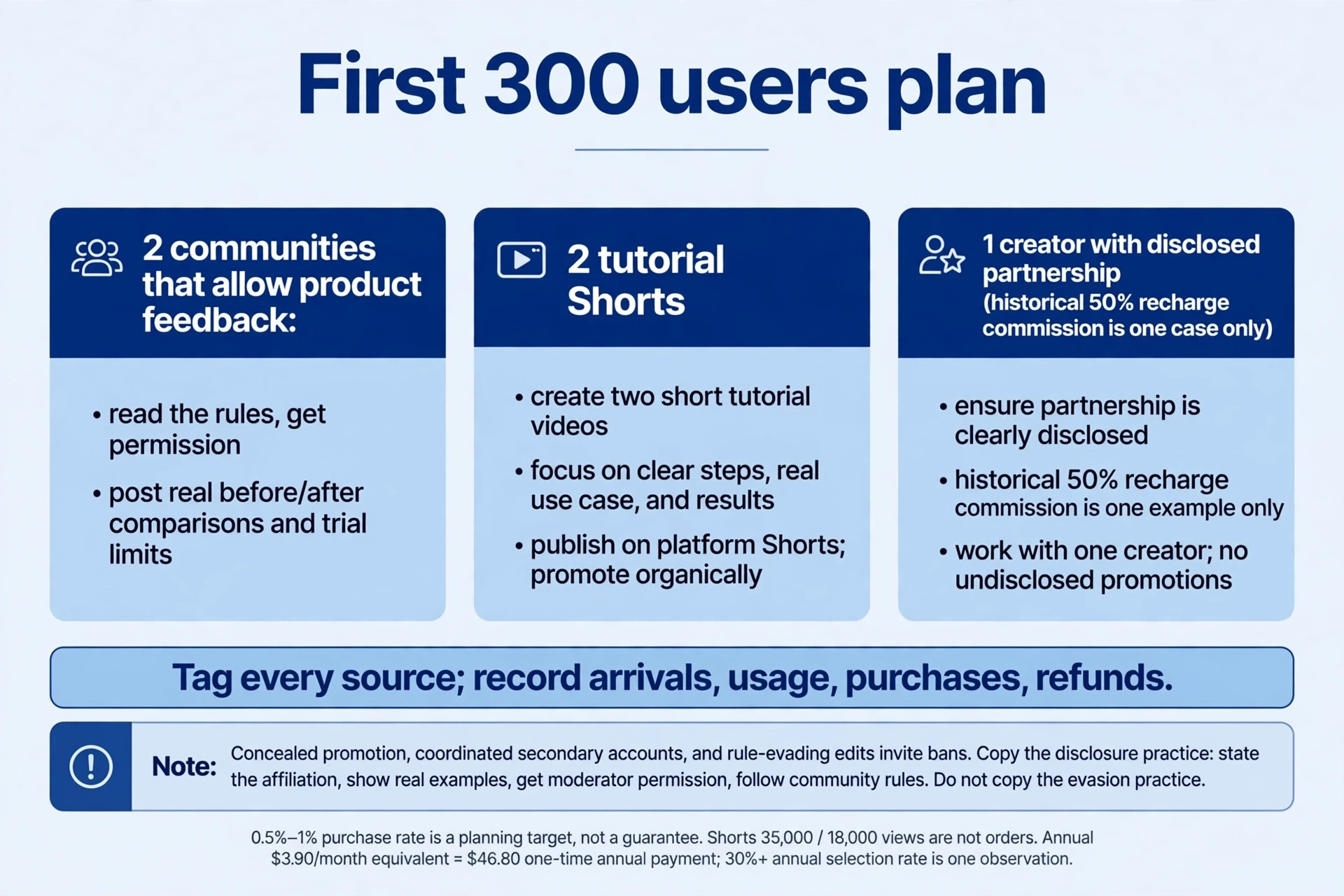
His first milestone is a sale. Using an experiential 0.5%–1% new-site purchase rate, he conservatively targets the first 300 relevant users. This is an operations planning target. Statistics give probabilities, not guarantees: even a true 0.5% probability can yield no purchases. Locate target groups and create content around their actual questions. If the audience is unclear, revisit demand. Developer/product communities include a developer forum, Indie Hackers, a product-discovery blog, Product Hunt, Hacker News, and BetaList. Novel products may attract early attention, though eligibility, fees, and rules change, so historical free-submission claims read as operations history rather than current assertions.
One site initially relied mainly on Reddit and one YouTube creator. Three of five roughly 1,000-karma accounts failed, while relevant communities later shared it organically and Reddit paid ads worked only moderately. The account’s exact sequence is commenting on popular posts, asking without links, using a second account to introduce a link, then linked posts. It also mentions plain text later edited into hyperlinks, pinned replies with later links, profile links, and freelance outsourcing. These historical actions and failures are retained as a warning: concealed promotion, coordinated secondary accounts, and edits that evade rules invite bans, so copy the disclosure — affiliation stated, real examples shown, moderator permission obtained, community rules followed — not the evasion. Claims of automatic restoration after months and permanent bans only after repeat marketing await platform evidence.
YouTube offered two routes: Shorts and relevant comments on popular videos produced startup visits, with similar participation in fan communities and Hacker News. Separately, a creator promoted free allowance and affiliate links, earning a historical 50% recharge commission and reportedly driving orders for months. That commission is one historical figure, and copying it takes API-cost accounting. Shorts screenshots show views such as 35,000 and 18,000, not orders, and long-tail value takes referrals, core usage, refunds, and contribution after commissions — views alone mislead.
Historical paid-directory examples are roughly $99 for one ranking site and under $100 from memory for another, with other AI directories’ submission services also listed. Prices are historical, so current recommendations take current price lists, and submission is one action whose visits and sales take tracking to judge. Free channels still cost time and creative work. Direct contact reveals which function attracts whom and cannot be replaced entirely by submissions. For scaling he groups SEO, platform ads, creators, and direct posting into four methods, requiring consistent comparisons rather than copying a peer’s focus on leading trends.
Operations: Scale SEO and ads by turning experience into testable settings
His SEO sequence organises keyword pages by task, grows from long-tail coverage to main terms, uses internal links for structure, earns relevant references, and improves mobile performance. Listed pitfalls are mass low-quality AI pages, premature localisation, mixed intent, neglected internal links, and sudden spam-link volume. These pitfalls describe operations risks rather than bans on related synonyms or validated localisation, and a PageSpeed score of 90 in every category is his own target, with ranking thresholds left to official guidance. Link quality and genuine relationships matter more than quantity. Early trend entrants can decline, and patient improvement helps without guaranteeing that later entrants catch up — that takes competitive evidence.
For ads he chose a US account region, later faced verification, and recovered one older account with advisor assistance. Region, payment information, and advertiser verification must follow the real entity and official requirements. Mixed identities invite verification failure. New-advertiser credits vary by country, spending, and promotion conditions. He selected a middle tier and shows one $1,000 credit — one example, with availability varying by country, spending, and promotion conditions, and no credit justifying spend beyond what is affordable. Official support can assist without private advisor contact being a prerequisite.
He installed serious tracking late, then used a tag manager with AI assistance and support verification. Verify purchase events, amount, currency, deduplication, and paths before spending, rather than trusting an AI success claim at face value. His fourteen-day ROAS and two-week optimisation advice addresses delayed conversion and overreaction to daily operations data, but attribution and learning depend on volume, bidding, windows, and operations changes. It is advice about patience with delayed conversion, not a licence to spend blindly. ROAS is attributed revenue divided by ad spend and excludes API costs, so contribution and cash payback remain necessary.
The account claims ads can demonstrate retention to the search engine and raise inner-page authority. This claim awaits causal evidence. The search platform explicitly states that paid-search investment does not affect organic rankings. Ads can test which promises yield usage and payment and help users discover products. Ads buy discovery and testing, while rankings follow organic operations work, and expensive links are a poor way to acquire ranking credit — qualify commercial relationships appropriately.
Pricing and conversion: separate implementation, observation, and untested ideas
The third author’s internal funnel is landing, registration, experience, retention, and payment, revealing core value quickly with low friction and offering purchase after a useful result. Pricing changes with cost, competition, and stage. He defaults to a high annual tier as an anchor, believing it raises order value and makes monthly plans easier to accept — an observation that takes a controlled comparison to become a profit claim. Clearly display the annual total, actual billing interval, renewal, and cancellation, so an effective monthly price never implies monthly billing.
His annual-plan method calculates API costs, tests discounts of 50% or more, and displays an example $3.90 monthly equivalent billed annually, reporting at least 30% more annual selections. Without samples, controls, and full costs this stays one observation, and one passage calls it increased annual renewal while the examples mostly concern initial annual-plan choice, a different measure. Extra annual benefits and related operations workflow features may improve selection, though few users exhausting allowances removes no heavy-use, abuse, or model-price risk. Annual cash receipts include obligations for future services not yet delivered, so they cannot all count as earned profit.
Cancellation offers and an in-page paywall were unimplemented ideas heard from others, staying unvalidated until tested, and a social screenshot of 50% off three months is only an observed example. Genuine deadlines need clear conditions: fabricate no scarcity and obstruct no cancellation with offers. He discusses usage trials such as three daily runs or fifty signup credits, plus emails to lapsed payers, abandoned checkouts, and retained nonpayers. High-frequency sending led to one email provider’s closure and a switch to another, though changing providers fixes no consent or frequency operations problem.
The remaining methods are real testimonials and permitted names, avatars, and media logos; genuine daily-use or twenty-four-hour output counts; annual upgrades after purchase and allowance-based monthly upgrade prompts; precise vertical scenarios; payment methods suitable for the audience; low-entry one-time purchases; trial/refund/cancellation commitments; professional UI; and participation and registration before payment. His second-hand public operations case of $50,000 monthly from roof contractors has no verified accounting, and Western geography and Stripe are context only — conversion takes product-market fit. Participation should help users obtain results rather than manufacture sunk costs to pressure purchase.
He closes by attributing opportunity to luck and AI lowering barriers to expression, design, and development, acknowledges not coding, and considers games, video, and music. The useful practice is a stronger observation, delivery, and feedback system. Luck and AI are background conditions, not scientific explanations of any operations outcome, and hundred-site-a-year examples set no pace anyone must follow. Sustained operations still require demand, delivery, eligible accounts, costs, retention, support, and cash, each validated in records.

Practice: turn the three operations retrospectives into your own action record
-
Reconstruct the first author’s days 14–22: which causes remain unknown? Day 14 changed content/sitemap; day 16 found an indexed inner page and requested the homepage; day 17 saw top-fifty placement; day 18 completed Ko-fi with ten indexed pages; day 19 brought traffic without conversion; day 20 repaired PayPal; day 21 changed free functionality from Reddit feedback; day 22 received payment. The indexing cause, traffic-source shares, and unique first-sale trigger remain unknown. Add Search Console status, referral parameters, product events, failure codes, and test-order records next time.
-
How can another server crash be investigated without another blind operations migration? Record timing, requests, CPU/memory, process exits, API timeouts, and database connections, then reproduce the smallest failure. Back up and change one bottleneck. Retain rollback and test frontend, jobs, database, and payment callbacks. Standard SSH with authorised sudo is sufficient. Do not copy direct root login. Compare monthly cost, maintenance hours, and downtime after stabilising.
-
How should the second author’s move from $1 to $9.90 be evaluated? For each tier record orders, gateway fees, API cost, refunds, and delivered usage. Prices alone mislead. If a $1 order costs $0.70 plus $0.35 processing, it loses $0.05. A $9.90 package with ten times usage may still not improve contribution. Compare purchase, usage, refunds, and contribution in consistent cohorts and change one price or entitlement. Simultaneous promotional growth needs its own attribution.
-
Draft a concrete, rule-compliant operations plan for the first 300 users. Assume an opening-video tool for independent creators: find two communities allowing product feedback, read rules, and obtain permission, then post genuine before/after examples and trial limits. Publish two tutorial Shorts and approach one relevant creator with disclosed affiliation. Tag each source and record arrivals, usage, purchases, and refunds. Three hundred is a target, not a first-sale guarantee. Do not buy engagement or pose as users through alternate accounts.
-
How should an annual plan shown as $3.90 per month be displayed and calculated? Clearly state $46.80 charged once annually, renewal, cancellation/refund conditions, and annual allowance. The monthly equivalent is secondary. Calculate annual cost under normal, heavy-use, and API-price-rise scenarios, deduct processing, refunds, and support, then assess CAC and cash timing. Separate initial annual selection from next-year renewal. The reported 30% effect is one observation.
-
How can fraud warnings and refunds become an auditable operations workflow? Record event and order IDs, eliminate duplicate warnings and already-refunded/disputed orders, inspect 3DS, delivery, and usage, then act under official warning guidance and refund obligations. Give clear status and timing and retain messages/refund IDs. 3DS covers eligible fraud disputes. Other reasons follow other rules. Missing replies leave owed refunds owed. Do not bulk-copy historical operations risk thresholds.
-
How can you decide whether to keep a site or pursue a new term? Compare four weeks of relevant usage, returns, contribution, and operations maintenance hours with evidence of the new term’s users, competition, and launch effort. If people pay and return but delivery fails, fix delivery first. If impressions are large but intent mismatches, interview before adding pages. Give the new term an affordable time/budget cap and review core usage and willingness to pay instead of switching directions because a ranking looks exciting.
Document each link, keep peak and net figures apart, and let the next round’s actions carry dates, owners, and evidence.
Comments
Join the conversation. Comments are reviewed before appearing.
Loading comments…