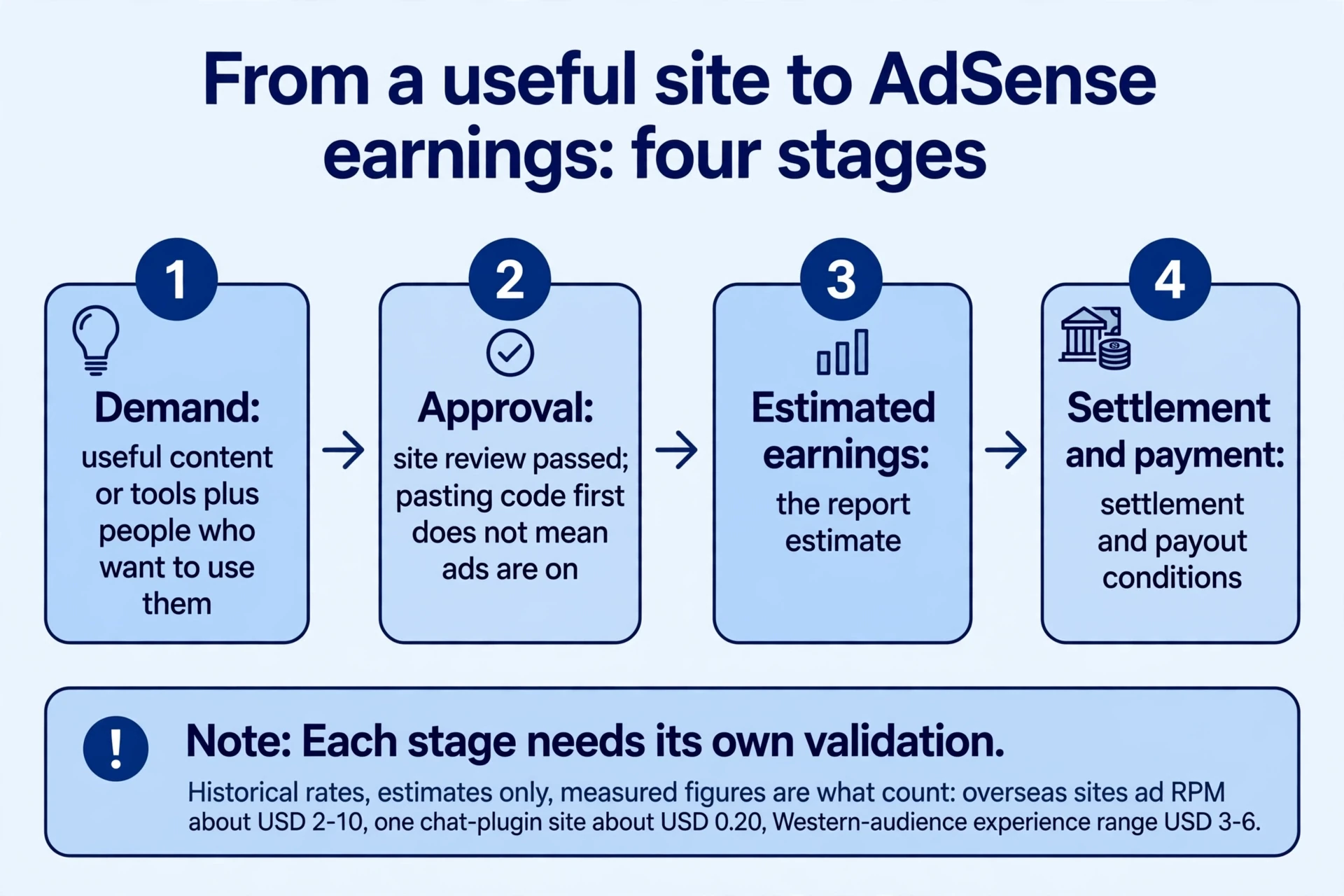
AdSense connects advertiser demand with publishers’ websites. You provide useful content or tools and attract people who want to use them. After AdSense approval and correct integration, the site can show ads and generate estimated AdSense earnings. Settlement and payment conditions then determine actual receipt. These stages answer whether there is demand, whether ads may run, how much was earned, and when payment can arrive. Each stage needs its own validation.
A talk given in Guangzhou on 8 July 2023 records a traffic mindset linking search, recommendation, and social sharing to sites or AdSense accounts, followed by direct sales of tools, services, content, books, or memberships, or advertising. AdSense Ad integration can be relatively simple, but functionality, content, policy compliance, and traffic quality still require maintenance. The author’s domain-query site, built in 2012, earned AdSense revenue for years with little code change, yet AdSense revenue fell as interest in domains weakened. That illustrates changing demand. Unattended years need their own evidence.
“English site” in the record broadly means serving overseas users, including multilingual sites. It observed historical AdSense ad revenue per thousand impressions around USD 2 to nearly 10 for overseas-facing sites versus about USD 0.20 for one chat-plugin site. Another experiential range of USD 3–6 applied to Western audiences. Language itself is one factor among many: geography, intent, category, demand, device, season, and impression quality decide rates. The platform’s AdSense earnings explanation likewise says actual operation is needed to know AdSense earnings. Treat estimates as estimates. Actual operation gives the number.
Build a sustainable site around a real task
Content sites must keep providing useful information. Tools must reliably complete tasks. Language models can assist writing and development without establishing accuracy, originality, or eligibility. AdSense Frontend examples include JSON formatting, Base64 encoding and decoding, and MD5 hashing, deployable on static hosting. MD5 is a hash rather than reversible encryption and is unsuitable for secure password storage.
Backend examples include a domain tool’s bulk AdSense registration checks, historically using TCP connections to registry-specific lookup servers and parsing responses, and tools that parse pages server-side to locate video files. These illustrate where computation and data access occur. Current interfaces and scraping permissions need fresh AdSense checks. Serverless hosting platforms were mentioned as hosting options. Current allowances, protocol support, request volume, and terms need checking rather than assuming all backends are free and portable.
Start with a task actually encountered. The author used a word counter for years and recorded roughly 300,000 monthly visits for one word-counter site, about seven million for another, and two million for a third. These are historical AdSense third-party estimates. Current figures need fresh AdSense measurement. Tool directories can reveal popular functions, but popularity there still needs validation against users, search intent, and competition. Attainable traffic for a new site needs its own validation.
One AdSense approach focuses a domain on one tool, expanding related tasks into pages such as IP lookup, conversion, and geolocation. The homepage links to useful pages, with return navigation, descriptive titles, heading structure, and images showing actual results. Claims about dedicated domains, expired domains, one keyword, one H1, and images larger than A4 are historical tactics rather than fixed search rules. Old domains retain rankings only through continued relevance, related intents can share a page, headings organise content, and image size should suit clarity and loading cost. Alt text describes the image without stuffing keywords. Descriptions can inform snippets. Snippet text follows the search engine’s choice.
Another two-hour experiment came from the observation that about 9% of a tool site’s traffic related to “How to screen shot on windows.” The author first built a structured tutorial, chose a domain, and submitted it for discovery, postponing tool development until demand appeared. The useful principle is delivering a complete answer cheaply: a full tutorial first, tool development after demand appears. Domains costing tens of yuan still add up across projects. Terms with one or two million daily searches may be unrealistic competitive targets. Models can assist keyword research and document-to-page production, but demand evaluation, functional tests, and factual AdSense checks remain necessary.
Discovery and acquisition are different. The record describes a sub-hour indexing experiment through a developer community and another screenshot dated around the following noon in GMT, and mentions a search console, a search engine’s webmaster tools, XML sitemaps, media coverage, community submissions, and genuine citations. Indexing, ranking, and AdSense advertising approval are separate stages. A sitemap supports discovery; AdSense approval needs its own evidence. The author avoided link buying. Reciprocal or paid links are equally unreliable as ranking shortcuts. AdSense Distribution examples include short-video apps, lifestyle and Q&A platforms, developer communities, video sites, and social networks, with early-platform content opportunities. One tutorial author’s posts on a developer platform leading to a messaging-app audience illustrate distribution. Followers and passive profit need separate evidence.
Identify the denominator before calculating AdSense revenue
| Metric | Meaning in this lesson | Do not confuse it with |
|---|---|---|
| UV | An estimate of unique visitors under a defined method and time window | Visits, pageviews, or AdSense ad impressions |
| Visits | Sessions or visits defined by the reporting tool; one person can generate several | Unique people |
| PV | Pageviews; pages per visit requires an explicit denominator | An unconditional substitute for pages per user |
| Ad impressions | Recorded ad presentations; a placement guarantees no impression | Ad requests, AdSense viewable impressions, or pageviews |
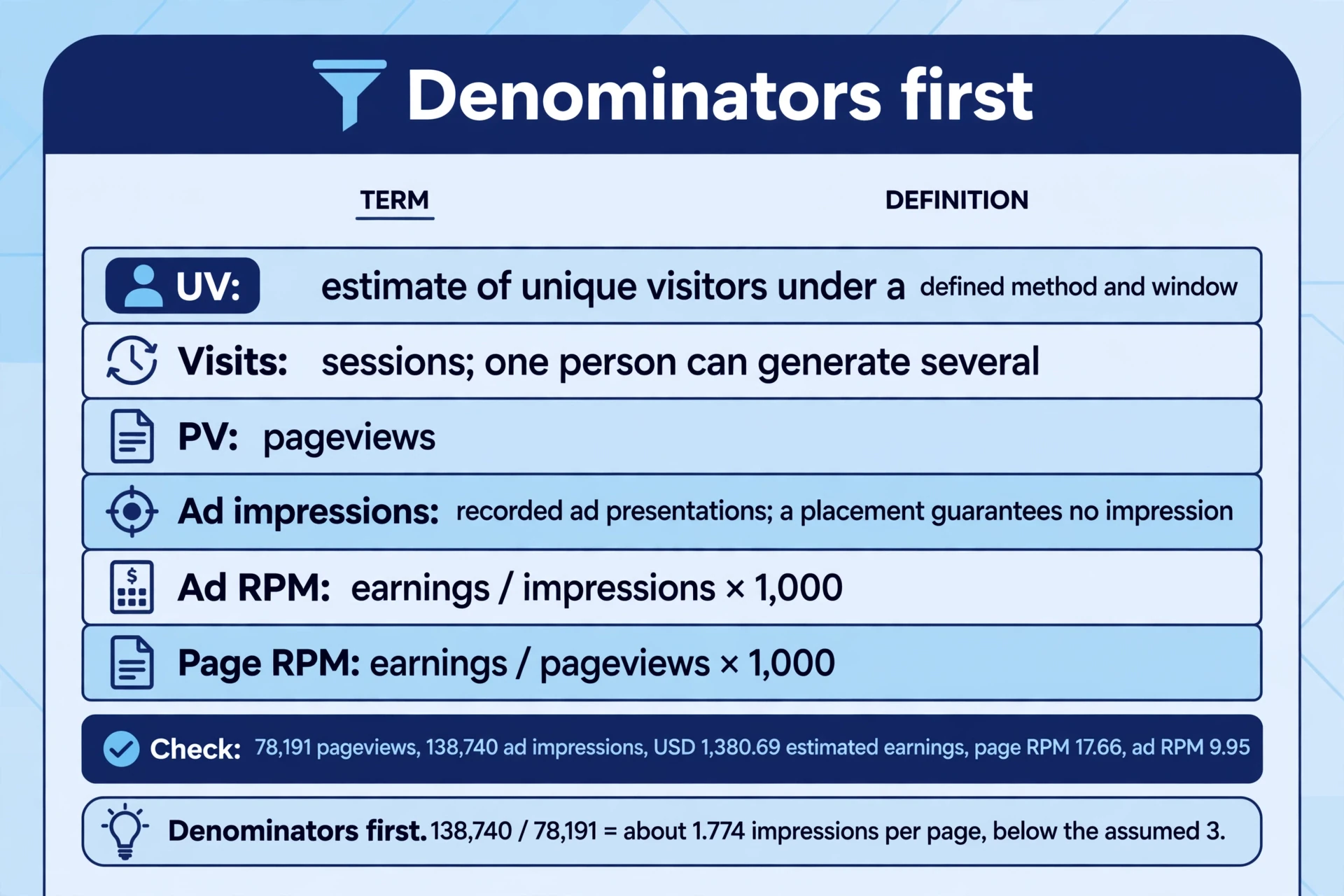
| Ad RPM / source eCPM | Estimated earnings / AdSense ad impressions × 1,000 | Page RPM or advertiser CPM bids |
| AdSense Page RPM | Estimated earnings / pageviews × 1,000 | Ad RPM; do not multiply by impressions per page again |
| Estimated AdSense earnings, balance, receipts, and profit | An AdSense report estimate, settled account amount, money received, and operating result after costs, respectively | A single immediately withdrawable amount |
The records often call revenue per thousand AdSense ad impressions eCPM. This lesson keeps that historical wording while aligning its denominator with the official AdSense Ad RPM definition. One report row shows 78,191 pageviews, 138,740 AdSense ad impressions, USD 1,380.69 estimated earnings, AdSense page RPM 17.66, and ad RPM 9.95. Dividing earnings by impressions and multiplying by 1,000 gives about 9.95. Using pageviews instead gives about 17.66. Revenue per thousand visitors or clicks needs different denominators.
Monthly estimated revenue = daily users × pages per AdSense user × ad impressions per page × days AdSense × ad RPM / 1,000. Monthly estimated revenue = monthly pageviews × page RPM / 1,000.

In one illustration, approximately USD 10 AdSense ad RPM, three impressions per page, and three pages per person produce about 330 pageviews or 110 people earning USD 10, or 11 people per dollar. Exact arithmetic gives 333.33 pageviews and 111.11 people. The quoted figures are approximations. More importantly, the screenshot’s 138,740 / 78,191 is about 1.774 AdSense impressions per page, below three. Placements and AdSense impressions are different counts. Layout, fill, scrolling, devices, and blockers can invalidate the assumptions. A peak rate combined with ideal delivery is one scenario. Steady AdSense earnings need sustained records — denominators first.
Understand AdSense advertising value through purchase intent
One AdSense case explains historical rates through closeness to purchasing. After an earlier college image site, the author collected product names, descriptions, and images from a marketplace, building a waterfall homepage, product pages, and token-based tag pages in two days. The author then registered nearly ten category domains and spent two weeks creating a shared backend: a web server bound multiple domains on one server; each site had categories and one or more listing URLs; a crawler fetched listings and details, stored and parsed them, and displayed them automatically. Preserving the process clarifies its content supply and maintenance dependencies. Copying a scraping network today needs current legal and permission AdSense checks.
The case used titles, descriptions, and tags to make product images understandable, and placed two ads beside the information and a third below the first large image. Searching for a specific product can indicate purchase intent and attract advertiser demand, but rates of USD 9.95, 8.94, and 6.26 are historical site results. Raising rates by surrounding ads with words needs controlled evidence. The old statement of a three-ad-unit maximum describes past AdSense practice. Current rules need the current AdSense policy text. Content value, density, and AdSense placement policies matter rather than a fixed three-slot limit.
The AdSense publisher policies, checked 23 October 2026, require attention to intellectual property, low-value or replicated content, ads exceeding content, and privacy disclosures. The AdSense placement policies also require avoiding confusion with images, navigation, or download controls, encouraging clicks, or artificially refreshing ads. Clearly distinguish ads from product imagery and prevent accidental clicks around tool controls. Splitting a single task into valueless pages simply to inflate pageviews wastes readers and AdSense risks policy trouble.
Wedding products, including dresses, heels, invitations, and decorations, were among the author’s strongest categories. Only later did peers reveal opportunities in wedding-dress exports. The missed opportunity was stopping at AdSense ad revenue without investigating why users came or whether a more valuable direct service existed. The practical AdSense lesson is studying the task, service value, fulfilment, and costs, and comparing net outcomes from ads, affiliates, and direct payment.
Work through three AdSense revenue estimates
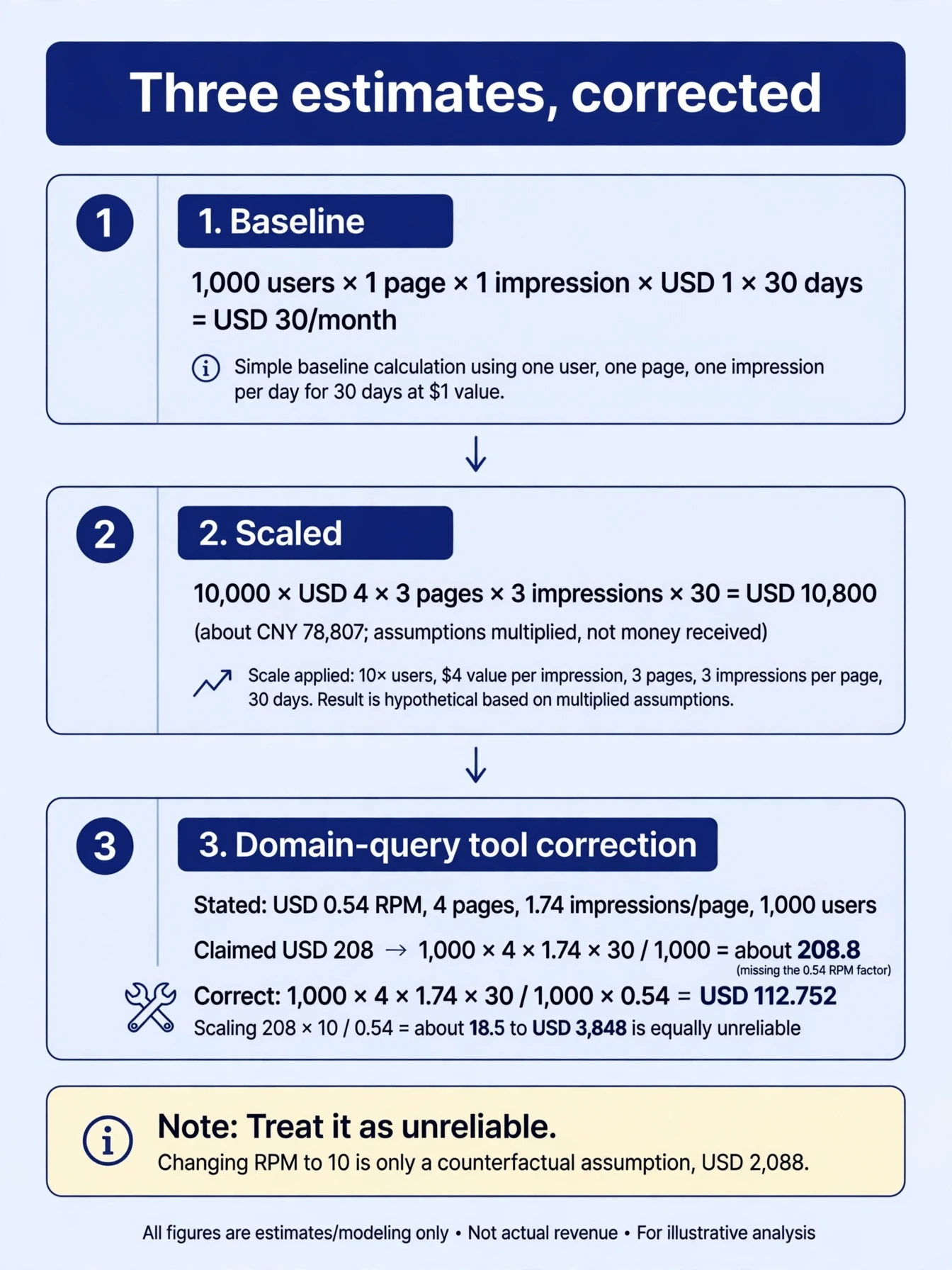
The baseline and query-tool assumptions. The baseline assumes 1,000 daily users, one page per user, one impression per page, USD 1 AdSense ad RPM, and 30 days, yielding USD 30 per month. Changing those assumptions to 10,000 users, USD 4 RPM, three pages per user, and three AdSense impressions per page gives 30 × 10 × 4 × 3 × 3 = USD 10,800, historically converted to about CNY 78,807. It demonstrates multiplication of assumptions rather than actual receipts. Ads must not be refreshed merely to manufacture AdSense impressions, and interactions in a single-page application generate pageviews only when the AdSense analytics setup records them.
The domain-query tool: correcting the formula. The stated AdSense ad RPM is USD 0.54, with four pages per person, 1.74 AdSense impressions per page, and 1,000 daily users, followed by a claimed USD 208 monthly AdSense revenue, about CNY 1,500. The figure actually calculates 1,000 × 4 × 1.74 × 30 / 1,000 ≈ 208.8, omitting 0.54. Including all stated assumptions gives USD 112.752. The subsequent scaling of 208 by 10 / 0.54, approximately 18.5, to USD 3,848 or CNY 28,000 rests on the same omission. Treat it as unreliable. Changing only that model’s AdSense RPM to 10 gives USD 2,088, still a counterfactual assumption.
The later screenshot changes to USD 0.58 ad RPM, 2,744 pageviews, 4,655 AdSense impressions, and USD 2.69 estimated AdSense earnings. The ratio of impressions to pages is now about 1.696 rather than the old 1.74. Reconcile within one time window: 2.69 / 4,655 × 1,000 ≈ 0.578 and 2.69 / 2,744 × 1,000 ≈ 0.980. Mixing a new AdSense RPM, an old delivery ratio, and another day’s users produces scenarios. Measured monthly AdSense revenue needs one consistent window.
The calculator site: keep visits and unique users separate. One estimation service reads an estimated 1.8 million monthly visits and 2.36 pages per visit, with 83.03% organic-search traffic. A 30-minute explanation counts visits at 08:00, 08:25, 08:50, 09:30, and 09:40 as three, but distinguishes session-start timing from inactivity timing loosely. Treat the count of three as approximate. Retain the tool’s monthly visits and pages-per-visit AdSense metrics instead of forcing them into unique visitors. The author’s alternatives of 20,000 daily unique visitors at three visits each, or 60,000 at one, are unverified assumptions.
The author saw three placements above the fold on the homepage but some below it on inner pages, estimating two AdSense impressions per page. Country shares were US 27.52%, Brazil 10.86%, Indonesia 7.80%, South Korea 4.59%, Türkiye 4.53%, and other 44.69%. USD 2.50 AdSense ad RPM was guessed from the mix. The original 30 × 60 × 2.5 × 2.36 × 2 = USD 21,240 is equivalent to 1,800,000 visits × 2.36 pages per visit × 2 AdSense impressions per page × 2.5 / 1,000. This form avoids assuming one daily visit per user and keeps denominators consistent.
The record proposed actual AdSense earnings around USD 20,000–30,000 without access to the owner’s advertising report, leaving the range unverified. As an AdSense sensitivity exercise, retain 1.8 million visits and 2.36 pages: 1.2 AdSense impressions per page at USD 1.50 AdSense RPM gives USD 7,646.40; two at USD 2.50 gives USD 21,240; 2.4 at USD 4 gives USD 40,780.80. These are scenarios, not confidence bounds. Reality may fall outside them. A domain registration in 2013 and a company founded in 2014 shown in one figure refer to different objects. A later start can still leave opportunity. Adding AI is one change. Profit needs cost and AdSense revenue accounting — scenarios, not receipts.
Account setup and adding a site are distinct steps
One AdSense advertising account can manage multiple sites. Existing publishers should add a site rather than open an AdSense account for every domain. Prepare an AdSense email account and a genuinely live website, then use the advertising platform’s signup pages. Suggestions to use a new AdSense email account for two to four weeks and publish one or two blog posts daily for half a month to a month are author experience, not universal account-ageing, article-count, three-month domain-age, or traffic requirements. A new domain approved in under a month is one case. Traffic-only causes need broader evidence.
Check the official AdSense eligibility requirements, including policy-compliant content and the age requirement. This lesson sets no universal minimum pageviews. Eligibility follows the official requirements. Choose the country and individual or organisation type matching the actual AdSense payment identity, with consistent real names and a deliverable address. The historical instructions used China, individual status, and Chinese names and addresses for a Chinese resident. Other applicants must use their actual circumstances. Choosing a country to chase higher rates misrepresents AdSense identity.
Add the site URL as requested by the current interface. The historical record used the top-level domain without a path. Complete the details, connect the site, and request review. Pasting code before AdSense approval prepares the site. Ads begin only after AdSense approval. One approved site covers one site. Each future site needs its own review. The official AdSense connection guide gives a usual AdSense review period of days, sometimes two to four weeks. Treat it as a typical window, not a deadline. Ensure the public site is reachable, the code complete, and the crawler not mistakenly blocked. Keep private user pages out of review.
The record describes crawlers checking code, collecting traffic, inspecting content, and then human AdSense review, and associates low traffic and sparse content with rejection. That is the author’s understanding. Official information describes the AdSense review in general terms. Fixed sequences and traffic priority have no public confirmation. Prepare reliable functionality, content that independently solves problems, clear navigation, and truthful foundational and privacy information. Preserve the exact rejection message and date before interpreting it.
Another current difference from the old advice is that the official AdSense account-creation guide allows account creation before a site is ready, with the site added later. That covers AdSense account setup. Ads still need AdSense site approval. Choose the actual payment country carefully: the guide says it cannot subsequently be changed to another country within that account. Confirm residence and mail delivery before entering it.
Distinguish AdSense verification, ads.txt, and ad-serving code
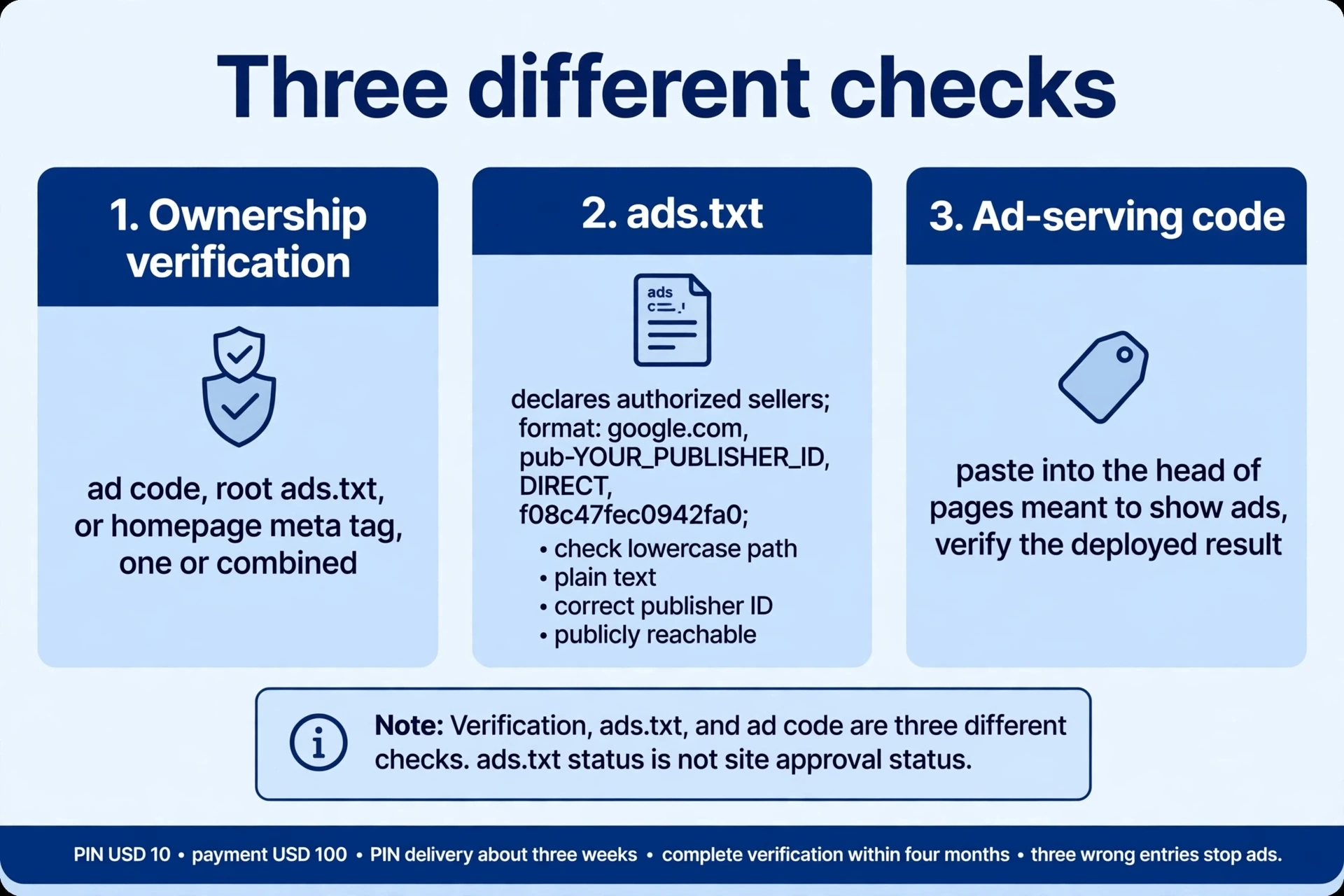
One 2025 record documented three ownership-verification options: the advertising snippet, root-level ads.txt, and a homepage meta tag. Current official AdSense guidance likewise offers alternative methods. The author’s preferred combination is one valid route among several. Ads.txt declares authorised sellers of site inventory. Ad JavaScript loads ads, while the meta tag associates the AdSense account. Their roles differ.
A reusable habit is copying the ads.txt entry from your own AdSense account, saving the lowercase filename, and visiting the domain’s ads.txt path after deployment. Confirm the expected plain text and publisher ID rather than a 404, login screen, or homepage HTML. Verify that method in the interface. If serving ads through JavaScript, copy the account-specific snippet into the head of pages intended to show ads and inspect the deployed result. Use only your own AdSense account’s IDs. Sample IDs from AdSense lessons stay out of production, and publisher-ID formats stay as the AdSense account shows them.
An ads.txt entry follows this form:
google.com, pub-YOUR_PUBLISHER_ID, DIRECT, f08c47fec0942fa0The specific 2025 sequence was verifying ads.txt first, proceeding without requesting review, expanding AdSense ownership verification, selecting the advertising snippet, installing it, and then requesting AdSense review. The meta tag was optional, and all three could be deployed together. The author demonstrated that verifying JavaScript first removed the ads.txt checkbox and AdSense verification button, followed by a “Not found” status in the list. This is a 2025 interface observation. Permanent sequences and unique causes need stronger evidence. Inspect publication, fetching, caching, and status updates separately. Asynchronous changes can also affect observations.
The author favoured preinstalling JavaScript for two reasons: a belief that sites with traffic receive AdSense review priority, and readiness to enable automatic ads immediately after AdSense approval. The latter can avoid another deployment. The former rests on belief. Public priority guarantees need official confirmation. Automatic ads still require activation and inspection on phones, desktops, and tool controls. Avoid blocking tasks in pursuit of every impression. Ads.txt status and AdSense site approval status are separate fields. Fixing one leaves the other to its own AdSense check.
The current official ads.txt guide calls it highly recommended. Treat it as strong preparation, and check the current guide for mandatory cases. Status changes take days, potentially longer for sites with few ad requests. Publishing the file and checking its ID and reachability is practical preparation. Verification, ads.txt, and AdSense ad code are three different AdSense checks.
Use an audit Skill as an AdSense evidence checklist
In July 2026, one community member shared an AdSense advertising audit Skill. Several community members reported AdSense approval after fixes, some the following day and one on a third application. These reports show potential usefulness but provide no control group, complete sample size, rejection baseline, or causal explanation from the platform. The tool is an AdSense community checklist. Official review and AdSense approval guarantees come only from the platform. The record offered the Skill through a keyword reply. Neither the actual file nor the complete rule list is in this lesson’s material. The lesson holds no copy of them. Its own checklist is a teaching aid, not the original Skill.
The three suggested moments are before a first application, after rejection with the complete message, and after fixes before resubmission. Supply the live URL and, where authorised and useful, the local code. Require affected pages, observable evidence, judgments, and proposed fixes rather than generic advice. Pass means supported compliance, Fail an observed issue, Unknown unavailable or unverifiable evidence, and N/A a justified non-applicable item. Inaccessible pages or unavailable rules require Unknown. Model confidence is one signal. Evidence is observable and checkable.
An AdSense audit request follows this form:
@adsense-site-auditor audit <your-site-URL> for AdSense readiness.
Cover every ADS-* check available in the installed Skill.
Return a complete Pass/Fail/Unknown/N/A table with URL, evidence, reason and proposed fix.
If the Skill or rule list is unavailable, say so; do not invent rule IDs.| AdSense Teaching check | Collect evidence | Fix and acceptance |
|---|---|---|
| Access and mobile experience | Open the homepage, tool pages, and mobile entry; complete the main action | Fix 404s, redirects, and blocking; repeat input through result |
| Content value | Inspect original explanations, complete examples, limitations, and results rather than word counts | Add needed information and merge or remove valueless thin pages, then inspect resulting internal links |
| Foundation and navigation | Relevant privacy, about, contact, and category pages, with truthful accessible content | Fill gaps without inventing a company or using empty templates |
| AdSense policies and rejection mapping | Record exact messages and compare them with official AdSense publisher policies | Separate observations from guesses and collect fresh evidence after fixing; changing AdSense ad code alone leaves content and AdSense policy issues untouched |
Prioritise blockers to access or the core task, clear AdSense policy and content issues, navigation and experience, then AdSense integration status. Preserve the before state, actual change, and recheck for each item. After AI edits code or content, inspect functionality, facts, sources, and newly generated pages yourself. Recheck the whole site for new dead links, thin pages, and missing foundation pages. The platform still decides AdSense approval. An all-Pass report is not permission.
Separate identity, address, AdSense earnings thresholds, and payment
Site approval, ads, a PIN at USD 10, and payment at USD 100 connect in the record. A PIN primarily verifies the AdSense payment address. Identity verification is a separate process, and reaching the AdSense payment threshold also requires resolving holds and other conditions. The AdSense payment thresholds, checked 23 October 2026, list USD 100 for AdSense USD accounts, with different amounts for other currencies. Follow your own Payments → Verification check rather than treating one currency as global or suggesting earnings begin only after address verification.
Historically, the record described ordinary mail from the US and delivery losses. The author recalled receiving a letter misdelivered to a neighbouring dorm mailbox. For friends who repeatedly received nothing, one AdSense account suggested checking resend availability after two weeks, using troubleshooting after three letters, and uploading ID plus a photo at an address landmark. One person reported AdSense approval the next day. These experiences are preserved as history. Universal current promises need current official AdSense guidance. A landmark selfie appears in one AdSense account. Standard requirements follow current official prompts.
As of this check, the official AdSense PIN guide describes approximately three weeks for delivery and replacement requests if it does not arrive, with four months from generation to complete AdSense address verification. Three incorrect entries stop ads. It directs users to troubleshooting if the fourth replacement letter still has not arrived after three weeks. Depending on location, online AdSense identity verification may remove the need for address verification. Follow actual account prompts, and submit only the evidence currently requested.

Check the AdSense payment name, deliverable address, and postal code for consistency, recording PIN generation, each request, and the current status. Enter the received code in the official interface and use the official troubleshooter for problems. Verification, resumed ad serving, AdSense settlement, and bank receipt may occur at different times. Expect separate timelines.
Practice: validate the process with a complete review
-
What is monthly revenue for 1,000 daily users, four pages each, 1.74 AdSense impressions per page, and USD 0.54 AdSense RPM? Assuming 30 days, 1,000 × 4 × 1.74 × 30 × 0.54 / 1,000 = USD 112.752. The historical 208.8 omits RPM. Confirm consistent windows for users, pages, and AdSense impressions. Estimates are not settlement or profit. Scale no erroneous result by 10 / 0.54.
-
How do you avoid confusing unique visitors when a tool reports 1.8 million visits and 2.36 pages per visit? Monthly pageviews are 1.8 million × 2.36 = 4.248 million. Assuming two AdSense impressions per page and USD 2.50 AdSense RPM gives USD 21,240. The calculation needs no once-a-day visitor assumption. Without AdSense account evidence for delivery and RPM, present scenarios rather than actual receipts.
-
What should you do when ads.txt opens but the interface says Not found? Check publisher ID, lowercase path, plain-text response, and public access, then deployment and caches. Reverify as the interface permits and observe updates. Record ads.txt and review statuses separately. Diagnose the cause rather than assuming the historical button sequence caused it or repeatedly resubmitting.
-
Can an all-Pass AdSense AI audit justify guaranteed approval? Record the audit version, accessible pages, evidence, and Unknown items. Test core functions and mobile experience, and map rejection text to official policies. Invent no ADS identifiers if the actual Skill rules are missing. Recheck fixes. The platform decides AdSense approval.
-
After two weeks without a PIN, should you upload a landmark selfie from the old tutorial? Check the AdSense account verification page and current AdSense PIN guide first. Delivery usually takes around three weeks. Request replacements when available and record dates. The old three-letter and selfie advice describes past AdSense practice. Current requirements follow actual official prompts. Any upload option and required evidence depend on them.
Connect value, approval, measurement, and payment into one inspectable process. AdSense earnings follow useful pages and honest records.
Comments
Join the conversation. Comments are reviewed before appearing.
Loading comments…