A large search volume search number answers only one question, and it is rarely the question that matters most. Before building a page, answer three separate questions: how much demand exists, when it arrives, and whether a searcher still has a reason to open a website.
Keep those three search volume questions in separate columns. A phrase can have high volume and poor search volume timing. It can return every year and still leave almost no clicks, because the answer already appears on the results page. The method in this article keeps volume, search volume timing, and clicks apart, and turns each one into a search volume record you can check again later.
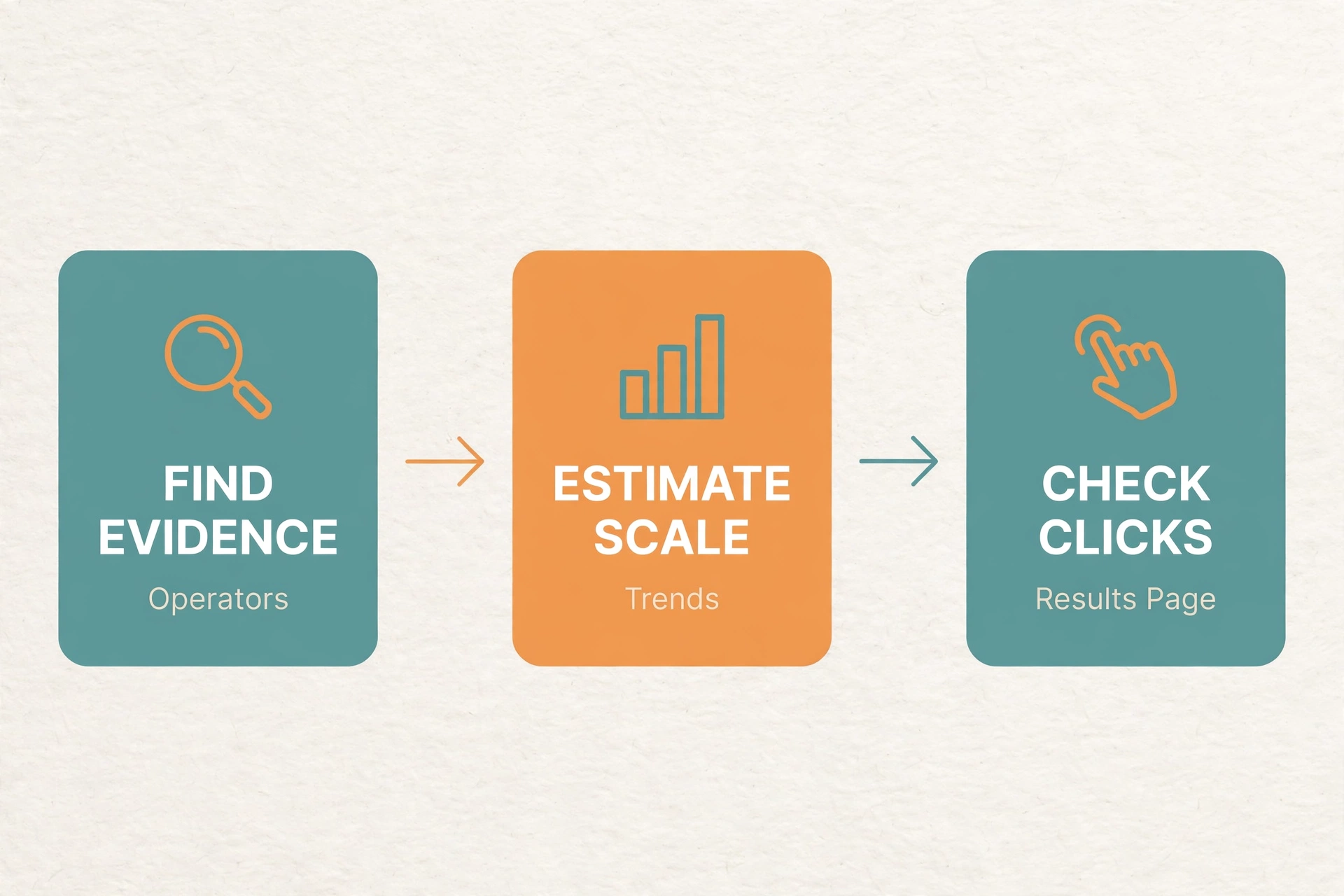
Find evidence, search volume estimate scale, check clicks
Work in this order:
- Find search volume evidence. Narrow the query with operators, then open the pages the query returns.
- Search volume Estimate scale. Calibrate a trend comparison with a known phrase, on the same chart, with the same settings.
- Search volume check clicks. Inspect the results page and decide what extra value would make a visit worthwhile.
Each step produces a different kind of search volume record. The first produces a set of pages worth comparing. The second produces a search volume scale, a range, and a confidence level. The third produces a decision about the page to build, or a reason to stop. A single search volume number from a tool, taken on its own, replaces all three search volume records with a guess.
Use operators to narrow search volume questions, not result counts to size a market
Once you have a candidate phrase, specific search volume questions follow: which pages has one site already built, what appears when the leading site is excluded, and do comparable pages put the phrase in their titles? Search operators act as filters for those search volume questions. Each operator narrows the set of results to a group worth opening, and each one pairs with a page inspection.
Distinguish finding clues from search volume measuring scale. Search results vary with time, region, and interface, and the approximate count under the search box is a rough guide to page supply. Result counts are not search volume. Decide first what you want to exclude or examine, then choose the syntax that matches that search volume question.
| Operator | Research use | Limit |
|---|---|---|
"pricing page" | Narrow to an exact phrase and check whether others use the same wording. | Quoted and unquoted results can differ; inspect meaning too. |
site:example.com pricing | Find pages on one domain, or clues about what it has indexed. | The count is not an exact indexed-page total. |
pricing -site:example.com | Exclude the leading site to find reviews, tutorials, and alternatives. | Retellings and duplicates remain after one exclusion. |
phone model -"phone model plus" | Exclude an unwanted complete phrase. | Unquoted exclusions can be broader than intended. |
intitle:"phone model" | Find pages with titles focused on the phrase, to inspect supply. | A matching title is not search volume evidence that the task is satisfied. |
inurl:login, filetype:pdf travel | Inspect URL structure, or locate publicly available files in a given format. | URL words and file formats are clues; verify provenance and permission. |
For a search volume calendar example, start with a site-scoped query for that site’s calendar pages. Open them and see whether they help users view dates, print calendars, or plan activities. Next, run the same calendar query with that site excluded, to examine supply from other sites and judge whether the search volume approach you just saw is common. Then use a title query to see how other sites express the need in their titles. Each inspection supplies the search volume question for the next query, and each query has a reason behind it.

After these steps, you have a set of pages to compare. The search volume comparison still needs three more search volume checks: which page formats the current results favour, the quality of the existing content, and whether users have a reason to click through to another site. Operators help you find search volume evidence. Judging an opportunity means opening those pages and studying the tasks they serve.
Separate stable demand, annual updates, and one-off search volume spikes
After reviewing page supply, ask when the need arises and how long it lasts. A long-running date and calendar tool, operating since the late 1990s, recorded about 47.21 million monthly visits in one snapshot, about 4.96 million indexed pages, and roughly 68% of traffic from search. Its search volume scale reflects years of accumulation and many recurring date tasks. Treat those historical figures as search volume context for a mature site, and set a new site’s short-term target from its own first checks instead.
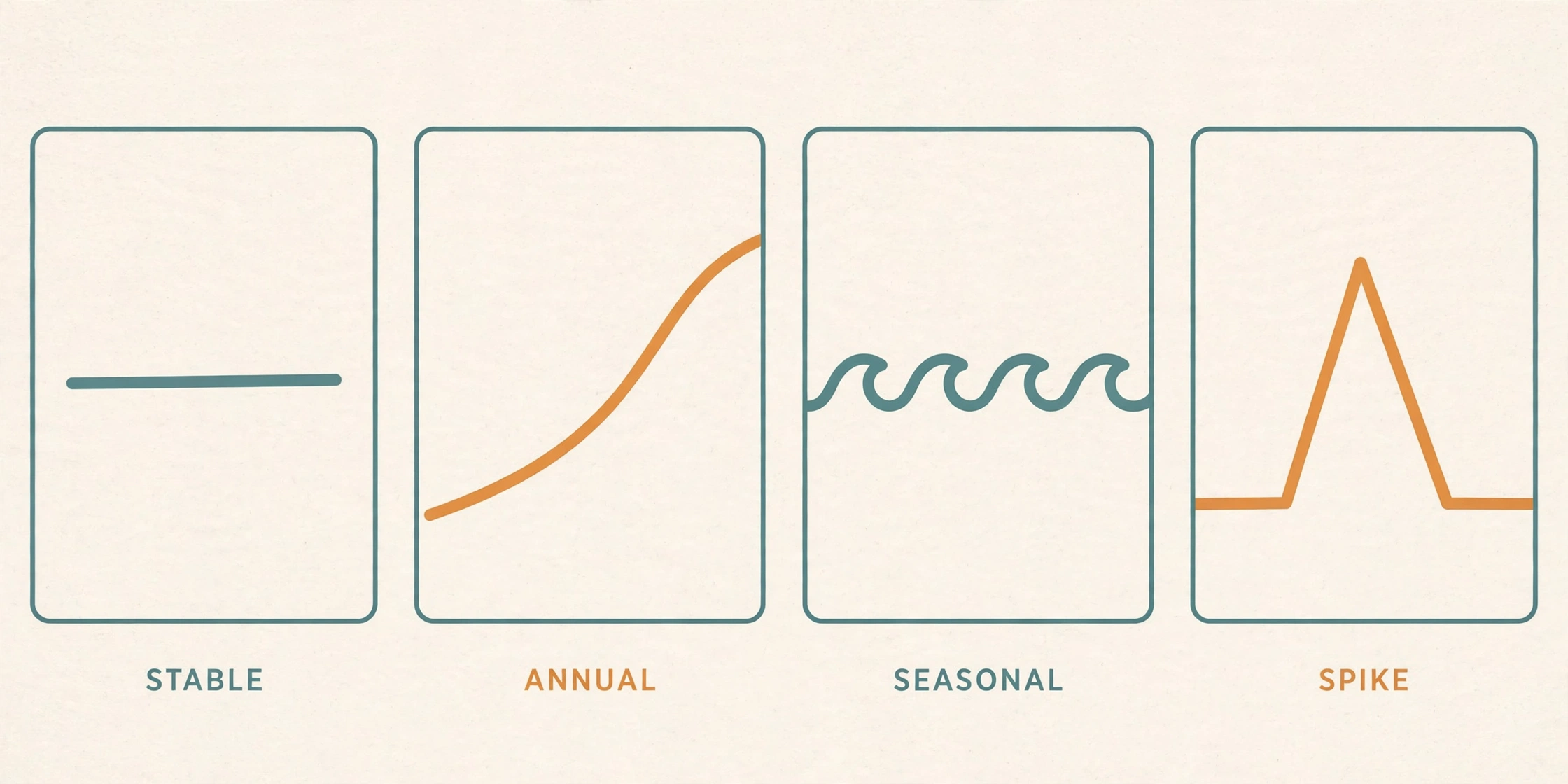
The search volume case is most useful for reading demand over time. The year in a phrase such as a yearly calendar changes, while the tasks of checking dates, printing calendars, and planning holidays return. When volume looks high in one month, place it on a timeline first: is this year-round demand, demand that returns annually, or a brief peak from a single event? The four types below call for different preparation schedules.
| Demand type | Trend shape | Page and update search volume timing | Typical misreading |
|---|---|---|---|
| Stable tool | A year-round baseline with occasional fluctuations. | Keep functionality correct; maintain versions and units. | Treating high overall searches as a promise of many clicks. |
| Annual phrase | The next year rises during a recurring season. | Prepare usable next-year content early; label old pages and link onward. | Copying pages with changed years and no genuine content differences. |
| Holiday or season | Interest rises during a particular search volume period each year. | Publish ahead of time; review whether demand returns after the season. | Treating the peak month’s volume as the yearly average. |
| Sudden search volume trend | A brief spike that can decline quickly. | Verify the event and the search volume user questions before investing. | Projecting long-term revenue from a search volume spike. |
To build a calendar for the next year, first establish the page’s region and the first day of the week, then prepare correct dates and printable formats for that year. A new annual page must perform the new year’s task: changing the year in last year’s title gives users no usable calendar. After launch, review when demand rises and falls, and use that search volume timing to plan the next update.
Demand cycles can guide a publishing schedule. They do not establish revenue on their own. A search volume revenue estimate attached to the search volume date-tool case in the source material was the author’s conjecture, with no audited search volume data behind it. Keep it out of a project budget, and replace it with your own search volume site data when you have it.
Calibrate search volume trends with a known phrase and retain uncertainty
Even when demand recurs, its size can stay unclear. An advertising keyword tool sometimes shows broad ranges for some accounts and more detailed search volume figures for others. A supplementary search volume method fills the gap: find a known phrase with readable search volume data in that tool, then use it to estimate another phrase’s order of magnitude.
How far the search volume method reaches depends on consistent settings and definitions. search volume A trends tool reports relative interest, not search counts. Its search volume scale runs from 0 to 100, normalised by time and geography, and its search volume comparison guidance distinguishes search terms from topics. The curves help compare relative interest. Converting them into search counts needs a verifiable numerical basis first, and that basis is the known phrase.
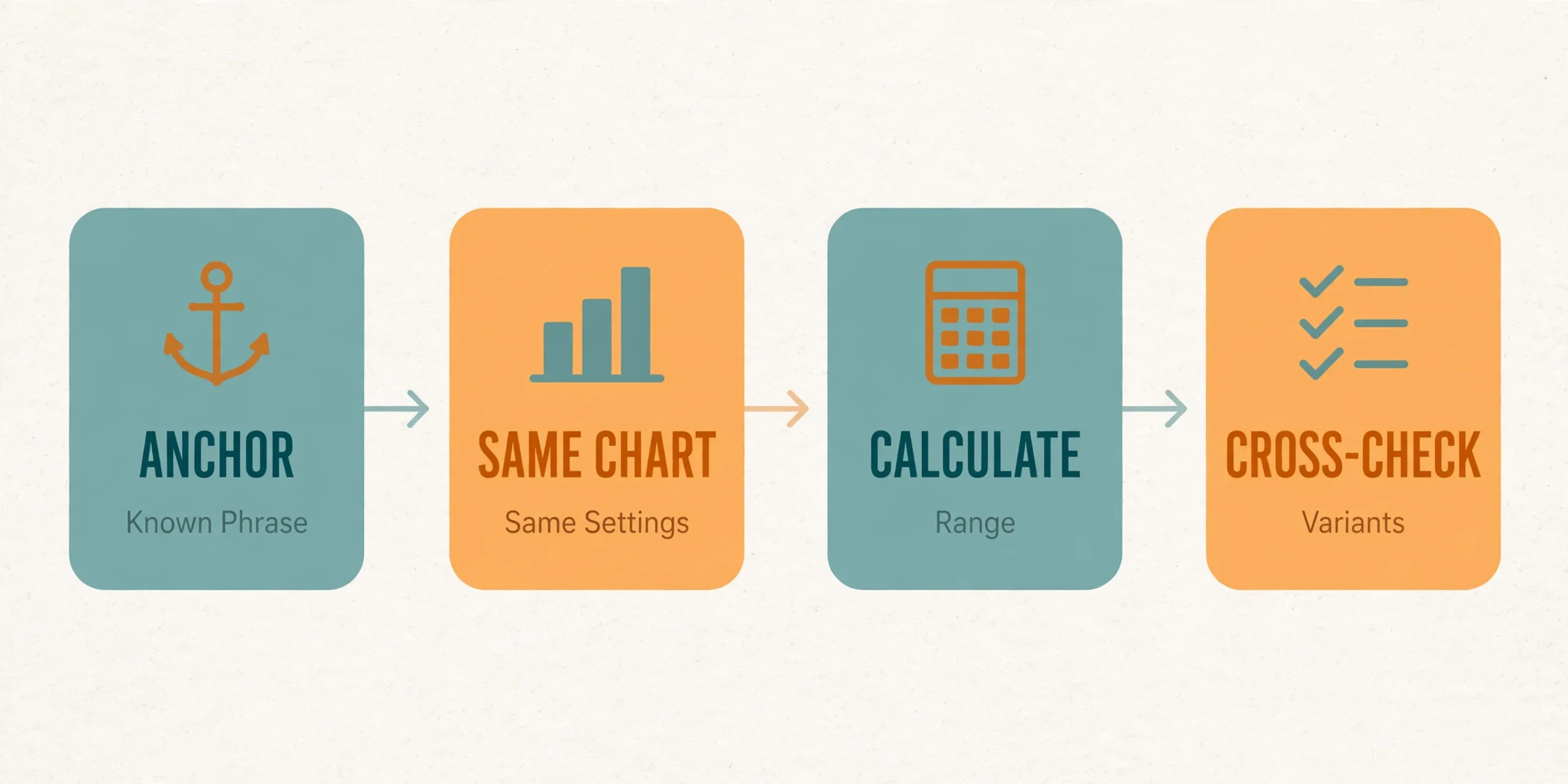
Start by choosing a verifiable known phrase as an anchor. Record the specific month, region, search network, and search volume measurement definition behind its search volume advertising-tool data. If the phrase has clearly been grouped into a larger phrase, choose another phrase or investigate the grouping first. An unreliable starting point makes every later calculation less useful, however detailed it looks.
Next, put the known phrase and the phrase you want to estimate on the same search volume chart, with the same settings. Use the same region, search volume period, search type, and term-or-topic setting. Two separate search volume charts are normalised independently: a value of 80 on one and 40 on the other does not establish double the search volume. Use a comparison on the same search volume chart for the same month, or averages for corresponding weeks. For seasonal phrases in particular, an annual average is not a substitute for the peak month.
Only after aligning the search volume comparison should you divide the known phrase’s monthly volume by the search volume number of days in that month, then use the curves’ relative levels to estimate the unknown phrase. After calculating, return to the advertising tool to review historical months and check whether close variants have been grouped together. Check whether the search volume trends tool’s related queries match your expectations. If the two sources disagree, record the difference instead of forcing the search volume figures to match. Present the final result as a search volume scale with a confidence level, for example “roughly hundreds of thousands; low to medium confidence”, and list the search volume assumptions with the greatest effect on it.
| Demonstration | Calculation | Interpretation |
|---|---|---|
| A known photo-editing phrase has an search volume advertising-tool estimate of about 200,000 in one month. | About 6,600 a day, used as the historical anchor. | A historical search volume estimate under selected settings, possibly including close variants. |
| On the same search volume trends chart, a new photo-editing phrase shows about three times the interest of a well-known chatbot phrase, which sits close to the known anchor at that time. | Through this intermediate search volume comparison, roughly 18,000 a day, or 540,000 a month. | Both search volume comparisons are approximate, so the conclusion establishes search volume scale only. |
| Adjacent advertising-tool months: about 550,000 and 1.5 million. | One is close to the calculation; the other differs substantially. | Variant grouping is a suspect. Settings, months, and samples can also differ and need checking. |

The same demonstration then ran the chatbot phrase through the advertising tool and received a search volume figure of about 24.9 million, suggesting the phrase had been grouped with a broader phrase. Treat that search volume figure as a signal to check the scope of the phrase, not as the monthly volume of the phrase itself. search volume Advertising-tool figures include close variants and depend on month, region, and search network settings. When a discrepancy like this appears, check the scope of the phrase before deciding whether to keep using the anchor. A claim that detailed search volume figures required a certain amount of advertising spend describes one account’s experience at the time; what you can see today depends on the actual interface and the tool’s own help pages.
Search volume: High volume still has to pass the results-page test
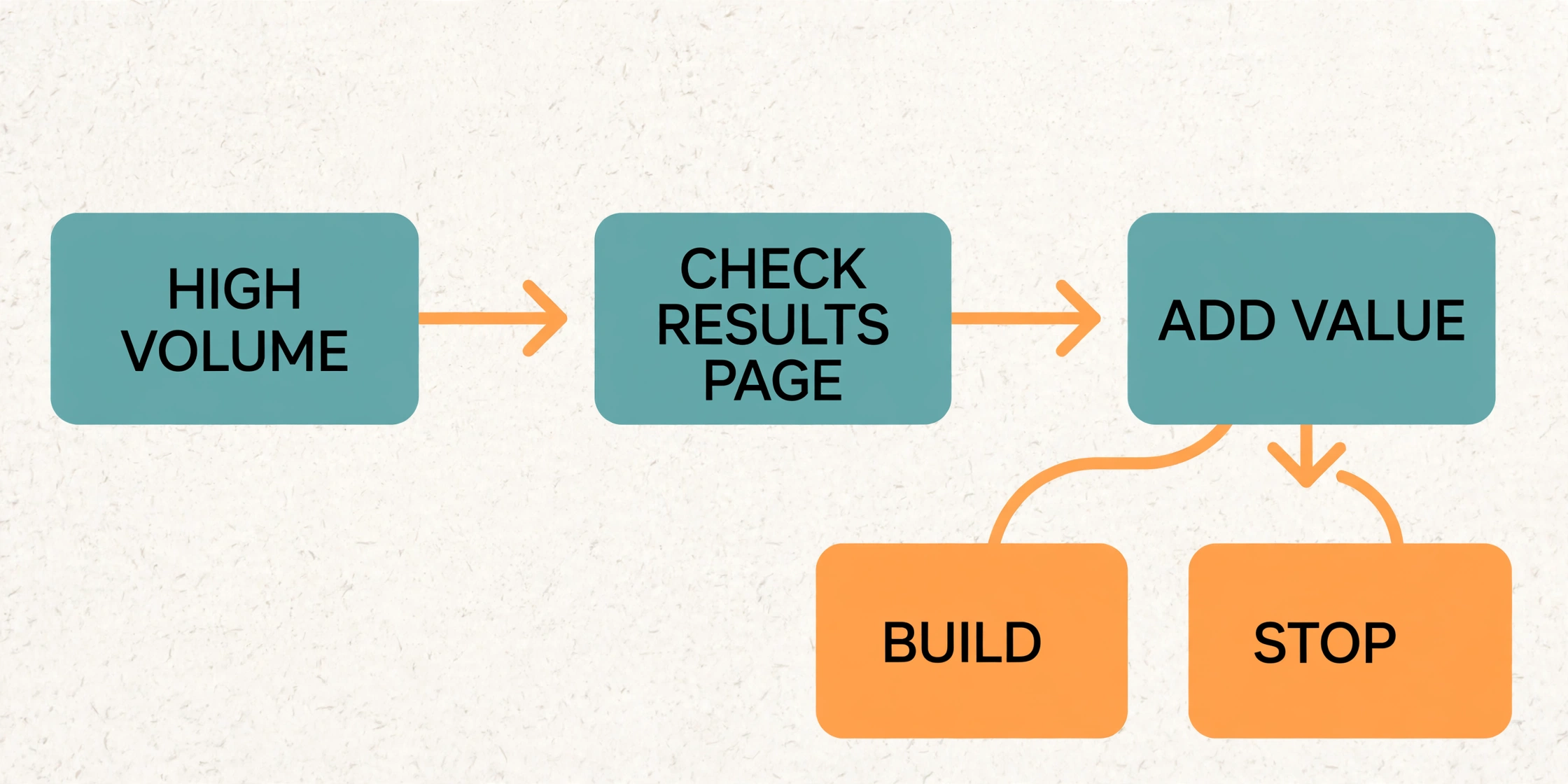
Even with estimated demand in the hundreds of thousands, one decisive search volume question remains: how many of these searches require opening a website? Two high-volume phrases for converting inches to centimetres show the test in action. A built-in converter on the results page supplies the answer directly, so many users finish the task without opening any page.
That does not remove every opportunity. A conversion site registered in 2013, with about 3 indexed pages and tool-estimated traffic of roughly 240,000 monthly visits in one snapshot, shows that direct answers and clicks to websites can coexist. Investigate which tasks users still click for, what the existing results lack, and whether your page can fill that gap. The table below pairs common results-page features with actions for investigating them.

| Results-page feature | Additional external-page value | Research action |
|---|---|---|
| A single conversion answered directly | Batch conversion, unit explanations, copyable tables, or specialist contexts. | Check whether related longer phrases actually require these features. |
| A featured snippet answers completely | Deeper steps, sources, updates, or interaction. | Do not assume its source link receives many clicks. |
| Videos and images dominate | Usable content of that type, or a relevant tool. | Verify that a webpage is an appropriate delivery format. |
| Many ads, maps, or product panels | A differentiated service or a narrower subtask. | Correct search volume keyword-tool forecasts with actual click data. |
Even after assessing the room for clicks, a search volume traffic estimate does not become a revenue promise on its own. A calculation in the source material multiplied 250,000 monthly page views by 4 ad slots, divided by 1,000, and applied a rate of one dollar, reaching about 1,000 dollars a month, then extrapolated over several years. Treat that calculation as an illustration of the model only. Visits, page views, ad fill, country-specific rates, and actual earnings were not audited. A budget needs your own search volume site data and real advertising reports, replacing those search volume assumptions one by one.
Similar search volume search scale can lead to opposite decisions
Taken together, these methods show why the same search volume scale of searches can justify further search volume research in one case and a narrower task in another. The two cards below use historical search volume data. The first asks approximately how large demand is; the second asks whether searchers still have a reason to click. They show the sequence of calculation and judgment. The old figures are not search volume traffic forecasts for today. When completing your own cards, retain the tool, month, region, and unknowns, so the next search volume check has a clear basis.
Worksheet A: the search volume scale of a new photo-editing phrase
| Field | Historical material | Assessment |
|---|---|---|
| Known anchor | A known photo-editing phrase, about 200,000 in one advertising-tool month. | About 6,600 a day; first check close-variant inclusion. |
| Same-chart comparison | On the same search volume trends chart, the new phrase shows about three times the interest of the chatbot phrase, which sits close to the known anchor. | Roughly 18,000 a day and 540,000 a month, with two search volume comparison layers and uncertainty in curves, meanings, and months. |
| Cross-check | Adjacent advertising-tool months: about 550,000 and 1.5 million. | One agrees and one diverges; do not select only the search volume matching figure. |
| Conclusion wording | “A candidate need on the scale of hundreds of thousands; exact monthly volume undetermined.” | Next, separate related phrases and inspect results and actual delivery. |
After completing Card A, ask what the “three times” comparison actually measures. Every search volume trends point reflects the selected search volume period and region, and interest in the sample phrase itself changes. A ratio observed at one time does not transfer across the year on its own. Search terms and topics cover different scopes, and the advertising tool can group close variants. Those differences carry through to the final result. Expressing the conclusion as an order of magnitude and a range preserves those uncertainties; a precise-looking search volume point estimate makes it easier to forget that the underlying conditions are still inconsistent.
Search volume worksheet B: click opportunity for unit conversion
Card B takes another step into how the user completes the task. The conversion phrases had high search volume at the time, but the results page displayed the conversion directly. Starting with “search volume times an assumed click rate” can count clicks that may not exist. First search a few representative queries yourself, such as a single conversion and a conversion table, and observe whether the first is already answered directly and whether the second still needs a table or a bulk tool. Only after making that distinction can you decide which page module to test. Although the two groups of phrases concern similar subjects, their room for clicks can differ.
- User action. Enter a value and immediately see centimetres. If the results page answers directly, a basic single-conversion page adds little.
- Possible additional value. Batch conversion, imperial-size tables, precision explanations, or printable tables; build them only when relevant queries and use justify them.
- Historical site. The archive search volume estimates about 240,000 monthly visits for an older site operating since 2013. Results and competition may have changed; this is not a new site’s target.
- Search volume Revenue estimate. 250,000 page views times 4 slots, divided by 1,000, times one dollar, equals 1,000 dollars in the model. Sellable impressions, rates, and geography are unknown, so this does not promise single-page income.
A defensible decision statement reads: “The historical tool shows high volume, but current results already solve individual conversions. I will test underserved subtasks such as printable size tables. If query, click, and usage evidence is insufficient, I will stop expansion.” That statement is more actionable than “high volume, low difficulty, worth doing.”

Separate quantity, search volume timing, and clicks
Use this search volume worksheet for one candidate phrase, and keep the three questions apart from the start.
- Use operators to find comparable pages, and open the first three actual results.
- Record the month, country, network, account state, and variant inclusion behind any search volume volume figure.
- Inspect five-year, one-year, and search volume 90-day trends, labelling stable, annual, seasonal, or spike search volume patterns.
- If estimating, calculate a range with an anchor on the same search volume chart, documenting sample and settings.
- Capture current result features: direct answers, ads, videos, maps, products, and others.
- State your additional value; reject the phrase if none exists.
- Replace search volume paper estimates with real impressions, clicks, and task completion after launch.
Make the conclusion verifiable: “In this region and month, this phrase has approximately this scale, this trend shape, and these result features. Our page adds this specific value, so we will first validate this metric.” That sentence prevents starting from one large search volume number alone.
That is the whole method. Find the pages, estimate the search volume scale on a consistent basis, and test the clicks on the results page itself. Quantity, search volume timing, and clicks, recorded separately, turn a large search volume number into a decision: one phrase, one range, one page to test, and one check that will replace the estimate with search volume evidence.
Comments
Join the conversation. Comments are reviewed before appearing.
Loading comments…