You can build the page, and the keyword competition looks weak. Is the project worth doing? Those are three separate questions, and a yes to the first two does not answer the third. A tool that works, a low keyword difficulty score, and a page that reaches the first results page still leave the keyword business questions open: how many suitable users will arrive, why they would use what you built, and whether revenue covers building, promotion, and maintenance.
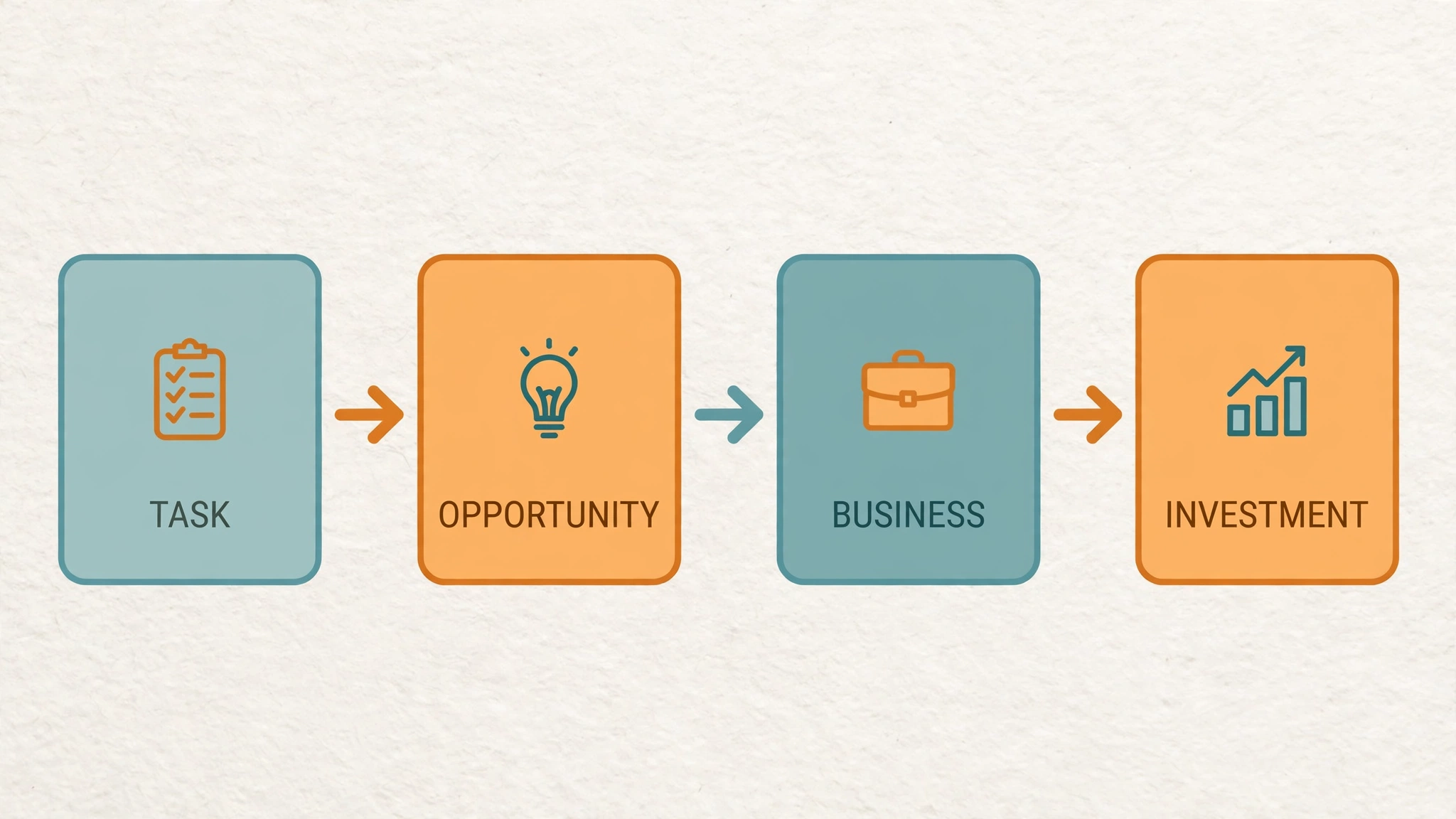
Judge a keyword candidate in this order: the task, the keyword opportunity, the business, and the investment. The task is what searchers want to do and whether you can deliver it. The opportunity is keyword demand scale, trends, leading supply, and the positions you can realistically reach. The business is a revenue path through advertising, subscriptions, affiliate programs, or leads. The investment is development, content, promotion, external services, and continuing maintenance. A small keyword is worth pursuing when user value justifies the full cost.
Keyword Three feasibility questions, answered separately
Buildability asks whether the keyword can be turned into a working page or tool. Rankability asks whether a particular tool considers the keyword competition relatively weak. Investment value asks whether the users, the revenue path, and the costs add up for you. Keep the evidence for each question apart. A working demo proves buildability. A low keyword score suggests weak competition in one tool’s model. Neither shows how many users will arrive or what they will pay for.
The same keyword can pass one test and fail another. A keyword with real demand can still be the wrong investment for a new site at a particular moment, because the leading pages are expensive to displace and the attainable business is small. That is not a contradiction. It is the difference between asking whether something can be built and asking whether building it is the best use of limited time and money.
State the purpose first
Before comparing keyword candidates, name what this project is for. The purpose sets what counts as success, and the same keyword can be a good choice for one purpose and a poor one for another. A first practice project succeeds when you complete the full workflow: research, building, launch, crawling, and observation. A revenue project also needs evidence that income covers costs.
| Purpose | Acceptable outcome | Keyword priorities |
|---|---|---|
| First practice project | Complete the workflow and learn from real feedback; ranking goals stay separate. | Understandable, deliverable, low-cost tasks with clear feedback. |
| Ad-supported traffic business | Enough visits for advertising to cover the investment. | Obtainable clicks, geography, advertising buyers, and real revenue per thousand impressions. |
| User-paid product | People complete a task and pay, covering delivery costs. | Problem intensity, payment reason, conversion, repeat purchases, and service costs. |
| Expand an existing site | New pages serve the same audience while protecting existing pages. | Relevance, distinct delivery, internal links, and reused capabilities. |

Fix the purpose first so later conclusions stay consistent. Read historical keyword difficulty, traffic, and advertising figures alongside their dates. Figures from an earlier year describe that year, not today. Before committing money, check the results as they stand now instead of entering old samples directly into a budget.
Two routes for small phrases
Starting small is often recommended for a first project, and for a practical reason: a smaller keyword usually has a more narrowly bounded problem. That makes it easier to complete keyword research, building, launch, and observation, and to identify which step failed. One historical starting point was about 10,000 monthly searches with a keyword difficulty score below 29. Treat both figures as one author’s screening preference at the time, not a universal threshold. Ten thousand means searches per month, not visitors per day.
Route one: secure one task, then expand
A small foothold starts with one task you can complete reliably. Explore the keyword questions users ask around the main keyword, choose one with clear boundaries, and make the page explain its purpose, deliver a usable feature or a complete answer, and offer related keyword questions, examples, and internal pages. Covering the task thoroughly is the work; buying a domain and adding a few hundred words is not.
After launch, create real routes for people to reach the page. Observe whether they use it, which queries start generating impressions, and which pages receive clicks, then add relevant content from that keyword evidence. Once a distinct but adjacent task is confirmed, add the matching feature and page. That is how you expand to sibling needs. Only after several narrower tasks are well served should you consider a broader main keyword. Expansion rests on users you understand and pages you have validated.
A keyword coloring-pages example shows the shape of this route: start with one specific kind, such as sea turtle coloring pages, and later consider a parent need such as ocean animal coloring pages. A neighbouring topic, such as beach coloring pages, may simply be adjacent; whether it belongs in the same product needs checking against search results and usage contexts, not keyword classification by wording alone. Relationships among terms need keyword investigation instead of grouping by similarity of words.
If the homepage’s scope later needs broadening, build internal pages and entry points for genuinely distinct tasks first. Preserve the task that already works, keep keyword evidence, backups, and a change log, and do not replace a working homepage all at once in pursuit of broader terms. A working homepage is the basis for further validation.
Route two: combine many small needs
The other route combines many distinct small tasks into one business. A historical analogy from a large online marketplace described how, after advertising space on major portals was taken, an advertising network reached personal websites instead. The point was that when large entry points are hard to access, many small ones can reach the same audience. Applied to a website, it means providing a separate page for each of many distinct long-tail needs. Whether that becomes a business still depends on establishing keyword demand, clicks, and maintenance conditions page by page.
The arithmetic is seductive and insufficient. Ten thousand phrases at one hundred visits a day each would total one million visits a day. Ten thousand phrases at ten visits a day would total about three million a month. Correct multiplication does not establish the assumptions behind it: real demand for each keyword, actual clicks to each page, and no double counting. Count effective entry points serving real needs, not pages produced. Repeating synonyms across thousands of thin pages does not add the same number of new tasks.
The two routes can combine. Use a few pages to show that user tasks can be satisfied, pages can be discovered, and the revenue model merits further testing, then expand to the same quality standard. Validation comes before keyword scale, not after it.
CPC suggests buyers; it does not calculate your revenue
Cost per click is the price advertisers pay for clicks, usually estimated in keyword tools. Several steps separate a website visit from an advertising payment: whether the user sees the ad, whether it matches, whether the user clicks, and how revenue is shared. CPC therefore does not directly indicate the value of one visit to your website, and it is not revenue already received. Understand that relationship before using CPC to choose topics.
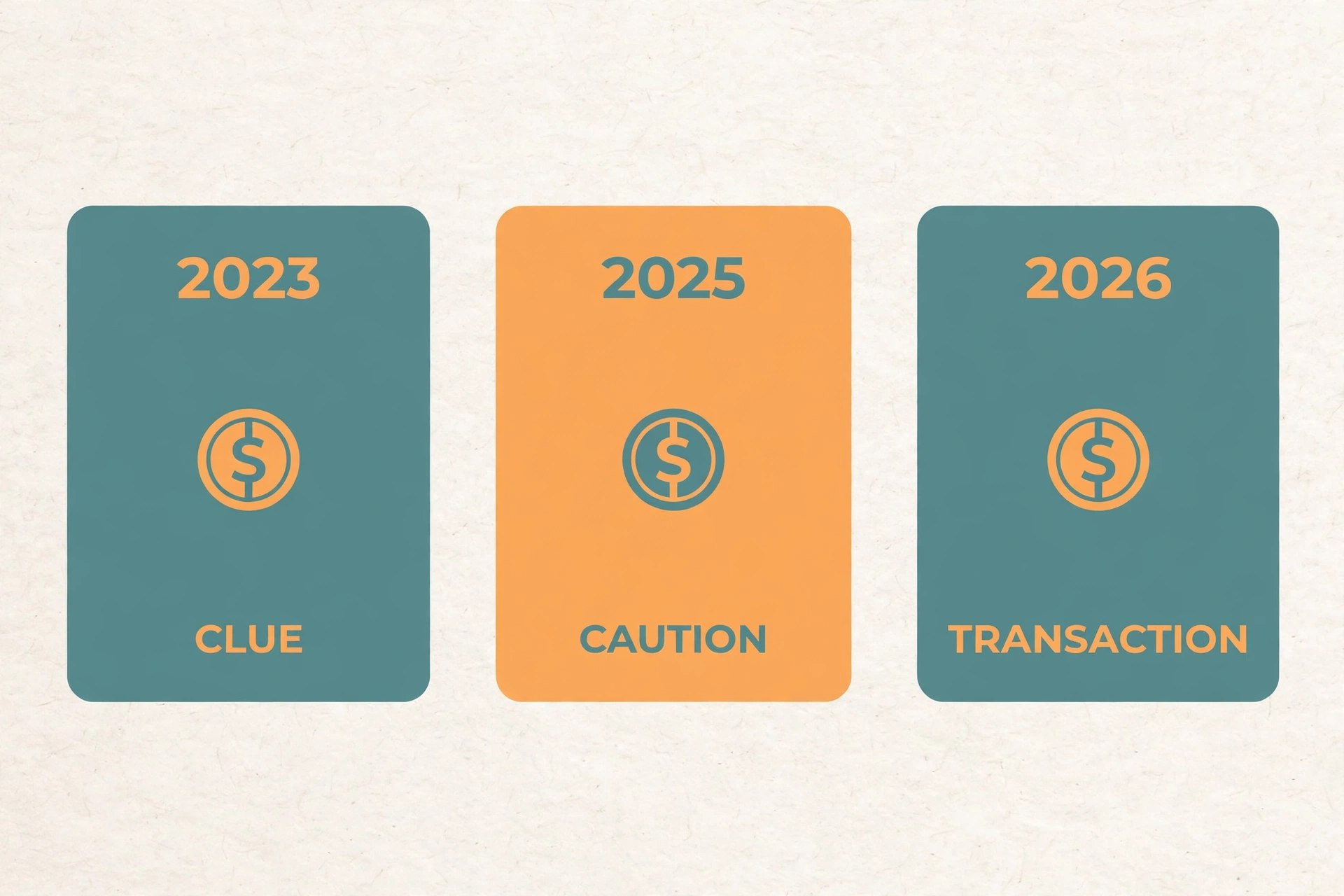
Views on CPC changed over time, and the change itself is instructive. In 2023, high-CPC, low-difficulty small phrases were treated as deserving attention, with volume and keyword difficulty combined and country and region considered. By 2025, the same line of work argued that early CPC filtering can mislead and usually ignored it, with exceptions depending on context. By 2026, the stronger keyword evidence was real ads, phrases, landing pages, prices, and keyword scale, rather than CPC alone. Ask who will pay for these users before asking how high a tool’s CPC is.
CPC differs across phrases because it reflects bidders. An advertiser bidding too little may buy no clicks; continually raising a bid beyond what the business can afford causes losses. A business with higher transaction values, margins, or repeat purchases may sustain a higher bid. The figure you see reflects those businesses and their keyword competition. Judging whether your own product can be profitable still requires examining why customers would pay, conversion, and delivery costs.
If CPC is zero, investigate why. The tool may have no data, or too few advertisers may have bought that keyword at the time. That does not establish that keyword demand has no value. If you plan to earn through subscriptions, affiliate programs, consultation leads, or premium features, whether users have a reason to pay is a better first keyword question than whether CPC is low.
For a site of text and images funded mainly by advertising, the buyers’ businesses matter more directly. Lawyers, insurance, real estate, and healthcare are often named as fields with paying advertisers, and calculator topics in finance, tax, and health are used to ask who would pay to reach those users. Before choosing such subjects, confirm that you have the domain knowledge and can deliver reliably. Potential buyers do not automatically supply those abilities.
A high-CPC trap
A concrete keyword example shows why a high CPC should not automatically determine a topic. When a keyword table for coloring pages was sorted by CPC in descending order, the top result was a keyword about changing a page background color on a website-builder platform. It had only 20 monthly searches and a CPC of $17.10, against $1.75 for coloring pages generally. It shares words such as color and page with coloring pages, but the user’s task concerns operating a website platform, not coloring.
Opening the results page confirmed a platform-operation task, so the keyword belongs off a keyword coloring-product topic list. The platform behind it was a large business that could charge customers directly and buy advertising, but that does not prove it advertised on this particular keyword. What can guide topic selection is the official help document found in the results: it confirms the task. Price and relevance can diverge completely. Adding a keyword volume filter of 600 or more monthly searches brought candidates closer to coloring tasks, but 600 is a keyword demonstration filter, not a minimum keyword demand threshold for every product. Inspect each task, establish asset permissions, and assess your own delivery capability before deciding which topics are feasible.
Use a keyword screening score to order research, not to forecast revenue
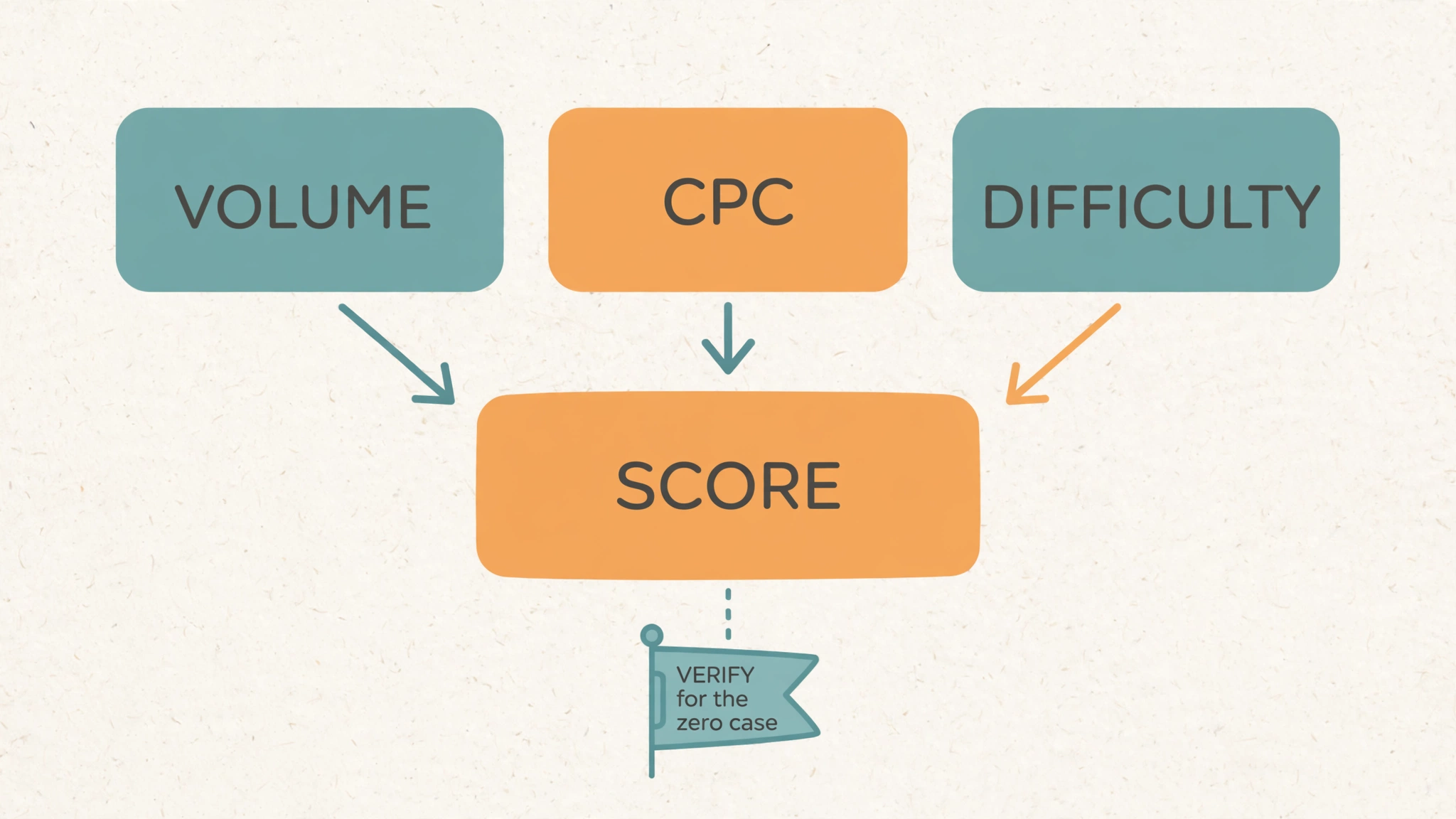
When a keyword table has hundreds of rows, which parts do you investigate first? One historical method proposed a score: keyword volume multiplied by CPC, divided by difficulty. It uses keyword search scale and advertising price as clues to potential returns, and keyword difficulty as a clue to investment, to help prioritize research. The formula omits click share, actual revenue, development time, and real costs. It is a keyword screening score, not financial return, and it cannot tell you whether a project will ultimately make money.
The historical process started with a root term, calculator, in one keyword tool’s US database in US dollars. It set keyword volume to 600 or more, keyword difficulty from 0 to 29, CPC above $0.10, and excluded “near me” phrases, producing 357 terms. Those conditions define the sample. If region, currency, or keyword filters change, record the new conditions instead of carrying the ranking over directly.
Next, export the keyword table and retain four columns: keyword, volume, difficulty, and CPC. Save the original export separately so excluded terms can be reviewed. Add a keyword score column with the formula, fill it down, and sort. Terms near the top gain only priority for keyword investigation. You still need to establish what users actually need, how strong the leading results are, whether you can deliver, and who will pay.
Handle zero and missing values before sorting
The first row of the historical sample exposes the problem: keyword difficulty zero. Ordinary division cannot produce a valid keyword score, and the row cannot take part in the ordinary keyword ranking. Handle this case before sorting. Replacing zero with one just to obtain a number changes the model; the result cannot be called the original formula’s output.
| Phrase | Volume | Difficulty | CPC | Score |
|---|---|---|---|---|
| A celebrity-named calculator | 1,900 | 0 | $0.98 | Needs manual verification |
| Audiobook speed calculator | 1,600 | 7 | $13.90 | 3,177.14 |
| Audiobook calculator | 1,600 | 8 | $12.34 | 2,468.00 |
| Lab equipment calculator | 5,400 | 19 | $5.79 | 1,645.58 |
| Exam keyword score calculator | 1,300 | 16 | $12.63 | 1,026.19 |
| Construction loan calculator | 6,600 | 14 | $1.71 | 806.14 |
| Paycheck calculator (brand) | 5,400 | 18 | $2.64 | 792.00 |
| Fabric calculator (brand) | 720 | 17 | $17.70 | 749.65 |
| State paycheck calculator | 5,400 | 29 | $3.95 | 735.52 |
| State paycheck calculator | 5,400 | 29 | $3.92 | 729.93 |
The second row calculates normally: 1,600 × 13.90 ÷ 7 ≈ 3,177.14. After obtaining a high keyword score, investigate the corresponding task instead of immediately building a calculator. Phrases relating to celebrities, exams, brands, tax, or laboratory equipment may require specific knowledge and user contexts. Having “calculator” in the name does not mean a basic arithmetic page can complete the task correctly.
For a real keyword worksheet, add two practical columns alongside the keyword score. Use a data-status column to keyword flag difficulty zero, missing CPC, inconsistent regions, or obvious anomalies. Use a manual-conclusion column to state what has been established and what is still missing. Put difficulty-zero rows in a queue for verification, and separate flagged rows when sorting. The formula organizes data. The final choice still depends on the user task, the keyword competition, and the delivery conditions.
Case one: an identifier generator the evidence rejects
Apply the criteria to a complete keyword selection process. A question asked whether building an online unique-identifier generator was worthwhile. After keyword investigation, the advice was against it as a new-site topic at that time. That conclusion reflects the timing, objectives, and keyword opportunity costs of that moment. Follow how the task was narrowed, the competition examined, and the keyword business scale estimated. Do not memorize it as a claim that such a tool can never be worth doing.
First, narrow the main keyword. The broad term covers many needs, so inspect suggestions and related searches first. Phrases for online generation may indicate the tool task, while phrases involving programming environments, versions, and keyword examples can require other page tasks. Define online generation before assessing its keyword competition.
Next, check difficulty and keyword scale in more than one tool. One keyword showed a difficulty score of 46 and a keyword estimate of followed links from about 71 sites for top-ten entry. That is a rough keyword tool estimate, not a required count. Trend charts showed relative interest only: interest in one generator keyword was less than half that of a popular AI chatbot, while another was about one tenth. A single relative trend value cannot be converted directly into absolute monthly searches. Check whether several sources point in a consistent direction.
Then inspect the actual leading sites. The first three were established generator sites, with whole-site monthly keyword visit estimates of roughly 430,000, 30,000, and 130,000. Those totals describe whole sites, not clicks from this keyword alone, and ranking order need not align with overall site size. Whole-site visits are not keyword clicks. Finally, compare opportunity cost: the leading competition looked costly for a new site, and the existing keyword scale was not attractive enough, so another keyword was chosen. Compare with two deliverable alternatives rather than asking only whether you can code the function.
If you already serve developer users, or can provide an API or specialized bulk workflows, your revenue and acquisition conditions may differ. Those are new keyword business hypotheses requiring separate validation. You still need to compare two other keyword candidates you can deliver to judge whether the investment is suitable.
Case two: a game collection where low difficulty misleads
A keyword browser game collection candidate showed some trend interest, a keyword difficulty score of 1, and an estimate of links from about two sites for top-ten entry. The advice was still to inspect the leaders before registering a domain. A weak modeled competition signal is not keyword evidence of revenue or of a new site’s opportunity.
After opening the leading results, the picture grew more complicated. The top three had single-digit backlink counts, while the fourth had 81 referring sites and a much higher authority rating. Link counts alone could not easily explain that ordering. Examining titles and headings clarified what the pages promised: the fourth page’s title named a different game, and its main heading had no text. It may have served a different task, in which keyword case more backlinks would not automatically make it a better match for this query. Task alignment must be checked together with link counts and wording.

The second-place site recorded a little over seventy thousand monthly visits for the entire site and about nine referring sites. The advice was still against it as a revenue topic at the time: reaching first place looked challenging, and the keyword business scale indicated by second place was not attractive. For practice, reaching the top ten was considered a possible goal. The same keyword candidate yields different conclusions under two objectives, which returns to the keyword purpose table: fix the purpose before judging the keyword. The seventy-thousand figure remains a keyword estimate of whole-site visits, not clicks this one keyword sent to that result.
Case three: a puzzle solver where timing and promotion decide
A keyword puzzle-solver case compares two domains registered about five weeks apart in autumn 2024. By January 2025, one recorded about 2.3 million monthly visits against about 13,000 for the other, while the later site had more referring domains. More referring domains did not produce more visits. The difference lies in timing, product, and promotion together, not in link counts alone.
| Time | Clue | Supported inference |
|---|---|---|
| Early September 2024 | First domain registered; a webpage snapshot followed a day later. | Launch preceded substantial solver interest. |
| Late September 2024 | A community-forum post introduced the tool and asked for feedback. | Verifiable promotion brought the product into the player community. |
| Late September 2024 | Solver interest appeared in trend charts. | Promotion and search interest are close in time; sequence alone does not prove causation. |
| October 2024 | Short-video demos were posted. | Users can discover the product through communities before search. |
| October 2024 – January 2025 | First site’s monthly visits rose, then fell. | Growth also declines; examine overall keyword game demand and page performance. |

The operator appears to have noticed the solver task as the game became popular, built a product early, and promoted it so players learned such a tool existed. Search, product experience, and brand awareness then reinforced one another. Claims that a search engine has permanently recognized the site as a brand, or that it will be hard to overtake as long as it makes no mistakes, remain judgments, not public algorithm rules. Engagement differences between the two sites warrant further examination of the two experiences, but do not prove they directly caused the ranking difference. Examine when keyword demand emerged, whether the product solves the problem, and how promotion reaches users together.
When traffic later declines, examine demand for game-related searches, keyword positions, click rates, functional errors, and channel changes together. If overall keyword demand is receding, a few title changes may not recover traffic. If keyword demand has not declined and only rankings have fallen, competition and page delivery deserve closer investigation.
Work back from ads to demand
Keyword research is not the only entry point. Examine who is willing to spend money acquiring users: products that keep buying keywords may have validated some ability to generate transactions, but they may also still be testing, acquiring users at a loss, or depending on repeat purchases later. After finding an ad, investigate how the business works and assess whether you have an keyword organic-search opportunity. There is no need to open an advertising account or copy the product immediately.
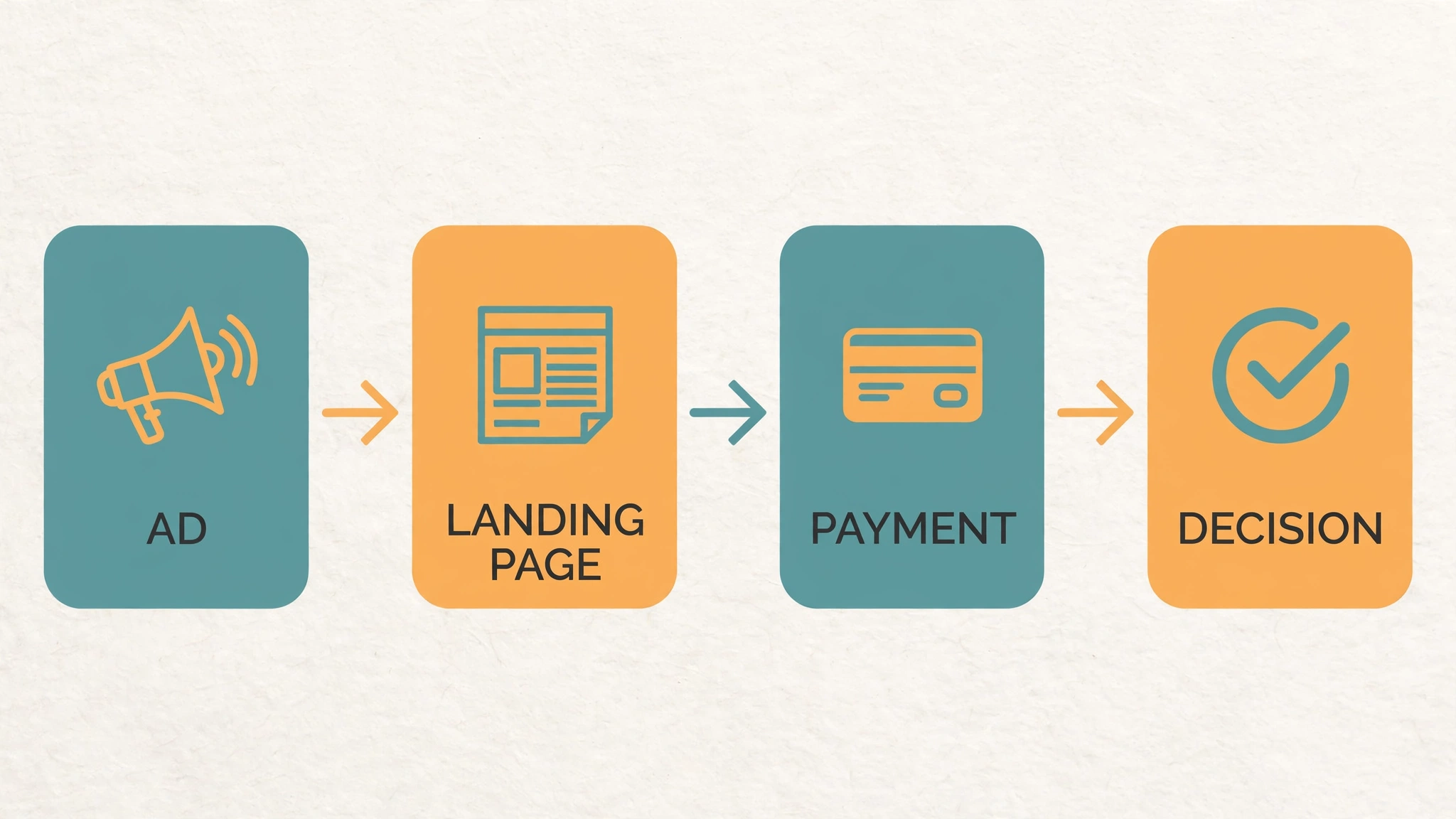
Work in five steps. First, find advertisers and record the ad, the keyword, and the final landing page as one line: product, keyword, copy, and URL. Fix the time, region, and platform first, then read the ad’s clues together: what the copy emphasizes, what kind of query the top keyword represents, and where the final URL takes users. Second, inspect phrases and separate brand navigation from deliverable tasks. Brand names and a famous chatbot’s name mainly signal navigation; a keyword describing a task, such as an image generator, more clearly describes something to build. Third, trace the complete landing-page transaction. Fourth, verify keyword payment evidence. Fifth, assess an organic-search version.
| Landing-page location | Keyword evidence to record | Why inspect it |
|---|---|---|
| Initial screen | Whether the keyword promise aligns with input, upload, examples, or downloads. | Verify users can start the task immediately. |
| Main button | Download, generate, upload, register, or purchase. | Assess step count and reasons users continue. |
| Charging model | One-off payment, subscription, trial-to-subscription, ads, or another model. | The same keyword can support different cost and revenue structures. |
| Trust information | Real results, keyword reviews, FAQ, refunds, privacy, and verifiable endorsements. | Assess how payment concerns are reduced; do not fabricate testimonials. |
| Organic-search keyword opportunity | A stable tool, template, lookup, or generator page. | A thin ad landing page’s keyword conversion approach may not suit lasting organic traffic. |
When researching an app, first check the developer, platform, app identifier, and region to confirm you are examining the same product, then inspect download and keyword revenue estimates from an app-data service. Two similarly named apps cannot simply have their rows added together, and a screenshot fragment without a measurement period cannot be relabeled as monthly revenue. Seek keyword payment evidence in official pricing, in-app purchases, extension installation counts, keyword review counts, and channel mix. Aligning that keyword evidence with the landing page’s transaction path helps explain how the product acquires users and charges them. It still does not directly prove profit or promise that copying it will produce the same returns.
Finally, return to your own ability to deliver. Can the task be completed on a webpage, saving users an installation? Are there clearly defined long-tail tasks you can serve? Where are existing results difficult to use, and can you make a verifiable improvement in a specific scenario, default settings, outputs, or explanations? Answer these individually before organizing the keyword table, page structure, and first tool version. Keyword Build evidence sequentially rather than concluding from one signal.
Produce a keyword decision you can execute or reject
Choose a keyword and two alternatives, researching all three with the same time, region, and definitions. Do not register a domain first and invent justification later, or present uncertainty as certainty. The worked example below uses an audiobook playback-time calculator as a keyword teaching hypothesis: users enter original duration and playback speed to obtain listening time and time saved. Ten hours at 1.5× speed gives 6 hours 40 minutes, saving 3 hours 20 minutes. Keyword candidates, prices, and effort are illustrative; keyword volume, competition, and real income need new keyword investigation.
- State the user task. Describe the action and output in one sentence; keyword list merged synonyms and ambiguities requiring separate keyword investigation. A reading-speed calculator involves word count and reading speed and must not be merged with a listening-time calculator before intent checks.
- Keyword Assess scale and longevity. Record monthly keyword volume, trends, region, and seasonality, noting available clicks separately when direct answers or brand navigation dominate. Mark blanks as “to be verified,” not zero.
- Inspect current leaders. Open several leading results and record page type, delivery, title, launch clues, and referring domains, supplementing with keyword scores. If leaders already provide free, smooth completion, low keyword difficulty alone establishes no gap.
- Draw the revenue path. Identify who pays, why, and how a visit becomes revenue; unsupported prices and conversions remain assumptions. Basic duration arithmetic has free alternatives, and an advertising price cannot establish subscription willingness.
- List the minimum investment. Identify development, reliable content, external services, promotion, and maintenance, choosing the smallest verifiable version. One page can provide duration and speed inputs, listening time, savings, clear errors, and a formula with reproducible examples. An illustrative cap of ten hours total demonstrates a trial limit, not a labor quotation.
- Compare keyword candidates. Choose build, small test, keyword practice, defer, or reject, with reasons and the keyword evidence that would overturn the keyword decision. Consider commercial investment only with stable keyword demand, a clear gap, and keyword cost evidence.
- Review after launch. Check crawling, queries, impressions, clicks, completion, income, and cost; act at the failing layer. Unindexed: inspect delivery and discovery. Few clicks: inspect position and keyword intent. Low completion: fix input and output. Unverified revenue stays unverified.

#keyword ## Practice with numbers without treating searches as income
The following is a purely hypothetical keyword teaching example with no real site. At 10,000 monthly searches and an assumed 5%–15% click share, visits are 500–1,500 a month. Assuming one page per visit and actual revenue per thousand impressions of $4 yields only $2–$6 a month. It is not searches multiplied by an advertising price. Click share and revenue per thousand impressions require measurement after launch.
A paid-tool scenario is also hypothetical: 500 visitors, 2% purchasing, $8 contribution each, yielding about $80 before fixed maintenance and acquisition costs. Similar small traffic can support different businesses; this is not an income promise, and an advertising price does not determine purchase rate.
| Keyword decision field | State clearly | Next step if unclear |
|---|---|---|
| Purpose and task | Practice or income; the specific action. | Return to demand and use contexts. |
| Scale and keyword competition | Time, geography, definitions, and page-versus-site distinctions. | Re-check trends and leaders. |
| Revenue path | Buyer, transaction, payment reason, or keyword advertising evidence. | Inspect ad destinations, prices, and real feedback. |
| Capability and cost | Functionality, content, maintenance, promotion, and validation timeframe. | Reduce scope to one task-completing page. |
| Conclusion and stop conditions | The next action and keyword evidence that would stop work. | Run a bounded small test and record outcomes. |
Review at the preset cost limit. Indexed but no queries: inspect task and wording. Impressions but few clicks: position, keyword brand intent, and result presentation. Clicks but low completion: functionality and friction. Use but no income: buyers and costs. Expand into sibling, parent, or many smaller phrases only after the relevant pages work. A keyword score alone is not a keyword decision; the inspected supply, the revenue path, and the named costs are.
Comments
Join the conversation. Comments are reviewed before appearing.
Loading comments…