This chapter connects four historical accounts into a cross-border operating chain: customers pay for a product; a cross-border payment provider records the transaction and settles to a cross-border business account; funds then cover business costs or are transferred to an individual on an appropriate basis. The entity, tax identifier, merchant account, receiving account, personal bank account, and wallet have different roles. A displayed balance is one figure. Ownership, spendability, and net-of-costs status need separate checks.
The cross-border accounts date from 7 February and 11 November 2024 (reference versions), 13 August 2023 (a US-company experience), and 8 February 2025 (a Hong Kong account-opening trip), with current checks dated 23 October 2026. Historical prices, processing times, card benefits, and cross-border transfer methods describe their own dates. Verify every link against current official guidance, and get professional assessment for entity choice, reporting, and owner withdrawals.
Compare entity paths and actual cross-border maintenance costs
One account compares a domestic chain of company, cross-border business account, domestic payment merchant account, cross-border product payment, and withdrawal, followed by appropriately documented salary or other payments to individuals. An overseas business substitutes different entities, cross-border payment providers, and receiving accounts. The analogy describes two cross-border chains. Whether a project needs a foreign company depends on the provider checks. First inspect the provider’s supported merchant countries, entity types, product categories, operating location, and user market. Choose the structure before purchasing accounts without a purpose.
For the UK route, the author used a formation agent, created a cross-border account, scanned a passport, and supplied information by email, reporting a cost of tens of dollars and just over a week when smooth. A US agent through an e-commerce marketplace at over CNY 2,000 and about two weeks was a friend’s route, not personally tested by the author. In the 2023 cross-border account, the contributor chose an incorporation service and a Wyoming LLC, preferring a visible dashboard. These are time-specific choices. Compare routes on current prices, timelines, and cross-border maintenance.
Current UK formation needs current guidance. Old screenshots are starting points only. Companies House identity-verification information and its rollout notice describe mandatory verification beginning 18 November 2025, with role-specific and transitional timing. The director-responsibility guide also covers ongoing records, cross-border accounts, and filings. Paying an agent leaves directors’ responsibility with the directors. Check cross-border maintenance and reporting before comparing initial formation packages.
| Historical item | Recorded price | Clarify before comparing |
|---|---|---|
| US phone number | USD 36 a year | Twelve months at USD 3; check current retention, roaming, and messaging |
| Formation service | USD 399 | An initial fee, not all future cross-border maintenance |
| Mail address | USD 350 a year | Distinguish mail, forwarding, notarisation, and actual cross-border business premises |
| Company agent | USD 299 a year | The record includes annual-report and tax tools, not necessarily every government fee or professional filing |
Adding the historical items gives USD 1,084 in year one: 399 + 350 + 299 + 36. Excluding the one-time formation item leaves USD 685 in listed recurring annual items.
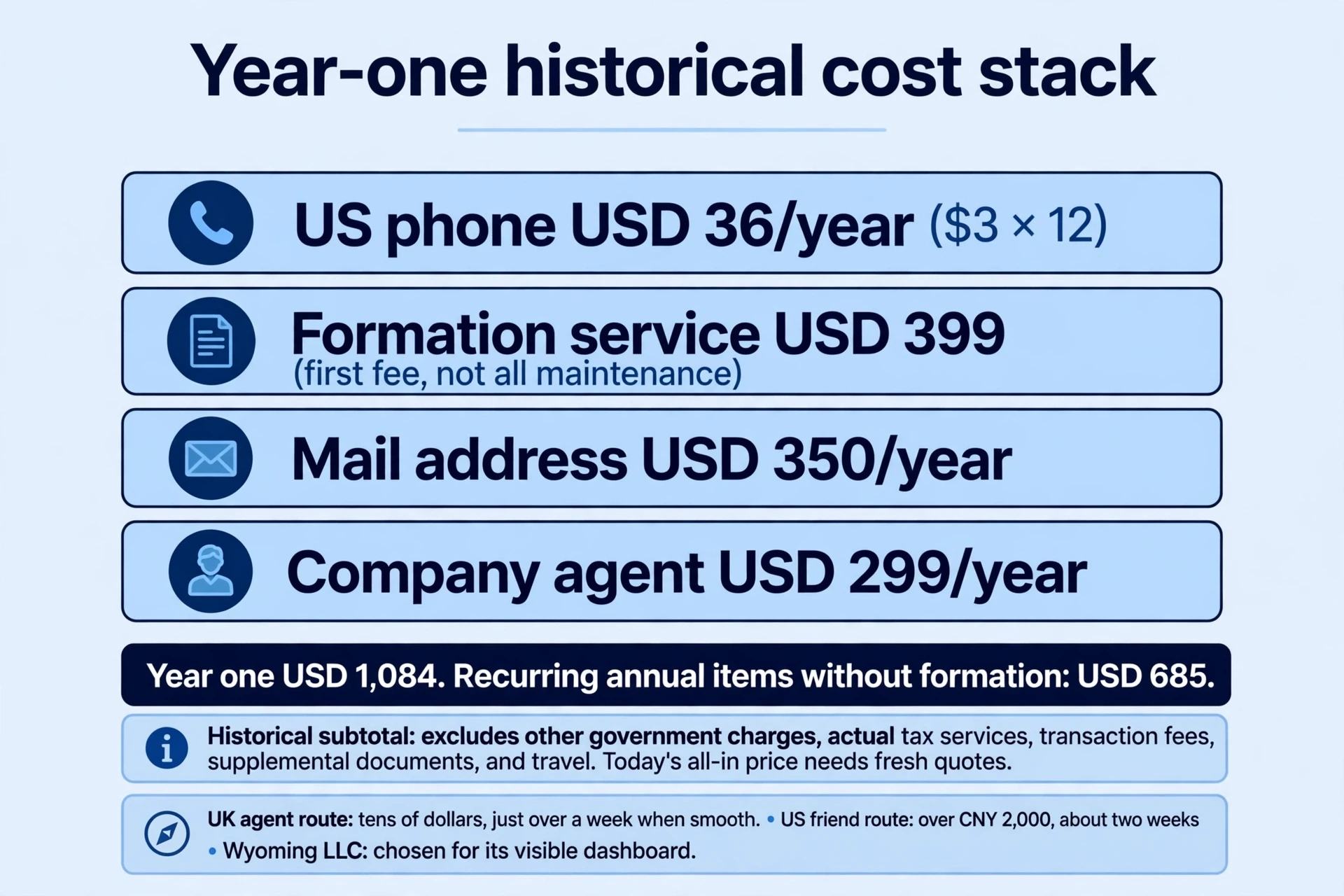
This arithmetic excludes other government charges, actual tax services, transaction fees, supplemental documents, and travel, so treat it as a historical subtotal. Today’s all-in cost needs fresh quotes. The Wyoming official annual-report worksheet confirms state-level annual-report charges, reinforcing the need to separate agent packages from statutory obligations.
Distinguish phone numbers, mailing and operating addresses
Both historical cross-border routes prepare a number that can receive verification messages. One cross-border account lists one UK carrier text every 180 days at GBP 0.30 for retention, a US prepaid plan at USD 3 monthly, and official ordering or faster domestic sellers. Another cross-border account bought a UK SIM through an e-commerce marketplace, activated it on the official site, and quoted a minimum plan around GBP 6 monthly with SMS reception in mainland China. Retention activity and a monthly package are different charges. Confirm current availability, roaming, and identity requirements with the carrier. No number satisfies every service automatically. Test each service’s verification.
One cross-border account rented a private mail address and used a remote video notarisation service for the postal service’s mailbox form (Form 1583). It prepared a driver’s-licence translation costing tens of yuan, suggested placing the document and address on one A4 page, and described showing it on video, confirming consent, and signing. The author used the mailbox for billing, card forwarding, and advertising letters. A mailbox serves mail. Residence and operating location need separate evidence. Follow current postal, mailbox-provider, and notary document requirements. The old translation layout is one historical example.
Keep legal, mailing, owner residential, and principal cross-border business addresses distinct. Mercury’s current cross-border eligibility guide requires a real principal business location in the US or a supported international location, and its address verification spells out the evidence it accepts. Registered agents, PO boxes, and store addresses serve different purposes. Formation in Wyoming says nothing about principal business location. Location needs its own evidence, and the EIN fax route follows the routing table, not the state of registration alone.
Understand the EIN fax method without copying a sample
For a current cross-border application, start from the IRS employer identification number guidance, then verify the instructions for the applicant’s actual circumstances. Keep the form version, official source, and verification date with the application record. The historical fax account below is useful for understanding the process, while the official instructions determine the application you prepare now.
An EIN is an IRS identifier for tax filing and reporting. Formation, banking, and exemption are separate matters. One cross-border account compares it to a cross-border business identity number and emphasises that direct IRS application is free. Separate that from agent, fax, mailbox, and ongoing cross-border operating costs. The current IRS application page still offers free applications and defines online eligibility. Not everyone qualifies online, and not all US LLC owners sharing a nationality have the same route.
The historical cross-border method starts with a fax service, using a cloud-storage login if available. The author selected a then-USD 9.99 plan with a 30-day trial to obtain an incoming fax number, entered card details, and planned cancellation under the terms before renewal. Free sending alone may leave no return number. Paid plans add a fax line. The service now operates under a new name. Its official plan explanation distinguishes free sending from paid plans with a fax line. The old price, trial length, and refunds are historical. Check current terms. Check reliable inbound receipt, number retention through processing, and the renewal date.
Second, obtain the current SS-4 from the IRS rather than editing an old screenshot. The pictured 2019 sample covers legal name in line 1; mailing address in 4a/4b; a different street address in 5; principal county and state in 6; responsible party and taxpayer-ID status in 7a/7b; LLC status, member count, and US formation in 8a–8c; tax entity type in 9a; cross-border application reason in 10; start date in 11; accounting year-end in 12; expected employees in 13; first wages in 15; industry and specific activity in 16–17; prior EIN in 18; and signature, title, date, phone, and return fax. Check each against actual documents, especially the return number.
The sample uses Foreign, one member, US formation Yes, Foreign-owned U.S. Disregarded Entity, December, zero employees, wages N/A, Software, Develop Apps and sell to customers, and No prior EIN. Each depends on actual facts and tax classification. In particular, line 10 selects Changed type of organization and writes LLC. A newly formed company needs its own reason. Copying the sample’s selection risks a wrong filing. No employees is one fact. Filing obligations need the current instructions. Complete the third-party section only where the responsible party genuinely authorises a designee. Confirm classification, absent-ID treatment, and cross-border application reason against current instructions or qualified advice.
The author combined a signed SS-4 with formation documents such as Articles or Certificates of Organization or Formation into a PDF. The package was uploaded to the fax service and sent to the IRS fax number for the author’s routing condition. That is the author’s package and routing. Formation-document attachments and fax numbers follow the current instructions. The current SS-4 instructions route applications according to legal residence, principal cross-border business location, or office or agency in a US state or DC. Cases without such a location also distinguish sending from inside or outside the US.
| Routing condition in current IRS instructions | Fax number, checked 23 October 2026 |
|---|---|
| A qualifying residence, principal cross-border business location, or office/agency in a US state or DC | 855-641-6935 |
| No such location, fax sent from within the United States | 855-215-1627 |
| No such location, fax sent from outside the United States | 304-707-9471 |
This table explains official branches. A cloud fax’s sending location and an entity’s principal cross-border business location need separate clarification. Clarify uncertainty with the IRS or a qualified representative first.
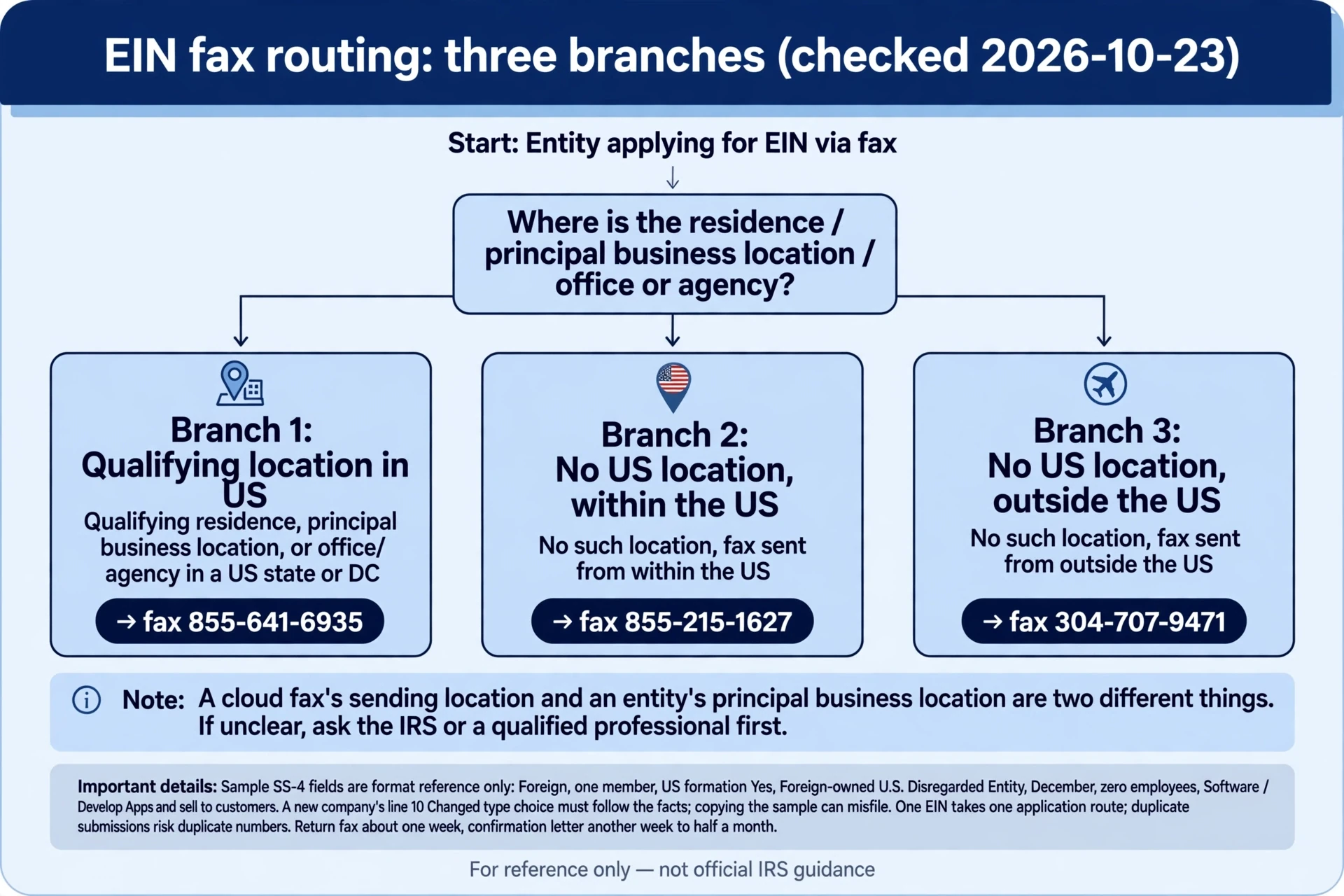
Numbers can change, so recheck the official page before an actual submission. Online eligibility also involves operating location and a valid responsible-party taxpayer ID, not merely possession of a US mailbox or an SSN. One EIN needs one cross-border application route. Duplicate submissions risk duplicate numbers.
The author received a return fax in about a week, with the EIN in the upper right, followed by a confirmation letter at the mailing address after another week to half a month, and urged saving scans. These historical timings are one case. Present processing speeds need current IRS guidance. The warning about a lost letter covers one document. The IRS EIN help page provides lost-number and confirmation-document guidance. Retain submission evidence, transmission confirmation, return fax, and formal notice. Losing a letter calls for the help page’s cross-border process, not a new application.
Build the cross-border receiving chain without assuming automatic approval
In the 2023 cross-border account, the incorporation service applied for the EIN after mailbox notarisation. The contributor received an IRS letter on the tenth business day, then submitted EIN and passport through the Mercury integration and reported approval in about one business day, roughly two weeks overall. Mercury’s current document guide requests formation and EIN evidence plus relevant owners’ and controllers’ identification, and country and cross-border business eligibility still apply. Mercury is a fintech account service, so bank guarantees and balance coverage follow the cross-border provider’s own terms. An EIN starts the checks; approval follows eligibility, not the document alone.
For the UK company, name, registration number, and address supported a Wise Business application. The author described tighter review from late 2023 and a roughly one-month wait. Another receiving provider was offered as an allegedly easier alternative without a verified approval rate. USD, GBP, and EUR account details have distinct features and conditions, and a cross-border payment account is not a separately owned cross-border bank deposit account. Its fund-protection explanation distinguishes safeguarding from banking, while business-address verification requires a physical operating address in a supported location. Features described in older cross-border accounts need rechecking against current terms.
Both routes then applied to Stripe using company information, representative identity and address, cross-border business details, a real working product website, and a matching payout destination. The US route used a passport and Mercury. The UK route used the UK company and Wise and noted possible additional address evidence. Stripe’s cross-country cross-border account requirements include the appropriate entity, tax ID, physical location, phone, government ID, website, and bank information. A registered company address satisfies company checks. Personal address checks need personal evidence, and one cross-border provider’s approval is one provider’s decision — one approval, one provider.

The records also list other processors and merchants of record, with one cross-border account noting website checks for two of them. Their models, supported merchants, settlement, and tax roles differ. Determine whether the need is processing, a merchant of record, or cross-border receipt instead of opening every option as a backup. One account describes multiple Stripe accounts under one login and entity, one per product to reduce concentration. Separating records is useful, but risk decisions may extend across cross-border accounts of the same entity, and additional cross-border accounts need their own compliant basis. Bypassing restrictions risks closure.
Reconcile customer payments, subscriptions, and bank receipt
Build a reconciliation row for each cross-border payment: order identifier, charged currency, provider fee, refund status, settlement identifier, and receiving-account entry. Keep the dates attached to each stage. The revenue measurement guide explains why sales and receipts need separate columns; the operations retrospectives show why failed delivery and payment migrations also belong in the review.
For the product, one cross-border account starts with a pricing page describing plans and benefits, then integrates the cross-border payment API. It favours monthly or annual renewals, potentially producing recurring revenue rather than one-off sales, but suitability depends on continuing value, consent, and cancellation. A cross-border payment notification app can reveal customer activity promptly. Reconciliation still needs transaction status, refunds, disputes, access, and cross-border settlement records. A notification reports an event. Bank receipt is the credit to the account.
The historical cross-border account describes selecting a currency and automatic or manual payouts, with fees deducted and arrival in roughly three to five business days. Stripe’s current first-payout guide describes a typical initial seven-to-fourteen-day wait. Subsequent timing also depends on country, settlement, schedule, and risk status. Record customer payment, funds availability, payout initiation, and receiving-bank credit separately, including exchange rate, charges, and refund provisions. One cross-border account record shows a USD 379.49 payout over an October 30–31, 2024 timeline, and payout timing follows the provider’s schedule and risk status.
A teaching reconciliation might begin with a USD 100 customer payment, platform net settlement P, cross-border transfer charge F, and local-currency receipt B. Retain evidence for all four.
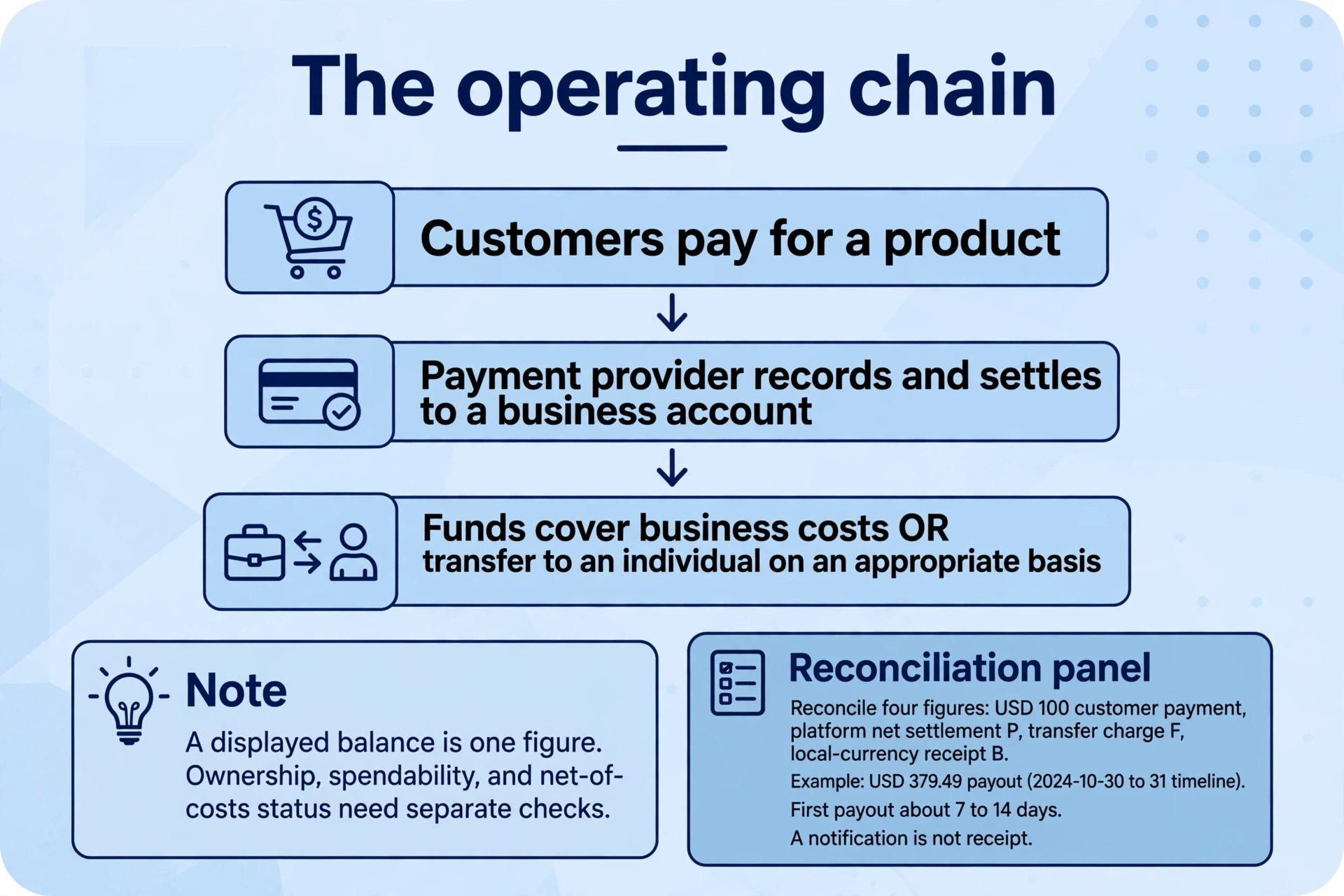
Universal fees need real quotes. Attribute server, token, software, cross-border entity maintenance, and necessary professional-service costs to the relevant period before discussing operating results. Bank balances, MRR, and monthly revenue measure different things.
Preserve all four fund-use paths
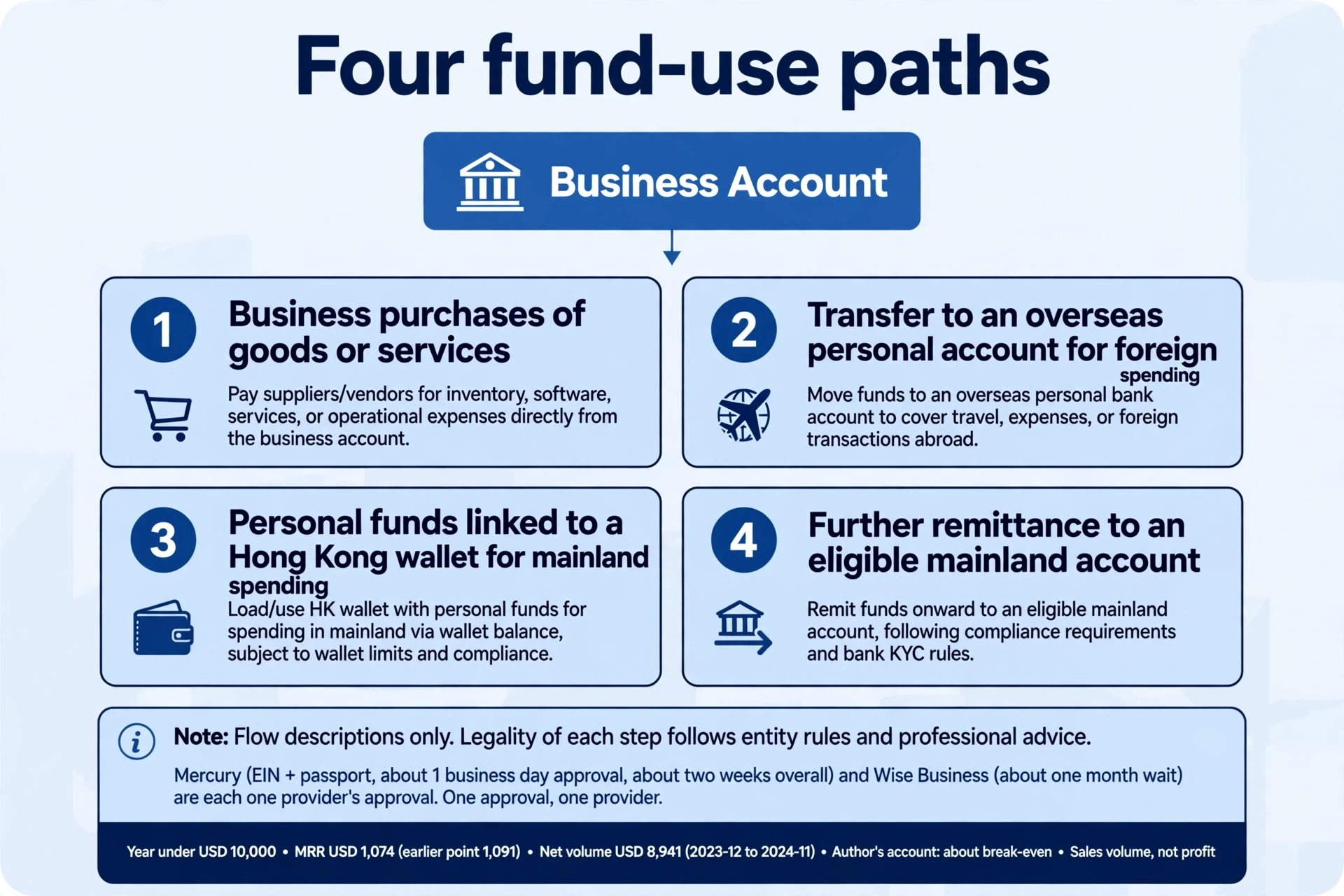
One cross-border account gives four destinations: business purchases of goods or services; a transfer to an overseas personal cross-border account for foreign spending; personal funds linked to a Hong Kong wallet for mainland spending; and a further remittance to an eligible mainland account. These are flow descriptions. Legal permission for each movement needs the entity’s rules and professional advice. Business costs, salary, reimbursement, loans, and distributions have distinct evidence and treatment requirements. Determine them from the entity and transaction. This course offers no tax-optimal method for an individual. Treatment follows the entity and transaction.
For business costs, the author never received the requested Wise physical card but used digital cards for cross-border business services such as AI APIs, mentioning wallet support. The 2023 cross-border account historically described free unlimited Mercury employee cards with merchant and spending restrictions, separate cards for search and AI providers, and domestic-payment-app linking with a historical exemption from a 3% fee below CNY 200. Current availability, delivery, limits, merchants, and charges need individual verification. Stopping or deleting a card ends the card, not the contract. Use the provider’s cancellation process and retain evidence.
For overseas personal cross-border accounts and in-person spending, the record compares three cross-border providers. One Singapore bank was reportedly opened through an app from mainland China in about a week. Its ordinary-mail card never arrived but app spending worked. A Hong Kong bank branch rejected the author in September. Later the author applied over Hong Kong Wi-Fi, signed at a branch, and requested registered mail, yet still lacked the card. A virtual bank’s Hong Kong app application reportedly produced a physical card in three days for cross-border card payments and ATM withdrawals, with an overseas-travel setting enabled for foreign use. A fourth bank has no test record in the cross-border account. Wise transfers, conversion, and instant arrival were case-specific experiences. Promises across currencies need current terms.
The current Singapore bank remote-onboarding page names eligible biometric passports and being in or planning to come to Singapore for work, study, or residence. It describes eligibility for specific travellers. Mainland-resident timelines need individual checks. The Hong Kong bank mobile-opening page still includes a cross-border route for mainland visitors physically in Hong Kong, subject to its eligibility and documents. The virtual bank’s visitor eligibility explanation includes valid mainland identity and bank-card and phone cross-border requirements. Wi-Fi alone is insufficient.
For Hong Kong wallets and mainland remittance, the historical cross-border wallet route searched a messaging app for Hong Kong wallet activation, linked a Hong Kong-issued cross-border account, used the Hong Kong bank, and switched wallet region before buying travel, food, and coffee. At the time, the author encountered an identity-document requirement when linking the virtual bank and transferred through the Hong Kong bank instead. These are historical cross-border account and wallet conditions. 2026 eligibility needs current wallet and bank terms. Check wallet identity rules, supported banks, merchants, currencies, limits, charges, and source of funds separately.
For remitting to a mainland personal cross-border account, the author explicitly had not tested it, mentioning the Hong Kong bank’s express cross-border transfer, an account-opening service, and a Guangdong same-name bank route, or remittance services. The account-opening service only opens cross-border accounts, so confirm its transfer functions and linking conditions with the bank and judge the route by approval and actual receipt, not by a listed feature. Prepare truthful purpose, source, transaction, and recipient evidence. Approval and actual receipt are the acceptance test.

Identify historical shortcuts and unconfirmed current conditions
The three accounts in this section are historical records, and current conditions need fresh checks. The personal Wise section of the 2023 cross-border account records mainland identity and passport use, Mercury-funded activation, and a suggestion of third-party top-ups through an e-commerce marketplace. It says cards were unavailable to mainland applicants but describes changing an address after activation, paying USD 9, and receiving three virtual cards. Current address changes must reflect real residence or cross-border operations. Fictitious eligibility fails verification. Third-party top-ups and mixed wallet funds may also fail funding-source or same-name cross-border requirements.
The record claims Wise could convert to CNY for bank, messaging-app, or domestic-payment-app receipt and was often cheaper than remitting through Hong Kong, also naming another receiving provider. Currency, cross-border account details, purpose, recipient location, limits, quote, and arrival must be checked against the actual cross-border account. Cheapest provider varies by route and date. Compare live quotes. One cross-border account’s virtual-card section describes domestic-payment-app-funded virtual cards with phone and network services. Present service status, fund protection, and merchant acceptance were not officially verified, so the old affiliate route is no current recommendation and no permission to disguise residence through a network setup.
The 2023 account also describes funding a crypto exchange with USDT, selling through the order book for EUR rather than a more expensive instant conversion, then using a European cross-border bank transfer to Wise in about one business day for a claimed EUR 1 charge. That mainland-identity account lacked USD ACH withdrawals. Wise’s current crypto policy restricts buying, selling, trading, exchange flows, and P2P, so executability today needs current policy checks. A platform’s regulated status is one fact. Acceptance follows the cross-border provider’s current policy. Keep asset conversion distinct from SaaS customer revenue and meet the rules relevant to the cross-border account’s location and activity.
The record also mentions company app-store developer accounts, eligible startup benefits, and possible later tax-ID or personal-card applications. These are future directions. Approvals follow each service’s own cross-border process. An EIN is an employer identifier, not an individual tax ID, and a US company is one credential. Each overseas service applies its own residence rules. Decide whether to continue based on real cross-border business needs and current terms.
A half-day Hong Kong trip: preparation is more reusable than the cross-border route
The 2025 trip began around 16:00 on 8 February 2025: metro to the border, then a bus toward Tuen Mun, using a preconfigured ride-code app and a recorded fare of 16. The author got off at the first Hong Kong stop, a market, went upstairs into a mall, and found Wi-Fi. A footbridge led to the return side for the border, or the nearby rail allowed further travel. After 20:00 the author used a maps app to find the exit and a passage beside light rail to the bus stop. This is a historical cross-border route. Check transport and border arrangements before travel, without treating 16 as today’s fare.
Four applications were submitted that afternoon: three Hong Kong banks and a virtual bank. Only one issued a cross-border account number immediately.

The others remained under review. Approvals follow each bank’s review. Mobile data worked for one bank, while another failed to recognise the Hong Kong location until mall Wi-Fi was used. Physical presence, device location, and network recognition are different checks, and simulated location fails cross-border presence requirements.
Before travel, download official apps and prepare valid identity and travel documents. Because the author’s ID address differed from the residential address, both PDF and image versions of a domestic bank card statement were prepared. The image was used. After arrival, the author downloaded an entry-exit record PDF through the immigration authority’s app and reported all four requested it. Follow each bank’s current cross-border checklist and actual residence rather than universalising one app experience.
Document recognition was unreliable against the author’s palm and improved on a laptop shell. Generalise the lesson to a flat, contrasting, glare-free background without obscured edges, rather than a particular laptop. Use a simple background and even lighting for facial checks. Choose the closest truthful occupation category and explain where requested. Use accurate concise information for character limits and the required romanisation where Chinese is unsupported. Then distinguish submission, additional documents, approval, online cross-border banking, and card delivery.
The author chose a cross-border premium account, recording a three-month fee waiver followed by HKD 380 monthly below the required balance, and therefore recommended a basic cross-border account at the time. No physical card had yet been requested. The plan was to update delivery details online. Choosing the basic cross-border account is one choice. Fee outcomes follow the current fee schedule. The current basic-account page describes below-balance conditions for non-HKID customers opening on or after 1 January 2026, with the HKD 100 monthly fee waived when average Total Relationship Balance meets HKD 10,000 for three consecutive months. This is a dated condition for that customer class. Other classes follow other schedules.
The current opening page distinguishes Hong Kong-resident HKID holders from customers in specified overseas locations, potentially using selected passports or travel permits. An HKID-specific paragraph describes one class. Mainland-visitor eligibility follows the overseas-locations section, and the historical cross-border case is one approval. Timelines vary by applicant. Check documents, location, existing relationship, intended product, and fees, then prepare for the applicable current official route.
Distinguish a working cross-border process from actual profit
One cross-border account closes with under USD 10,000 over a year and MRR just over USD 1,000. One figure specifically labels USD 8,941 as Net volume from sales for December 2023–November 2024. Another shows current MRR of USD 1,074 and a prior point of USD 1,091. Net sales volume, MRR, and a bank balance measure different things. Profit needs cross-border costs deducted, and MRR is a run-rate metric. Receipts that month need bank records. The author described high AI-token and server-traffic cross-border costs paid by a mainland credit card outside the overseas cross-border receipts account, leaving the overall year roughly at break-even.
Spending with a virtual bank’s Visa while travelling in Korea gave the author a tangible demonstration of the cross-border chain, while USD 10,000 MRR remained a future goal. Open-source SaaS templates offer payment-enabled starting points for studying product-payment integration. Deployability is one test. Merchant eligibility, reporting cross-border compliance, and customer support need separate validation. Validate a complete cycle through customer payment evidence, platform records, received funds, fee reconciliation, an appropriate purpose, and ongoing maintenance. A cross-border payment notification alone is one signal — sales volume, not profit.
Practice: complete a documented cross-border chain review
-
Can a Wyoming LLC with a virtual mailbox directly use the fax number for a qualifying US location? Those two facts are insufficient. Separate legal, mailing, and principal cross-border business addresses and consult current SS-4 routing. Without a qualifying US location, clarify where the fax is actually sent from. Ask the IRS or a qualified representative when cloud-fax location is unclear. The sample’s Changed type selection and one-member count also need factual verification.
-
Why can the historical first-year budget exceed USD 1,000 when EIN application is free? Direct IRS application is free, unlike formation agents, mailboxes, phones, notarisation, and maintenance. The listed items total 399 + 350 + 299 + 36 = USD 1,084, excluding all government costs and actual professional filings. Compare one-time, annual, and transaction charges and package scope. 1,084 is a historical subtotal.
-
Why is a completed customer payment and payout company money first? Reconcile the transaction, refunds, and fees, then confirm actual receipt in the cross-border business account. Funds may still belong to the company. Personal receipt needs an appropriate genuine basis such as salary or reimbursement. Customer cross-border payment, settlement, transfer, personal availability, and profit are separate layers. Retain evidence and confirm treatment with a professional in the relevant jurisdiction.
-
How should you prepare without mistaking old Hong Kong promotions for eligibility? Check official cross-border requirements for documents, physical location, real address evidence, entry record, and product charges, then download official apps. Diagnose location-recognition failures normally. Spoofing fails presence checks. Four submissions produced one immediate approval in the cross-border case, and 2026 basic-account conditions for new non-HKID holders require separate cross-border review. Verify approval, online access, and delivery independently.
-
Can USD 8,941 annual sales volume and USD 1,074 MRR be described as USD 8,941 profit? Preserve the Net volume from sales and MRR labels and periods, then include token, bandwidth, server, software, entity, transaction, and necessary cross-border service costs. The author called the overall result break-even. Mainland-card-paid expenses belong in the total. Ignoring them overstates results. MRR is a run-rate measure. Annual profit and monthly receipts need their own records.
Document each link, verify current conditions, and keep cross-border business and personal funds on separate, evidenced bases. A cross-border chain is only as usable as its weakest verification.
Comments
Join the conversation. Comments are reviewed before appearing.
Loading comments…