Organic search brings people with a problem. The business serves their next action. Some read content monetised by ads. Others generate, download, or save a revenue outcome and may buy directly. Repeated use, collaboration, or continuing updates can support subscriptions. Affiliate referrals and lead services can also work when they genuinely help decisions. Traffic alone establishes no business.
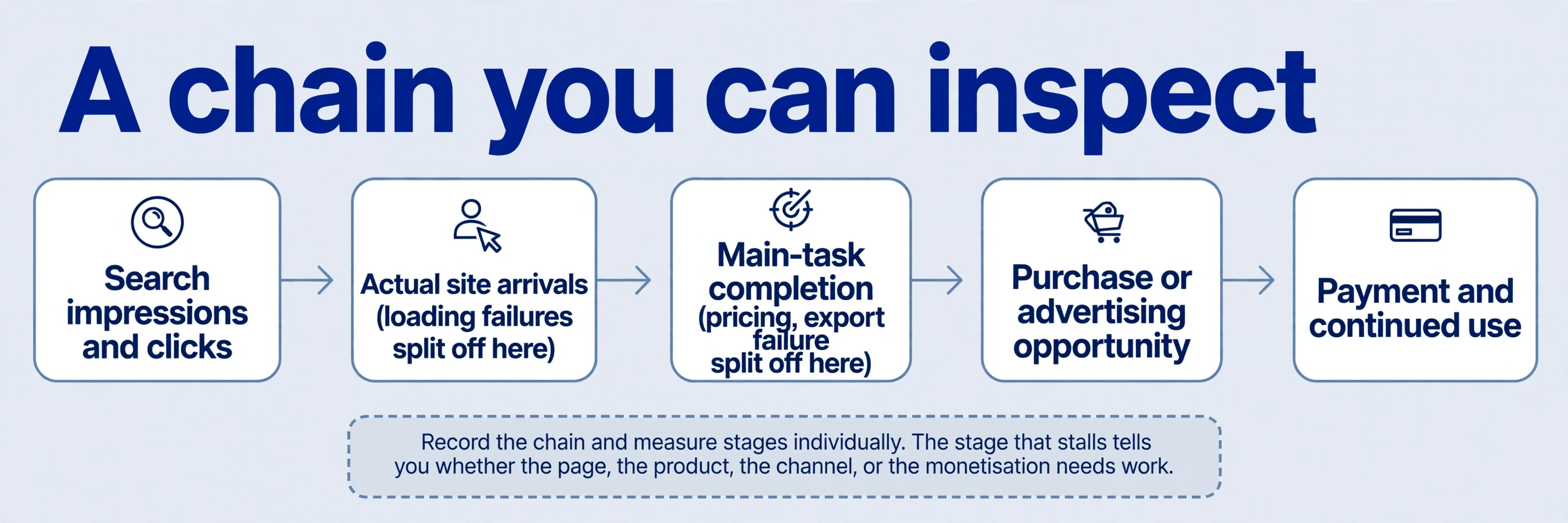
Build a chain you can inspect: search impressions and clicks, then actual site arrivals, then main-task completion, then an appropriate purchase or advertising opportunity, then payment and continued use. Loading failures separate clicks from arrivals. Pricing, failed export, or infrequent use separate task completion from payment. Record the chain and measure stages individually. The stage that stalls tells you whether the page, the product, the channel, or the generation needs work.
Advertising account amounts, organic visitors, registrations, paying customers, subscription revenue, and a business sale are distinct measures. Retain period, currency, target, and evidence type with every number.

The 2016 advertising case: demand exceeded delivery capacity
The site in this revenue case already had substantial browsing and downloads before any redesign. Home and category pages were text lists. Detail pages supplied book descriptions. Each page had one ad placement. That traffic reads as evidence of useful curation. Descriptions and styling were copied from a large book retailer’s pages. Reproduce the teaching with owned, licensed, or otherwise legitimately reusable materials.
Four bottlenecks held the site back: slow pages, downloads competing with the website on one server, difficult book discovery, and limited use of the existing readership through ad placement. The code queried the database while rendering HTML and queried again inside loops, potentially multiplying round trips for one listing request. Diagnose query counts, indexes, resource contention, and response time.
The owner rewrote the backend and frontend in a PHP framework, redesigned the database, imported the old revenue data, and launched around 25 June 2016. Protect the routes: keep /book/keji.html for the old category and /book/view/9.html for the old detail, pointing at the same objects, so search results, references, and bookmarks keep working. If a move is necessary, map equivalent redirects instead of breaking old routes wholesale. Entry points are assets. A redesign that breaks them pays for its new paint with old traffic.
Revenue: Redesign pages so each entry supports the next task
Before changing the revenue model, inspect one complete visitor route. Use the internal links worksheet to connect the entry page to its next useful action. When the entry is visual, follow the image-preview-to-download journey. Record each stage separately so a broken download is repaired as a delivery problem rather than mistaken for weak purchase demand.
The redesign used four-book card rows on home and category pages, exposing covers, authors, formats, categories, and usage information rather than names alone, with three ad placements per page. Detail pages retained descriptions with restyling, added related discovery routes, and carried three placements. Tags grouped books by topic. Authors became a special tag-based collection. Site search supported known-title lookup. Static archives survive, without search-result screenshots. This chapter covers the page structure and templates they show.

On-page work went further than a universal title change. The home title combined the site name and service, the description explained the offer, and the H1 used name and slogan. A detail title used book name, site name, and a general term; its description combined book, author, and service, with the book name as H1. A category title used category, site, and slogan; its description explained the collection, and the H1 named the category. Tag titles used tag name, site, and slogan, with the H1 naming the tag. Author pages expressed the author collection. Templates express page identity. A generic phrase stuffed into every page expresses nothing.
Seven years later, the owner noticed the tag description had been omitted. The tag description field is empty. That omission teaches one revenue lesson only: sample every template. Check home, detail, category, tag, and author output for actual titles, descriptions, H1s, links, and content, rather than accepting completed backend fields alone. An empty field and a helpful field look identical in a dashboard.
Three placements were the historical revenue practice. The ad platform’s ad-to-content policy prohibits ads and paid promotion exceeding publisher content, while placement policies require avoiding accidental clicks and confusion with navigation or downloads. Test content length, mobile layout, task placement, and loading effects; prescribe no fixed box count. The red rectangles in the revenue case illustrate locations. They mark spots on a diagram.
Read the revenue growth: one series, several possible causes
The advertising screenshot labels each monthly amount “closing balance.” Read them here as historical advertising account amounts, in 2016 US dollars:
| Month | Closing balance shown |
|---|---|
| June 2016 | $874.04 |
| July 2016 | $1,475.09 |
| August 2016 | $1,481.95 |
| September 2016 | $1,622.17 |
| October 2016 | $1,710.51 |
| November 2016 | $2,100.70 |
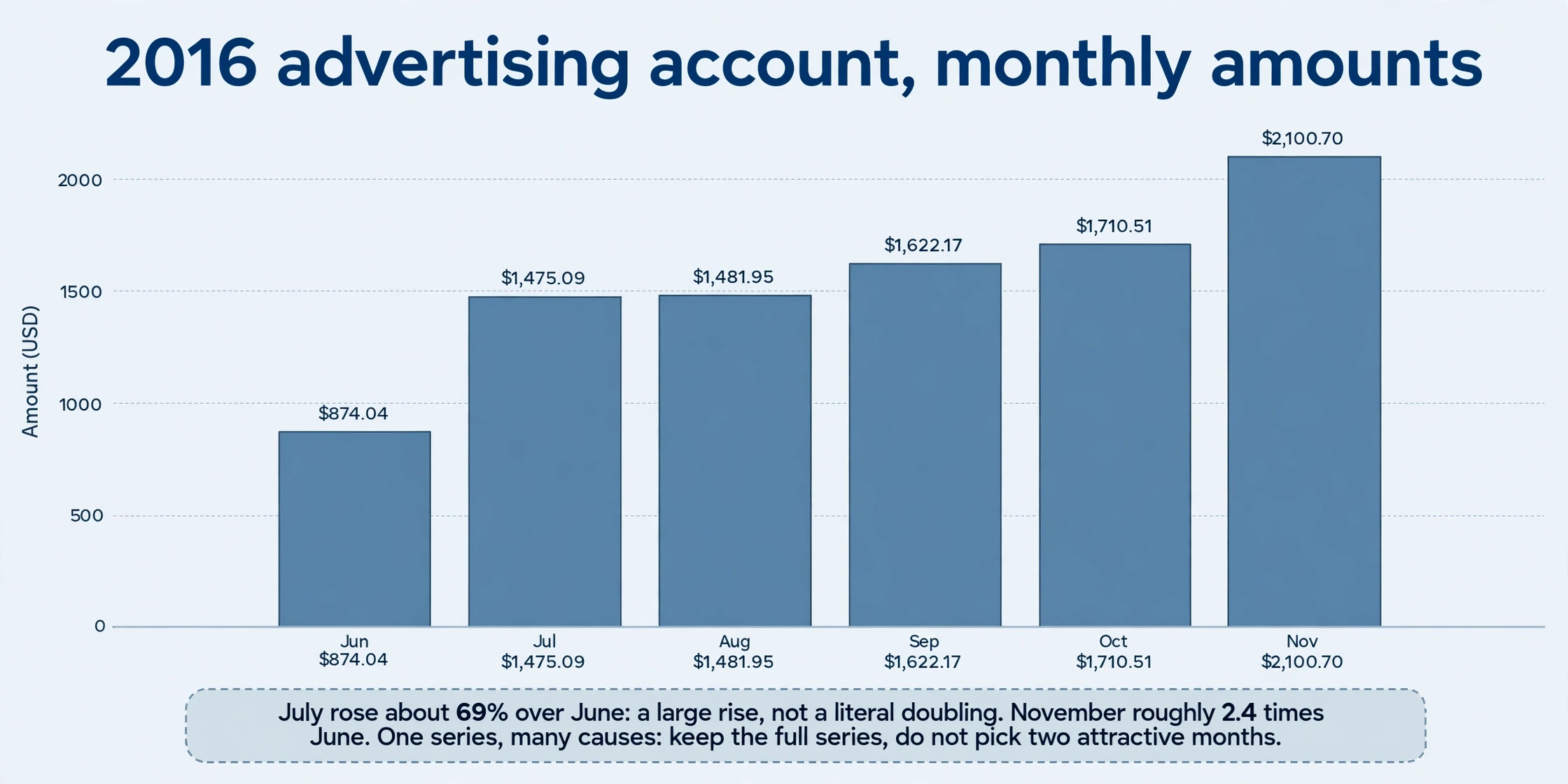 |
July rose about 69% over June — a large rise, not a literal doubling. November was roughly 2.4 times June. August was nearly flat before later increases. Advertising auctions, geography, traffic quality, impressions, and visibility can all move amounts. The revenue record leaves their contributions combined. Code, search work, and placements changed together. One series, many causes: keep the full series rather than select two attractive months.
The owner reports higher visitor and pageview counts the next day, attributing them to fewer loading-related abandonments and more browsing through tags and search, followed by indexing and ranking improvements. Those mechanisms are plausible. Check daily visitor counts, search-console data, ad impressions, and controlled revenue comparisons before claiming a cause. Faster pages may also let analytics record more arrivals that previously vanished mid-load. Separate new search users, returning readers, and better recording in the check.
When reproducing the work, observe delivery and advertising changes separately. Delivery checks use loading success, errors, and task completion for the same entry. Ad experiments examine revenue per thousand pageviews, actual impressions, and task completion with clear denominators. If more ads raise short-term amounts while making discovery or downloads harder, reduce or move them. Calculate revenue from revenue per thousand pageviews, actual impressions, and task completion. Three placements carry no fixed multiplier. Delivery first, ads second — a page that loads and completes its task can carry ads. Ads cannot carry a page that fails its task.
Seven acquisition methods: give each a validation job
The seven channels below come from a saved written talk published in February 2024. The embedded recordings were unavailable. Start with the speaker’s own failure, because it teaches the chapter’s rule: measure interest and purchases separately.
In 2008 he sold a public-speaking magazine for RMB3 with a RMB1.8 purchase cost — a RMB1.2 gross difference per copy. An Olympic quiz offered magazine coupons and was promoted through class chat-group mailboxes, a campus forum, and a large revenue discussion platform. Participation was high. Purchases were low. The campus-ambassador domain later sold for RMB800. Quiz participation and magazine purchases are separate counts. A RMB90 win from a 2004 telephone quiz inspired the idea. Record the RMB800 sale as an asset transaction; record the RMB90 win separately from website revenue.
The same experience created a revenue opportunity. Three unrelated people recommended him for a bilingual company website. After over a month of development and search work on a Chinese search engine, he received RMB1,000 for the project. Later image, film-information, and humor sites attracted search traffic. Translating a Chinese site into English brought search traffic, citations, and ad revenue. English earnings running “many times” Chinese earnings stands as his self-reported experience, with no comparable amounts added. Five subsequent years at a game publisher building an advertising system developed his paid-acquisition skills.
Search and paid search serve similar intent with different investment timing. Search serves active queries through useful pages, structure, and credible references, supporting long-term work on durable needs. Rankings change, and only some searchers pay. Count content, development, and maintenance as costs. An AI-video-generation query shows a task. Check completion, fit, and payment. Treat organic search as a channel to maintain, not a permanent free supply. Paid search can reach explicit intent sooner and test a landing page and payment action, but it still needs preparation and may not stay stable. Highest-bidder-first with three ad slots is a simplified picture. The ad platform’s ranking guidance includes bids, ad and landing-page quality, thresholds, competition, context, and expected asset effects. Define affordable test spend and the target action, then inspect queries, qualified arrivals, successful generation, and actual payments before increasing spend.
Feed ads and email connect feedback to value. Feed ads can use revenue conversion feedback to help platforms select audiences. Payment feedback refines a model. Incorrect events, duplicates, poor-quality conversions, and creative fatigue can distort learning. Define successful generation, payment, and refund separately, and reconcile platform reports with orders. While scaling, monitor acquisition costs and continued use rather than platform conversion counts alone. Email can bring relevant users to tutorials, trials, and updates. The talk names registrations from other products and purchased lists, followed by repeated sends, click, registration, and payment tracking, and changes to copy, landing pages, and price. Reuse the feedback chain rather than unlimited sending. Start with contacts appropriate for and consenting to that purpose, with clear subscription and exit choices and small audience-specific tests.
Community posts, PR, and creators distribute relevant demonstrations. For community posts, the talk recommends a product-launch site, mentions a historical list of over 200 AI directories — some automatically collecting launches, others accepting manual submissions — and names two large revenue discussion platforms and a startup-showcase board. Communities apply their own rules and relevance judgments. Show the task, audience, and working revenue example, then track referrals and completion after submission. PR involves technology media writing or publishing a story. The talk names free coverage, paid publication, supplied copy, and historical leads at two press-release services. Establish audience overlap, newsworthiness, and usefulness, then define publication scope, sponsorship, link relationships, and deliverables. Count new customers, not revenue article counts. Label paid coverage as paid. Creator marketing uses influence within a particular audience to demonstrate or introduce a product. Suitable creators converting relevant traffic remains a hypothesis. Check audience fit, credible interaction, and a complete input-to-output demonstration, then define content, tagged links or codes, and review revenue metrics. Word of mouth can reduce later acquisition costs. Test sharing; do not assume it. Do not generalise one product’s marketing story to all products.
Websites support rapid validation through direct publishing and updates visible on refresh. Each payment, advertising, app-store, and service process follows its own revenue review. Use one fast channel to test tasks and pricing, then cover validated needs through search. The seven methods can cooperate. Revenue record costs, arrivals, completion, and payments separately, and count no person’s repeated touchpoints as several new customers. One person, one count — touchpoints multiply in revenue reports; customers do not.
What success stories suggest, and where the revenue record stops
A practitioner community invited the speaker in December 2025 to discuss eight people. The revenue record is a prepared-text adaptation of the talk, stopping partway through one participant’s former role in internet operations — about 972 Chinese characters in total. A 4,000-member community counts members, not earnings. Six themes and one partial process are on the revenue record. The eight complete stories are missing; mark the gap and teach from what is present.
Six reported themes survive: move from client work to an owned project; discover genuine needs; consider higher-ceiling generation; practise and validate quickly; learn through community exchange; and keep iterating through setbacks. Make each attempt deliver demand evidence, a working task, a pricing hypothesis, and feedback. Persistence means revising revenue assumptions rather than funding the same failed idea indefinitely. Revise, don’t repeat: the same idea with the same evidence is the same bet.
The partial process belongs to one participant: studying search optimisation from September 2023, attending an exchange in December, launching a first website with AI assistance during March to June 2024, and continuing to learn in a work environment. Parts of the projection are obscured. learning, practice, and peer feedback can reinforce one another. Treat the fragment as one person’s visible steps, not a template for a one-year career exit.
The resume-site case: turn a durable need into a page system
The resume-site case focuses on a durable need. Graduates, job changers, career switchers, and overseas applicants search for role examples, no-experience templates, profiles, work history, formats, and career gaps, often needing immediate editing and submission. The founder had recruitment experience. The revenue case emphasises understanding candidates and recruiters before learning marketing and search optimisation. Initial audience and funding figures come from his public account. Treat them as self-reported, not independently audited.
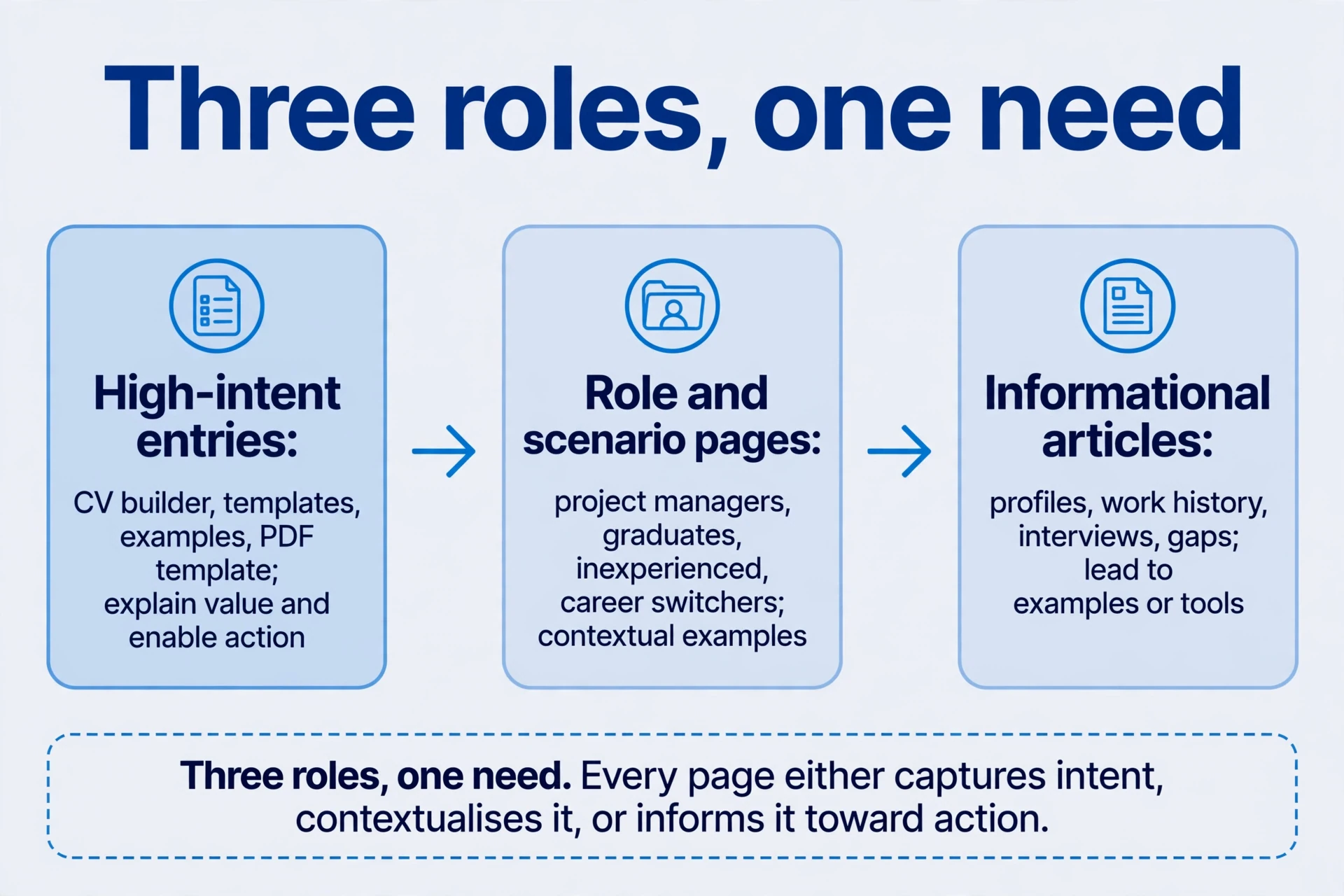
The system has three page roles. High-intent entries such as CV builder, CV templates, CV examples, and PDF CV template explain value and enable action. Role and scenario pages for project managers, graduates, inexperienced applicants, and career switchers provide contextual examples. Informational articles address profiles, work history, interviews, and gaps, then lead to relevant revenue examples or tools. Neither generic blogging for every topic nor a separate page for every wording is required. Three roles, one need: every page either captures intent, contextualises it, or informs it toward action.
For a project-manager query, show a relevant revenue example explaining project scale, responsibilities, and revenue outcomes, then open an editor with the corresponding structure. Merely swapping “project manager” for “accountant” in generic advice creates no distinct value. Different evidence, writing choices, and structures can justify a separate scenario. Begin with a few complete pages and expand from feedback rather than generate every role, region, and experience combination. A page earns its existence with distinct evidence, not a distinct keyword.

Links follow the career context too. Career blogs, recruitment sites, student resources, and university career services reach relevant readers. Revenue research, statistics, and free tools can become reference assets. Explain why a revenue source needs the asset, where revenue data comes from, how it is maintained, and how people use it, rather than count links alone. Relevance establishes no quality by itself, and paid cooperation retains its actual relationship. A link from the right room with the wrong reason is still the wrong link.
From content to paid export: keep revenue data categories separate
A successful checkout starts a second record: receipt, fees, refunds, settlement, and bank arrival. The cross-border operating-chain guide separates the accounts and fund movements involved. Use those records to reconcile revenue with actual receipts, then use the sustained-operations retrospectives to plan delivery checks and customer support after the first payment.
The reported journey runs revenue examples and templates, then online editing and layout, then payment at download or document export. Content explains how. The tool enables action. generation serves the same task. The sales-page material also stresses a useful experience for nonbuyers. Explain price, scope, and subscription terms before substantial user effort rather than replace value with a surprise paywall. A paywall after effort is a toll booth at the exit.
The first tool version underperformed and was rebuilt after investigating nonpayment and friction. Inspect editing starts, completed resumes, export requests, price views, successful payment, successful download, and refunds. Editing friction concerns usability. Payment friction may concern promises, price, or trust. Failed delivery after payment comes first — a customer who paid and received nothing is a support emergency, not a funnel statistic.
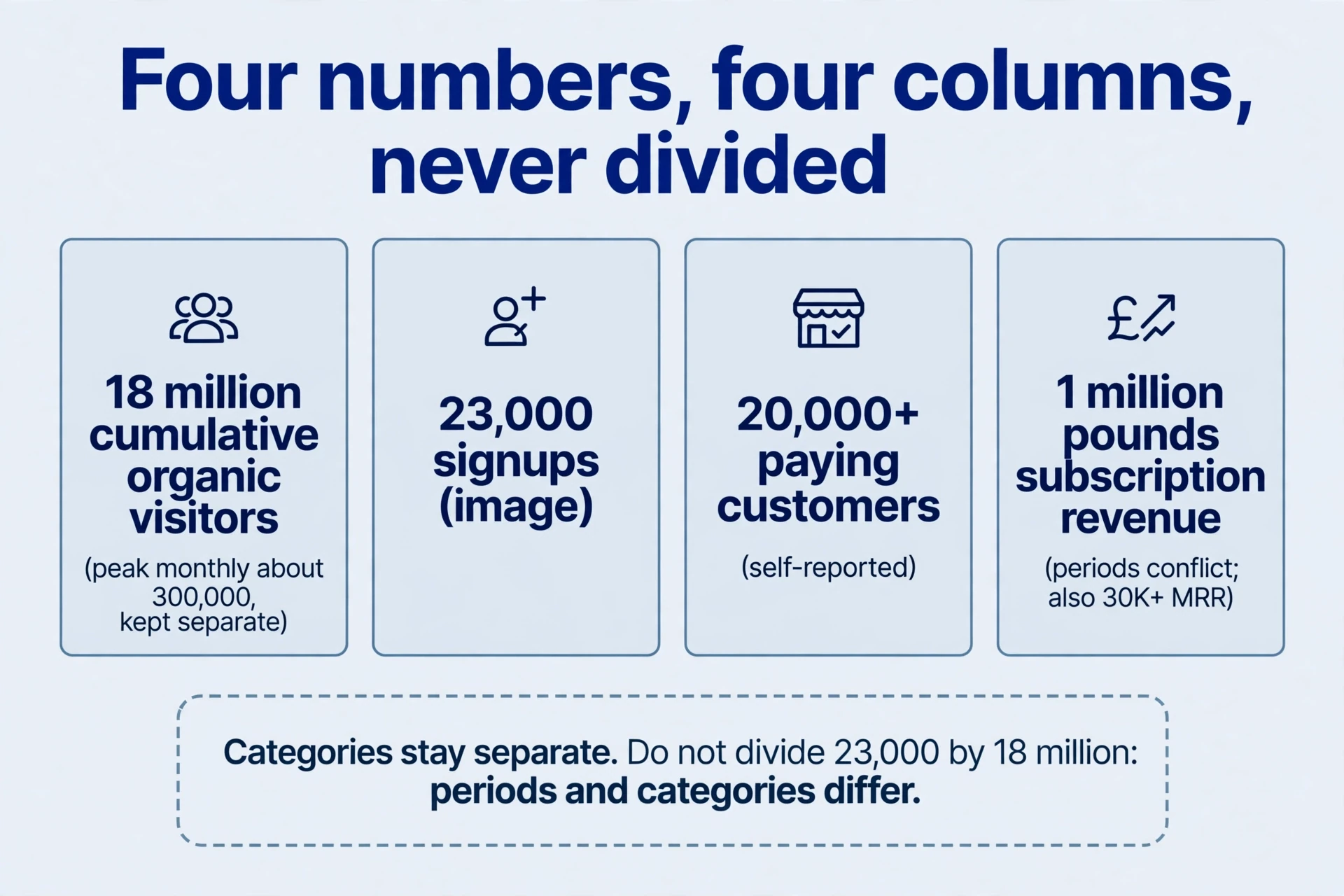
Read text and images together, because they disagree. The case reports over 18 million cumulative organic visitors, more than 20,000 paying customers, and over £1 million subscription revenue, plus a sale in early 2026. One image instead heads its revenue figures 18 Million Organic visitors, 23,000 Signups, and £1 Million Revenue. Another separately states over 20,000 paying customers and 140K video-platform subscribers. Count signups, paying customers, video-platform subscribers, and visitors in separate columns. Eighteen million is cumulative, not monthly; the same image separately mentions roughly 300,000 monthly at peak. Categories stay separate: a signup, a payer, a subscriber, and a visitor are four different people in four different counts until evidence joins them.
Revenue periods are unresolved too. One image says over £1 million in annual subscription revenue while linking to scaling to £30K+ MRR. The other states over £1 million subscription revenue without matching periods. MRR measures recurring monthly revenue. Annual revenue, cumulative revenue, annual-plan sales, and contract value each measure something else. Whether the statements describe the same stage stays unresolved. Keep the period labels attached to each figure. Do not divide 23,000 by 18 million: periods and categories differ.
Turn the revenue case into bounded acceptance work. For a graduate-resume page, observe five target users and whether the revenue example improves their experience descriptions. Have them move from content to the editor and export a usable document. Explain charges and cancellation before launch. Keep each stage’s denominator consistent and separate new customers, repeat use, receipts, and refunds. If use is rare but a single export is valuable, compare one-off payment with subscription fit. Five-user testing finds problems; market-wide rates need larger samples.
A sale suggests a transferable asset can include content, product, brand, customers, and operating processes. Record the sale without a price; no revenue valuation method is given. Advertising and subscription sites share one revenue acceptance question: what did users complete, what did they pay or experience, what did the operator actually receive, and can the value continue? Receipts, not headlines — revenue claims answer that question only with periods and categories attached.
Practice: turn attractive figures into executable work
-
How should the claimed June–July 2016 doubling be reported? The displayed closing balance rose from $874.04 to $1,475.09, about 69%. The owner interprets it as ad revenue. Code, search work, and placements changed together, without isolated revenue contribution data. Retain August to November too. Call it the displayed closing balance.
-
Define three release checks for an existing book-site redesign. First, test /book/keji.html and /book/view/9.html for the same original objects. Second, complete discovery, details, and download on mobile with errors and loading recorded. Third, sample home, detail, category, tag, and author output for titles, descriptions, H1s, and navigation, then check advertising interference.
-
Olympic-quiz participation is high but magazine sales are low. What changes next? Interview magazine buyers about their needs, use relevant excerpts or speaking exercises to attract those needs, and explain purchase clearly. Measure participation, revenue coupon claims, purchase entry, and payment separately. Record the RMB800 domain sale as an asset transaction, not improved magazine sales.
-
Assign fast-validation and long-term channels to an AI video tool. Test a specific generation task and price through a small affordable search-ad experiment, recording successful generation and payment rather than clicks alone. Use feedback to improve one working search scenario page with maintained revenue examples and limits. Expand from evidence, not assumptions that the highest bid always wins or free access guarantees sharing.
-
How should 23,000, 20,000, 18 million, and £1 million appear in a revenue case record? Label 23,000 as image-two signups; 20,000+ as self-reported paying customers from the other image; 18 million as cumulative self-reported organic visitors, with roughly 300,000 peak monthly kept separately. Mark £1 million subscription revenue with conflicting periods, retaining the annual wording from one image, the unspecified timing from the other, and £30K+ MRR. Keep the four revenue figures labelled separately.
-
How can teaching continue when stories are missing and media has expired? Teach the seven channels from the saved written talk and mark the recordings unwatched. Teach the six themes and the readable participant fragment while marking the eight-story gap. Label added exercises as teaching assumptions. Specify the missing evidence for exact earnings and careers.
Serve the task, validate the channel, verify the revenue — in that order, with the denominators attached. A business is a chain of completed tasks with receipts at the end. Count the chain, not the applause.
Comments
Join the conversation. Comments are reviewed before appearing.
Loading comments…