A live website can still be invisible in search. The page exists. Nobody finds it. Before changing anything, ask a narrower ranking question: what exactly am I waiting for?
Ranking context. The search engine may not know the URL exists. It may know it and never have fetched it. It may have fetched it without indexing it. Or it may have indexed it without ranking it prominently for your ranking query. Four different stalls. Four different fixes. Guessing wrong wastes weeks.
This ranking lesson connects the earlier work — assigning URLs to needs, completing the task, expressing the subject, maintaining value — to the search process itself. Then it sets honest timelines, using two fast ranking launch cases and one old study, read carefully.

Find the stalled ranking stage
If a URL has been fetched, the HTTP and rendering inspections help check what actually arrived. If a fast-launch story is shaping your expectations, compare it with the tool-site growth cases, where each result retains its own site, measurement, and period.
| Stage | What it establishes | Next step |
|---|---|---|
| Discovery | The engine knows a URL exists. A fetch is not yet established. | Provide real links and a list of canonical URLs. |
| Crawling and processing | A crawler received content. Successful interpretation is a separate ranking question. | Check the response, the content, rendering, and the canonical URL. |
| Indexing | The page sits in the index and can be considered for search. | Review intent, usefulness, and competition. |
| Impressions, clicks, lasting ranking positions | Being shown, being chosen, and holding a ranking position are three different outcomes. | Record first impressions, first clicks, and later trends separately. |
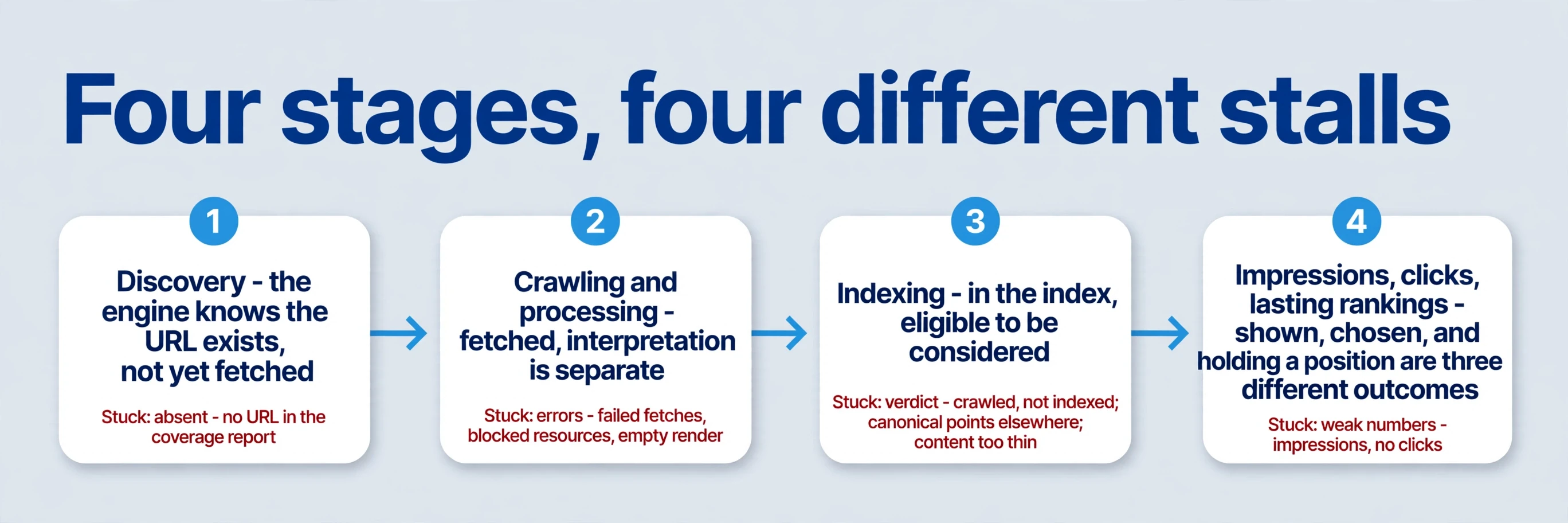
Ranking context. Each row answers a different ranking question, and each stall looks different when you go looking. A discovery stall shows up as absence: the URL appears nowhere in coverage reports, no page links to it, no sitemap lists it. A crawling stall shows up as errors: failed fetches, blocked resources, a page that renders empty for the crawler. An indexing stall shows up as a verdict: crawled but not indexed, a canonical pointing elsewhere, a duplicate of a stronger page, content too thin to earn a place. A ranking stall shows up as weak numbers: impressions without clicks, or clicks that never hold.
Ranking context. The wrong fix follows from misreading the stall. Requesting indexing for a page nobody linked to ranking changes nothing — there’s no path for the crawler to walk. Rewriting titles for a page never crawled ranking changes nothing either — the engine hasn’t seen the page at all. Adding more content to a page that ranks but doesn’t get clicked misses the presentation problem. Find the stall first. Everything after that follows.
Ranking: Make the launch traceable
A new site has no ranking link history. Nothing points at it yet. So give the search engine a way in, and keep a record of what you did — the record is what makes later ranking changes explainable.
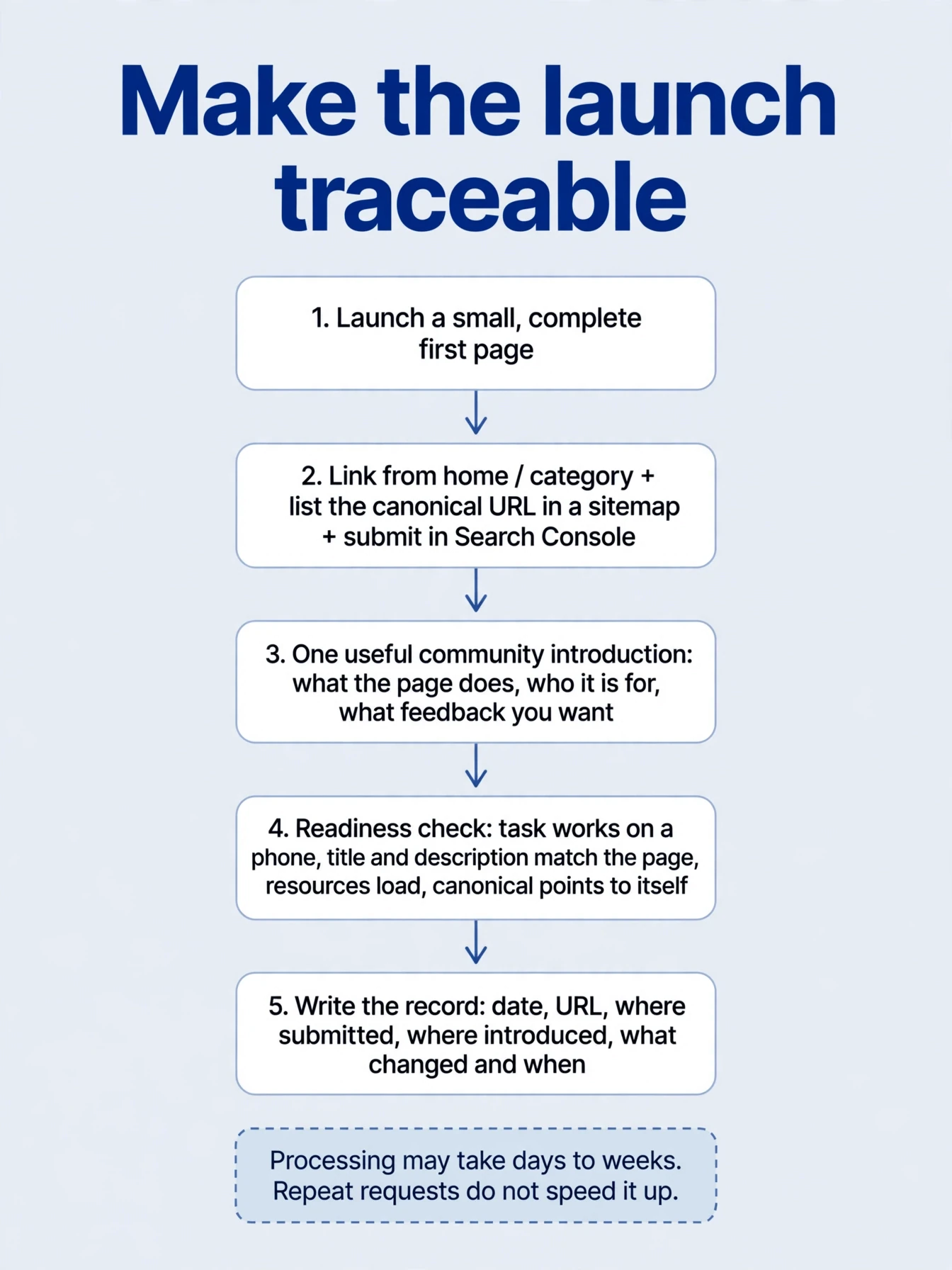
Ranking planning. Launch a small but complete page first. Explanations should answer the ranking question. Download pages should provide the file. Tools should complete the operation. Link the page from a home or category page, list its canonical URL in a sitemap, and submit it in the search console. Then introduce it in a relevant community — an existing public page becomes an entry point to the new site. Discovery still depends on whether that page is public, whether its link is crawlable, and whether a crawler reaches it.
Ranking context. The introduction itself does real work. A useful explanation — what the page does, who it’s for, what feedback you want — gives people a reason to visit and a reason to link. A bare URL dropped into an unrelated thread gives neither. Show up where the topic already lives, answer the replies you get, and let the visit be the reader’s choice. One honest introduction beats ten dropped links. The community post is an entry point, not a ranking lever.
Ranking review. Before asking for indexing, run a short ranking readiness check. Does the task complete on a phone? Do the title and description match what the page delivers? Are resources loading, links working, the canonical pointing at itself? Requesting indexing for a broken page just gets the broken version processed faster. Fix first, request second.
Ranking review. For a few important URLs, use URL inspection to request indexing. Use a sitemap for larger sets. The two tools serve different scales: inspection is a nudge for a handful of pages you care about right now; a sitemap is the full list, crawled on the engine’s own schedule. Official recrawl guidance says processing may take days to weeks, requests guarantee no indexing, and repeating the same request speeds nothing up. Make the page ready, provide entry points, then observe. The waiting is part of the work.
Keep the ranking record simple and written down: date, URL, where it was submitted, where it was introduced, what changed and when. A month later, when traffic moves, that log is the only thing standing between a real explanation and a guess.
Ranking review. Know what counts as an entry point, because not every link qualifies. A link from the homepage or a category page counts — crawlers walk those paths regularly. A sitemap entry counts as a list of URLs to consider. A public community introduction counts if the page is crawlable and the link is a plain link. What doesn’t count: a link on a page nobody crawls, a link marked not to pass ranking discovery signals, a link behind a login, or a link that only appears after JavaScript the crawler never runs. Entry points are paths a crawler can actually walk. Audit yours by walking them yourself, as a crawler would: start from the homepage, follow the links, and see whether you reach the new page without typing its address.
The ranking one-hour case, read straight
On July 6, 2023, someone built a page about a newly launched social platform — an informational page, not a complex tool — and got it discovered fast. The ranking timeline is worth reading exactly, because every retelling since has blurred it.
Ranking evidence. The domain was registered at 11:09. The author wrote the page, committed the single HTML file to a code repository, and deployed it through a static host. DNS changed around 15:20. Once it stabilised, the author posted an introduction in a community forum at 16:44. The archived cache timestamp reads 17:56 — about 72 minutes after the post.
| Time | What happened |
|---|---|
| 11:09 | Domain registered |
| Morning | Informational page written, committed, deployed |
| ~15:20 | DNS changed, then stabilised |
| 16:44 | Introduction posted in a community forum |
| 17:56 | Archived cache timestamp — about 72 minutes after the post |
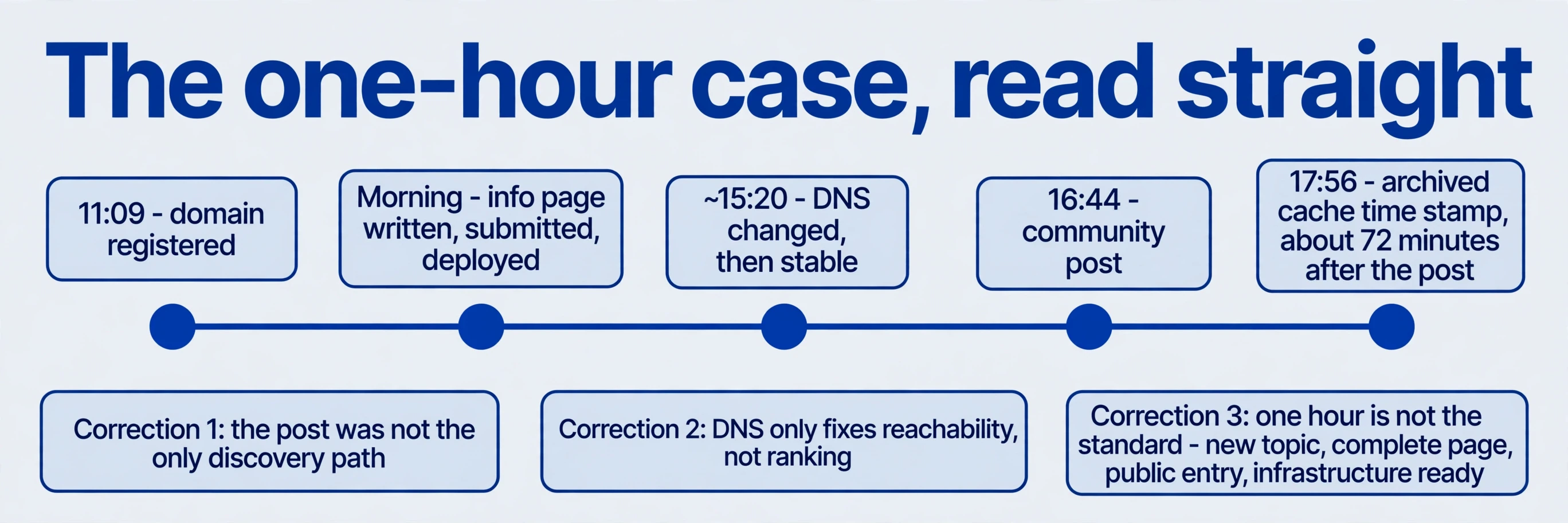
Ranking context. The table is the whole ranking evidence. Six hours from registration to a cached copy, most of it waiting on DNS. The discovery itself took barely over an hour once a public entry existed. Read it that way and the ranking case stays useful: infrastructure ready, page complete, one public path in.
The records support rapid discovery and indexing in this ranking experiment. That’s all they support. Three retellings need correcting.
Ranking context. First, the forum post did it alone. The records don’t isolate the post as the only discovery route. The page also sat behind a fresh deployment, a changed DNS record, and whatever other paths the crawler already knew. The post was the visible entry point. Visible isn’t the same as sole.
Second, changing DNS providers boosts ranking positions. DNS affects reachability, not ranking. What the DNS change did here was simpler: once it stabilised, the page could be fetched at all. Reachability is a precondition. Preconditions don’t rank pages.
Ranking planning. Third, one hour is the standard. This ranking case stacked advantages most sites don’t have: a newsworthy topic on launch day, a simple complete page, a public link from an active community, working infrastructure. Remove any one of those and the ranking timeline stretches. One success sets no deadline for every site.
The author said it too: indexing is only the first step. Ranking stays a separate challenge. Fast ranking cases teach the mechanism — fresh demand, a ready page, a public entry, working infrastructure — not a schedule. Copy the mechanism. Leave the stopwatch alone.
Ranking: First clicks are the beginning, not the end
A second ranking case keeps the same discipline. The domain was registered July 20, 2023. The search console recorded clicks on July 21: 36 clicks and 92 impressions. Around 45 days later, the author reported a stable first ranking position for the core term. Registration, first search visit, and later strong ranking positions are three distinct milestones. The “48 hours” headline describes early traffic. It doesn’t describe completed growth.
The conditions mattered more than the speed. Five of them, each doing separate work:
- An emerging term. Demand was forming. Few established answers existed yet, so a good page had room to be found.
- Limited ranking competition. The incumbents were thin, off-task, or absent. The page didn’t have to displace strong pages.
- Clear naming and URLs. The subject was readable from the address itself. People and crawlers alike could tell what the page was.
- A page that delivers. It explained, supplied, or performed what users needed — not a placeholder with the right words.
- A manageable keyword. One core term, narrow enough to serve completely, rather than a head term owned by big sites.
Keyword-containing domains can communicate a subject. They guarantee no ranking positions. And a new term still needs the three ranking checks from the earlier lessons, in plain words: is anyone searching for it, will they still be searching in months, and who already serves them well? Demand, longevity, ranking competition. Skip any of the three and speed tells you nothing.
Ranking evidence. A seven-day view in the same ranking record showed 694 clicks and 1,200 impressions. Small demand, and still a meaningful validation. A 58% click-through rate on a small base means high intent on a narrow term — people who saw it wanted it. You don’t need a huge market to learn whether a page works. You need a real one. Validation answers “does this work?” Scale answers “how big is it?” — a later question, needing its own ranking evidence. The next check after validation is whether demand persists and widens, not whether you can declare victory.
Ranking evidence. Watch how headlines compress this. “48 hours” flattens three milestones into one number: registration, first clicks, and a stable ranking 45 days later. The headline isn’t false — clicks did arrive the next day. It’s incomplete, and incompleteness is what misleads. When your own early numbers look good, resist the two reflexes: scaling immediately, and rewriting the page that just worked. Early clicks validate the page and the term. They don’t validate a hundred more pages, and they don’t promise the ranking position holds. Observe the full ranking window first. The 45-day milestone is the one that tells you whether the ranking lasts.
Ranking: Read the denominator before the headline
Old studies get quoted as present-day success rates. They aren’t. A 2023 ranking article discussing a 2017 study by a link-analysis company warns about exactly this: summaries can drop details or invent ranking claims, and translation can soften qualifications. Use summaries to locate passages and organise ranking questions. Then verify samples, dates, axes, and denominators against the ranking evidence itself. If you can’t find the denominator, you don’t have a finding — you have a slogan.
The study ran two samples that answer different ranking questions. Keep them apart and most misreadings disappear.
| Sample | What it looked at | What it answers |
|---|---|---|
| Winners | Top ten ranking results for two million keywords | What established winning pages look like |
| New pages | Two million pages first seen a year earlier | What happened to newly observed pages |
Ranking evidence. The winners sample: pages in the first ranking position averaged nearly three years old, pages in the top-ten ranking positions over two years. The ranking age chart grouped roughly 22% under one year, around 18% at two years, and about 58% at three years or more. Those are ranking observations about pages that already won. They set no waiting requirement. A new page doesn’t need to age three years before it can rank. Age correlates with the time a page had to earn links, content, and trust. Correlation describes the winners’ past. It doesn’t prescribe your future.
One ranking chart in that sample labels its axis ”% of pages” and shows roughly 1.2% at ranking position one. Don’t restate that as a percentage of all ranking first-position results without establishing the denominator. Read the title, the axis, and the sample together. An isolated ranking percentage changes meaning the moment it leaves its chart. Keep the chart and its ambiguity rather than converting it into a precise forecast.
Ranking evidence. The new-pages sample is the one people quote, usually wrongly: 5.7% — about 114,000 pages — reached the top ten ranking positions for at least one keyword within a year. Another 19.5% reached ranking positions 11–100. And 74.8% didn’t reach the top 100 at all. Work the arithmetic once and the picture sharpens: 114,000 successes out of 2,000,000 tracked pages. The other 1,886,000 include roughly 390,000 that landed between 11 and 100, and about 1,496,000 that went nowhere near the top 100.
The ranking timeline chart that follows covers only the successful 5.7%. “Most successful pages reached the top ten in roughly six months” describes that successful subset. It says nothing about most new pages. The subset already survived the filter. Reading subset timing as overall odds is the classic denominator error — and it flatters every new page into thinking six months is typical. Typical, in this sample, was not reaching the top 100.
Ranking evidence. Higher link-authority groups performed better in that sample. But the authority score is the tool company’s own link metric, not a published ranking score from the search engine. Treat it as a correlate with its own definition, not as a lever the search engine pulls. A page can carry a strong third-party score and still miss the intent, and a page with a weak score can win a narrow term outright.
Split by search volume, about 0.3% of pages reached the top ten ranking positions for high-volume keywords, 1.3% for medium-volume terms, and 4.8% for low-volume terms. Successful high-volume ranking positions also tended to take longer.
| Search volume | Reached the top ten ranking positions within a year |
|---|---|
| High | About 0.3% |
| Medium | About 1.3% |
| Low | About 4.8% |
Ranking review. That supports investigating smaller or emerging ranking opportunities — while still checking current competitors, page value, and effort. A younger high-difficulty term isn’t automatically easier than an older low-difficulty one. And doing optimisation work doesn’t automatically lift a page past every ranking result below position twenty. Each term is its own contest, with its own incumbents.
The study’s use is narrow and real: calibrate ranking expectations, aim at smaller openings first, and keep denominators attached to every percentage you quote.
Make it a habit. Five ranking checks before quoting any study number:
- Who was sampled? Winners, new pages, or everyone? Each answers a different ranking question.
- When? A 2017 sample describes 2017. The web, the index, and the ranking competition have all moved since.
- What’s the denominator? A percentage without one is decoration. Find the total it divides.
- What does the axis say? ”% of pages” and ”% of results” are different fractions. Read the label, not the shape.
- Which subset does the ranking chart cover? Timing charts for winners describe winners. Don’t generalise them to all pages.
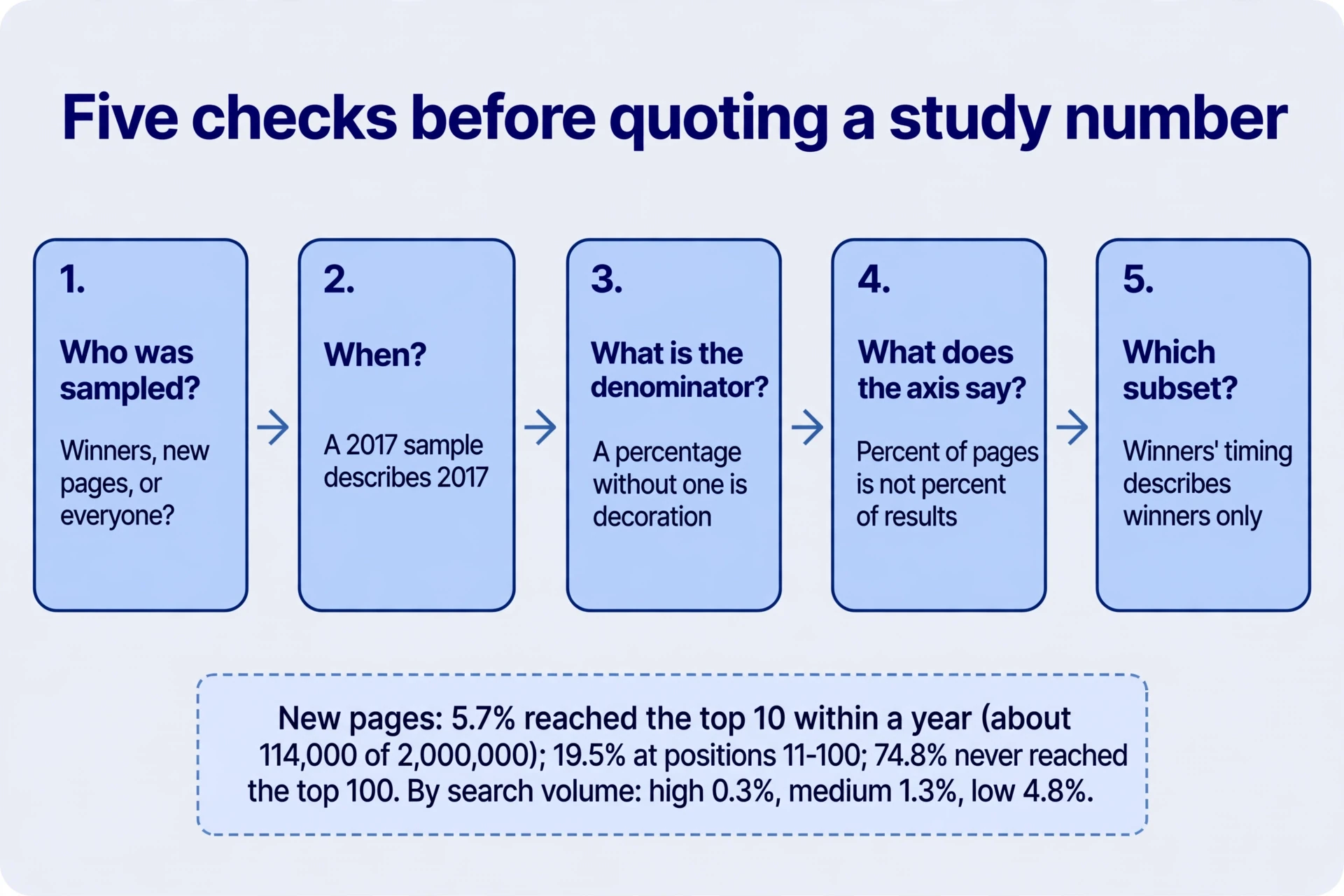
Run those five and most quoted statistics either hold up or fall apart in under a minute. The ones that hold up are worth building plans on.
Ranking: Scale only after one page works
Ranking evidence. Bulk publishing tempts everyone once. An old-domain project reportedly published hundreds of thousands of pages and saw roughly two thousand indexed the next day. Ranking Domain history, structure, quality, and discovery routes weren’t controlled separately. The old domain may have carried existing crawl attention. The structure may have funnelled crawlers efficiently. The pages may have been better than average, or worse. With all of those moving at once, the anecdote sets no ranking timelines for new domains and proves no indexing value for every generated page. Uncontrolled stories explain nothing twice.
Ranking evidence. The same material used hexadecimal colours to explain programmatic pages: 16 to the sixth power gives 16,777,216 combinations. A template can return a specific colour page from its URL instead of needing that many hand-written files. A request for /colors/ff5733 fills the template with that colour’s name, values, conversions, and palettes. Categories, related-colour links, and a sitemap provide entry points. That explains how programmatic pages work mechanically. It establishes no demand and no indexing value for every combination. A URL that resolves isn’t a page people want.
Ranking evidence. Then the arithmetic that misleads: “100,000 pages times ten visits a day equals one million visits.” Conditional arithmetic — true only if every premise holds. Test the premises instead, one by one. How many pages carry distinct demand — real searches, not combinations nobody types? How many carry useful information beyond the template’s filler? How many actually get indexed? And what do indexed pages really earn in clicks? Start with a small colour set — previews, conversions, palettes, copying — and expand after real use is established. Each premise gets its own ranking evidence before the multiplication starts.
Ranking context. The failure mode is worth picturing. Sixteen million thin pages don’t just sit there harmlessly. Crawlers spend their attention walking them, the index fills with near-duplicates, and the pages that deserved attention get less of it. Each generated page still has to carry its own correct values, its own conversions, its own palettes, and copy that works — the template fills the shape, not the substance. A colour page with wrong values is worse than no page: it answers a real question wrongly, and the visitor who notices won’t come back. Programmatic scale multiplies quality and error at the same rate. Prove the unit, then multiply.
Ranking context. The business model needs the same separation. Advertising needs volume plus placement that people tolerate. Subscriptions need repeat value people return for. Commissions need purchase intent at the moment of the visit. Each is its own ranking experiment with its own numbers. Traffic arithmetic tests none of them.
Ranking planning. Build the small version with familiar tools. A JavaScript framework or a DOM library, one useful function completed, machine assistance for implementation and local debugging. Browser-only tools can often begin on static hosting. A minimum version narrows the development scope without removing the function users need. Familiar tools matter because the ranking goal is learning fast, not learning a new stack while also learning whether anyone wants the thing.
One ranking probability claim in the material needs correcting, because it flatters fast ranking experiments. Ten independent attempts at a fixed 10% success rate give a 1 − 0.9¹⁰ chance of at least one success — 1 − 0.3487, roughly 65.1%. The arithmetic is right. The inference isn’t. Real attempts aren’t independent — learning transfers, so each try changes the odds of the next — and the 10% itself is invented. The number illustrates how repeated tries accumulate chances. It forecasts nothing. Faster ranking experiments provide earlier feedback and better decisions, not a guaranteed calendar deadline. Ten tries don’t promise a win by Friday. They promise ten chances to learn.
Turn waiting into documented ranking observation
Use this teaching scenario: you’ve launched a colour converter with a home page and five working colour pages. The ranking operating data below are hypothetical. Write your answers before reading the samples. The ranking goal is a record that can explain ranking changes — not a promise of success by a particular date.
Set the ranking review calendar before launch, not after. Day three: a first check — was anything discovered, fetched, indexed? Day seven: impressions and clicks, read against the ranking launch record. Day twenty-eight: trends, with complete data and the same filters as the baseline. Quarterly: demand, competition, and whether the topic still earns its place. Each ranking review asks one question and writes down the answer. The calendar turns waiting into ranking observation.

-
Which ranking result will you validate first? Validate fetching and indexing for the canonical colour pages first, then ranking record impressions and clicks separately. Finding the home page establishes nothing about indexing for all five pages. One unsuccessful manual search establishes no zero impressions either. Check the ranking stage, not the feeling. The order matters because each ranking check is cheap and each wrong assumption is expensive: confirming indexing takes minutes, rebuilding a page that was never the problem takes days.
-
What should the ranking launch record contain? Home-page category links, the five canonical URLs, sitemap submission time, the community post and its timestamp, deployment time, and significant ranking changes. The record preserves the order of submissions, crawling, and releases — the sequence you’ll need when something moves. Without it, every later ranking change is guesswork: did traffic shift because of the edit, the submission, or something outside your control? The log doesn’t answer that by itself, but without it you can’t even ask properly.
-
What if there are no clicks after three days? Check discovery, fetching, and indexing first. Fix access or rendering if content never arrived. If the page is indexed with no impressions, investigate demand, topic expression, and competition. Allow for reporting delays. Three days is a ranking review point, not an indexing deadline. The distinction matters: a ranking review point triggers a check, a deadline triggers panic. Check, record, and set the next ranking review — seven days, then twenty-eight, matching the ranking observation windows from the ranking title-experiment lesson.
-
When should you expand to tens of thousands of pages? After representative pages show real demand, distinct information, and effective use. Compare discovery, indexing, impressions, and task completion by batch. When low value turns systematic, fix the template and the topic selection instead of expanding through it. Scaling multiplies whatever the template does — including its flaws. Prove the unit first, then multiply it.
Four ranking stages, three milestones, one record. Discovery first, then indexing, then first clicks, then lasting ranking positions — each on its own timeline, each with its own ranking evidence. Launch small, give the engine entries, write down what happened, and let the record tell you what to change next. Patience here isn’t passive. It’s documented.
Comments
Join the conversation. Comments are reviewed before appearing.
Loading comments…