An SEO page needs two things to succeed. People need a way to find it, and the SEO page needs to help them finish what they came to do.
Ranking alone finishes neither job. A high ranking with a page that fails the task sends visitors away. A useful page with no way in stays unseen. SEO works inside a larger SEO workflow, and each step in that workflow points to a different fix when traffic stalls.
Four questions before you touch an SEO title
Work through these in order:
- SEO demand. Who wants to do what, and in which situation?
- Delivery. Does the SEO page provide the answer, tool, or transaction?
- Discovery. How do search, sharing, promotion, and recommendations bring a first visit?
- Review. What do impressions, clicks, completion, and return visits show about obstacles?
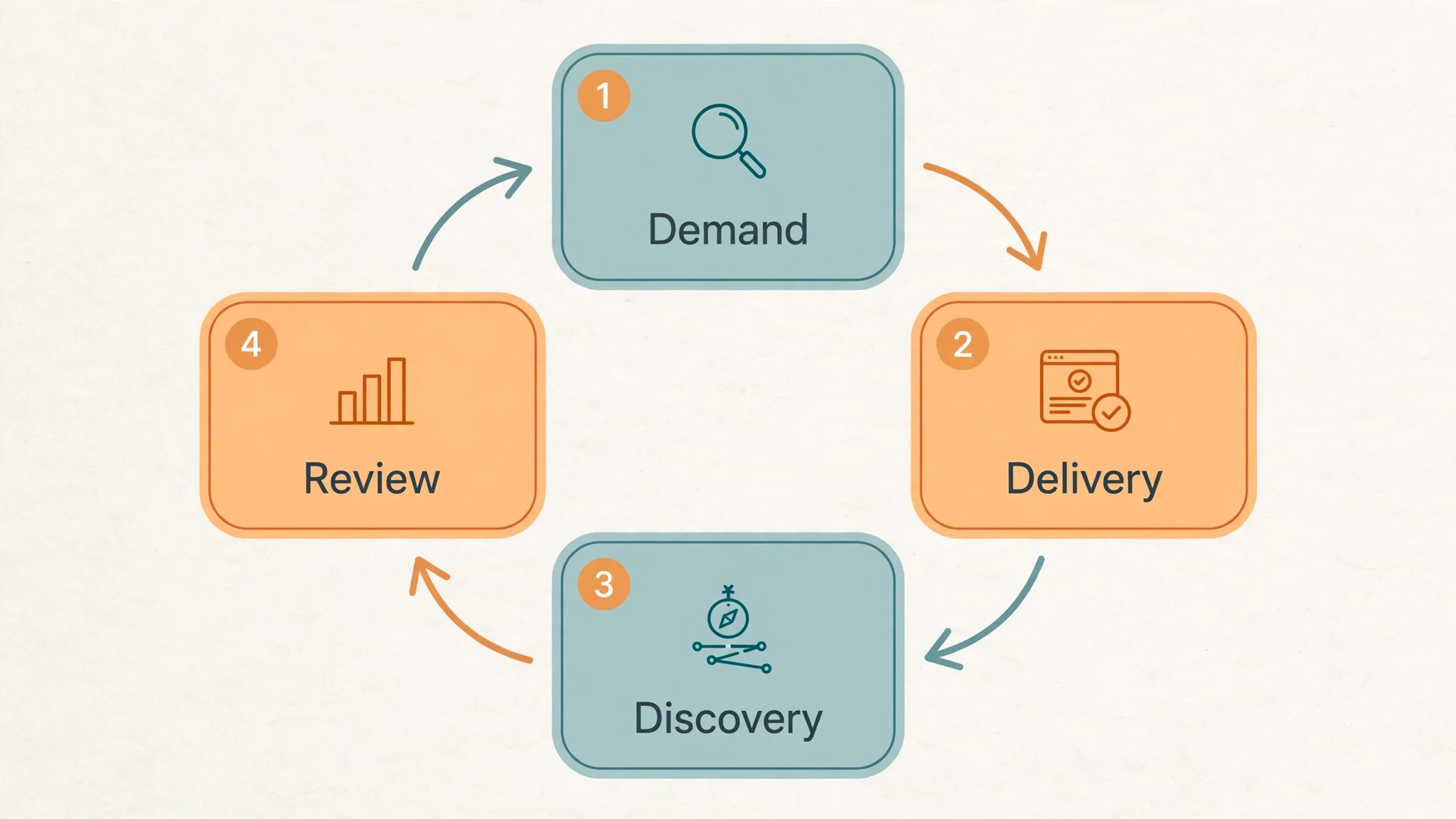
Take printable maze puzzles for kids as an example. People searching for them want mazes they can preview and print. An SEO title with the right phrase and no usable mazes fails delivery. Good mazes with no crawlable categories and entry links fail SEO discovery. Impressions with few clicks point to the SEO title, the snippet, and the other results on the SEO page. Plenty of clicks with little printing point to the files, the buttons, and how the page works on a phone.
Each symptom leads somewhere different. Keep them apart instead of summing them up as SEO not working.
| What you see | Check first | Next action |
|---|---|---|
| Almost no impressions | Whether the phrase has SEO demand and the page is public, crawlable, indexed, and matched to intent | Fix indexing and SEO page direction, then recheck the same queries |
| Impressions but few clicks | Title and snippet accuracy, position, result layout, and direct answers already shown on the SEO results page | Sharpen the promise in the SEO title and snippet, then watch the same queries |
| Clicks but little use | Load speed, SEO first-screen content, core functionality, file quality, and mobile operation | Fix delivery on the page |
| Much use but few returns or little revenue | Whether the need is one-off, whether a next task exists, and whether monetization fits the task | Add related tasks and contact or subscription paths, and reassess cost and value |
Tools make observation faster. Topic choice, SEO page quality, and iteration still decide the result. Budget each SEO experiment in time and money, write down what you expect it to do, and record what it returns.
The same thinking applies to a tool that promises automatic SEO traffic. Look at the supplier’s own site and ask where its traffic comes from. Count tool costs and labor costs together. Test the tool on one small, measurable task before committing to it.
The five ways visitors arrive
Visitors arrive through five channels. They overlap, and they belong in separate lines in your reports. A spike from sharing is a sharing result. Search growth is a separate result.
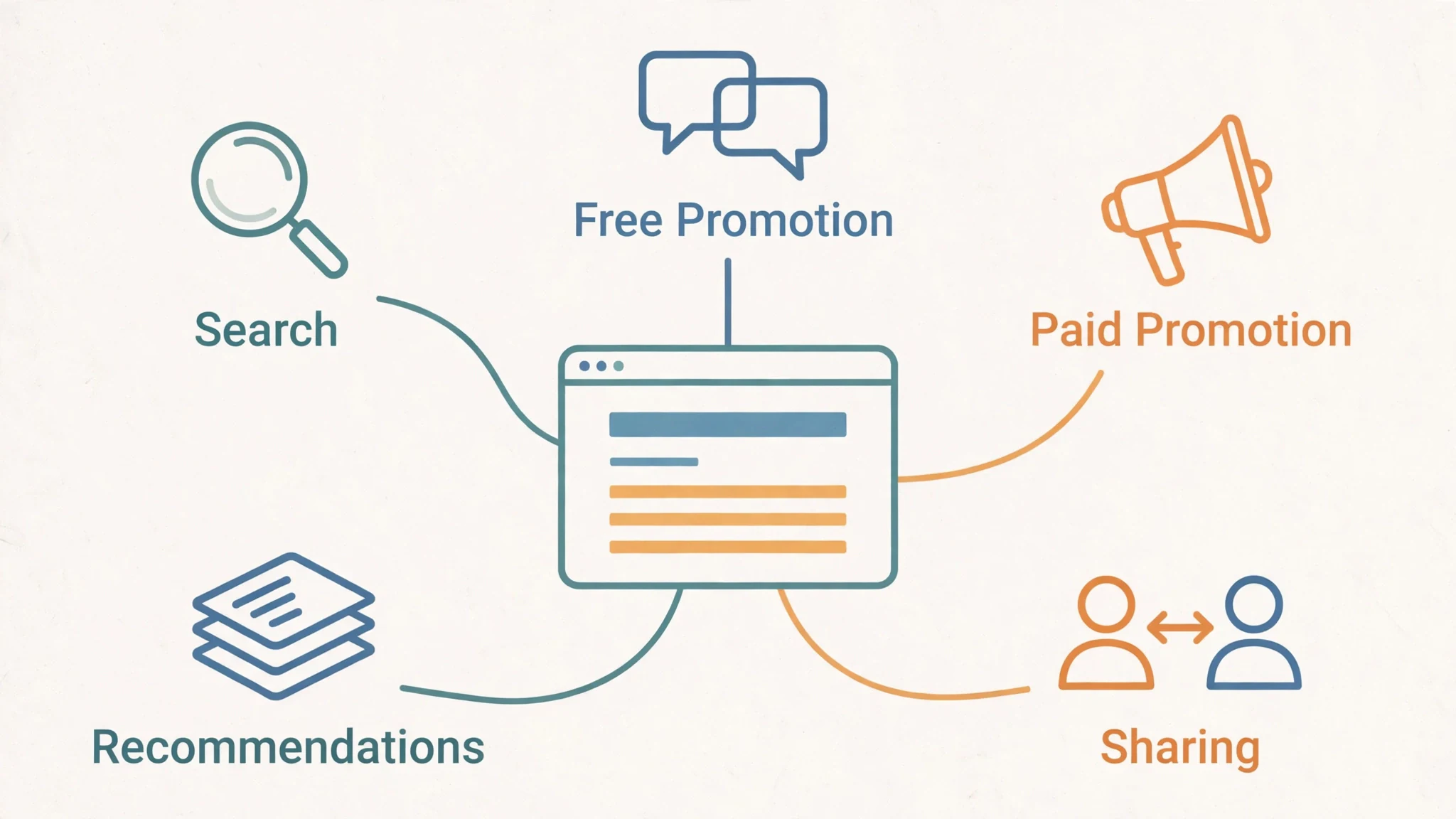
Search. People type a question or task phrase and click a result. Check queries, landing SEO pages, and the path from impressions to clicks. Use search volume estimates to compare scale between phrases. Measure your own clicks in Search Console.
Free promotion. Links in community replies, directories, and SEO media content bring first visitors to a new site. Record where you published, how many referral visits arrived, what people said, and how many completed the task.
Paid promotion. Ads and paid placements buy a test. Use a small budget to test the audience, the cost per click, and task completion. Judge the test on cost and completion, not on visits alone.
User sharing. People send an SEO page or a result to others because they have a reason to pass it on. Watch sharing paths, newly referred users, and return visits. A one-day campaign peak is a campaign result, not lasting SEO demand.
Recommendation systems. Platforms distribute SEO content based on its characteristics and audience feedback. Track recommendation impressions, clicks, and later use separately for each platform. Recommendations shift with the platform. Treat them as their own channel, not as search rankings.
Start with two channels close to your audience. For maze puzzles, search plus relevant parenting and teaching communities is a sensible pair. Make the SEO page usable first, then test the channels. For any paid test, set a budget limit in advance and check whether people actually print.
Removing friction helps a new site get tried. No login, no paywall, and fewer ads lower the barrier to a first use. Free service carries ongoing costs, so plan how charging works later and what stays free. Pick the level of friction you can sustain, and test it against a smoother experience.
Give every SEO page one job
A keyword in an SEO title names the topic. It does not finish the job. Each page needs one clear primary task, and the SEO page structure needs to carry a visitor through it.
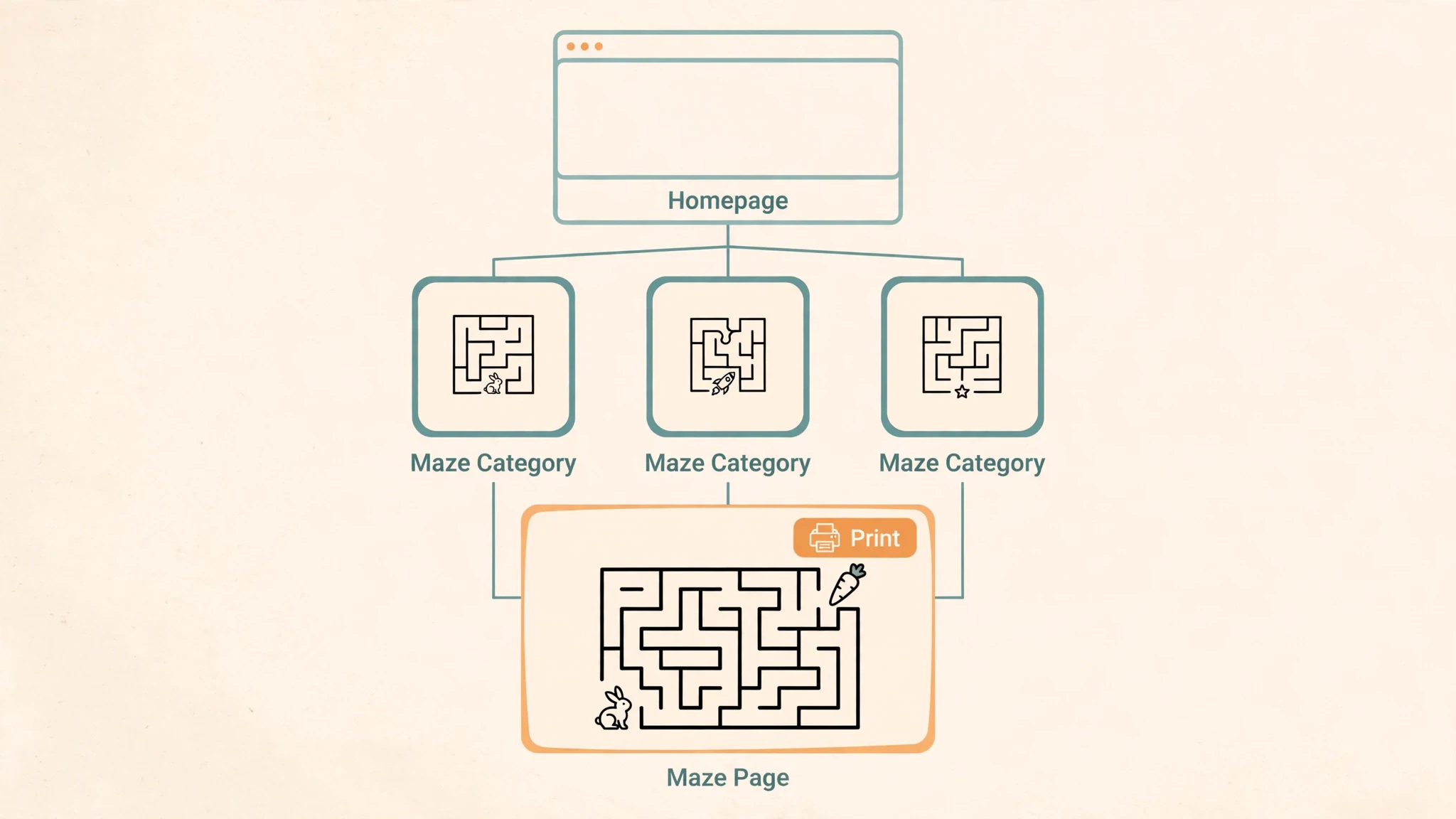
For a maze site, the work splits three ways. The homepage explains the maze puzzles on offer and helps visitors pick a theme. The maze category helps visitors select a puzzle. An individual SEO maze page handles previewing and printing one puzzle.
Build each SEO page around its task:
- Write a readable SEO title and main heading. The SEO title summarizes the page. The main heading tells visitors what they can do here. Subheadings organize categories, steps, and related material. The description reflects the actual SEO content. Search engines generate snippets from the SEO page and the query, so write the description for readers first.
- Use meaningful structure. Use paragraphs for prose and headings for groups. Write alt text that describes the image and its purpose on the SEO page. For a maze, describe the puzzle itself, such as a square maze with a rabbit at the start and a carrot at the finish, instead of packing in synonymous keywords.
- Link the path forward. Homepage to maze category to individual maze, and back again. Use ordinary crawlable links with anchor text that explains the destination. Each maze links back to its category and to similar mazes.
- Check the real result after launch. Test mobile use, printing, file validity, navigation, and links. Review search data to see which queries match which SEO pages, and fix what breaks the task.
| Page | Primary task | Required SEO content | Internal links |
|---|---|---|---|
| Maze homepage | Find a suitable theme | Theme categories, selected mazes, and clear instructions | Real animal, space, holiday, and other categories |
| Maze category | Choose a maze | Recognizable thumbnails, difficulty filters or groups, and a short explanation | Individual mazes and the parent theme |
| Individual maze | Preview, download, or print one puzzle | Large maze, format, print button, solution, and licensing information | Maze category and similar mazes |
Learn a site in five days
Studying other sites teaches the SEO workflow faster than reading about it. Pick one familiar site and work through it in a week. Write down what you find each day.
Day 1: The site and its traffic. Record the product, the audience, and the main task. Inspect total traffic, direct traffic, and the share from organic search, with the country and date range noted.
Day 2: Phrases and landing SEO pages. Find non-brand phrases and the SEO landing pages they lead to. Leave name-only searches out. Brand searches show existing awareness. Non-brand phrases show the tasks a new page can serve.
Day 3: SEO Page structure. Inspect the title, description, main heading, and major sections of an SEO landing page. Check how naturally the page covers the task and whether the promise matches the delivery.
Day 4: Competition and neighbours. Search the phrases again. Look at the kinds of SEO pages competing for them and what they deliver. Follow related SEO pages to find neighbouring sites and repeat the same inspection.
Day 5: Build something small. Choose a small need you can serve. Write the SEO page specification, build a minimum usable version, and test whether a visitor can complete the task. Note what to observe next.
Frontend developers can start with a working small tool. Writers can start with a clear SEO answer page. Either route completes the same loop: demand, delivery, discovery, and SEO review.
One task, many phrases
People describe the same task in different words. Judge the task, not only the wording.
“Who called me,” “phone number lookup,” and “reverse phone lookup” all point to caller identification. “Word count” often describes an outcome, while “word counter” often describes the tool. “OCR,” “image to text,” and “extract text from image” overlap around one core action: getting text out of an image. “Image,” “photo,” and “picture” carry subtle contextual differences, and the same goes for editors built around each word.
Start with one SEO page that naturally covers the expressions for one task. Split SEO pages when the result types, the functionality, or the audiences clearly differ, and give each new SEO page a unique deliverable. A tool that extracts text from an uploaded image covers the everyday OCR expressions on one page. Developer documentation for an OCR API belongs on a separate page, with authentication and request examples.
Duplicating near-identical SEO pages to chase more phrases adds maintenance without adding value for visitors.
Put it together: maze puzzles for kids
Here is the full SEO workflow on one example, from task to review.
1. Define the task. “Maze puzzles for kids” usually means browsing mazes and choosing one to print. “Easy maze for kids” usually means seeking a simple maze at the right difficulty. Check current results first. When leading SEO pages are printable mazes with solutions, build printable mazes with solutions. Writing about the benefits of puzzles misses the task.
2. Build an SEO page tree. The homepage offers themes. The maze category holds the actual puzzles, grouped as easy, medium, and hard, and by theme. Individual SEO pages support previewing, downloading, or printing. Build only as many categories as you have mazes to fill. Three mazes do not need ten empty categories.
3. Write the page elements. An SEO category title states the offer and the real maze count, for example printable maze puzzles for kids with the number you actually have. The main heading explains the SEO page. Maze alt text describes the specific puzzle, such as a square maze with a rabbit at the start and a carrot at the finish. The description states the real formats, difficulty, and printing options. Counts, formats, and permissions match the SEO content on the page.
4. SEO Test discovery paths. Check results and related phrases in the target region. Introduce usable mazes to suitable parenting and teaching communities and record referrals separately from SEO search results. Set a budget limit for any paid pilot and record cost, clicks, and prints.
5. SEO review outcomes. Low impressions point to indexing and page direction. Many impressions with few clicks point to SEO titles and results. Many clicks with little printing point to mazes, buttons, files, and mobile operation. Change the relevant obstacle, record the date, and compare the same measures after the change.
The files for a project like this stay simple: a keyword-and-task table, a three-level page sketch, a printable sample maze, a channel log, and a one-week metric SEO review. Together they show which step needs work: demand, delivery, discovery, or SEO review.
Diagnose before you change anything
For discovery problems, work through the internal links worksheet before adding more pages. For apparent growth, use the tool-site case measurement windows to check which dates and quantities are comparable. When visits increase but purchases stall, trace the visits-to-revenue chain to the first incomplete action.
Measurement follows the same four steps. Search Console shows impressions and clicks by query, SEO page, country, and device. Click-through rate is clicks divided by impressions. Track downloads and print starts separately from visits, and express completion as the share of visitors to an SEO target page who perform the action. For return visits, count first-time visitors who come back within the next seven days, using the same definition every time.
When a number drops, work the SEO diagnosis table at the top of this article before changing the SEO page. Change one clearly identified issue, record the date, and compare results using the same definitions. A low ranking means few clicks no matter how good the SEO title is, so fix position and SEO page direction first in that case. Visits with little use mean the page itself needs work, so fix mobile operation, design quality, files, and buttons first in that case.
Set the SEO review date when you launch. One week after launch, review usability, tracking, and early use. SEO Search results need longer observation, so keep watching the same queries and pages after that first review.
SEO is the loop, not one step in it. Find a real task people want to finish. Build an SEO page that finishes it. Give people a way to discover the page. Watch what happens, fix the obstacle you find, and run the loop again.
Comments
Join the conversation. Comments are reviewed before appearing.
Loading comments…